
Face to face: An exhibition of portraits traces city’s past | Mumbai News
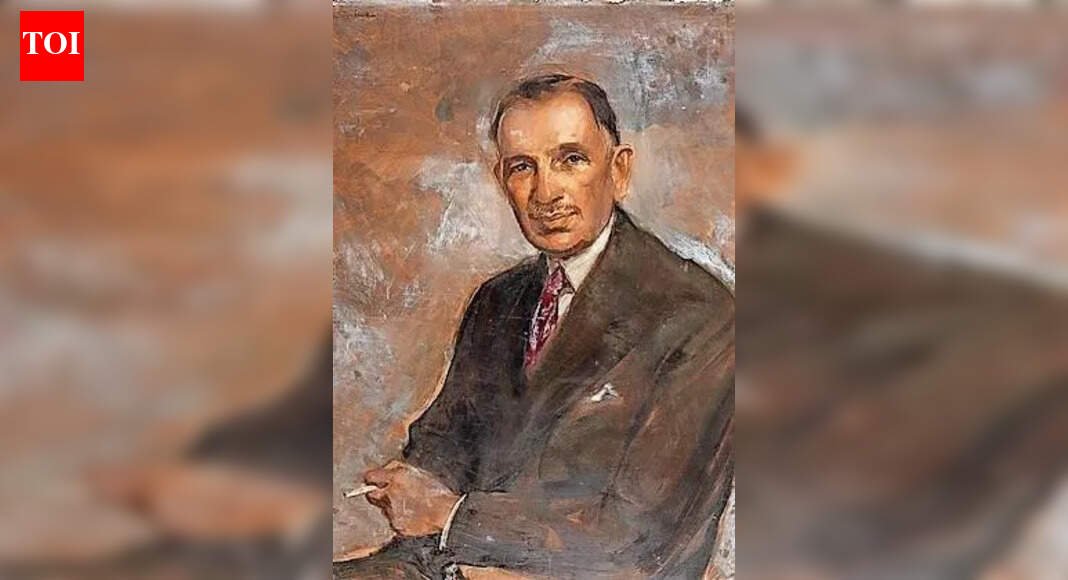
The deep emerald-green court jacket, embroidered with gold floral motifs; the crimson, lopsided pagri crowned by a jewelled feather; hands resting on the hilt of a ceremonial sword; and an unwavering gaze — Jaswatsingji Fatesingji Thakor Saheb, the English-speaking ruler of Limri (Limbdi), radiates quiet authority in this 1892 portrait. Executed by artist Frank Brooks — who famously trained Raja Ravi Varma’s brother in the art of figure painting — the commissioned work offers an intricate glimpse into a time when the city was a Presidency shared by maharajas and fakirs.Presented by DAG for Mumbai Gallery Weekend 2026, Face to Face: A Portrait of a City — on view until Jan 11, 2026, at DAG, The Taj Mahal Palace — brings together 30 portraits tracing Bombay’s evolving social fabric from the 19th to the 20th century.Spanning Parsi philanthropists and political icons, rendered by Indian masters and Western artists such as Brooks and Cecil Burns, the faces reveal a city shaped by empire, trade, migration and modernity.“Portraiture, quite literally, puts one face-to-face with people as its subject…,” says Ashish Anand, CEO and managing director of DAG. “And these people’s lives are inextricably linked not just with the city, but with the Presidency.”Organised across sections devoted to princely representation, influential figures, the Parsi community, artists’ self-portraits and everyday Maharashtrians, the exhibition charts how Bombay learned to see itself between 1892 and 1992.Brooks’ series itself emerged from imperial ceremony, Anand points out. Commissioned by the political agent of the Kathiawar Agency — a union of 193 princely states — his portraits were created for the Memorial Institute in Rajkot to mark the golden jubilee of Queen Victoria. As the exhibition moves into the 20th century, the tone shifts. In VB Pathare’s portrait of Dr BR Ambedkar, the architect of India’s constitution sits formally in a dark suit and tie, posture erect, expression contemplative. The image anchors Ambedkar within Bombay’s intellectual and political life: his years at Elphinstone College, his professorship at Sydenham College of Commerce and Economics, his election to the Bombay Provincial Legislative Assembly, and his Marathi roots.“As a pioneering advocate for social justice and the eradication of caste discrimination, Ambedkar’s presence in the exhibition underscores Bombay’s importance as a site of reform and public leadership,” says Anand.Nearby, MV Dhurandhar’s portrait of Bal Gandharva glows with theatrical presence. The legendary actor is shown in elaborate costume, the contours of his expression soft yet commanding. The image captures the magnetism that made Narayan Shripad Rajhans a cultural icon. His stage name — Bal Gandharva — Anand notes, was given by Lokmanya Tilak, whose own likeness appears in MK Parandekar’s portrait.The exhibition’s mood evolves again in the self-portraits and artist portraits by MV Dhurandhar, Pestonji Bomanji, SL Haldankar, Baburao Sadwelkar and MF Husain. Faces emerge from quiet studio light: Haldankar’s refined realism, Sadwelkar’s softened lines, Husain’s bold modernist treatment — each revealing how Bombay’s artists gradually broke away from strict academic convention towards individual, intuitive expression.The Parsi presence appears with equal force. In the portrait of Sir Jamsetji Jeejeebhoy, he is shown in traditional Parsi attire, the iconic black pagdi framing a dignified face. Beside him, MF Pithawalla’s portrait of a Parsi woman radiates confidence and modernity, projecting the new position Parsi women were claiming in public, cultural and philanthropic spheres.Works by Abalal Rahiman broaden the panorama: regional rulers, local communities, varying occupations and social positions, all rendered with careful attention to costume, posture and expression. A special pleasure of the show lies in the faces of the faceless: a weathered fakir wrapped in layers of ochre and ash; an elderly gentleman in a dark coat and cap; an old man with a snow-white beard spilling across his chest.The final chapter unfolds with the modernists. In the post-Independence works of the Progressive Artists’ Group — including MF Husain — portraiture abandons the certainties of realism for abstraction, psychology and experimentation, marking a new understanding of identity in a newly independent nation.