
BMC elections see candidate proliferation in slum clusters in Mumbai | Mumbai News
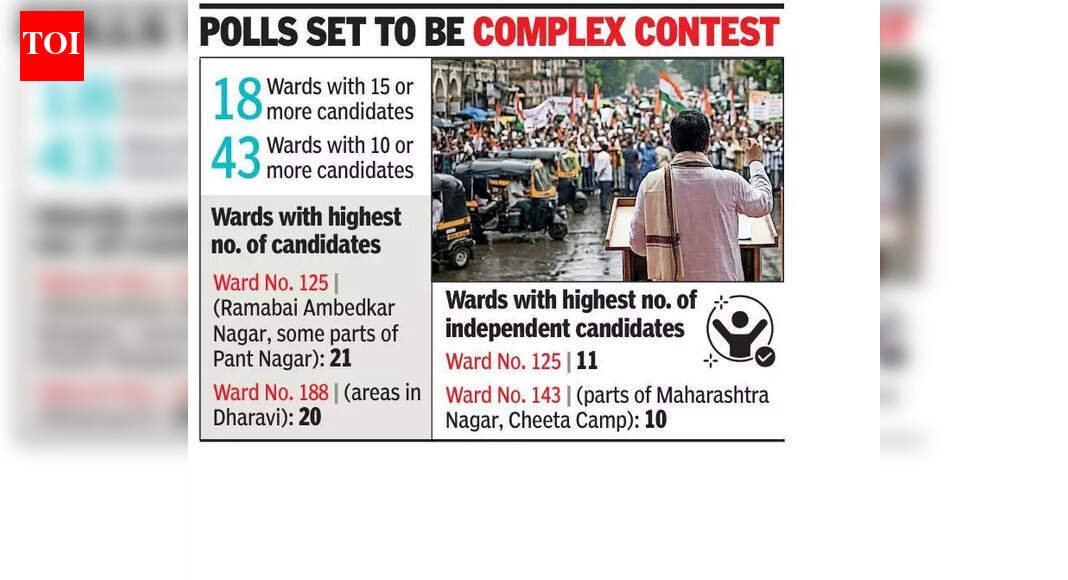
Mumbai: Several wards in the city have witnessed a proliferation of candidates in the BMC elections, particularly in areas with relatively homogeneous voter profiles such as slum clusters, besides Dalit-dominated neighbourhoods and Muslim pockets.Data from the nominations show that 18 wards have 15 or more candidates each, increasing the complexity of the contest. In six of these wards, the number of contestants has exceeded the limit of 16 candidates per ballot unit. These wards also have a large number of independent candidates, alongside entries from national parties, regional outfits and smaller political formations — some of which have limited organisational presence in Mumbai, but influence in other states. While such fragmentation appears to intensify competition, analysts point out that it often works to the advantage of larger parties.
Mrudul Nile, professor of political science at Mumbai University, attributed the factions of various parties and political fragmentation of some communities, as one of the reasons for proliferation of candidates. Bigger parties also field proxy candidates sometimes with the same names. In areas dominated by voters who are homogenous and of socio-economically disadvantaged groups, every party fields its candidates. Some contest to ensure their candidature is considered for the next elections, he said.“At this point, it is difficult for independent candidates, lesser-known candidates or candidates of smaller parties to get elected, and a large number of candidates help major parties. Aspirations among the lower socio-economic groups also leads to an increased number of candidates,” Nile added.Political scientist Surendra Jondhale said: “In contemporary elections, a large number of people have political aspirations. People with a bit of money and net worth consider contesting elections, while some look at it as a tool to earn money….Many also think that they can buy votes in slum pockets to get elected even if they do not secure tickets from parties. In socio-economically disadvantaged areas, people ask for money for casting votes and candidates know they can purchase votes.” Bhiwandi MLA Rais Shaikh said for the socio-economically disadvantaged groups the stakes are higher, as the civic body plays an important role in their lives. “For some of the candidates, contesting elections is a way of getting recognition for themselves,” he said.Activist Anil Galgali cited the delay in the conduct of elections and the aspirations among the older generation and the current generation among the reasons for the increased number of candidates. “Some are worried that they might be deprived of a chance next time around due to dynastic politics or nepotism, some think that they can resolve local problems only by becoming a corporator, and others look at it as a way to earn fast money.“