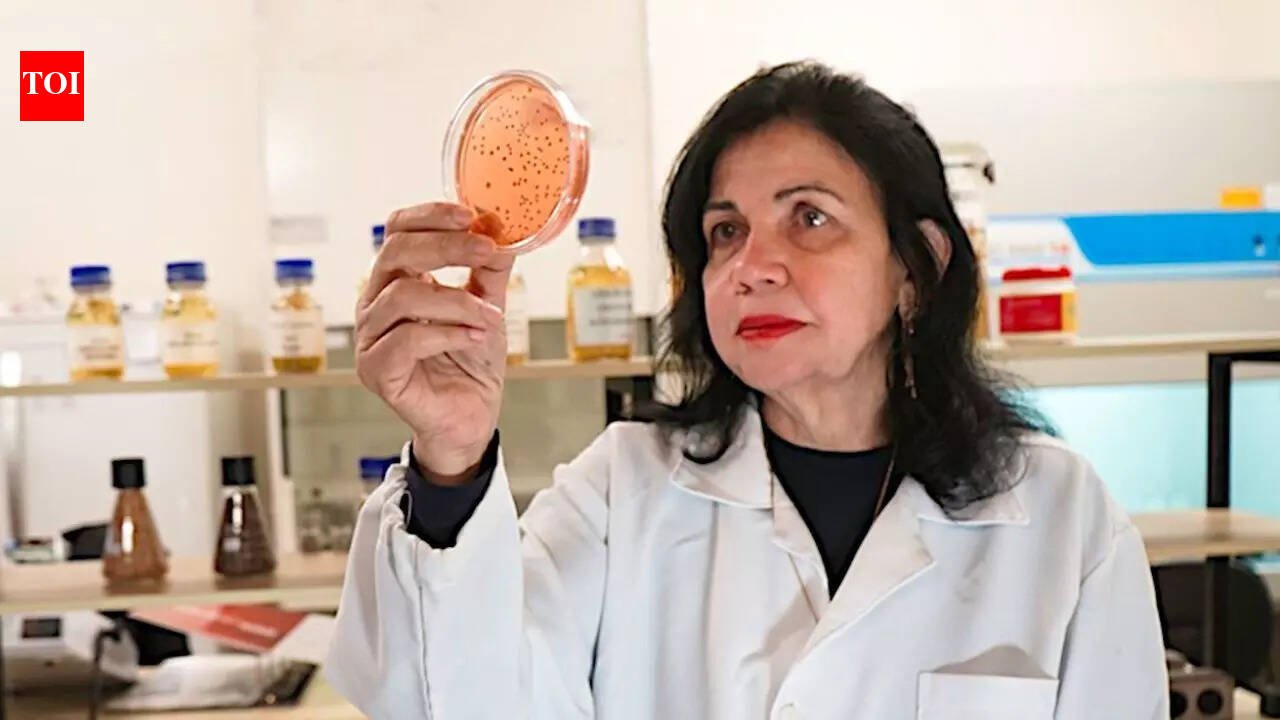

Meet Mariangela Hungria: The Brazilian scientist who replaced fertilisers with microbes, saving billions and restoring soil |
[ad_1]
For decades, modern agriculture assumed that high yields required heavy doses of synthetic nitrogen fertilisers. Mariangela Hungria proved otherwise. Working quietly at Embrapa, she spent more than 40 years studying beneficial soil bacteria that allow crops to draw nitrogen directly from the air. Her research helped transform Brazilian agriculture, cut dependence on chemical fertilisers, and turn Brazil into the world’s largest soybean exporter. In 2025, her work earned global recognition with the World Food Prize.Nitrogen is essential for plant growth. It is a key building block of proteins, enzymes, and chlorophyll. While nitrogen makes up most of the air, plants cannot absorb it directly. For much of the 20th century, agriculture solved this problem with synthetic fertilisers produced using fossil fuels. These fertilisers increased yields but also brought high costs, pollution, and major climate impacts.
The science behind Mariangela Hungria’s breakthrough
Hungria focused on biological nitrogen fixation, a natural process in which certain bacteria convert atmospheric nitrogen into a form plants can use. In soybeans, these bacteria live in nodules on plant roots and form a mutually beneficial partnership. The plant provides sugars. The bacteria supply nitrogen.Her contribution was not discovering the process, which was already known, but identifying and improving the most efficient bacterial strains for tropical soils and proving that they could work reliably at commercial scale.
From laboratory to farm fields
At Embrapa’s soybean research centre, Hungria led efforts to develop practical microbial inoculants that farmers could apply to seeds before planting. These inoculants replaced or sharply reduced the need for nitrogen fertiliser. Crucially, her team also worked on quality control and farmer outreach, ensuring the technology performed consistently outside the laboratory.As adoption spread, millions of hectares of Brazilian farmland shifted to microbe-based nitrogen supply.
Transforming Brazilian agriculture
The impact was national. Brazil reduced its dependence on imported nitrogen fertilisers while maintaining high yields. Farmers cut costs and improved soil health. Emissions linked to fertiliser production and runoff fell. Over time, biological nitrogen fixation became standard practice in Brazilian soybean farming, underpinning the country’s rise as a global agricultural powerhouse.
Global recognition and wider implications
Hungria’s World Food Prize citation highlighted not only the scientific achievement but its scale. Few agricultural innovations reach tens of millions of hectares. Fewer still do so while lowering costs and emissions at the same time.Her work is now studied by researchers and policymakers in Africa, Asia, and Europe as fertiliser prices rise and climate pressures intensify.
A different model for the future of food
Hungria’s career offers a powerful lesson. Instead of forcing productivity through chemistry alone, agriculture can work with biology. Her approach shows that solutions rooted in local ecosystems can outperform imported industrial models.“This is not just about soybeans,” agricultural scientists often note. “It is about redesigning farming around living soil.”In an era searching for sustainable ways to feed a growing population, Mariangela Hungria’s work suggests that some of the most effective answers are already beneath our feet.
[ad_2]
Source link