
After thaw, bonhomie: Carney, PM Modi sign $2.6 billion uranium deal | India News
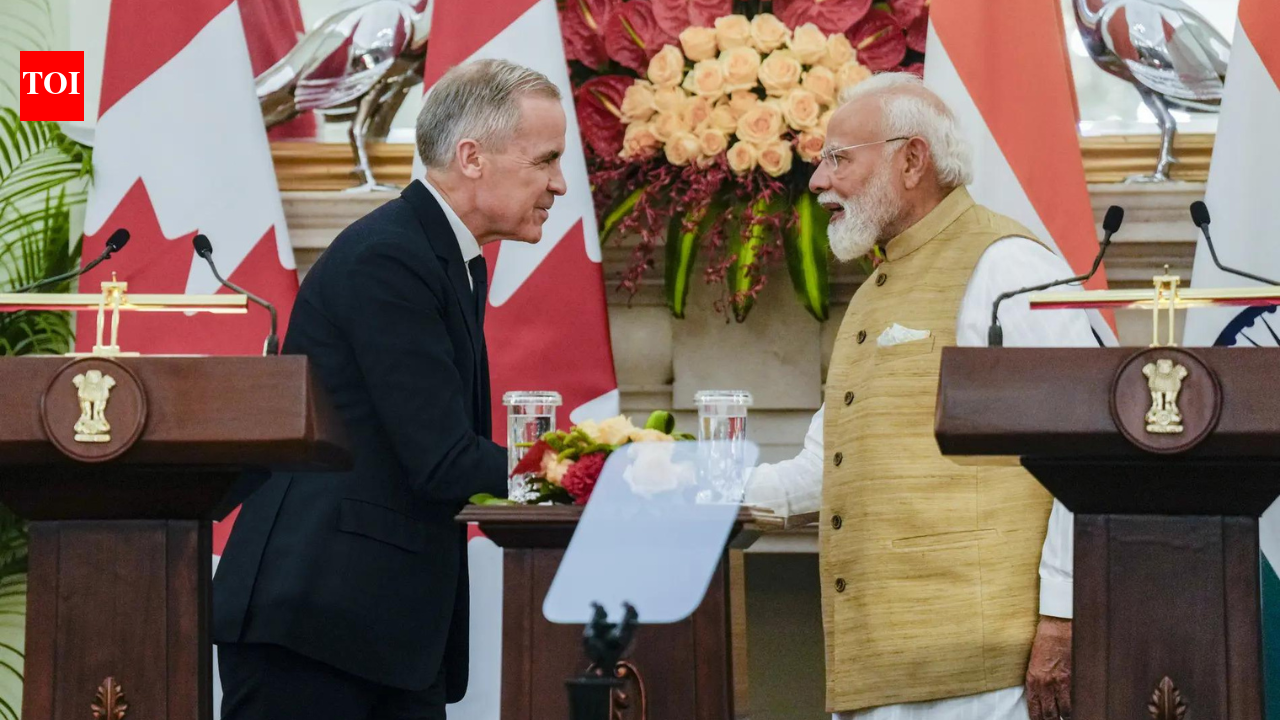
NEW DELHI: The dramatic turnaround in India-Canada relations in the past 10 months culminated in a series of major announcements and agreements, including a landmark $2.6 billion deal for supply of 22 million pounds of uranium to India from 2027 to 2035, as PM Narendra Modi hosted his counterpart Mark Carney for talks.The leaders committed to conclusion of a Comprehensive Economic Partnership Agreement (CEPA) by the end of this year, as both sides finalised the terms of reference, and announced agreements to intensify cooperation on critical minerals while also launching a new strategic energy partnership and defence dialogue.
Both sides discussed each other’s security concerns – activities of separatists in India’s case and transnational repression for Canada – but the leaders avoided any explicit mention of these issues in their media remarks as they endorsed in the meeting ongoing security cooperation and focused on consolidating the normalisation of the relationship.Modi gave credit to Carney for the increasing momentum in all areas of cooperation. The Canadian PM responded by saying that this wasn’t just a renewal of the relationship but also an expansion of the partnership as India and Canada were transforming their economies to be more diversified, more independent, and more resilient in a rapidly changing world.
However, the Ministry of External Affairs (MEA) later strongly rejected allegations of involvement in transnational violence or organized crime as reported in the Canadian media, saying these claims were baseless, politically motivated, and “unsupported by credible evidence despite repeated requests”.“India believes that concerns of this nature must be addressed through credible law enforcement and judicial processes, not through public or politicized narratives,” said MEA secretary (east) P Kumaran. The official was responding to questions related to reports in the Canadian media linking Indian officials in Vancouver to the killing of Sikh separatist Hardeep Nijjar and a Canadian readout of the Modi-Carney meeting that said Canada will continue to take measures to combat transnational repression. According to the Canadian readout, the leaders agreed to advance bilateral cooperation on security and law enforcement, including issues of mutual concern to Canada and India.
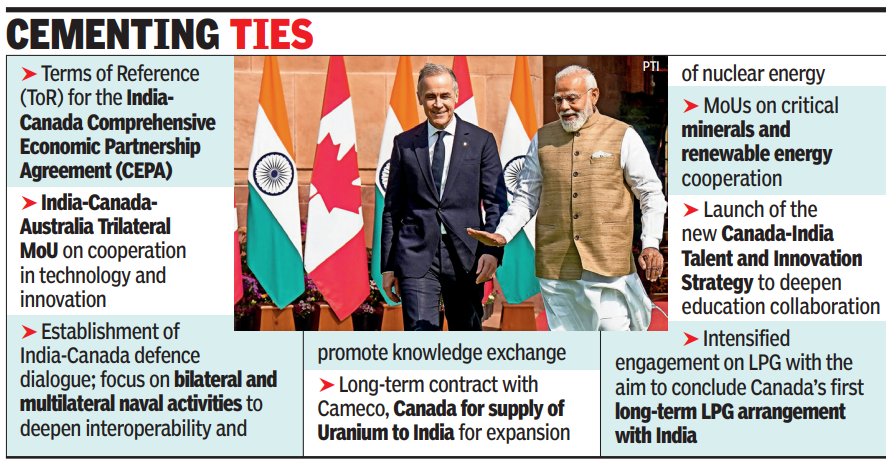
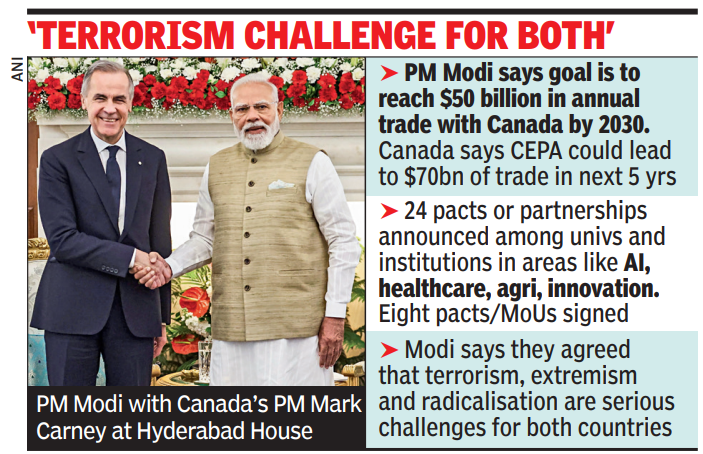
Modi said that the forward movement in ties was being powered by both sides’ unbreakable trust in democratic values, diversity and humanity and the goal was to reach $ 50 billion in annual trade by 2030. The Canadian side said CEPA could see $ 70 billion trade in the next 5 years. While 8 agreements/ MoUs were signed at the government level, there were 24 other agreements or partnerships that were announced among among universities and institutions in areas such as AI, healthcare, agriculture, and innovation. An MoU was also signed under the Australia-Canada-India Technology and Innovation Partnership for development and deployment of AI.“It is our priority to unlock the full potential of economic cooperation. Therefore, we have decided to finalize the CEPA as soon as possible. This will create new opportunities for investment and employment in both countries,” said Modi, calling India and Canada natural partners in technology and innovation.“With Canada and India as innovation partners, we will turn ideas into global solutions,” said Modi, adding that the MoU on critical minerals will also strengthen supply chain resilience.While Carney didn’t touch upon the issue of terrorism in his remarks, Modi said that they agreed terrorism, extremism and radicalisation were shared and serious challenges not only for both countries, but for all of humanity. “Our close cooperation against them is crucial for global peace and stability,” said Modi.A joint statement said that as pluralistic democracies, they agreed to deepen collaboration to address issues relating to violent extremism, terrorism, organized crime, including the illegal flow of narcotics and fentanyl precursors, cybercrime, extortion, financial fraud, trafficking and related criminal networks.The Indian PM also said that the growing cooperation in the field of defence and security symbolised “the maturity of our deep mutual trust and ties”.“We will work to expand defence industries, maritime domain awareness, and military exchanges. For this purpose, today we have decided to establish the India-Canada Defence Dialogue,” he said, as both leaders welcomed a new Maritime Security Partnership in areas such as defence material Cooperation and supply chain resilience, as also appointment of defence attache by both sides.“Our strategic partnership, and the speed at which we are working to unleash its potential in energy, talent, and AI, is the result of two confident, ambitious nations who want to build the future, together,’ said Carney, who also invited Modi to visit Canada.According to Canada, to leverage their strengths as complementary economies, Canada and India announced a new Strategic Energy Partnership, including in LNG, LPG, uranium, solar, and hydrogen. The leaders backed efforts to conclude India’s first long-term LPG supply arrangement with Canada.According to the joint statement, the leaders underscored that closer cooperation between India and Canada will help reinforce international rules and norms that are applied fairly, strengthen economic resilience, promote sustainable development, and address other global challenges.