MUMBAI: Around 15 lakh cancer cases are detected in India every year, adding a patient load equal to the population of a city such as Nashik. Yet several states are excluding hundreds of experienced, fellowship-trained oncologists in the private sector from treating (PMJAY) patients.Their exclusion is not due to inadequate training or lack of experience, but because they do not hold National Medical Commission (NMC)-recognised super-specialty degrees such as DM (Doctorate of Medicine), MCh (Magister Chirurgiae) or DrNB (Doctorate of National Board).Doctors affected by the move told TOI that this ignores the reality that, until a few decades ago, fellowships were the only route into oncology; formal courses did not exist. Even now, it’s considered prestigious for postgrad doctors to bag two- or three-year fellowships at cancer hospitals for hands-on training in head and neck surgery, gynae-oncology, haemato-oncology or paediatric oncology surgery.
Veterans Trained Via Fellowships Ineligible, Impacts Critical Care In Several States
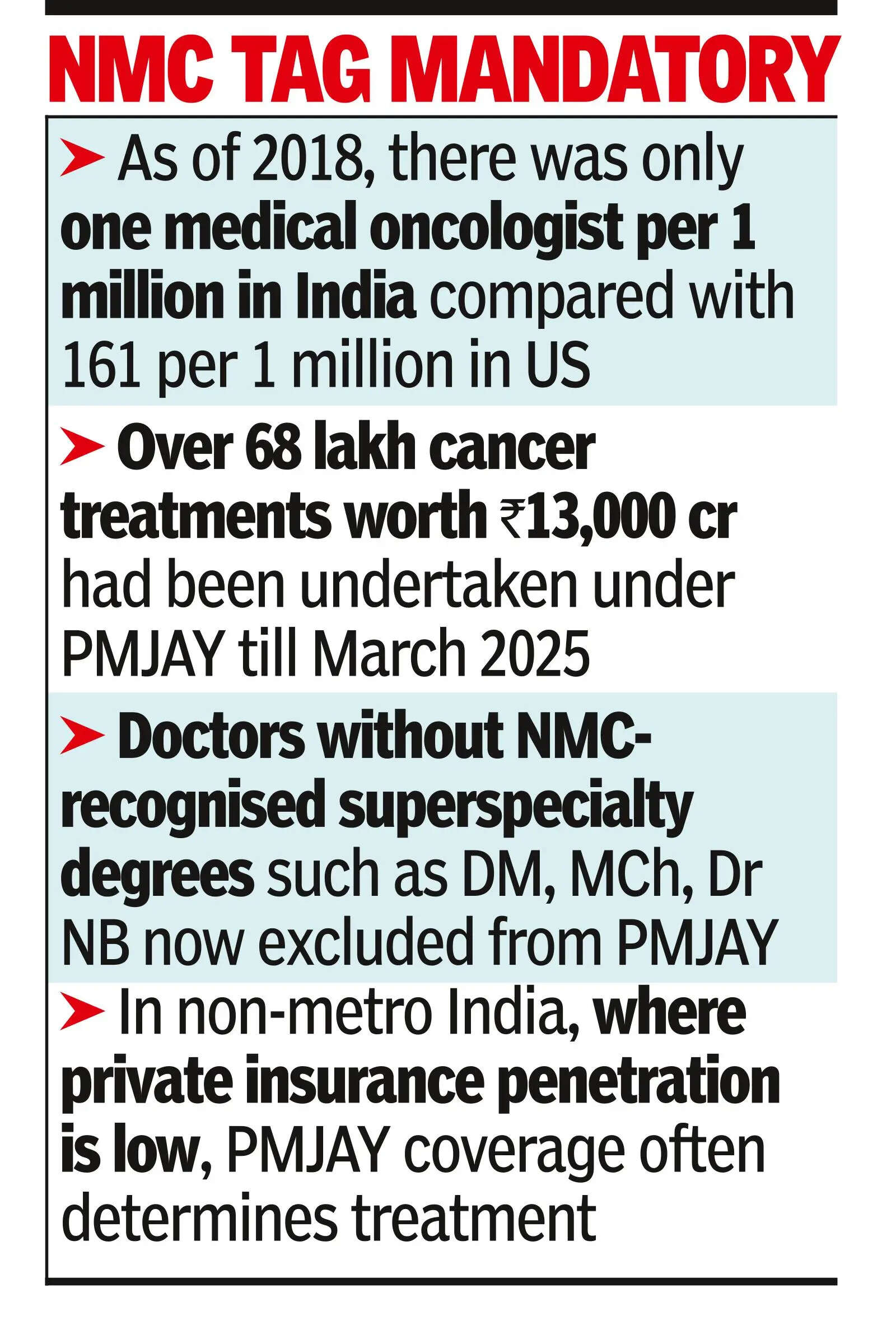
Many of those now rendered ineligible have gone on to become department heads, medical directors, teachers and senior surgeons, each treating cancer patients over decades. Surat-based Dr Hemish Kania, who compiled data showing more than 300 such doctors affected across states, said some of those now barred have even taught oncology to DM or DrNB students.The shift in eligibility criteria is striking not only because of India’s high cancer burden, but also because of its shortage of cancer specialists.Mumbai: Hundreds of cancer specialists have been rendered ineligible for providing treatment under the Ayushman Pradhan Mantri Jan Arogya Yojana (PMJAY) for lack of superspecialty degrees recognised by the National Medical Commission (NMC). India has roughly one medical oncologist per one million and only about 4,000 oncosurgeons. Excluding 300 trained specialists from PMJAY-linked care could reduce access to treatment, especially in smaller cities where private insurance penetration is low, and substantially for many poor patients who avail of govt medical insurance. ‘Meaningless fellowships?’ Dr Ravi (name changed), a 42-year-old general surgeon from Uttar Pradesh, completed a three-year head and neck cancer fellowship at Tata Memorial Hospital, Parel. In 2021, he returned to his Tier-II hometown expecting to fill a gap in cancer care: the city had only six onco-surgeons, four of them fellowship-trained. He, however, finds himself barred from operating on PMJAY cancer patients. “If four of six private-sector cancer surgeons are excluded, PMJAY patients are forced into longer queues,” he said. Whether one spends three years in Tata Memorial in Mumbai, AIIMS Delhi, Gujarat Cancer Research Institute in Ahmedabad, RCC Thiruvananthapuram or B Borooah Cancer Institute in Guwahati, the affiliation seems to have no weight now, he added. In Patna, Dr Arun, 40, (name changed) said he is “safe” because he works in a govt hospital. “In govt hospitals, at least one member in the team is likely to have recognition under PMJAY. But it may be different if I step into the private sector,” he said. His batchmates in private hospitals in Patna and Kochi are no longer operating on PMJAY patients. Some doctors said their names have been removed from the HEM 2.0 portal used by the National Health Authority (NHA) to manage PMJAY, the world’s largest public insurance scheme (see graphic). Doctors said hospitals are ending contracts because these specialists can no longer generate PMJAY claims. Dr Kania said, “PMJAY may just be the beginning. Slowly, other govt schemes, such as CGHS, could have similar eligibility criteria.“ The genesis of the problem Multiple issues have led to the current problem, especially the interpretation of NHA & NMC rules by state health authorities. The genesis of the problem can be traced to before 2018 when efforts by the erstwhile Medical Council of India (MCI) to increase the number of oncology teachers. Dr K S Sharma, former academic dean of Tata Memorial Centre, recalled that between 2002 and 2010 there were very few DM and MCh seats in medical and surgical oncology. In 2011, after he joined the erstwhile MCI’s board of governors, he framed a plan to fix the shortage of teachers by expanding fellowship programmes at reputed cancer hospitals. “These fellowships were not recognised by MCI, but had sanctity,” he said. MCI introduced a rule that MS or MD post-graduate doctors with two years’ experience in a dedicated cancer hospital as senior residents/ fellows could be regarded as teachers until India had enough degree-holding oncologists. Many trained fellows thus took up teaching posts in public cancer institutes, and over time some moved to smaller cities to build independent practices. But in 2020, MCI was replaced by NMC, which issued guidelines requiring oncologists to hold recognised degrees. Fellowships were not mentioned. Rajasthan Medical Council on Sept 5, 2023, directed that any claim of specialty/expertise must be backed by a qualification in that branch recognised by the MCI or NMC. This became the basis for the Rajasthan state health authority to debar fellowship-trained oncologists from operating on PMJAY patients. A Gujarat state health authority official told TOI that NMC-recognised courses are the basis for enlisting an oncologist under PMJAY. Incidentally, NHA guidelines don’t have the NMC-recognition clause. A Vadodara-bas-ed doctor, who completed a head and neck fellowship from Tata Memorial Hospital 20 years ago, said, “NHA guidelines to this day say that ENT and general surgeons with fellowships can operate on PMJAY patients. Why are state health authorities being different?” The road ahead When contacted, NHA CEO Dr Sunil Kumar Barnwal said NHA empanels hospitals, not doctors, and that doctor qualifications are decided by NMC. Efforts to contact NMC chairman Dr Abhijat Sheth failed, but doctors who met him said he had asked them to approach NHA. State authorities, meanwhile, have asked doctors to obtain written clarification from NHA and NMC in this regard. As no such clarification has been issued, the deadlock continues. Doctors also point to inconsistencies. “One point many fellows have raised is that post-graduate dentists are allowed to operate on oral cancer patie-nts while general surgeons wi-th advanced oncology fellowships are not,” said Dr Kania. Dr Sharma said he has taken up the issue with NHA, “but it wants NMC to give a certificate to these past fellows.” (It’s learnt that NMC is considering recognising fellowships). He said the matter rests with state health authorities. He added that if state authorities do not respond, affected doctors may have to move the high court. Meanwhile, medical associations, including the Indian Medical Association, have taken up the issue with NMC and NHA. Doctors argue that the rule cannot be applied retrospectively. The Indian Association of Surgical Oncology wants eligibility to be extended to trained oncologists from premier institutions with fellowships, or at least two years of training in such centres. IASO’s Dr Rudra Acharya said, “Given the rising incidence of cancer and the long waiting list in government cancer institutions, the eligibility clause needs to be revised.“