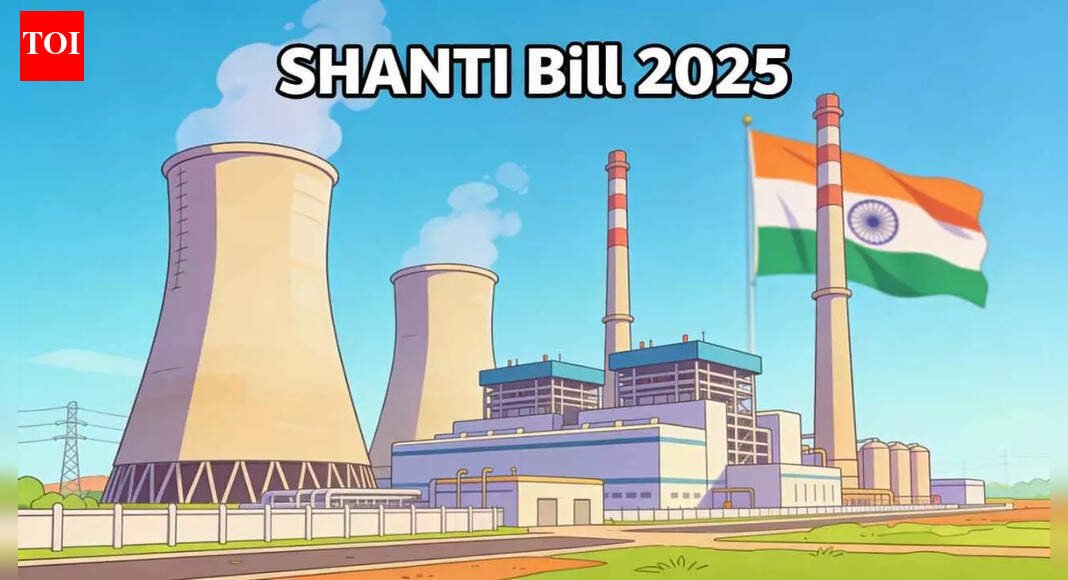

What is SHANTI Bill 2025? Top things to know about the new nuclear energy bill & what it means
[ad_1]
The Lok Sabha on Wednesday passed the Sustainable Harnessing and Advancement of Nuclear Energy for Transforming India Bill (SHANTI), 2025, clearing the way for a major overhaul of India’s civil nuclear framework. The Bill was approved by voice vote during the ongoing Winter Session amid a walkout by most opposition members. Introduced earlier this week by minister of state for the department of atomic energy Jitendra Singh, the legislation marks a significant policy shift by opening parts of the nuclear energy sector to private participation for the first time.According to Singh, the Bill is intended to “modernise India’s nuclear framework in line with contemporary technological, economic and energy realities, while retaining and strengthening core safety, security and regulatory safeguards that have been in place since the Atomic Energy Act of 1962”.The government pointed to gaps in the current regime, including inadequate safety coverage across the nuclear lifecycle, limited regulatory powers and a post-accident focus on compensation rather than prevention. The SHANTI Bill introduces a consolidated legal structure that brings regulation, enforcement, civil liability and dispute resolution under a single statute.
Here’s what you need to know about the SHANTI Bill
Accelerate nuclear power growth: The Bill aims to promote the growth of nuclear energy and its applications across a range of sectors, aligning with the country’s target of achieving 100 GW of nuclear power capacity by 2047. Private firms allowed to enter: A major change under the bill is the entry of private enterprises into civil nuclear operations, which was, till now, reserved for government entities,. The Bill allows private companies and joint ventures to get authorisation for establishing and operating nuclear facilities, as well as transport nuclear fuel. However, the government pointed out that sensitive operations such as uranium enrichment, spent fuel handling and heavy water manufacturing will still remain exclusively under the control of the Central government. Similarly, oversight of radioactive materials and radiation-producing equipment will also continue under the Centre to ensure that safety standards are maintained.Statutory regulator: The Atomic Energy Regulatory Board (AERB) will be given statutory status, giving it the power to inspect facilities, investigate incidents, issue binding directions and suspend or cancel operations that fail to meet safety standards.Licensing reforms: A clear licensing regime will define who can build and operate nuclear facilities, strengthening accountability, ET reported.Embeds safety measures: Safety oversight will be legally embedded across the entire lifecycle of nuclear facilities, from construction and operation to transport, storage, decommissioning and waste management. Activities involving radiation exposure will require explicit safety authorisation in addition to operational licences. The Bill also introduces a specialised nucleartribunal to resolve disputes. Changes to nuclear liability provisions: Another significant aspect of the Bill is the modification of the nuclear liability framework to encourage investment while limiting risks. The law removes the clause related to the liability of suppliers of nuclear equipment. Singh said that the Bill provides for “a pragmatic civil liability regime for nuclear damage” and does not dilute compensation to victims. He said operator liability has been rationalised through graded caps linked to reactor size, aimed at encouraging newer technologies such as small modular reactors, while ensuring full compensation through a multi-layered mechanism. He added that supplier liability was removed after considering global practices and advances in reactor safety, while negligence and penal provisions would continue to be enforceable under the law.
[ad_2]
Source link