
India-New Zealand FTA: Faced with Trump tariffs, why new trade deals are important – explained
[ad_1]
India announced concluding a Free Trade Agreement (FTA) with New Zealand on Monday paving the way for duty-free entry of Indian goods into New Zealand and a planned inflow of $20 billion in investments over the next 15 years. Prime Minister Narendra Modi and New Zealand PM Christopher Luxon made the announcement through their social media handles. The two sides also expect the pact to support their goal of doubling bilateral trade within five years.However, New Zealand’s foreign affairs minister Winston Peters has voiced his opposition to the trade agreement, claiming the deal was ‘neither free nor fair’. Peters posted on social media platform X, “New Zealand First is regrettably opposed to the India Free Trade Agreement announced today. We consider the India-New Zealand Free Trade Agreement to be neither free nor fair. Regrettably, this is a bad deal for New Zealand. It gives too much away, especially on immigration, and does not get enough in return for New Zealanders, including on dairy,” said Peters.India on its part has always maintained that agriculture and dairy sectors are a red line for any trade deal. This will be India’s third free trade agreement in a span of a year, after similar deals with the United Kingdom in July and Oman earlier this month. The agreement provides additional temporary employment visas for Indians and smoother market access for pharmaceuticals and medical devices. The India-New Zealand FTA is expected to be formally signed within the next three months and is likely to come into effect next year.Commerce and Industry Minister Piyush Goyal said the trade deal is India’s seventh free trade agreement concluded under the Modi government. The deal assumes significance since it comes at a time when India is looking to diversify markets for its exports, especially given trade barriers that have been erected by the Donald Trump administration.Goyal’s message was clear: “In an increasingly protectionist world, India is trading more and concluding FTAs, resulting in a rise in exports, leading to prosperity for our farmers, traders, exporters & MSMEs.”
What is a Free Trade Agreement & why are FTAs important?
A free trade agreement is a trade deal where the economic arrangement between two or more countries helps eliminate or substantially reduce customs duties on a wide range of traded goods. These pacts also aim to lower non-trade barriers on a significant share of imports, while easing rules to encourage services exports and cross border investments.Such agreements offer multiple benefits. Zero duty access to partner markets helps exporters diversify and expand their reach. FTAs also tend to attract foreign investment, which can support domestic manufacturing, while improving access to raw materials, intermediate inputs and capital goods needed for higher value manufacturing.
Which are the 7 trade agreements India has concluded in the last 5 years?
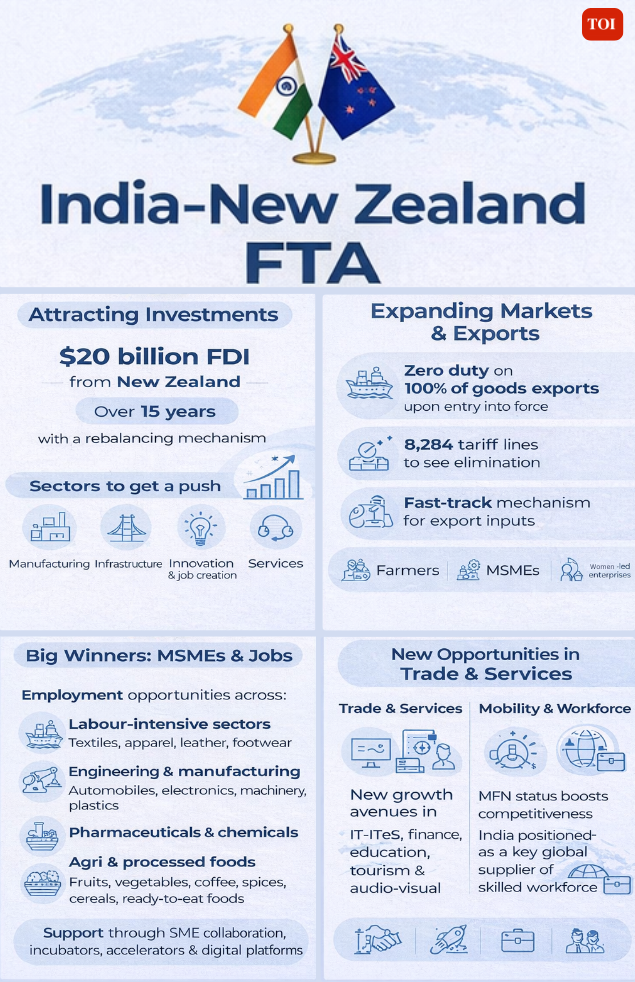
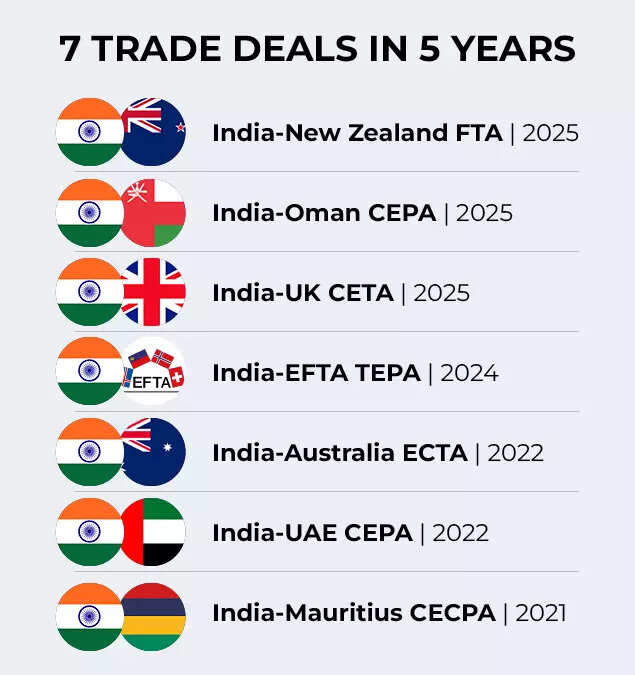
In the last five years, India has sealed seven significant trade pacts as part of its effort to expand its global economic footprint. These are:India–New Zealand FTA (2025)All Indian exports to New Zealand will now face zero duty once the deal comes into place. Under the terms of the pact, tariffs will be eliminated or lowered on about 95% of New Zealand’s exports to India, covering products such as wool, coal, timber, wine, avocados and blueberries. However, India has retained protections for sensitive sectors and has not opened its market to imports of dairy products, onions, sugar, spices, edible oils and rubber in order to safeguard farmers and domestic industries.New Zealand’s investment commitment of $20 billion will be directed towards manufacturing, infrastructure, services, innovation and employment generation in India.
India-New Zealand FTA
For India, the agreement strengthens access to a high-income, rules-based Pacific market and supports its broader Indo-Pacific economic strategy. For New Zealand, it offers more secure entry into one of the world’s fastest-growing large economies at a time of rising global trade uncertainty, notes Global Trade Research Initiative in an analysis.India–Oman CEPA (2025)India-Oman Comprehensive Economic Partnership provides almost complete duty-free entry for Indian exports, and creates wide-ranging prospects across labour-intensive industries, advanced services, and skilled workforce mobility.The agreement brings exceptional access to the Omani market, strong commitments on services and investment, improved pathways for Indian professionals, and targeted benefits for sectors such as pharmaceuticals, traditional medicine, and regulatory standards, underscoring a key advance in India’s economic outreach to the Gulf region.India–UK CETA (2025)India and the United Kingdom’s Comprehensive Economic and Trade Agreement grants almost complete duty-free entry for Indian products and significantly expands export prospects, particularly for labour-intensive industries.Beyond goods trade, the agreement includes far-reaching commitments in services, simplified movement for Indian professionals, and a key social security arrangement that increases workers’ net earnings while reducing compliance expenses for Indian firms.Some of the other trade agreements are:
- India–EFTA TEPA (2024)
- India–Australia ECTA (2022)
- India–UAE CEPA (2022)
- India–Mauritius CECPA (2021)
Why are free trade agreements important for India?
India’s biggest export destination continues to be the US and with the Donald Trump administration imposing 50% punitive tariffs, exports to one of the main trading partners have been hit. Discussions between India and the United States are ongoing, but a final agreement has yet to be reached. A visiting US delegation held talks in New Delhi last week, though the meetings did not result in a breakthrough, even as Prime Minister Modi and President Donald Trump continue to describe their periodic phone conversations as “great”.The US is seeking to narrow its trade deficit by increasing exports of energy and agricultural products. While India has indicated a willingness to partly raise energy imports, it has made it clear that opening up the farm sector is not negotiable. Indian officials now believe the agreement could be signed by March.In the meantime, India has stepped up efforts to widen its export base and reduce reliance on any single market. As part of this push, stalled negotiations with the European Union have been revived. The India-EU trade agreement is in the works and discussions are ongoing with Chile.
7 Trade Deals in 5 Years
Gulzar Didwania, Partner at Deloitte India tells TOI that India’s CEPA with Oman and the newly concluded Free Trade Agreement with New Zealand represent watershed moments in India’s export-led growth strategy. “The India-Oman CEPA delivers zero-duty access for goods in Oman on nearly 98% of its tariff lines, covering key sectors such as textiles, engineering goods, medical devices, pharmaceuticals and automobiles. Similarly, the India-New Zealand FTA would reduce tariffs on 100% on India’s exports to New Zealand, opening NZ’s market more broadly to Indian goods and services. This is expected to double bilateral trade over the next five years.,” he explains.Didwania is of the view that trade deals and FTAs not only deepen market access but also help diversify India’s export destinations by lowering barriers, facilitating regulatory alignment, and enhancing services mobility.Agneshwar Sen, Trade Policy Leader at EY India notes that India’s recent pivot toward ‘new-age’ Free Trade Agreements signify a fundamental shift in trade architecture.“These are not just tariff-reduction exercises; they are strategic gateways into high-value developed markets. By securing zero-duty access for over 90% of our tariff lines, India is leveling the playing field for labor-intensive exports like textiles, engineering, and jewelry against global competitors,” Sen tells TOI.“These pacts move beyond merchandise trade by embedding binding investment commitments and professional mobility for our services export. These agreements integrate our MSMEs into the heart of global value chains, ensuring that ‘Make in India’ is backed by ‘Market Access for India.’ This proactive trade diplomacy is exactly what is needed to address the growing protectionist tendencies, globally. India is effectively insulating itself from global trading uncertainties, particularly in our traditional markets,” he concludes.India has so far signed trade agreements with Sri Lanka, Bhutan, Thailand, Singapore, Malaysia, South Korea, Japan, Australia, the UAE and Mauritius. It is also a member of the ASEAN trade pact covering ten Southeast Asian nations and has an agreement with the four country EFTA bloc comprising Iceland, Liechtenstein, Norway and Switzerland. Under the India New Zealand FTA, all Indian goods will receive zero duty access into New Zealand, including products from labour intensive sectors such as textiles, plastics, leather and engineering goods. New Zealand has also committed to facilitate foreign direct investment of USD 20 billion into India over a 15 year period.The agreement includes commitments covering a broad range of high value services, including IT and IT enabled services, professional services, education, financial services, tourism, construction and other business segments. It also opens new skilled employment avenues through a Temporary Employment Entry Visa pathway for Indian professionals in skilled occupations, with a quota of 5,000 visas available at any given time and a maximum stay of up to three years.
[ad_2]
Source link