
Isro delivers its heaviest punch as Bahubali puts BlueBird into orbit | India News
[ad_1]
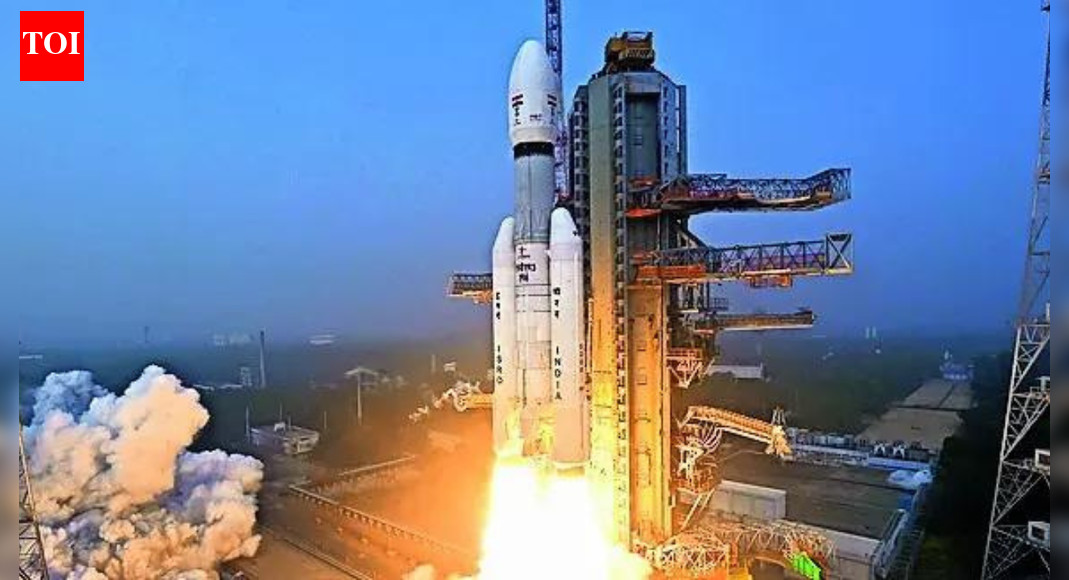
SRIHARIKOTA: Baahubali sent BlueBird to the heavens. India’s space ambitions gained new heights and heft. Isro capped 2025 with a flawless heavy-lift statement Wednesday, as its LVM3 rocket — nicknamed Baahubali — hurled the US communications satellite BlueBird Block-2 into low Earth orbit, the heaviest spacecraft ever launched from Indian soil.The lift-off came from the second launch pad at Sriharikota at 8.55 am, delayed by a minute to sidestep space debris. Fifteen minutes later, precision prevailed. The 6,100kg satellite was injected into a near-perfect circular orbit, marking another clean chapter for India’s human-rated launcher.The mission extended LVM3’s unbroken streak to nine consecutive successes — a milestone that sharpens confidence for the Gaganyaan human spaceflight programme and signals India’s arrival as a serious player in the global LEO communications market.Isro chairman V Narayanan called it a standout flight on multiple fronts. The launcher achieved orbital accuracy of less than 1.5km, placing BlueBird at 518.9km against a target of 520km — the best performance by an Indian rocket to date. “With nine consecutive successful LVM3 launches, our confidence in the Gaganyaan mission has significantly increased,” Narayanan said.Beyond mass and accuracy, the launch carried historical weight. It marked Isro’s 434th satellite deployment for 34 countries across 45 years, and the first back-to-back LVM3 mission, executed with a turnaround of just 52 days.Technological upgrades pushed the rocket further. Payload capability rose by more than 150kg after electro-hydraulic actuators were replaced with electro-mechanical systems to control the massive S200 booster motors. “With additional technologies, we have demonstrated that Isro is in a much better position for future missions, including Gaganyaan,” said mission director T Victor Joseph.The flight underscored rising commercial momentum. P Mohan, acting chairman and MD of Isro’s commercial arm NewSpace India Ltd, said interest in the launcher is accelerating. “There is interest for six to 10 LVM3 missions annually, with several global companies seeking up to six launches per year from 2026–27 onwards,” he said.Wednesday’s mission, designated LVM3-M6, was flown under a commercial agreement between NSIL and US-based AST & Science LLC. BlueBird Block-2 forms part of a global LEO constellation designed to deliver direct-to-mobile 4G and 5G connectivity.Shanti Gupta, chief operating officer of AST SpaceMobile, said the company aims to deploy 45 to 60 satellites by the end of 2026 for worldwide coverage and is in talks with space agencies across the globe, including Isro.Industry voices framed the launch as a strategic inflection point. Space Industry Association of India president Subba Rao said India now stands among a select group capable of reliably deploying heavy-class LEO payloads for next-generation telecom networks. “Its significance lies not just in launch success, but in what it signals about India’s industrial readiness, reliability, and ability to support constellations at scale over time,” he said.Indian Space Association director general Lt Gen (retd) AK Bhatt described the mission as a quantum leap. “It exemplifies Isro’s engineering excellence and operational maturity, enabling heavier payloads for global satellite constellations,” he said. “The mission strengthens India’s self-reliance in launch services and positions Isro as a preferred provider for international missions, while accelerating growth across the domestic space ecosystem.”As Baahubali faded into the morning sky, the message lingered on Earth: India is no longer testing the limits of heavy lift — it is defining them.
[ad_2]
Source link