
Day cricket stopped at Kotla: How a ‘hair transplant’ Delhi pitch abandoned India vs Sri Lanka ODI in 2009 | Cricket News
[ad_1]
Cricket matches usually end because one team scores more runs than the other. On December 27, 2009, in Delhi, the pitch ended the contest instead.The fifth and final ODI of the series between India and Sri Lanka at the Ferozeshah Kotla was abandoned after just 23.3 overs because the surface was deemed unsafe. India had already won the five-match series, but this game never reached a sporting conclusion. Instead, it became a reminder that a cricket pitch can take control of a match when it behaves beyond what players can reasonably expect.The Ferozeshah Kotla became the centre of attention for the wrong reasons after the match was abandoned following concerns over safety of payers. The decision brought an uncomfortable end to the series and even raised questions about the venue’s readiness to host international cricket.
India had already sealed the five-match ODI series before the teams arrived in Delhi. However, only 23.3 overs were possible before officials decided that the surface offered “extremely variable bounce and was too dangerous for further play”. From similar areas of the pitch, the bounce ranged from shin height to shoulder height.Batters could not trust length, pace, or bounce; but could only react and hope.Sri Lanka were asked to bat first. Within a few overs, it was obvious that this was not a normal contest between bat and ball. Balls climbed sharply. Others stayed low. Some seamed off the grass, others died off bare patches. The danger was not theoretical. Batters were being hit.On a surface where deliveries of similar length behaved very differently within an over, Sri Lanka were fortunate to escape with only two blows that required medical attention. The uneven bounce made batting difficult and unpredictable throughout the short duration of play.Former India captain Sunil Gavaskar, who was on pitch-report duty, expressed his displeasure with what he saw. He described the irregular grass cover on the wicket as a “hair transplant” with bald patches. He explained that balls hitting grassy areas seamed and bounced, while those landing on bare patches stayed low. What added to the problem was that the areas producing such contrasting behaviour were close to each other. Moisture in the pitch added to the difficulty.Despite lasting only 23.3 overs, the match saw a lot of action. There was a wicket off the first ball, a dropped catch off the first ball of the second over, several blows to the body, thick edges flying past third man, and wickets for Zaheer Khan, debutant Sudeep Tyagi and Harbhajan Singh. MS Dhoni, returning after a two-match ban, impressed behind the stumps, handling both low shooters and rising deliveries without conceding a single bye.
How it unfolded
The match was abandoned after 23.3 overs, triggering unruly scenes in the packed stands. Angry spectators threw water bottles and chair covers and damaged parts of the stadium, bringing a chaotic end to a series India won 3-1.The relaid Kotla pitch proved difficult for the Sri Lankan batters, who were asked to bat first. Deliveries rose sharply, forcing players into awkward defensive shots. Sri Lanka were in the 24th over when Thilina Kandamby approached the on-field umpires to express concerns.This led to a meeting involving match referee Alan Hurst, India captain MS Dhoni, Sri Lanka captain Kumar Sangakkara, coaches Gary Kirsten and Trevor Bayliss, and curator Vijay Bahadur Mishra. Officials from the Delhi and District Cricket Association (DDCA), including vice-president and former Test cricketer Chetan Chauhan, offered an alternative pitch. However, the match could not be resumed.
Inglorious end
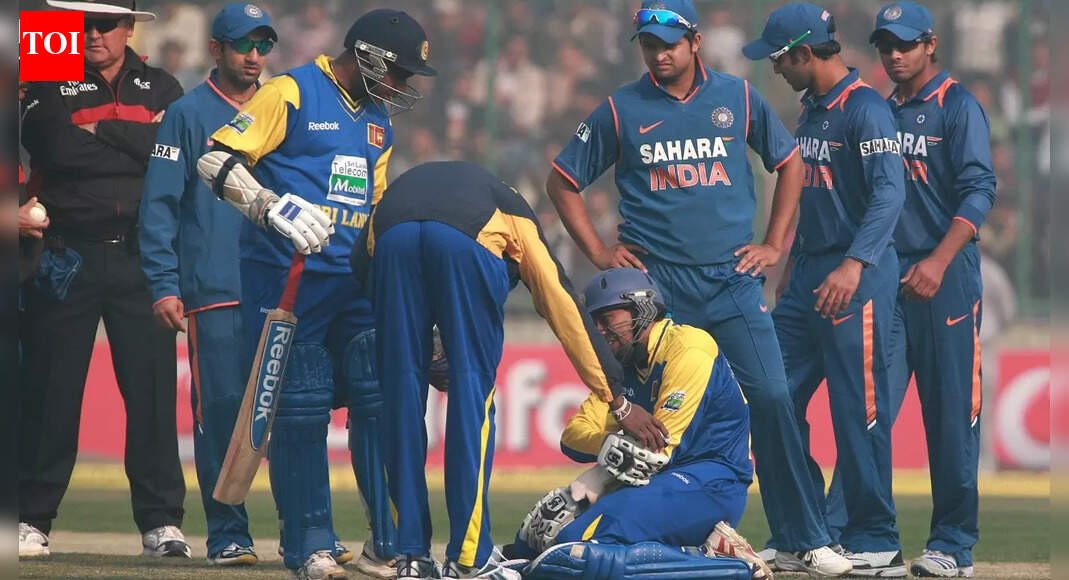
India entered the final match hoping to finish the series with a win, but the conditions made that impossible. Sri Lankan opener Tillakaratne Dilshan was struck on the forearm by an Ashish Nehra delivery and needed on-field treatment after falling to the ground in pain. Sanath Jayasuriya, who batted the longest, was hit several times on the upper arm and wrist during his stay. Despite visible discomfort among batters, play continued until the 24th over.The situation escalated after a delivery from Sudeep Tyagi rose sharply and Kandamby again complained to umpires Marais Erasmus and Shavir Tarapore. The match was eventually abandoned, though the official announcement came more than an hour later. By then, both teams and officials had already left the ground.Earlier in the day, conditions had seemed favourable for hosts. Dhoni, back after serving a ban, won the toss and chose to bowl. India’s bowlers reduced Sri Lanka to 63 for several wickets inside 18 overs.Zaheer Khan struck with the first ball of the match, beating Upul Tharanga’s defence. Ashish Nehra nearly dismissed Dilshan with his first delivery, but Suresh Raina dropped a catch at cover. Dilshan later took a blow to the forearm from another Nehra delivery before Zaheer ended his innings.Sri Lanka captain Kumar Sangakkara was dismissed for one run, becoming Sudeep Tyagi’s first ODI wicket. Sanath Jayasuriya struggled through his innings before Harbhajan Singh trapped him lbw with a top-spinner. Thilan Samaraweera was run out following a mix-up with Kandamby.The match continued for another 5.3 overs before it was finally called off, marking one of the most uncomfortable days in Delhi’s cricketing history and a reminder of how unsafe pitches can bring international matches to a halt. Feroz Shah Kotla, now known as the Arun Jaitley Stadium, was barred from staging international matches for one year, a decision that proved lenient as a two-year ban from the ICC would have cost Delhi its 2011 World Cup fixtures.
[ad_2]
Source link