
‘No fuel without PUCC, restricts entry of non-BS6 vehicles’: Delhi environment minister enforces permanent curbs to tackle pollution | Delhi News
[ad_1]
NEW DELHI: Delhi Environment Minister Manjinder Singh Sirsa announced on Saturday that two key restrictions under the Graded Response Action Plan (GRAP-4) will now be permanent, in a bid to tackle the city’s persistent severe air pollution. Speaking to the media, Sirsa said vehicles will not be provided petrol without a valid Pollution Under Control Certificate (PUCC) until further notice, according to news agency ANI.
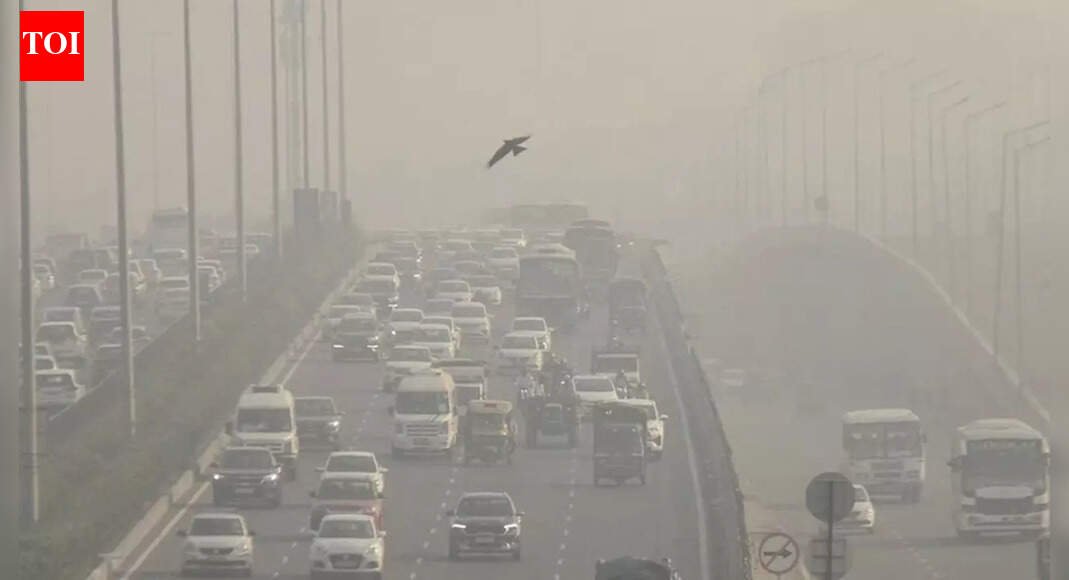
“Out of the restrictions under GRAP-4, we have decided to make two permanent. First, the PUCC requirement: you will not get petrol anywhere without a PUCC certificate until the next orders,” he stated. The minister also confirmed that vehicles entering Delhi from outside the city that do not meet Bharat Stage VI (BS6) emission standards will face restrictions. “Vehicles from outside Delhi that are below BS6 will also be restricted from entering the city,” he added. Sirsa noted that authorities are closely monitoring the weather, as the Western Disturbance may lead to adverse conditions. “The possibility of bad weather is being indicated. Therefore, we are continuously monitoring the situation,” he said, emphasizing that the government’s priority is to minimize pollution-related hardships for Delhi residents. Delhi’s air quality has deteriorated, with the Air Quality Index (AQI) reaching 390 at 6 pm on Saturday, placing it in the ‘Very Poor’ category, according to the Central Pollution Control Board (CPCB). Experts advise vulnerable groups, including children, the elderly, and those with respiratory conditions, to limit outdoor exposure and use protective masks. Thick smog and fog are trapping pollutants, reducing visibility, and disrupting daily life. Authorities are enforcing measures such as the ‘No PUC, No Fuel’ rule and Stage III restrictions under GRAP, including limits on construction and industrial activities. Earlier, the Delhi Cabinet, led by chief minister Rekha Gupta, approved measures to strengthen environmental governance in the capital. A key decision includes allocating Rs. 100 crore for the rejuvenation of water bodies across the city. Delhi has around 1,000 water bodies, 160 of which fall under the government’s jurisdiction. Sirsa said, “The rejuvenation of Delhi’s water bodies will play a crucial role in pollution control. The chief minister has directed that full financial support be provided to complete this work within the year.” The Cabinet also approved the establishment of Delhi’s first E-Waste Park at Holambi Kalan, spanning 11.5 acres. The facility will follow strict pollution-control standards and operate on a 100 per cent circular, zero-waste model. Sirsa explained, “This will be India’s first state-of-the-art e-waste facility built on zero pollution and zero wastage principles. The plant will fully recycle and reuse water through an advanced recirculation system.”
[ad_2]
Source link