
INSV Kaundinya: Navy’s engineless ship to embark on maiden voyage — all you need to know | India News
[ad_1]
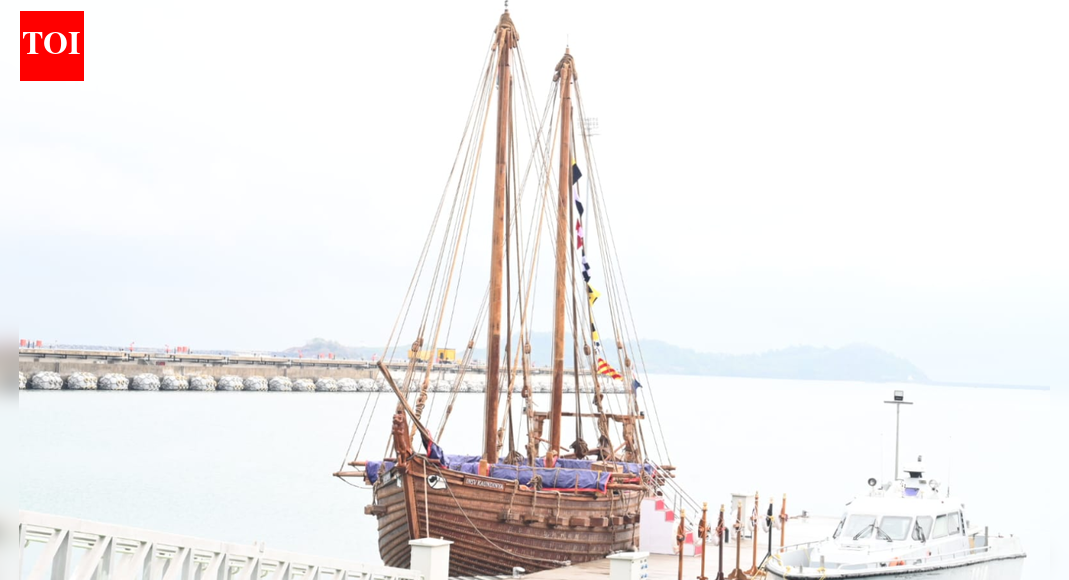
NEW DELHI: The Indian Navy’s stitched sailing vessel INSV Kaundinya will embark on her maiden overseas voyage on Monday, sailing from Porbandar in Gujarat to Muscat in Oman. The journey will symbolically retrace ancient maritime routes that once connected India with West Asia and the wider Indian Ocean world, testing traditional shipbuilding techniques that predate modern navigation by more than a millennium.The voyage marks a rare operational deployment of a vessel built entirely using ancient stitched-plank technology, with no engine, no metal fastenings and no modern propulsion systems. The ship will rely solely on wind and sails, recreating the conditions under which Indian mariners once undertook long-distance oceanic voyages.
A ship built without engines or metal
INSV Kaundinya is a non-combat sailing vessel constructed using a shipbuilding technique believed to date back to at least the 5th century CE. Unlike modern naval platforms, the wooden planks of the vessel are stitched together using coir rope made from coconut fibre and sealed with natural resins, cotton and oils to ensure seaworthiness.
This stitched construction allows flexibility in the hull, enabling the ship to absorb wave energy rather than resist it rigidly. Such flexibility was crucial for ancient sailors navigating rough seas across the Arabian Sea, the Bay of Bengal and beyond.
Inspired by ancient Indian sources
The vessel’s design draws inspiration from depictions of ships found in the Ajanta cave paintings, descriptions in ancient Indian texts and accounts left by foreign travellers. With no surviving blueprints, the Indian Navy reconstructed the design through visual interpretation and scientific validation.Hydrodynamic testing and stability studies were conducted with the support of academic institutions, including IIT Madras, to ensure the vessel could safely undertake open ocean voyages despite its ancient design.
Dimensions and crew
INSV Kaundinya measures approximately 19.6 metres in length and 6.5 metres in width, with a draft of around 3.33 metres. The ship is powered entirely by sails and is crewed by about 15 sailors trained to operate the vessel under traditional sailing conditions.
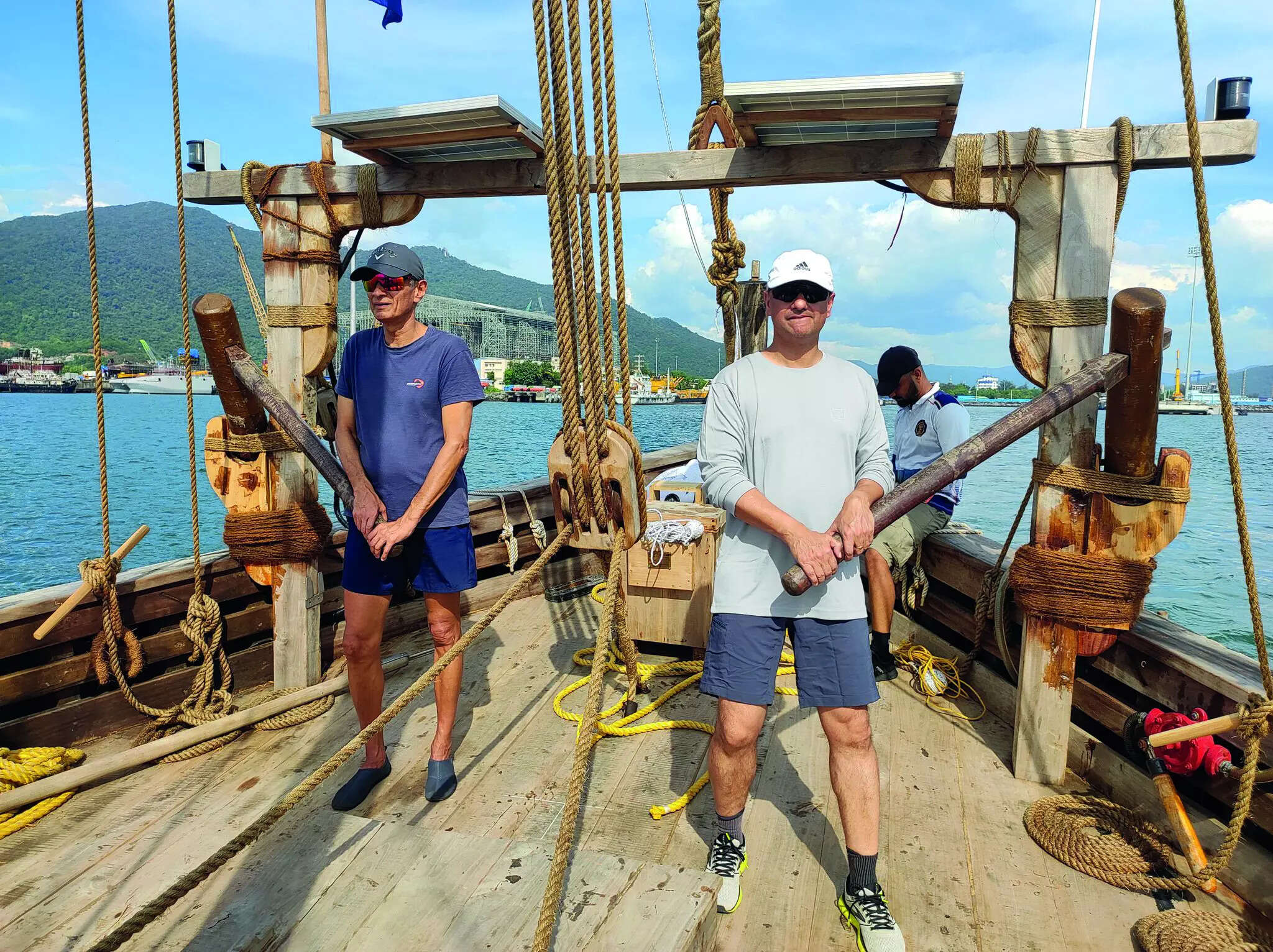
The construction follows the Tankai method, an indigenous Indian shipbuilding practice in which the hull is stitched first and ribs are added later, avoiding the use of metal entirely.
A collaborative revival project
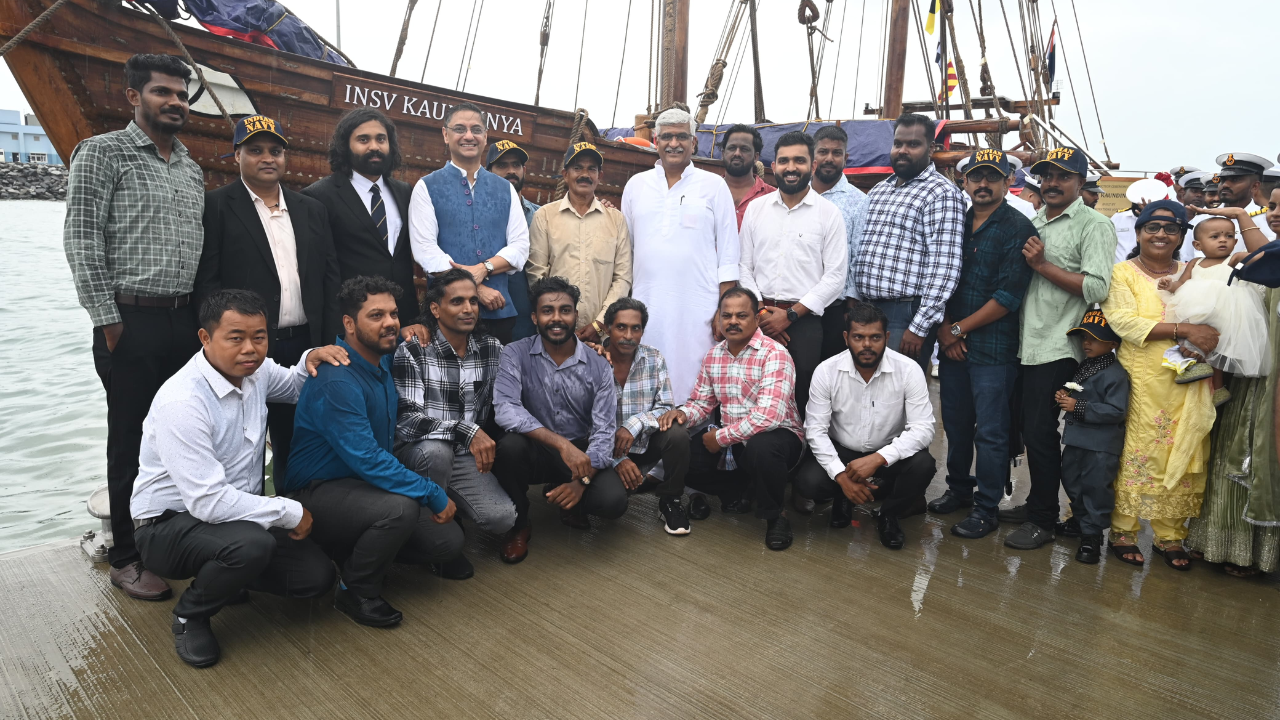
The project was initiated in July 2023 under a tripartite memorandum of understanding between the Ministry of Culture, the Indian Navy and Hodi Innovations, with funding provided by the Ministry of Culture. Traditional artisans from Kerala, led by master shipwright Babu Sankaran, stitched the vessel entirely by hand.The ship was launched in February 2025 and formally inducted into the Indian Navy in May at Karwar in Karnataka, marking a milestone in the revival of indigenous maritime knowledge systems.
Cultural symbols on board
INSV Kaundinya carries several motifs associated with India’s maritime and civilisational heritage. These include the Gandabherunda, the two-headed eagle of the Kadamba dynasty, sun motifs on the sails, a Simha Yali mythical lion figure on the bow, and a Harappan-style stone anchor placed on the deck.Each symbol reflects different periods of India’s seafaring past and its long-standing engagement with overseas trade and cultural exchange.
Named after a legendary mariner
The vessel is named after Kaundinya, a first-century Indian mariner referenced in Southeast Asian and Chinese records. According to these accounts, Kaundinya sailed to the Mekong Delta, married Queen Soma and helped establish the Kingdom of Funan in present-day Cambodia.The kingdom became one of the earliest Indian-influenced states in Southeast Asia, with later Khmer and Cham dynasties believed to trace their origins to this union. Although Indian records do not mention him, Kaundinya is regarded as the earliest named Indian sailor with a documented global historical impact.
Recreating ancient maritime highways
The Porbandar to Muscat route was once a vital corridor for trade and cultural exchange. Indian merchants and sailors used these sea lanes to transport spices, textiles and ideas across West Asia, Africa and Southeast Asia.By sailing this route again, INSV Kaundinya seeks to demonstrate the sophistication of ancient Indian shipbuilding and navigation while reaffirming India’s long-standing identity as a maritime civilisation.
[ad_2]
Source link