
Women inmate count rising fast; prisons aren’t ready for them | Mumbai News
[ad_1]
Rose a 32-year-old sex worker who was arrested in a police raid — was a bundle of nerves when advocate Sunita Salsingi – kar first met her in a prison in Ma – harashtra. “She was a simple, quiet woman... she had no idea why she had been arrested,” recalled Salsingikar. That was three years back.

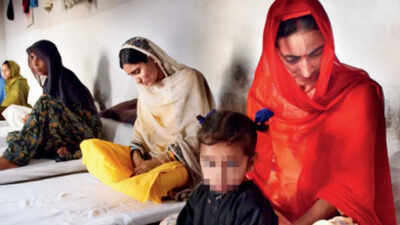
Cut to two months ago, Salsingikar was in for a surprise when she visited the jail. Rose had hardened into a tough-as-nails un – dertrial. “To adapt to life inside the jail, she became domineering,” said Salsingikar, co-founder of Dard Se Humdard Tak Trust, which provides free legal aid to jail inmates. “From being denied food to the empty prom – ises of her agent, who pretended to have met govt lawyers — whatever delays she faced in there turned her bitter and cynical.” Rose is one of thousands of women in prison across India who collectively represent a worrying national trend. The count of wom – en in Indian prisons has grown faster than the general population has over the last two decades, going by the sixth World Female Impris – onment List released recently by the Institute for Crime and Justice Policy Research (ICPR). The num – ber — including both undertrials and convicts — has shot up from 9,089 in 2000 to 23,772 in 2022, plac – ing India sixth globally after the US, China, Brazil, Russia and Thai – land. India’s population grew by about 30% during this period while the number of women inmates surged by 162%. Overall, women constitute only 4% of the 5.7 lakh inmates in Indian prisons, but the trend raises urgent questions about shifts in crime patterns, po – licing, and gender-responsive re – forms, say observers. Criminology research shows that women often operate at the lowest rungs of criminal networks; yet, in many countries, they are punished under harsh, one-size-fits-all laws designed for serious offenders, par – ticularly in drugs-related cases. India, it seems, mirrors some of these patterns as courts are increas – ingly unwilling to show leniency even in non-violent cases. What’s Driving The Rise? “In a lot of cases, non-violent offences such as sex work are dealt with more harshly than serious offences because there is a lot of social stigma involved,” says prison reforms lawyer Apurva Vivek, founder-director of Hashiya SocioLegal Centre for Women, which works with women in custody, pro – viding legal aid, skilling, education and mental health counselling. Vivek recalls an instance in Ranchi, where several young girls who were picked up from a hostel for soliciting clients had used the mon – ey simply to pay college fees. “Most of their parents were informed, pos – sibly leading to a total collapse of family support for them. The news was all over social media, with some people demanding that the girls re – main imprisoned for life or be given the harshest punishment possible. Yet, no one wondered where this demand for sex work was coming from and why none of the men avail – ing themselves of their services was being held accountable,” said Vivek. The changing pattern of wom – en’s involvement in crime also partly explains the rise in the num – ber of women prisoners. “In rural areas, women are rarely involved in property offences. But the profile is changing in urban areas, where more women are in public spaces. In cities like Mumbai, women are seen in organised crime, drug-relat – ed offences, cheating or human trafficking, etc. But in these types of crime, there would typically be a male accomplice,” said Prof Vijay Raghavan of the Centre for Crimi – nology and Justice at TISS. According to National Crime Records Bureau (NCRB) data, most women inmates are undertrials. Prayas’s Legal Representation for Undertrials in Maharashtra (2016- 19) study says that those arrested for small, poverty-driven offences — pickpocketing, minor theft, or carrying stolen goods at someone else’s behest — can remain behind bars for months simply because they are unable to access or pay for legal assistance. Social activist Ravindra Vaidya, founder of Voluntary Action for Re – habilitation & Development — a nonprofit working on prisoner support, rehabilitation, and community de – velopment, especially in the Vid – arbha region of Maharashtra — said that while the judiciary in the past used to be more liberal when it came to bail for women undertrials, it is not the case anymore. “We’re seeing more bail applications by women being rejected. This could be one of the reasons behind the growing number of women undertrials in prison. Conviction rate is also high – er now for women undertrials.” Another expert pointed out that procedural delays only deepen the crisis. “Undertrial review commit – tees are mandated to review all women’s cases every quarter, but the data shows that many cases are not reviewed,” said Madhurima Dha – nuka of the India Justice Report. Crackdown on illegal immigra – tion has also driven up women in – mate numbers. A prisons depart – ment officer said they’d seen a rise in the number of women prisoners belonging to other countries, espe – cially Bangladeshi nationals, fol – lowing intensified action against undocumented immigrants. Globally, more than 7.3 lakh women are in prison — a 57% rise since 2000. Despite the surge, the number of Indian women inmates remains low by global standards. Raghavan believes that is precisely why reforms must be accelerated now. “As women’s mobility in India increases, the number of both wom – en offenders and women victims will rise,” he said. Small Numbers, Big Gaps Infrastructure gaps add to the strain. “The women’s section is cramped across prisons. We need more coun – sellors, instructors and trained so – cial workers, too,” said Vaidya. Vivek agrees. “Prisons across the country are overcrowded and medical ser – vices remain unsatisfactory. There is a lack of empathy, both at the level of institutions and the society, which refuse to look beyond the criminality of prisoners,” she says. Through its efforts, Prayas was able to get ICDS (Integrated Child Development Services) angan – wadis started in seven prisons in Maharashtra for children living with their mothers. Between 2018 and 2025, Prayas worked with over 3,000 women across the Byculla, Thane and Kalyan prisons, provid – ing legal aid, and assisting with bail and counselling. Experts say incarceration am – plifies trauma. A study in The Lan – cet Psychiatry shows suicide rates in Indian prisons nearly doubled between 2001 and 2019 — from 12.1 to 24.2 per 1,00,000 (men and women combined). Women, often separated from children, are at heightened risk, experts say. The Way Forward The ICPR data highlights large gaps across legal aid, sentencing and prison infrastructure. Internation – ally, community service, probation, drug-treatment courts, and restora – tive justice have reduced recur – rence of criminality while minimis – ing harm to families. In India, the National Commis – sion for Women recently convened a national consultation on women prisoners, focusing on healthcare, gender-sensitive correctional sys – tems, rights of incarcerated moth – ers, and humane treatment of transgender and foreign inmates. However, the Union home ministry points out that prison administra – tion is a state subject, making re – forms contingent on local priorities. Vivek argues that reform must start by acknowledging women’s distinct needs. “Women form a very small percentage of the prison pop – ulation. That has unfortunately translated into fewer rehabilitation and skill-building efforts for them. For many, prison becomes their only home.” Stressing the need for interdepartmental coordination, she added, “Collaboration between the prisons department and social wel – fare department is urgently needed to create transitional shelter homes. Dignity after prison should be as much a priority as justice inside it.” Vivek also called for alternatives to incarceration. “One must begin by asking whether imprisonment in non-serious offences or offences aris – ing from circumstances is necessary. Fundamentally, we must start look – ing at open prisons, community service, and bail reform for women, who face multiple vulnerabilities.” For Salsingikar, who blames ju – dicial delays for the surge in women inmate numbers, one solution tow – ers above all: fast-track courts for women. “You can give them washing machines and sewing kits inside the jail, but what they really want is to just get out of it,” she
[ad_2]
Source link