
Zohran Mamdani makes history, taking oath on Quran as NYC’s first Indian-African-Muslim immigrant mayor
[ad_1]

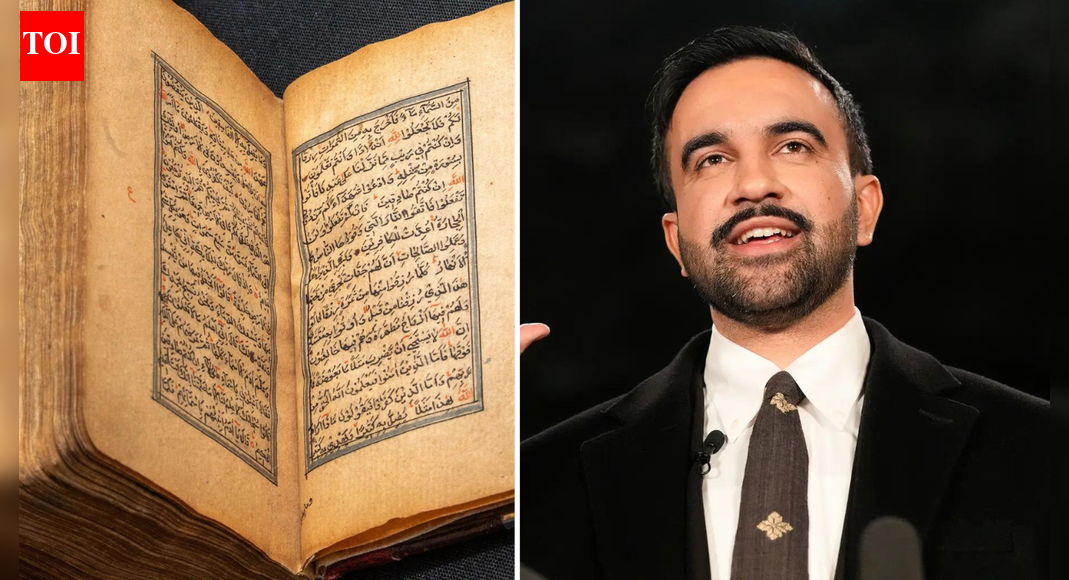
TOI correspondent from Washington: At the stroke of midnight on New Year’s Day 2026, New York turned a page in its long, turbulent chronicle. In a decommissioned subway station beneath the city it once ferried to power and possibility, Zohran Mamdani took the oath of office on the Quran, becoming the 112th mayor of the largest city in the United States. Few inaugurations in recent memory have carried such dense layers of symbolism—or such quiet irony.The book, the venue, and the officiator were all deliberate choices, each freighted with meaning. In a city whose skyline still bears the phantom ache of the September 11 attacks, Mamdani, 34, placed his hand on two Qurans held by his Syrian-origin wife, Ruma Duwaji. In doing so, he claimed a cascade of firsts: the youngest mayor in the city’s history; the first Muslim to hold the office; the first person of Indian origin; the first African-born New Yorker—he was born in Kampala, Uganda—to lead what is arguably the modern world’s most celebrated metropolis.
New York has always measured itself in symbols, and Mamdani’s inaugural gestures spoke volumes. His choice of the Old City Hall subway station for a private oath was his first executive statement. Closed in 1945, the station is a jewel of the Gilded Age, adorned with Guastavino tilework and vaulted skylights that once opened toward the seat of municipal power above. By descending into this architectural relic, Mamdani sidestepped the spectacle of a Times Square-style swearing-in and instead anchored his moment in the city’s buried history—its forgotten spaces as much as its gleaming facades.The oath was administered by New York Attorney General Letitia James, herself a figure of defiance in national politics and a frequent antagonist of former President Donald Trump, who has repeatedly targeted her for pursuing legal action against him. The pairing underscored the political tenor of the new administration: unapologetically progressive and unafraid of confrontation.Later on Thursday, Mamdani was sworn in again, this time publicly, on the steps of City Hall. That ceremony carried a different kind of theatre. Officiated by U.S. Senator Bernie Sanders, Mamdani’s political mentor, and featuring Congresswoman Alexandria Ocasio-Cortez, his closest ally, the event drew thousands of supporters. A jubilant block party spilled onto Broadway’s storied Canyon of Heroes, turning the inauguration into a street-level celebration of movement politics.At the centre of it all stood Mamdani, whose ascent to City Hall defied almost every conventional rule of New York politics. A third-term Assembly member from Astoria, Queens, he entered the mayoral race as a marginal figure, polling at less than one per cent when he announced his candidacy. Yet by running an unambiguously left-wing campaign focused on affordability—rent freezes, universal childcare, and expanded public transit—he tapped into a deep reservoir of frustration with political centrism and establishment caution.His path to victory required the political equivalent of slaying giants. Most notably, Mamdani defeated former governor Andrew Cuomo not once, but twice: first in the June Democratic primary, and again in the general election after Cuomo mounted an independent bid. It was a repudiation not just of a rival, but of a style of politics that many New Yorkers had come to see as transactional and exhausted.Branded by his team as the “Inauguration of a New Era,” Thursday’s ceremonies reflected both New York’s storied past and its rapidly shifting demographic and political future. This is a city rebuilt repeatedly from catastrophe—economic collapse, social unrest, terror—and Mamdani’s elevation signals a renewed turn toward progressive experimentation at a moment when much of the United States appears to be retreating into a nativist, protectionist shell.The religious symbolism threaded through the day was especially striking. Multiple Qurans were used across the two oath ceremonies, including a family heirloom and a centuries-old volume that once belonged to the great historian Arturo Schomburg. For many New Yorkers, the sight of a mayor sworn in on the Quran in a city that endured virulent anti-Muslim sentiment after 9/11 felt like an act of civic reclamation—a passage from years marked by mourning and suspicion back toward pluralism and power.From an international vantage point, particularly among diasporas from the Indian subcontinent and Africa, the resonance was impossible to miss. For a quarter-century after 9/11, the figure of the Muslim immigrant in New York was often filtered through the lens of national security. Africans, too, were marginalised, with citizens from nearly half the continent now effectively barred from entering the United States.Today, that composite identity occupies the city’s highest office. New York, which once recoiled from the “other,” has entrusted an Indian-African-American Muslim with the task of addressing its most pressing challenges: a punishing housing crisis, an aging and overstretched subway system, and a widening gulf between wealth and poverty.The city that was once defined, in the world’s imagination, by an act of terror is now led by a man whose faith was once invoked to explain that tragedy. Whether Zohran Mamdani succeeds as mayor will be judged by governance rather than symbolism. But his inauguration has already etched itself into history—as a moment when New York, yet again, chose reinvention over fear, and transformation over memory’s darkest confines.
[ad_2]
Source link