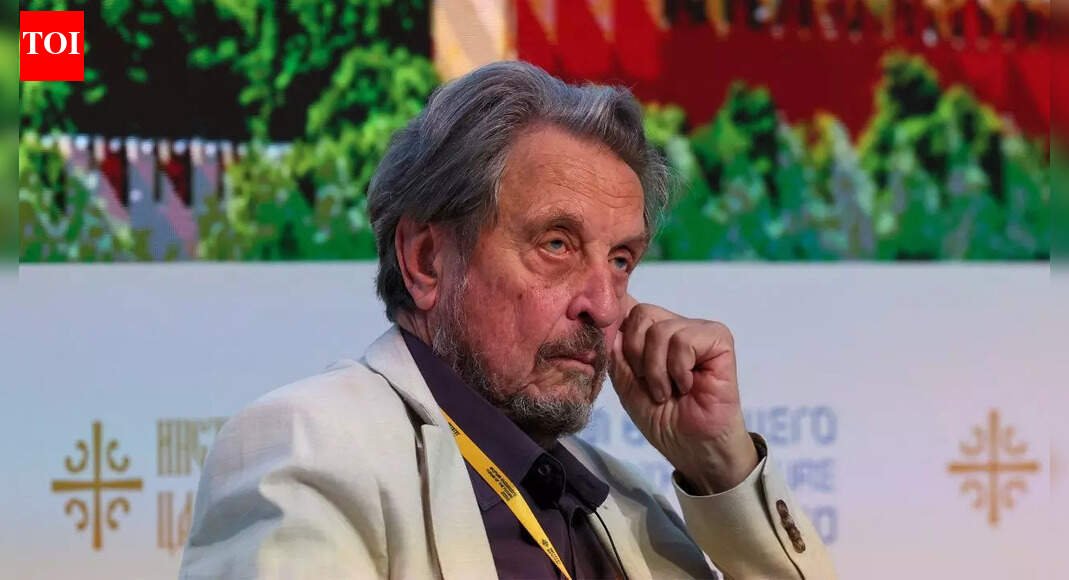

‘You want to go back to the jungle?’: Elon Musk’s father Errol claims US will be ‘doomed’ if whites become minority | World News

Errol Musk, father of Elon Musk, has triggered widespread controversy after remarks he made in a CNN interview on demographic change in the United States, warning that a decline in the white population would have severe consequences for the country’s future.Speaking to CNN correspondent Donie O’Sullivan for a documentary segment examining conspiracy theories around “white genocide,” Errol Musk reacted to US Census Bureau projections showing that non-Hispanic White Americans are expected to fall below 50% of the population by the mid-2040s. Musk described this projected shift as “a very, very bad thing to happen” and claimed that the United States would be “doomed” if whites became a minority.
“You want to see the US go down? Why?” Musk asked during the interview. “You don’t like electric cars, and you don’t like technology? What is it, you want to go back to the jungle?” The remarks were widely criticised for implying that technological progress is dependent on racial demographics.
Comments on South Africa and apartheid
Musk went on to draw comparisons with South Africa, where he lives. He argued that the country’s small White population had historically projected “European culture” and values that contributed to national development. During the exchange, Musk denied that Black South Africans had been systematically oppressed under apartheid, dismissing such claims as “nonsense.”These assertions were directly challenged on air by CNN, and have been widely condemned by historians and commentators. Apartheid, which lasted until the early 1990s, is internationally recognised as a system of institutionalised racial segregation and oppression, documented by courts, governments, and human rights organisations worldwide.
Political context and reaction
Musk’s comments have sparked backlash across social media and international media outlets, with critics arguing that his views echo long-discredited racial and civilisational theories. The controversy comes amid heightened global sensitivity around race, migration, and identity politics.The remarks also intersect with recent political tensions involving South Africa, following earlier claims by Donald Trump alleging “white genocide” in the country, claims that have been repeatedly rejected by South African authorities and independent investigations.
What the data actually show
US Census Bureau projections indicate that demographic change in the United States is being driven by long-term trends, including lower birth rates among non-Hispanic Whites, higher birth rates among other groups, and immigration. Demographers note that becoming a “minority-White” country does not mean any group becomes numerically dominant, nor does it imply economic or technological decline. Historically, periods of immigration and demographic transition in the US have coincided with innovation and growth.Errol Musk’s CNN interview has nonetheless placed him at the centre of an ongoing global debate on demographics, culture, and identity, highlighting how population data is increasingly being interpreted through political and ideological lenses rather than empirical evidence.