
‘I was elected as a Democratic Socialist’: Decoding Zohran Mamdani’s inaugural speech | World News
[ad_1]
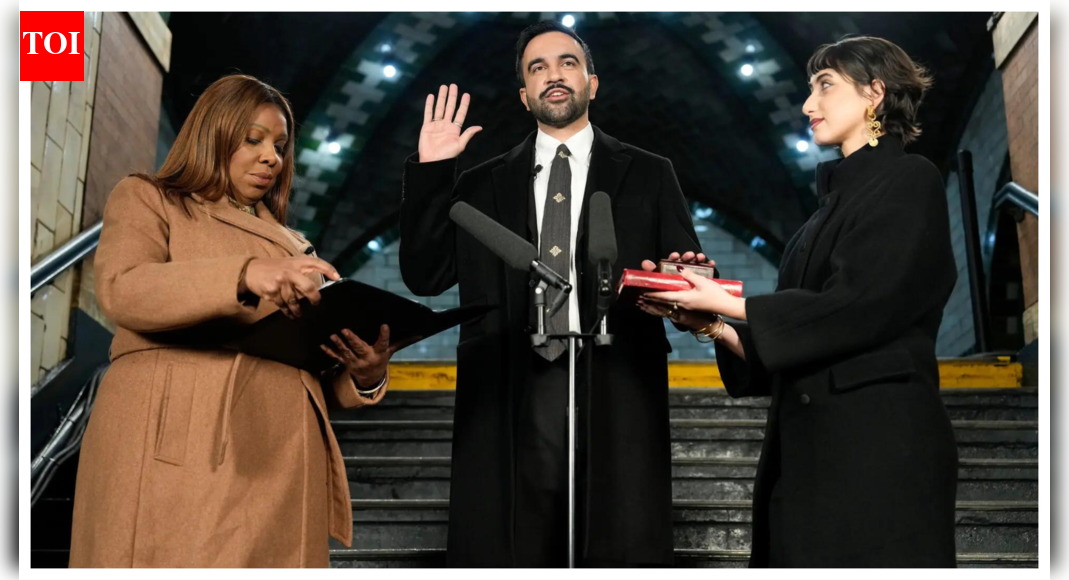
Zohran Mamdani’s inaugural address was notable not for its length or flourish, but for how explicitly it challenged the governing assumptions New York has lived with for years. Instead of emphasising constraints, he foregrounded ambition. Instead of defending incrementalism, he framed it as failure. And instead of presenting affordability as an unfortunate by-product of global forces, he treated it as a problem government has actively chosen not to confront.The speech was light on implementation detail, but heavy on direction. Read closely, it sets out a governing philosophy built around direct cost relief, public provision, and an openly confrontational posture towards institutions that block change.
Here is what Mamdani said, and what it actually means.
Resetting expectations: rejecting the politics of caution
“In writing this address, I have been told that this is the occasion to reset expectations, that I should use this opportunity to encourage the people of New York to ask for little and expect even less. I will do no such thing. The only expectation I seek to reset is that of small expectations.”What this signals:This is Mamdani’s clearest break from recent administrations. New York governance has increasingly been shaped by expectation management. Leaders promise process, cite constraints, and treat boldness as irresponsibility.Mamdani rejects that logic outright. He is not promising that everything will succeed. He is promising that failure will not be pre-empted by timidity. This line sets the tone for a mayoralty that prefers visible effort over quiet restraint.
Using state power unapologetically
“To those who insist that the era of big government is over, hear me when I say this: No longer will City Hall hesitate to use its power to improve New Yorkers’ lives.”What this signals: This is a direct rebuttal to the post-1990s consensus that city governments should defer to markets and limit intervention. Mamdani is arguing that government’s failure has not been overreach, but underuse of authority.The emphasis here is not on expanding government for its own sake, but on abandoning hesitation. It foreshadows regulatory fights, public provision, and policies that test the limits of what City Hall can do without waiting for permission.
Free buses: making relief immediate
“Getting on a bus without worrying about a fare hike or whether you’ll be able to get to your destination on time will no longer be deemed a small miracle, because we will make buses fast and free.”What this signals: Free buses are not presented as a transport reform alone. Mamdani frames them as a daily indignity that government has normalised.By choosing buses, he prioritises a policy that delivers immediate, visible relief across income and community lines. The political logic is clear: once a fare disappears, its return must be justified publicly. This shifts the burden of explanation from government to opponents.
Universal childcare: treating time as public infrastructure
“The cost of child care will no longer discourage young adults from starting a family, because we will deliver universal child care for the many by taxing the wealthiest few.”What this signals: Mamdani does not frame childcare as a labour-market efficiency measure or a demographic fix. He frames it as freedom from economic coercion.The emphasis on “starting a family” reflects how childcare costs reshape life choices in New York. By calling for universal provision, Mamdani is moving childcare from the realm of private sacrifice into that of public obligation.The speech deliberately avoids details on timelines or mechanisms. Its purpose is to establish childcare as a priority that must be funded, not a programme that can be deferred.
Rent freeze: turning housing into a political confrontation
“Those in rent-stabilised homes will no longer dread the latest rent hike, because we will freeze the rent.”What this signals: This is the most legally constrained and politically charged promise in the speech.Housing regulation in New York involves state law, courts, regulatory boards, and powerful landlord interests. Mamdani is aware of these limits. By promising a rent freeze anyway, he is forcing responsibility into the open.If the freeze is blocked, the focus shifts from inevitability to obstruction. The policy’s power lies as much in exposing who controls housing outcomes as in delivering immediate relief.
Public safety: redefining the role of policing
“New Yorkers will create a new Department of Community Safety that will tackle the mental health crisis and let the police focus on the job they signed up to do.”What this signals: Mamdani avoids abolitionist rhetoric. Instead, he reframes public safety as a system misaligned with its tasks.By separating mental health and social crises from policing, he positions this as a functional correction rather than an ideological overhaul. This allows the proposal to appeal both to communities harmed by over-policing and to voters concerned about order and response times.
Collectivism as policy logic
“We will replace the frigidity of rugged individualism with the warmth of collectivism.”What this signals: This line provides the connective logic for Mamdani’s policy agenda.Free buses reduce individual coping costs. Childcare reduces private improvisation. Rent freezes reduce solitary negotiation. Community safety reduces personal risk management.Collectivism here is framed not as ideological conformity, but as shared infrastructure for shared problems. Mamdani argues that New York’s fragmentation stems not from diversity, but from the privatisation of survival.
Defining “New Yorker” as a shared condition
“No matter what you eat, what language you speak, how you pray, or where you come from, the words that most define us are the two we all share: New Yorkers.”What this signals: Mamdani deliberately subordinates cultural difference to civic identity.“New Yorker” in this framing is not about heritage or ideology, but about shared exposure to high costs, long commutes, housing insecurity, and economic pressure. This allows Mamdani to justify universal policies without targeting specific groups.Relief is framed as something owed to New Yorkers as a class defined by material reality.
Governing without apology
“I was elected as a democratic socialist and I will govern as a democratic socialist.”What this signals: This line functions as narrative discipline.Mamdani is signalling that there will be no ideological softening once in office. Supporters are told not to expect triangulation. Critics are told not to feign surprise. The mayor is locking in expectations early to avoid accusations of bait-and-switch politics later.
From “no” to “how”: changing City Hall’s culture
“We will transform the culture of City Hall from one of ‘no’ to one of ‘how?’”What this signals:This is the most operationally significant promise in the speech.“No” is how bureaucracies preserve themselves. “How?” demands justification. It forces agencies, regulators, and higher levels of government to explain obstruction publicly.Mamdani is committing to governance that makes limits visible rather than quietly absorbed. Even failure, in this model, becomes politically useful if it clarifies where power lies.
The bottom line
Zohran Mamdani’s inaugural speech is not a detailed policy blueprint. It is a declaration of governing intent. He is not promising smooth delivery or consensus politics. He is promising confrontation, visibility, and a refusal to normalise unaffordability. The risk is overreach and voter fatigue if tangible relief lags behind rhetoric. The bet is that New Yorkers are already fatigued by caution disguised as realism. For now, the speech makes one thing unmistakably clear: New York’s new mayor intends to judge his administration not by how well it manages constraints, but by how hard it pushes against them.
[ad_2]
Source link