


MUMBAI: Two Tunnel Boring Machines (TBMs) for the underground stretch of the Mumbai-Ahmedabad bullet train project are set to arrive at Jawaharlal Nehru Port on Monday, marking a breakthrough after months of delays linked to geopolitical factors that held up consignments in China.Officials said the shipment includes the remaining components of the first TBM-whose cutter head reached Mumbai around Sept 24, 2025-as well as the complete set of parts for the second machine.Sources said, “The consignment left China in early March, reached Chennai port, and was dispatched for Mumbai on March 18.”
Mumbai-Ahmedabad bullet train underground work to begin soon
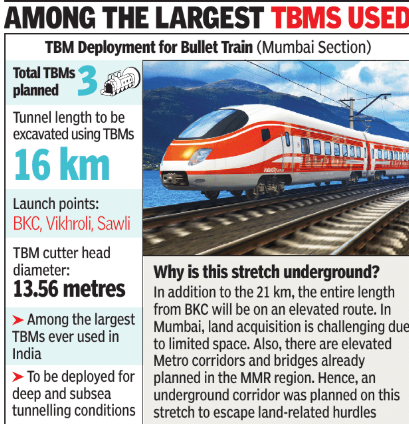
With both TBMs now arriving, work on the underground package can move forward. Boring is expected to begin in about three months after assembly and testing. The machine is equipped with a mixshield configuration, designed to cut through complex geology, and will be deployed for the 20.37-km underground section between Bandra Kurla Complex (BKC) and Shilphata, which includes a challenging 7-km subsea tunnel beneath Thane Creek.The development comes amid a broader easing of economic engagement between India and China. The Centre recently relaxed certain investment norms for firms with limited Chinese shareholding, signalling a calibrated approach to improving business ties even as strategic safeguards remain in place. Officials indicated that such measures have helped smooth project-linked clearances and logistics.The TBMs, though procured from German firm Herrenknecht, were manufactured at its Guangzhou facility and remained stranded at a Chinese port earlier this year without formal clearance. The delay emerged as a major concern for the timelines of the Rs 1.08 lakh crore high-speed rail corridor.The matter was taken up through diplomatic channels, with the railways ministry coordinating with the external affairs ministry. Sources said the issue was also flagged during Prime Minister Narendra Modi’s interaction with Chinese President Xi Jinping on the sidelines of the Shanghai Cooperation Organisation summit in Aug 2025.The underground package, being executed by Afcons Infrastructure Ltd, involves a complex stretch between Bandra Kurla Complex and Shilphata. The bullet train project, India’s first high-speed rail corridor, is designed for speeds of up to 320 kmph, with the Mumbai underground section seen as one of its most challenging components.The tunnel will run at depths ranging from 25 to 65 metres below the surface, dipping to as much as 114 metres beneath Parsik Hill near Shilphata. NHSRCL plans to deploy two TBMs initially, with an option of using a third if required to meet deadlines. The tunnelling will create a single-tube passage carrying both up and down tracks of the bullet train.

