


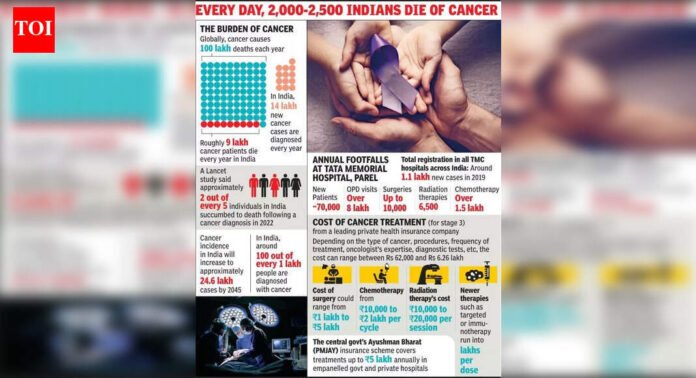
Mumbai: Treatment of cancer, one of the most feared diseases that claims 2,500 lives every day across India, is emerging as the fastest growing healthcare sector in Mumbai, with annual revenues from oncology services in many five-star hospitals now surpassing that from cardiac care.Mumbai’s leading private hospitals have increased CapEx to build entire floors, wings or new buildings for cancer care. They are installing bunkers for linear accelerators costing up to Rs 25 crore each, acquiring digital PET scanners for Rs 10 crore and offering premium services such as “more precise” robot-assisted oncosurgeries, “fewer side-effects” chemotherapies and immunotherapy at over Rs 2 lakh a dose.Fuelling this growth is a chilling stat: an increase in cancer cases due to better diagnostics and/or lifestyle- and environment-related causes. With increased chances of finding cancer in early stages due to annual checkups, experts expect the numbers to rise from the present 14 lakh cases annually. In addition, “good reimbursement rates” for chemotherapy and radiation under the central govt’s Ayushman Bharat insurance scheme have created a steady revenue stream for both public and private hospitals.When Where WhyCancer care was synonymous with the govt sector until 20 years back, with private hospitals staying away from this cost-intensive sector. “But as govt centres got overcrowded and waiting list longer, the private sector stepped in,” said hospital planning and management consultant Dr Vivek Desai. Nanavati Max Super Speciality Hospital COO Dr Vivek Talaulikar sees the present boom as the result of a huge gap between patient demand and supply of specialised cancer beds and specialists. “At present, 25 lakh Indians are under treatment for different types of cancer. About 70% of these require multi-stage chemotherapy, and 20-25% surgery and multiple cycles of radiation therapy,” said Dr Talaulikar. In the hospital’s new Block B with 269 beds, cancer care will occupy centrestage: two floors for onco patients and dedicated operation theatres. “We had two bunkers for linear accelerators previously, and now we have added three more,” said Dr Talaulikar. Also, from having two robots till about three years back, “we today have 30 robots,” he added.In Oct, Fortis Hospital Mulund inaugurated its Cancer Institute and the Institute of GastroSciences with “cutting-edge diagnostic technologies and advanced treatment modalities”. Parel’s Gleneagles Hospital, known for its focus on transplants, has roped in pancreatic and gastrointestinal cancer surgeon Dr Shailesh Shrikhande from Tata Memorial Hospital and announced a cancer wing. “We have a licence for 245 beds, and another 43 can be added in a year’s time,” said Gleneagles CEO Dr Bipin Chevale, indicating the new beds would be mainly used for oncology. “India has an aging population, cancer is one of the possibilities,” he added. Challenges and ConcernsDr Desai said that cancer care mirrored cardiology’s boom a decade ago. “Every hospital focused on heart care then, and the city got an excess of cath labs. Such an explosion of infrastructure may not occur with cancer because it is too cost intensive,” he said. He also pointed to a looming shortage of specialised nursing staff and radiation technicians. A senior doctor from a leading hospital explained why revenues per cancer patient stay high: “Unlike, say, heart, where the person gets an angioplasty or a bypass, a cancer patient keeps coming back.“Calls for RegulationFormer Tata Memorial Centre director Dr Rajendra Badwe said, “Cancer is on the rise, and there is a need to provide treatment.” He said there also is a need for audits and checks on private hospitals offering care. “The govt needs to work out some QAQC system. If a private hospital puts out its complication rates and five-year-survival rates, there should be a mechanism to appreciate it by providing it with, say, one star. Another star could be added for innovating with treatment and yet another for research,” he said. Finally, he said, there should be a cap on prices. “In Tata Memorial, we provide medicines at 20% of MRP, but what about private hospitals?” In cancer care, a chunk of earnings comes from pharmacy.

