


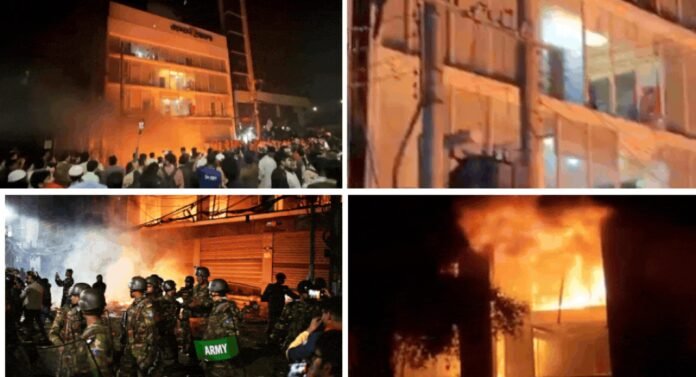
Bangladesh witnessed widespread unrest overnight on Thursday after the death of Sharif Osman Hadi, a prominent youth leader and vocal critic of ousted former Prime Minister Sheikh Hasina, triggering violent protests in parts of Dhaka and attacks on major media houses.Hadi, 32, died at a hospital in Singapore on Thursday, where he had been undergoing advanced treatment after being shot by masked assailants on a motorbike on December 12. He was attacked while riding in a rickshaw and was later airlifted abroad for medical care.
The shooting had taken place just a day after Bangladeshi authorities announced a date for the country’s first elections since the 2024 uprising, elections that Hadi was planning to contest as an independent candidate.
Protests turn violent, journalists trapped inside burning offices
As news of Hadi’s death spread late Thursday and early Friday, hundreds of his supporters poured onto the streets of Dhaka demanding justice and the arrest of those responsible for the killing.At least three incidents of arson were reported in the capital, including fires at buildings housing Bangladesh’s leading newspapers: The Daily Star and Prothom Alo, a spokesperson for the Fire Brigade and Civil Defence force told AFP.Groups of protesters stormed the offices of both newspapers, vandalising the premises before setting parts of the buildings on fire. Journalists and staff were trapped inside as smoke filled the offices.Zyma Islam, a reporter for The Daily Star, described the ordeal as she remained trapped inside the burning building. “I can’t breathe anymore. There’s too much smoke. I am inside. You are killing me,” she wrote on Facebook. The fire at The Daily Star office was brought under control at around 1.40 am, officials said, but 27 employees were still inside at the time. “We took refuge at the rear of the building and could hear them chanting slogans,” Daily Star reporter Ahmed Deepto told AFP, referring to the protesters.A journalist told bdnews24 that staff had received a phone call warning them that a crowd was moving towards the newspaper’s premises. When newsroom employees tried to move downstairs, they found that the mob had already vandalised the lower floors before setting them on fire. Night-shift staff reportedly fled to the terrace to save their lives.At least 25 journalists were rescued over four hours following the attack at the Kawran Bazar office, bdnews24 reported. Firefighters rescued people using ladders, while army contingents were later deployed around the buildings.“Hundreds of people have gathered here and carried out the attack,” a police officer told BBC Bangla. Troops were later deployed to secure the area. Witnesses said protesters first vandalised the Prothom Alo office before setting fire to The Daily Star building. It remained unclear why the two outlets, both known for their passive support for interim leader Muhammad Yunus, were targeted.In a televised address, Yunus announced special prayers at mosques on Friday and declared a day of mourning on Saturday. “Hadi’s demise is an irreparable loss for the nation,” Yunus said, urging protesters to remain calm.
Why the unrest matters for India?
The violence spilled beyond media houses.Hundreds of protesters surrounded the residence of India’s deputy ambassador in Dhaka, prompting police to use tear gas to disperse the crowd, according to local media reports.Protesters also blocked a key highway leading out of the capital, attacked the residence of a former minister in Chittagong, and vandalised Chhayanaut, a cultural institution in Dhaka.Large crowds gathered at Shahbagh intersection near Dhaka University, chanting slogans such as ” Who are you, who am I – Hadi, Hadi.” According to AFP, student groups including Jatiya Chhatra Shakti and the National Citizen Party (NCP) joined the demonstrations. NCP leaders alleged that Hadi’s attackers had fled to India and called for the closure of the Indian High Commission until they were returned. “The interim government, until India returns assassins of Hadi Bhai, the Indian High Commission to Bangladesh will remain closed. Now or Never. We are in a war!,” said NCP leader Sarjis Alm, AFP reported.Amid the turmoil, a parliamentary standing committee on external affairs warned that India faces its most serious strategic challenge in Bangladesh since the 1971 Liberation War.The committee, chaired by Congress MP Shashi Tharoor, said the evolving political and security situation, marked by rising Islamist influence, weakening political institutions, and growing involvement of China and Pakistan, poses a long-term challenge to regional stability.“India faces its greatest strategic challenge in Bangladesh since the Liberation war of 1971,” the report said, adding that while the threat is not immediately existential, it signals a generational shift in Bangladesh’s political order and a “potential strategic realignment away from India.

