


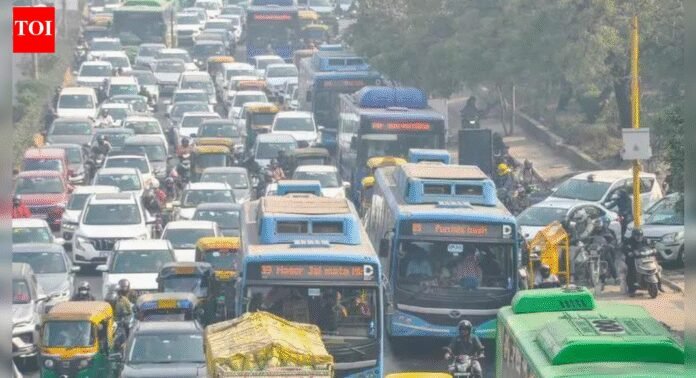
NEW DELHI: The record-breaking vehicle sales in the city in 2025 come with a warning — the growth is overwhelmingly driven by private vehicles, not public or shared transport.Of the 8,16,051 new registrations, around 7.2 lakh were private vehicles, highlighting that most buyers added personal vehicles rather than choosing public transport. About 75% of these vehicles run on petrol, including 3.89 lakh petrol-only and 1.99 lakh petrol/ethanol vehicles.
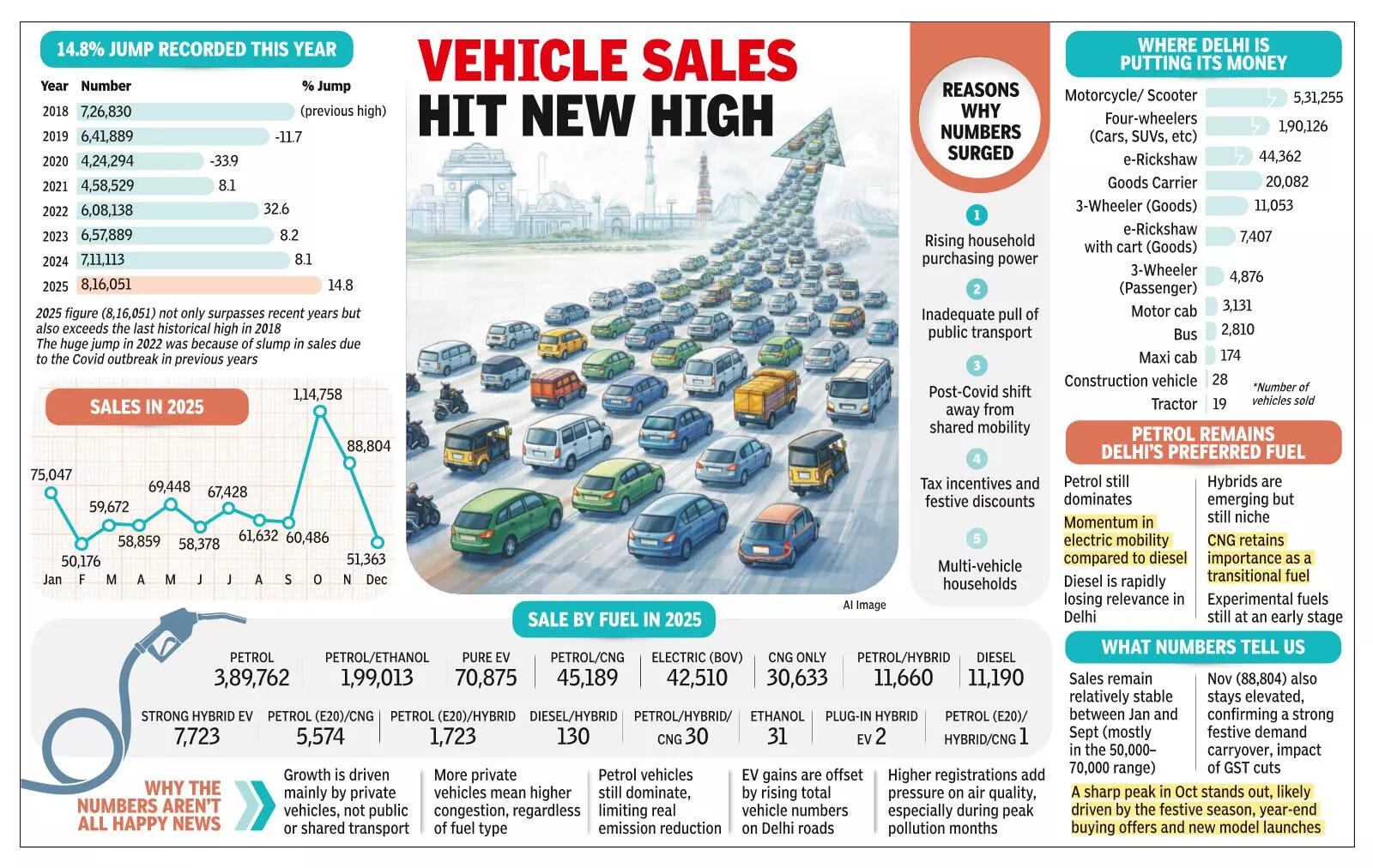
Amit Bhatt, India managing director at International Council for Clean Transportation, said, “While we were able to minimise diesel, petrol is still there and the EV push needs to be strengthened. This heavy reliance on personal petrol vehicles also suggests that while overall sales are rising, Delhi’s congestion and pollution challenges are likely to worsen rather than improve.”“More vehicles on the road, regardless of fuel type, inevitably increase congestion. However, internal combustion engine vehicles also place additional pressure on air quality. The sheer rise in overall vehicle registrations indicates that public transport systems are still not attractive or reliable enough for people to leave their private vehicles at home or avoid purchasing new ones,” he said.Anil Chhikara, faculty at Asian Institute of Transport Development, said, “With the govt mandating ethanol blending, most new petrol vehicles sold today are ethanol-compatible by default, which means that a large number of people are still using petrol.”“So petrol and petrol–ethanol should be read as 1 category. Buyers are not making a separate decision; they are complying with norms,” he said. “There is a need to give a better push to EV policy.”Even though electric and CNG vehicles are increasing, their share remains small compared to petrol-powered private vehicles. A month-wise break-up shows relatively stable sales between Jan and Sept, mostly in the 50,000-70,000 range. The standout month was Oct when registrations spiked to 1.14 lakh vehicles, followed by a strong Nov at 88,804. Officials and experts attributed this surge to the festive season, year-end discounts, new model launches, GST cuts and easier financing. Oct–Nov alone contributed over a quarter of the annual sales.Motorcycles and scooters dominate Delhi’s vehicle landscape, accounting for over 5.31 lakh registrations, or nearly two-thirds of total sales. Four-wheelers, including cars and SUVs, followed at 1.9 lakh, reflecting rising aspirations and greater affordability among middle-class households. Electric rickshaws (44,362) and goods carriers also saw notable numbers, pointing to growth in last-mile mobility and urban logistics. In contrast, sales of buses (2,810) and maxi cabs (174) remained marginal. Electric mobility continues to gain ground but remains secondary to petrol. Diesel’s decline reflects regulatory pressure, age caps on diesel vehicles in the NCR and growing consumer reluctance amid pollution concerns. Hybrids, while emerging, remained niche.So why did 2025 break all records? Economists and transport planners cite rising household purchasing power, easier access to auto loans, and aggressive festive discounts as key drivers. First-time buyers and upgraders alike entered the market, especially in two-wheelers and compact cars. “Another factor is the post-Covid shift away from shared mobility. Health concerns and reliability issues pushed many commuters towards private vehicles, a trend that did not fully reverse,” said Bhatt.Chikara argued that equally significant was the inadequate pull of public transport. Despite metro expansion, last-mile connectivity remained limited, prompting commuters to invest in second or even third vehicles, he said. Delhi’s 2025 vehicle boom, therefore, reflects economic confidence but also underscores the need for stronger public transport, cleaner mobility policies and congestion management if the city is to avoid paying a high environmental price for a record-breaking year.

