


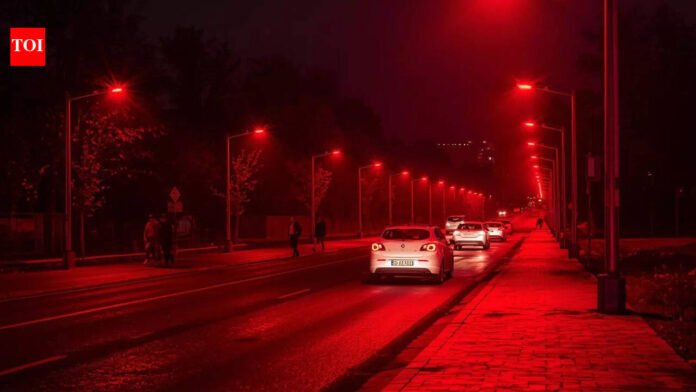
Denmark is testing a different kind of streetlight, one that changes colour rather than brightness. In a suburb near Copenhagen, familiar white lamps are being replaced with red lighting along selected roads. The shift is small in scale but deliberate in intent. Officials say it is designed to reduce harm to wildlife while keeping streets usable for people. Urban lighting has long focused on visibility and safety, often with little thought for ecological effects. This project reflects a slower reassessment of that approach. It draws on research, local conditions, and wider sustainability goals. While limited to one area for now, the experiment has attracted attention beyond Denmark, as cities elsewhere face similar questions about how to light streets without overwhelming the environments around them.
Denmark is testing red streetlights for the bats living in that area
The project is taking place in Gladsaxe, on the outskirts of Copenhagen. Red-toned lighting is replacing standard streetlights along parts of Frederiksborgvej near Skovbrynet. According to the press release from the Gladsaxe municipality, the area is known to host a local bat colony. Rather than turning lights off entirely, the municipality chose a colour that alters how light interacts with wildlife. The change is visible only at night and only along specific stretches of road.
Bats influenced the lighting decision
Bats played a key role in the preparation. Artificial lighting has been shown to interfere with bats’ ability to travel, feed, and navigate. Short-wavelength light, like that of blue, green, or white, usually has the biggest effect. Red light, which has longer wavelengths, may have less of an impact on bat behaviour, according to research from the Netherlands. Additionally, it is thought to be more appropriate for bats to hunt insects. Because to safety concerns, local officials stated that completely turning off the lights was not an option. The least disruptive option was red light.
Traffic safety remains part of the design
While parts of the road now use red lighting, safety for drivers and cyclists remains a priority. At junctions and crossing points, warm white lights are still used. These are mounted on higher masts to improve visibility where it is most needed. The lighting design varies along the route, adjusting to how people and animals use different sections of the road. The aim is to avoid a one size fits all approach.
Engineers balanced ecology and access
Road engineer Jonas Jørgensen from Gladsaxe Municipality said the goal was to limit disturbance without reducing accessibility. He noted that complete darkness would be ideal for bats but not realistic for a public road. The solution, he said, reflects a balance between environmental care and everyday use. The project required careful planning rather than a simple switch.
Designers saw the project as a test case
The lighting system was developed with professional lighting designers. They describe the project as an opportunity to challenge long-held assumptions about urban lighting. Philip Jelvard from Light Bureau said there would be an adjustment period for both people and bats. He added that the red light also carries symbolic weight, signalling that the area is environmentally sensitive.
Sustainability goals shape local policy
Gladsaxe was Denmark’s first municipality to formally align its strategy with the United Nations Sustainable Development Goals. Biodiversity protection is part of that framework. Mayor Trine Graese said the project shows how infrastructure can support both human needs and animal welfare. She described it as a practical example rather than a statement gesture.
A small change with wider interest
For now, the red streetlights remain limited to a specific route. There are no immediate plans to expand them across the city. Still, urban planners elsewhere are watching. As cities rethink energy use, biodiversity loss, and night time design, Gladsaxe offers a quiet example. It does not promise a solution for every street. It simply tests whether light can be used with more restraint, and whether cities can learn to notice what has long been lit over.

