


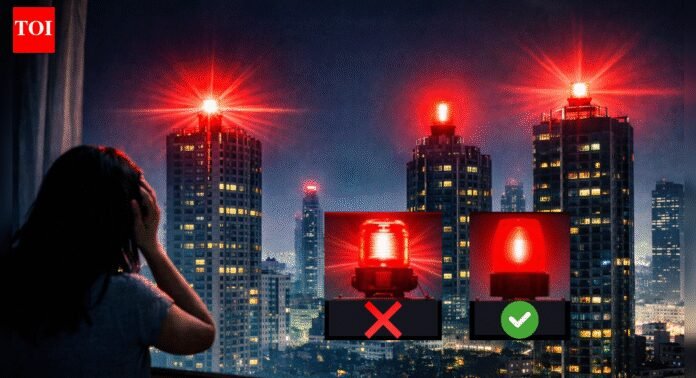
MUMBAI: The proliferation of high-rise buildings across Mumbai has brought an unintended consequence for some residents—persistent flashing lights from aviation obstruction systems on adjacent towers that penetrate through curtains and disrupt sleep patterns.Aviation Obstruction Lights (AOL) are legally mandated under International Civil Aviation Organization (ICAO) Annex 14 regulations, which India follows. Any building exceeding 45 meters in height must install these lights to ensure aircraft safety, particularly given Mumbai’s proximity to multiple helipads and the city’s dense airspace.
The regulatory frameworkUnder current regulations, buildings between 45-150 meters tall require Medium Intensity Obstruction Lights. These lights must be installed not only at the top of the building but also along external edges at uniform intervals for structures whose width or length exceeds 45 meters. This ensures the building’s outline is visible to aircraft from all angles.However, what many building managements and developers may not realize is that ICAO regulations provide multiple lighting options, each designed for different contexts.Three compliant optionsFor medium-intensity systems, the regulations specify:
- Type A: White flashing lights (primarily for daytime visibility)
- Type B: Red flashing lights
- Type C: Red
steady-burning lights (specifically designed for nighttime use)
The most common installation in Indian cities is the “Dual Type A/C” system, which flashes white during daylight hours and switches to red at night. However, the regulations explicitly state that the nighttime component can be either flashing or steady-burning.The choice between flashing and steady lights at night is not about compliance—both are legal. The flashing option is being chosen by default, but steady-burning lights achieve the same safety objective while being far less disruptive to residential neighbours.Urban context mattersICAO guidelines acknowledge that flashing lights, while highly visible, can cause visual disruptions in densely populated residential areas. The regulations specifically allow for steady-burning alternatives in such contexts.In cities like Mumbai, where high-rises are often built in close proximity to existing residential towers, the impact of lighting choices extends beyond the building itself. Residents in buildings adjacent to newly constructed towers have reported that flashing aviation lights are visible through blackout curtains and create a strobing effect that disrupts sleep.A question of awarenessIndustry sources suggest that the prevalence of flashing lights may be more a matter of default practice than deliberate choice. Building management teams, particularly for older high-rises that have had aviation lighting systems installed for years, may not be aware that retrofitting to steady-burning lights is both possible and compliant with regulations.The path forwardAviation safety experts emphasize that steady-burning red lights provide adequate visibility for aircraft at night while minimizing impact on surrounding residential communities. The lights maintain the required 2,000 candela intensity—sufficient for aircraft detection—without the pulsing effect that causes disturbance.As Mumbai continues its vertical expansion, urban planners and building developers may need to give greater consideration to how aviation safety requirements can be implemented in ways that balance regulatory compliance with liveability for the city’s dense residential fabric.For existing buildings, switching from flashing to steady-burning nighttime lights requires coordination with the original lighting contractor and, in some cases, reprogramming of the lighting control system. The modification does not require fresh approvals from aviation authorities, as both configurations meet ICAO standards.Building management associations and resident welfare groups in affected areas are beginning to raise awareness about these alternatives, hoping that a more informed approach to aviation lighting can reduce unnecessary disturbances while maintaining the safety standards that protect Mumbai’s airspace.[For buildings seeking guidance on aviation obstruction lighting configurations, the Airports Authority of India and ICAO Annex 14 documentation provide detailed technical specifications.]

