


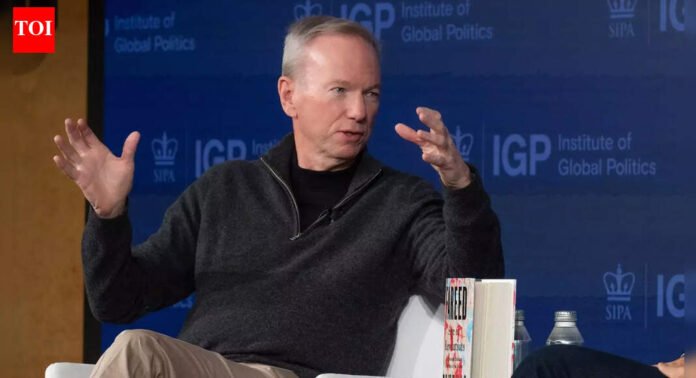
Former Google CEO Eric Schmidt declared his own programming expertise obsolete after watching an AI system autonomously generate an entire software program, calling it a “profound” moment that signals the end of traditional coding careers. “Holy crap. The end of me,” Schmidt said during a forum at Harvard University’s John F. Kennedy Jr. Forum earlier this month. “I’ve been doing programming for 55 years. To see something start and end in front of your own life is really profound.”The tech veteran underlined the rapid development of AI from being a useful assistant to a possible replacement for qualified programmers. Schmidt revealed that at leading AI research facilities, like OpenAI and Anthropic, the AI system is already performing about 10 to 20 percent of the work in programming, adding that the said percentage will further increase at a very rapid rate.
AI’s real impact extends beyond replacing programmers, says ex-Google CEO
Even with that striking demonstration, Schmidt said that AI is underhyped rather than overhyped. In discussion with Professor Graham Allison, he emphasized that this is where AI’s real economic potential-exists: in automatically performing corporate operations, not just in coding.The real transformation is happening inside companies, where AI systems are taking over billing, accounting, product design, delivery, and inventory management, Schmidt explained. These routine processes consume billions in corporate spending, and automating them could fundamentally reshape business operations.“If anything, it’s under-hyped because you are fundamentally automating businesses,” he said. “There’s an awful lot there—it’s extraordinary.”
Eric Schmidt says artificial general intelligence may arrive by 2029
Schmidt predicted artificial general intelligence (AGI)—systems matching the smartest mathematicians, physicists, and artists—will arrive within three to five years. This timeline is driven by what he calls “recursive self-improvement,” where AI learns independently without human instruction.“The computers are now doing self-improvement. They’re learning how to plan, and they don’t have to listen to us anymore,” he warned at another recent event.However, Schmidt emphasized the need for human oversight as AI approaches these capabilities. “Somebody’s going to have to raise their hand and say, ‘We just went too far,'” he cautioned. “I think there’s no higher duty than to preserve human agency and human freedom.”The former Google executive suggested Wall Street is underestimating the magnitude of AI’s impact on business automation and scientific discovery, pointing to medicine, climate solutions, and engineering as sectors where automation could accelerate breakthroughs.

