


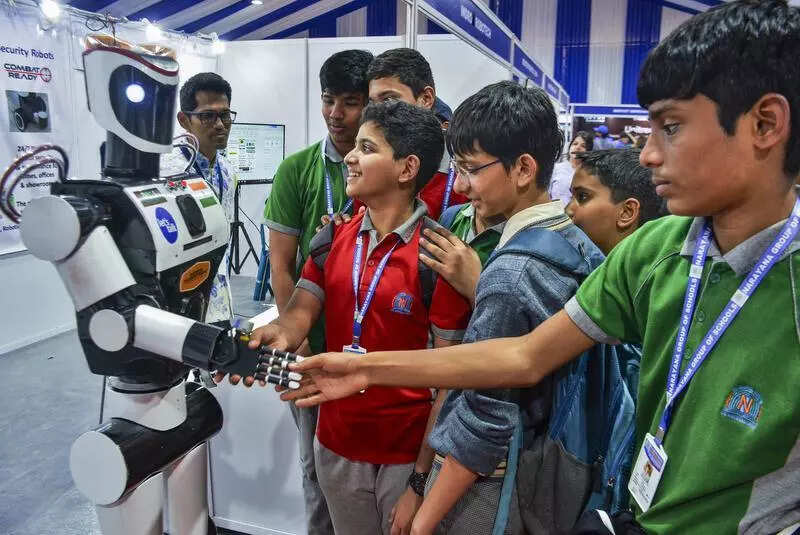
“Actually, we are at the cusp of an era where warfare is going to expand into newer and unknown domains,” he said. “Dynamism in warfare was also evident in the Israel-Iran conflict where actions in new domains particularly cyber, cyber-enabled ISR, information surveillance and reconnaissance, information operations and long-range precision effect shaped the strategic outcomes. Again, these new domains are the ones where actually you can create asymmetries between nations and those asymmetries actually help you win a war.“With that, he emphasised the need for Indian armed forces to maintain technological asymmetry if the nation wanted to be combat ready. “So multi-domain operations will no longer be an option but a necessity.” That will “require multi-domain capabilities and cross-domain control, command and control”.Interestingly, the DRDO’s Defence institute of Psychological Research which participated in the exhibition said they are introducing a new cadre of remotely piloted aircraft pilots in the army and navy that can man large drones to be used in surgical strikes and weapon delivery.Chauhan noted five trends altering warfare: high speed due to stealth technologies, sensor technologies that are making data available, robotics that will lead to man-to-machine combat, lighter and stronger weaponry with less dependence on global chains, and an intelligent battlefield armed with AI for faster decisions.The message found an institutional echo on campus. IIT Bombay recently announced a dedicated research Centre for Defence Technologies Innovation and Strategies, and the institute senate opened up a pathway for doctoral programmes, said IITB director Shireesh Kedare.The Powai institute has also decided to offer PhDs in other research centres like Centre for Traditional Indian Knowledge and Skills, Medical Technologies Research and Innovation Centre and Motilal Oswal Centre for Capital Markets. The Centre for Traditional Indian Knowledge and Skills is aimed at studying India’s knowledge systems with a focus on skill traditions that have endured for centuries. The idea, Kedare said, is to bridge a long-standing gap between ancient wisdom and modern engineering practice. “In most cases Indian knowledge is available in Sanskrit. Those who are experts in reading the old manuscripts do not have engineering reference to provide perspective for the information available in the ancient scripts,” he said. Earlier in the day, Infosys founder N R Narayana Murthy spoke on the adversities he faced when he started out —from staying in seedy hotels to eating one-dollar burgers, he said, no one can rise without sacrifice and hard work. Techfest’s lecture series opened with union minister Nitin Gadkari who said knowledge will be powerful as India becomes a US$ 5 trillion economy.
