


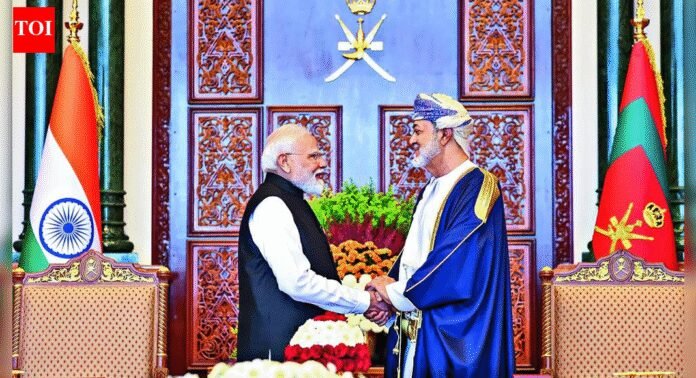
The India–Oman Comprehensive Economic Partnership Agreement (CEPA) will add to India’s growing network of preferential trade arrangements in the Gulf, but its significance lies more in consolidating market access and investment presence than in sharply expanding trade volumes, Ajay Srivastava, founder of the Global Trade Research Initiative (GTRI) said.India and Oman signed the agreement on December 18, marking India’s sixth free trade pact in the past five years, following deals with Mauritius, the UAE, Australia, the EFTA bloc and the UK. The pact is expected to come into force in the coming months.
Under the CEPA, Oman has granted zero-duty access on about 98% of its tariff lines, covering nearly 99% of India’s exports by value. India’s exports to Oman were about $4.1 billion in FY25, led by refined petroleum products such as naphtha and petrol, along with machinery, metals, aircraft, rice and consumer goods.“While more than 80% of Indian goods already enter Oman at an average tariff of around 5%, duties on some items go up to 100%. Their removal improves competitiveness, but the scope for large trade expansion remains limited by Oman’s market size,” Srivastava said.India, in return, has offered tariff liberalisation on about 78% of its tariff lines, largely through tariff-rate quotas, to protect sensitive sectors. India’s imports from Oman stood at roughly $6.6 billion in FY25, dominated by crude oil, LNG and fertilisers, along with key chemical inputs.The agreement also includes commitments in services, with Oman opening sectors such as IT, professional services, education, healthcare and research. Provisions to ease temporary entry for Indian professionals and streamline pharmaceutical approvals could reduce regulatory costs for Indian firms operating in Oman, Srivastava noted.According to GTRI, the broader importance of the CEPA lies in India’s investment and strategic footprint in Oman. Indian companies have more than 6,000 joint ventures in the country, with cumulative investments exceeding $7.5 billion, largely in the Sohar and Salalah free zones.“The agreement is less a trade breakthrough and more a consolidation of India’s economic position in a critical Gulf corridor,” Srivastava said, adding that it supports India’s longer-term interests in energy security, logistics, services exports and regional connectivity.Given Oman’s location at the entrance to the Gulf and its role as a logistics and energy hub, the CEPA strengthens India’s engagement in the region even as trade volumes remain modest, he said.

