


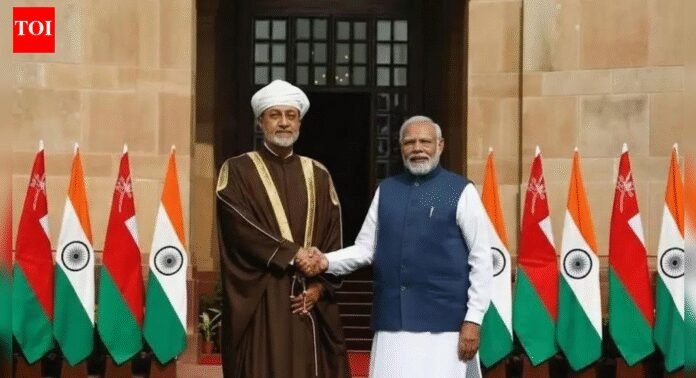
India and Oman signed a trade deal, expanding the country’s strategic and economic relations in the Persian Gulf, and helping exporters at a time when they are facing headwinds in several parts of the world.The Comprehensive Economic Partnership Agreement (CEPA), the second in West Asia after the one with UAE a few years ago, will allow 98% of Indian exports to enter Oman duty free, while India will remove tariffs on 77% of imports from the Gulf nation, excluding sensitive items such as farm and dairy products, gold and oil and gas. Omani dates, marbles and some petrochemical products will see zero duty access, but for limited quantities only. Indian exports to Oman stood at $4.1bn in FY25, while imports were at $6.6bn.While 85% of the products attract 5-6% duty in Oman, there are several food and other products that face up to 100% tariffs, which will be eliminated when the agreement is implemented in the first quarter of 2026. India is hoping to become the largest supplier of electronic goods to Oman, just like UAE.
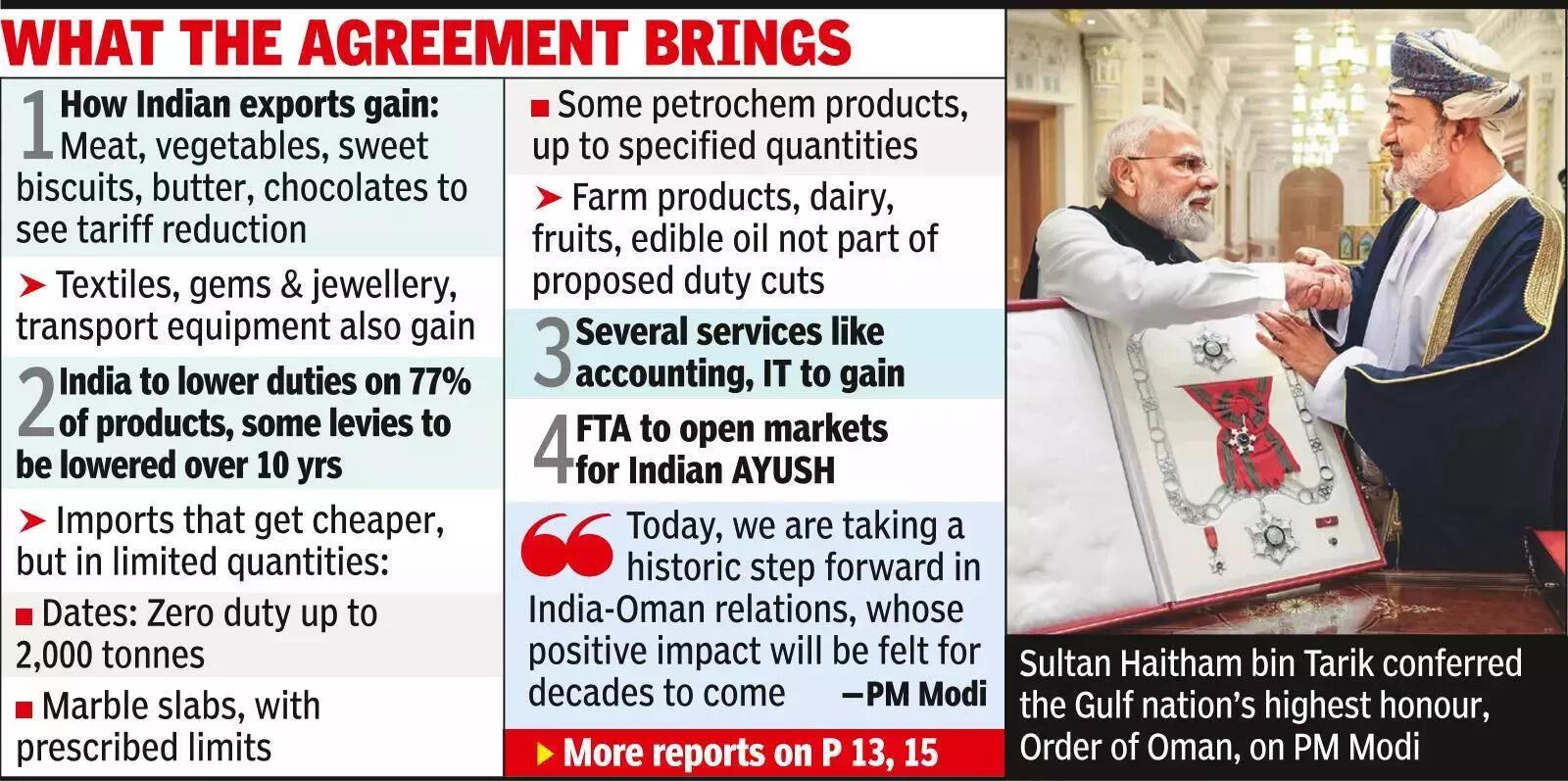
Services providers and professionals are expected to benefit due to changes in visa rules, while CEPA will open the AYUSH market for India, said officials. Further, Oman has agreed to fast-track approvals for Indian pharma products and will accept halal and organic food certification given by authorities here, helping provide easier access. A social security agreement is also on the anvil.CEPA was signed by commerce & industry minister Piyush Goyal and Qais bin Mohammed Al Yousef during PM Modi’s visit to Oman.
Positive impact of India-Oman pact to be felt for decades: PM Modi
Comprehensive Economic Partnership Agreement (CEPA) was signed by commerce & industry minister Piyush Goyal & Omani minister of commerce, industry and investment promotion Qais bin Mohammed Al Yousef during PM Modi’s visit to Oman. “Today, we are taking a historic step forward in India-Oman ties, whose positive impact will be felt for decades to come. CEPA will energise our ties in the 21st century,” PM said.“We see our exports growing by at least $2 billion (from the current $4 billion) in a short period, maybe in a year or two,” an official said.Officials said not only will domestic dairy product producers be able to compete more favourably with competitors from New Zealand and Denmark, but even Indian eggs, for which Oman is the largest market, will strengthen their grip. Similarly, Indian marine products, hit by US tariffs, automobiles, plastics and engineering goods, are likely to gain.While talks kicked off two years ago, they were on hold for a long time as Oman negotiated hard to get concessions on nearly 500-600 tariff lines, it could manage to get benefits for around 18-20 items.
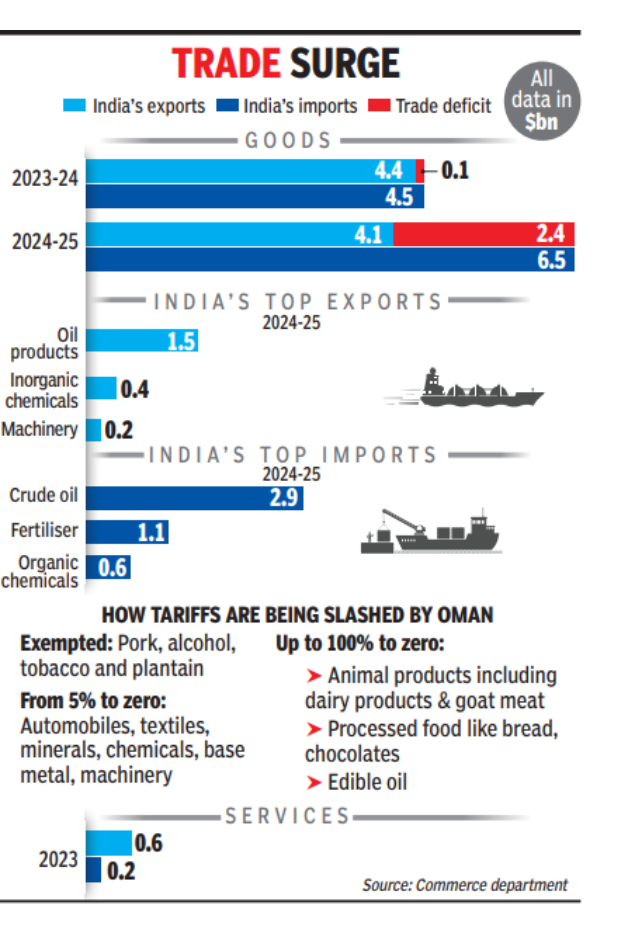
Among them are 10 petrochemical products, polypropylene and polyethylene, as govt sought to protect the interests of Indian companies, especially at a time when more projects are planned in the country. While it did agree to import 2,000 tonnes of dates, a small quantity compared with domestic production of 4-5 lakh tonnes, it managed to avoid lowering tariffs for chocolates.Govt also refused to offer the same concessions as UAE when it came to gold and oil and gas. India signed a trade pact with UAE a few years ago, which has helped it boost bilateral trade, and also use the Gulf nation as a hub for shipping goods to Africa. India is negotiating an agreement with Qatar even as it awaits clarity on talks with Saudi Arabia.Oman CEPA is part of a trade diversification strategy, especially after Trump’s punitive 50% tariffs hit Indian exports to US, prompting it to speed up negotiations with a host of partners — from New Zealand to EU and Chile. In recent months, India has implemented an FTA with the four-nation European Free Trade Association and also signed the long-negotiated treaty with the UK, which will be implemented in 2026.

