


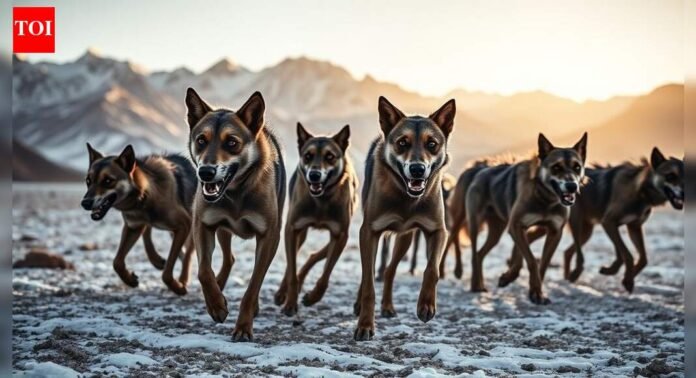
SRINAGAR: It’s bloody murder on the roof of the world.A new predator has quietly grown to dangerous numbers. Feral dogs roam the cold desert of Ladakh, preying, often in packs, on endangered wildlife and attacking people. Conservationists warn that they outnumber native predators in the region.What began as a byproduct of increased tourism, military deployment, and unmanaged waste in the cold desert moonscape of Ladakh has grown into a full-blown crisis. And it’s manmade.Scientists and wildlife officials warn that these free-ranging canines — estimated by the WCBCL at nearly 45,000, far in excess of what the region’s ecology can sustain — are preying on some of Ladakh’s rarest high-altitude species. They threaten snow leopards, wolves and foxes, and prey on rare species like Pallas’s cat, the Eurasian lynx, Tibetan gazelle, blue sheep, ibex, and Himalayan marmots, said Lobzang Visuddha, chairman of the Wildlife Conservation and Birds Club of Ladakh (WCBCL), a community-based voluntary initiative by young people.The killing of a Pallas’s cat, one of the rarest and least-studied species, by feral dogs in Anley last year has alarmed conservationists like Visuddha. “In fact, there are records of killing two Pallas’s cats and Eurasian lynxes by feral dogs,” he saidThe dogs also threaten ground-nesting birds, with packs frequently chasing black-necked cranes, the UT’s state bird, and attacking ruddy shelduck chicks when they move from rocky nesting sites to nearby water bodies, Visuddha said.Advocate Tashi Gyalson, who headed the local government in Leh as chairman of the Ladakh Autonomous Hill Development Council from Nov 2020 to Nov 2025, said the issue hasn’t been arisen all of a sudden. “We have to admit that this situation has actually been created by humans over a long period of time,” he said.Gyalson said these dogs have been part of the ecosystem and community but rapid urbanisation meant they lost their use as hunting dogs, shepherd dogs, watchdogs and companion animals. “This, multiplied by the abundant carrying capacity of the environment, caused their rapid multiplication, and eventually caused the current situation,” he said.Experts say the worst hit is eastern Ladakh, the region with the highest concentration of wildlife, where poor waste management are subsidising the dog population.“The main concern is the availability of excess kitchen waste in areas occupied by the Army and areas where there is tourism,” Gyalson said.The stretch from Kargyan Chibra to Tsokar, in eastern Ladakh, has become a hotspot for feral dog activity due to unsustainable waste “Feral dogs are by far the most serious threat as far as the wildlife of Ladakh is concerned. I have myself seen how stray dogs in Hanle and Tso Moriri actually raided the nests of the black-necked crane, and preyed upon the eggs and young ones,” said Intesar Suhail, who was wildlife warden of Ladakh in 2013-14.“I have even seen them chasing animals as big as the Tibetan wild ass. The active ground nests of waterbirds, particularly the black-necked crane and bar-headed goose, are more vulnerable as they are located in marshy areas, surrounded by shallow waters easily accessible to dogs,” he said.A strong sense of smell and pack behaviour give feral dogs a lethal advantage over wildlife that evolved without such human-introduced predators, Visuddha said.“Though these species face natural threats in the wild, feral dogs are not one of them, they are a problem introduced by humans,” said the WCBCL founder.Ladakh has also reported at least five fatal attacks on humans, mostly on women and children, by feral dogs, which was unheard of in the region until recently, he said.Phuntsog Wangail, president of the Chamba Animal Welfare Society, which runs Ladakh’s largest animal care facility, said Ladakh was facing growing fears of long-term ecological imbalance due to feral dogs.They survive largely on food waste from tourist camps, hotels, roadside dhabas and temporary settlements. When these facilities close or relocate, particularly during winter, the canines are left without reliable food sources and begin roaming over long distances.“This seasonal movement pushes dogs into wildlife habitats, increases territorial conflicts, and accelerates breeding, placing Ladakh’s fragile ecosystem under severe pressure,” Wangail said.Visuddha said the feral dog threat to wildlife of Ladakh was next only to human activity.The rapid infrastructure expansion, including road building, power lines and mobile towers, has already fragmented habitats, while the expansion of camps, resorts, guest houses and hotels has intensified pressure on wildlife, he said.In winter, when tourism grinds to a halt and food becomes scarce, the dogs roam extensively, leading to a rise in dog-bite cases, road accidents and formation of aggressive packs. “At the same time, winter offers the best window for sterilisation, as dogs tend to remain closer to human settlements.”Data from the Animal Husbandry Department in Leh shows that 32,887 dogs were sterilised between 2015 and 2024, yet officials and conservationists say the population remains dangerously high.Wangial said Ladakh should carry out mass sterilisation over the next two years, with a special focus on female dogs and puppies, while calling for strict enforcement of animal welfare laws, including heavy penalties for dog dislocation, abandonment and cruelty.He called for the replication of successful models from the Netherlands and Bhutan, where mass sterilisation, strict enforcement of animal welfare laws and strong community participation have led to significant reductions in stray populations.While Visuddha said govt appears unconcerned about the issue, Gyalson offered a contrasting view. He said that after Ladakh became a Union Territory in 2019, a mission-mode campaign was launched to control the dog population. “The impact of the programme is visible as there are far fewer street puppies, especially in Leh city,” he said.However, Gyalson said several challenges continue to hinder effective population control, including Ladakh’s vast and rugged terrain, extreme climate, dispersed dog population, difficulties in capturing animals, and the absence of an accurate census.

