


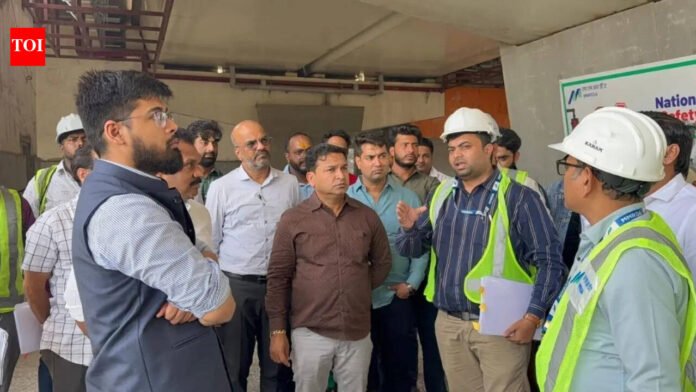
BHIWANDI: After years of delays, a fresh deadline has been set for the Mumbai Metropolitan Region’s much-awaited Metro Line 5 (Orange Line), often cited as one of the slowest progressing metro projects in the region. Officials now indicate that the first phase of the Thane–Bhiwandi stretch could become operational by December 2026.BJP MLA Mahesh Chaughule expressed confidence that the ongoing work is in its final stages and that all technical aspects of the project will be completed in time for the metro to be operational by the end of 2026.“MMRDA officials said that if everything goes as planned, the metro could be opened for passengers by December 2026,” he said after a joint inspection conducted on Thursday by officials from the Bhiwandi Municipal Corporation, MMRDA, and metro authorities.Earlier in the day, a key meeting on traffic planning and metro-related infrastructure was held at the municipal headquarters under the chairmanship of Mayor Narayan Chaudhary.Following the meeting, officials carried out an on-ground inspection of the stretch between Anjurphata and Dhamankar Naka, where work is currently underway.During the meeting, MMRDA officials presented a comprehensive infrastructure plan for the city, estimating a requirement of Rs 3,771 crore for development works across three phases. The plan is expected to accelerate long-pending projects, including road widening beneath the metro corridor and improvements along the Kalyan Road stretch.Welcoming the project, Mayor Chaudhary stressed that metro authorities must take full responsibility for maintaining cleanliness in areas surrounding the metro corridor. Civic Commissioner Anmol Sagar also discussed the possibility of generating revenue through advertisements on metro pillars.Currently, Bhiwandi lacks direct suburban railway connectivity to Mumbai, forcing commuters to rely on buses or travel via Thane and Kalyan. The metro project, approved by MMRDA in 2017 and inaugurated by Prime Minister Narendra Modi in 2018, has seen slow progress since work began in 2020. Notably, work on Phase 2 is yet to begin, adding to commuter concerns over continued delays.

