


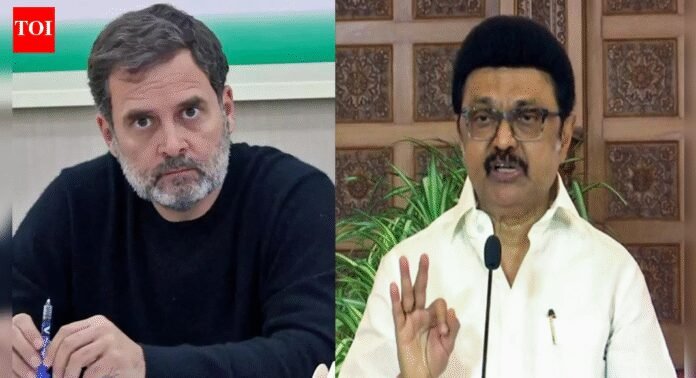
NEW DELHI: Senior DMK leader and rural development minister I Periyasamy on Sunday ruled out any scope for a coalition government in Tamil Nadu, asserting that chief minister M K Stalin is firm against sharing power with allies, including the Congress.Responding to questions on the Tamil Nadu Congress’s renewed demand for a share in power, Periyasamy said while it was the party’s right to make such a demand, the DMK had never favoured a coalition arrangement.“There had never been a coalition government,” he said, adding that the state had always been governed by the DMK on its own. “There is no doubt about this stand of the party, there will be no coalition government and the chief minister is firm on this stand,” he told reporters.The Congress has recently revived its pitch for power-sharing ahead of the assembly elections due by March–April. Congress MP Manickam Tagore said it was time to debate “share in power,” while CLP leader and Kanyakumari legislator S Rajeshkumar also spoke in favour of a coalition government. Congress’s in-charge for Tamil Nadu Girish Chodankar had asked if any political party “will say that they don’t want the power; then we should name ourselves as NGO.”Periyasamy’s remarks assert DMK’s long-held position on governance in the state. Since 1967, both the DMK and the AIADMK have formed governments on their own despite contesting elections as part of alliances. The only exception dates back to the first assembly (1952–57) in the then Madras state, when the Congress, lacking an absolute majority, accommodated non-Congress leaders in its Cabinet.In 2006, the DMK ran a full five-year government despite falling short of a majority, relying on outside support from allies, including the Congress, but without sharing ministerial power. Congress leaders had made similar demands during that term as well, without success.

