


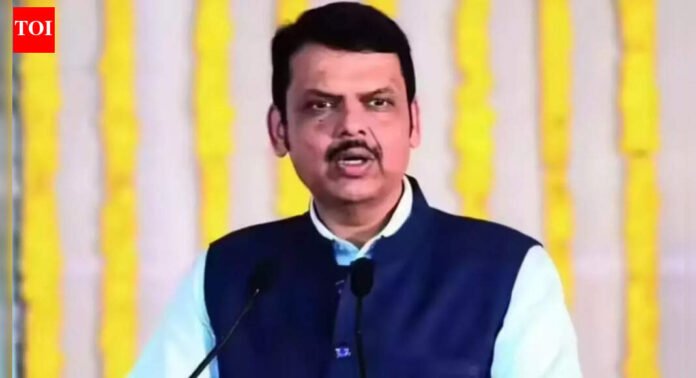
MUMBAI: The Mahayuti alliance on Sunday unveiled a comprehensive manifesto for the upcoming Mumbai civic body elections, pledging technology-driven governance to transform the city into a “global powerhouse.” The document promises a 50% fare concession for women in BEST buses and aims to “free” the city from Bangladeshi migrants.Chief minister Devendra Fadnavis, who presented the manifesto, said the BJP-Shiv Sena-RPI (A) alliance would integrate “Japanese technology” with local administration to address chronic civic issues and deliver services directly to citizens’ mobile phones.The manifesto has emphasised the use of artificial intelligence (AI) to curb corruption, speed up clearances and improve service delivery.“The city has seen 25 years of inefficiency in civic governance, and now I want to tell people to give us the opportunity to bring transparency in civic administration,” he said.“Our goal is a corruption-free municipal corporation,” Fadnavis said, outlining a “Municipality on your Mobile” initiative and an AI-driven platform to fast-track building approvals and ensure transparency in the real estate sector.He also promised to set up AI labs in all municipal schools to equip students with future-ready skills.Transport and women’s safety featured prominently in the manifesto. Fadnavis said the alliance plans to double the BEST fleet from around 5,000 to 10,000 buses, transition to electric vehicles, and provide a 50% fare concession for women commuters.Additionally, new “midi” and “mini” bus services will enhance last-mile connectivity near Metro and railway stations.“We will free Mumbai of Bangladeshis and Rohingyas. With the help of IIT, we will develop an AI tool to identify Bangladeshi migrants,” Fadnavis said.He stated that Rs 17,000 crore had been pledged for a climate action plan, under which a circular economy will be prepared.Speaking about the Dharavi Redevelopment Project, Fadnavis said an ecosystem will be created to ensure the upgradation of micro businesses in the area, and even ineligible residents will be included.The manifesto has also mentioned a “flood-free Mumbai” plan, promising the city would be free from inundation within five years by adopting Japanese techniques and collaborating with institutions such as IIT and VJTI for measures.Fadnavis said a research team from the Indian Institute of Technology (IIT) will study the city’s topography, with plans to construct four new underground floodwater tanks, revamp existing drainage lines, and expedite work on the BRIMSTOWAD 2 project.He added that civic hospitals will be upgraded to AIIMS standards, and a digital health card system will be launched to store the medical history of every Mumbaikar, aiming to speed up treatment.On housing and redevelopment, the alliance announced the “Pagadimukt Mumbai” initiative to resolve tenancy issues and pledged to issue Occupancy Certificates for 20,000 stalled buildings, benefiting lakhs of residents.The manifesto also proposed incentives for high-rises that adopt sustainable “Living Forest” practices.Speaking on the occasion, deputy chief minister Eknath Shinde stressed the preservation of Marathi culture alongside modernisation.He said that a cultural department would be set up in the Brihanmumbai Municipal Corporation (BMC) to promote local art and heritage, and announced plans for Marathi libraries, cultural centres and a “Mumbai Fellowship” programme for Marathi youth.Shinde said that the school syllabus would include the history of Mumbai and the Samyukta Maharashtra movement, and reiterated plans for the Hindu Hridaysamrat Balasaheb Thackeray Medical University.He also outlined a redevelopment plan for ‘koliwadas’ and ‘gaothans’ aimed at protecting the identity and livelihoods of the Koli community and other original inhabitants of the city. (With agency inputs)

