Breaking News
India–China reset in 2025: From Galwan’s shadow to tactical calm; how long can this balance hold? | India News


India–China reset in 2025: From Galwan’s shadow to tactical calm; how long can this balance hold?

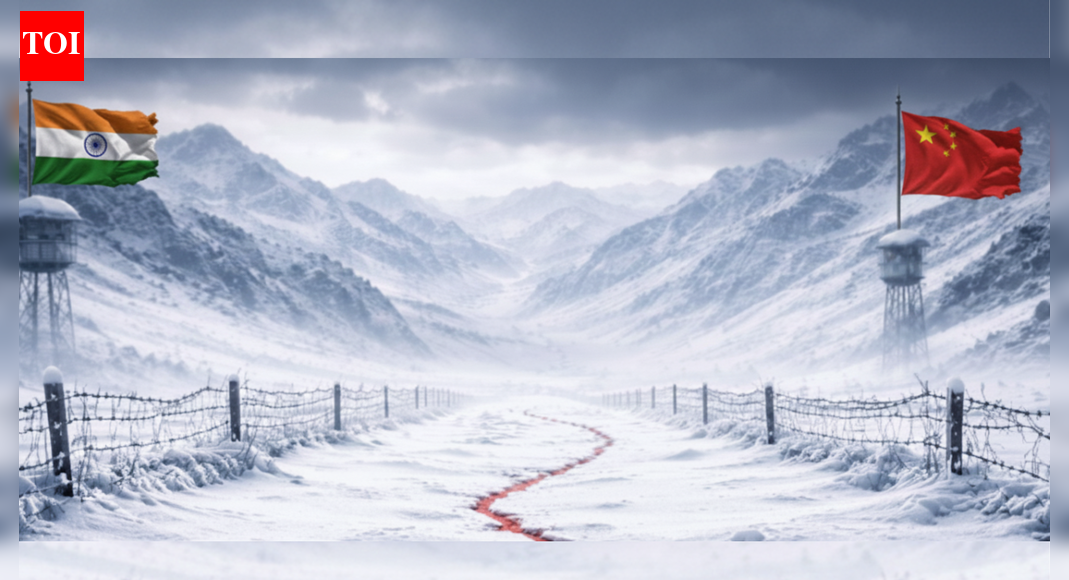
NEW DELHI: As India reopens channels with China, five years after the violent Galwan Valley clash, the moment carries an irony difficult to ignore. The last time an Indian prime minister trusted China, what followed has been echoing in our ears, at least for the past decade.In 2025, India–China relations have taken an unexpected turn. After years of diplomatic frost, military standoffs, and hardened rhetoric, both sides have stepped back from the edge, at least on the surface. High-level engagements resumed, including Chinese foreign minister Wang Yi’s visit to Delhi and Prime Minister Narendra Modi’s meeting with President Xi Jinping on the sidelines of the Shanghai Cooperation Organisation (SCO) summit. Talks on disengagement at sensitive friction points such as Depsang and Demchok were revived, commercial flights were restored, and limited trade channels reopened, catching many observers off guard.For a relationship long defined by suspicion, this thaw has raised as many questions as it has hopes.India–China ties are rooted in a long and uneasy history: the trauma of the 1962 war, recurring border confrontations, the Doklam standoff, and the prolonged deadlock following the Galwan clash of 2020. Against this backdrop, the question arises: how stable is this new calm, and what does it truly rest on?Just as important is what lies behind this shift. Strategic compulsions, economic pressures, and changing global alignments appear to have nudged both capitals towards a phase of managed stability, reset driven less by reconciliation than by necessity.For India, the sudden outreach to China marked a rare recalibration of posture. After years of projecting firmness and strategic distance, New Delhi’s decision to test a reset challenged long-held assumptions about Beijing. It signalled not abandonment of caution, but a willingness to probe whether limited cooperation could coexist with enduring rivalry, without compromising strategic autonomy or long-term security interests.

What all reopened

The 2025 reset unlocked channels that had remained frozen by mistrust since 2020. Direct passenger flights between major cities, including Delhi and Beijing, resumed after a five-year pause, restoring people-to-people contact and easing business travel that had effectively stalled since the Galwan clash.On the ground, border trade routes also saw movement. Nathu La in Sikkim reopened, allowing the exchange of local goods. These measures helped lift bilateral trade, supported by a gradual easing of restrictions on select shipments and licensing procedures.Diplomatically, both sides revived long-dormant mechanisms, from special envoys to working groups on boundary issues, creating channels to manage friction without escalating tensions. While none of these steps amounted to a breakthrough on the core border dispute, they helped restore a minimum level of predictability to a relationship that had become dangerously brittle.

Screenshot 2025-12-29 210435

.

Exports jump, but the imbalance deepens

India’s exports to China jumped sharply in November 2025, rising 90% year-on-year to $2.2 billion, according to the Global Trade Research Initiative (GTRI). From April to November, exports climbed 33% to $12.2 billion. At first glance, the figures suggested a revival in commercial ties after years of disruption.But the headline numbers conceal deeper vulnerabilities.GTRI notes that India’s export growth to China remains narrow and volatile, driven largely by a handful of products rather than a broad-based expansion of India’s traditional export basket. Naphtha and select electronics dominated the surge, while sectors such as iron ore and agriculture showed inconsistent or muted performance.At the same time, India’s imports from China remain heavily concentrated and structurally entrenched. Between January and October 2025, electronics alone accounted for $38 billion in imports, followed by machinery at $25.9 billion, organic chemicals at $11.5 billion, and plastics at $6.3 billion. These categories include mobile phone components, integrated circuits, laptops, solar modules, lithium-ion batteries, and pharmaceutical intermediates.The result is a widening trade imbalance. India’s exports to China fell from $23 billion in 2021 to $15.2 billion in 2022, remained subdued through 2023, and are projected to rise modestly to $17.5 billion in 2025. Imports, however, surged from $87.7 billion in 2021 to an estimated $123.5 billion in 2025, pushing the trade deficit towards $106 billion.Chinese customs data paints an even starker picture, suggesting a deficit of over $115 billion.India’s recent export gains to China are narrow, volatile, and heavily dependent on shifts in Chinese demand, GTRI warns. Without a sustained strategy to expand competitive manufacturing and reduce import dependence, short-term spikes will not alter the fundamentally imbalanced nature of the relationship.

Screenshot 2025-12-29 213830

.

A reset born of compulsion

Many analysts argue that the 2025 thaw was driven less by renewed trust and more by shared constraints. As Ashley Tellis put it in one of his articles, “The India–China detente is more tactical than transformative, driven by US tariff pressures and trade deficits, not genuine border resolution.”For Beijing, mounting pressure from renewed US tariffs under President Donald Trump, a slowing domestic economy, and widening Western efforts to reduce dependence on Chinese supply chains made engagement with India increasingly attractive. Stabilising ties with a major regional power offered China economic breathing space and diplomatic signalling at a time of global pushback.For New Delhi, the calculus was equally pragmatic. Prolonged military deployments along the Line of Actual Control strained resources and readiness, while global supply chain disruptions underscored the costs of sustained confrontation with the world’s manufacturing hub. De-escalation offered room to regroup without conceding core positions.What emerged was a carefully calibrated detente, transactional, limited, and hedged, designed to manage risk rather than resolve rivalry.

ChatGPT Image Dec 29, 2025, 08_40_14 PM

.

Is this sustainable?

The durability of the 2025 reset remains uncertain. There is still no agreed demarcation of the Line of Actual Control, and troop levels have not returned to pre-2020 positions. Even minor patrol incidents could quickly spiral into larger crises.Deeper political sensitivities remain unresolved. The presence of the Dalai Lama in India and Beijing’s concerns over succession continue to loom in the background. China’s strategic partnership with Pakistan, particularly in the aftermath of terror incidents such as the Pahalgam attack, remains a major source of friction.Former Indian ambassador to China Gautam Bambawale told DW, “Beijing knows this. So does New Delhi. For example, India is never going to permit Chinese firms like Huawei and ZTE into India’s telecom space again.”Without clearer ground rules and deeper strategic dialogue, many fear the thaw could remain temporary, vulnerable to the next shock.

Impact on Indian foreign policy

Opinions differ on whether India’s outreach to China reflects tensions with the United States or a broader recalibration. Beijing also recently rejected claims in a Pentagon report that China is easing border tensions to weaken US–India ties, calling such assertions misleading.For India, engagement with China fits a long-standing strategy of hedging, keeping options open, protecting strategic autonomy, and avoiding over-reliance on any one power. Strategic analyst Happymon Jacob, in an article, argued that the renewed bonhomie demonstrates that alternatives to exclusive alignment with Washington do exist.The reset has also improved India’s footing in multilateral forums such as the SCO and BRICS. With tensions temporarily eased, New Delhi will be able to engage more confidently, leveraging improved optics with Xi Jinping to press Global South concerns, development financing, and calls for a more balanced global order.At the same time, India can quietly continue to strengthen its neighbourhood strategy, deepening ties with Bhutan, expanding connectivity initiatives, and countering Chinese influence in Nepal and Sri Lanka.

What next

India now finds itself at a familiar but delicate crossroads. Over the past decade, it has sought to position itself as a central player in a multipolar world, balancing ties with the US and Russia while managing competition with China. This balancing act has become harder as global fault lines sharpen, forcing New Delhi to constantly reassess risks without locking itself into rigid alliances.Strategic analyst Brahma Chellaney, in an article, cautioned against overconfidence, warning that past experience shows how quickly tactical accommodation with China can unravel. History suggests that periods of calm in India–China relations often rest on fragile assumptions, vulnerable to sudden shifts triggered by border incidents, regional crises, or domestic political pressures on either side.Going forward, New Delhi will have to walk a tightrope. Military vigilance along the LAC cannot be relaxed even as diplomatic engagement continues. Economically, India must accelerate efforts to reduce critical import dependence, especially in electronics, pharmaceuticals, and clean energy components, while ensuring trade engagement does not translate into strategic vulnerability.The challenge ahead will be to preserve this fragile equilibrium: securing short-term stability without sacrificing long-term security, avoiding economic over-dependence, and ensuring that tactical resets do not harden into strategic illusions. For now, the 2025 thaw offers space, but not certainty.

Source link

Deadly water crisis in Indore: Family loses 6-month-old son born after 10 years; parents seek answers | Indore News


Deadly water crisis in Indore: Family loses 6-month-old son born after 10 years; parents seek answers
A six-month-old boy, born after a decade-long wait, has died in Indore after allegedly falling ill due to contaminated drinking water.

INDORE: A six-month-old boy, born after a decade-long wait, has died after allegedly falling ill due to contaminated drinking water, leaving his family devastated in Indore.According to the family, the infant developed diarrhoea on December 26 and was taken to a local doctor, who prescribed medicines. He was brought back home and remained stable for two days. However, on the night of December 29, the child suddenly developed a high fever, began vomiting and died at home.

Cleanliness Crown Cracks As Indore Loses 13 Lives To Poisoned Water And Administrative Lapses

The child’s father, Sunil Sahu, said, “He had diarrhoea and fever. We took him to the doctor on December 26. The doctor gave medicine and we brought him home. The child was fine for two days but again, suddenly, at night, he developed a very high fever. He vomited, and he died at home on December 29. This child was born after 10 years. I have a daughter, and this son was born 10 years later. He was 6 months old.”On Wednesday, chief minister Mohan Yadav visited several hospitals in the district where people are being treated after reportedly consuming contaminated water. He reviewed medical facilities, spoke to patients and instructed officials to ensure timely and proper treatment for all those affected.After the visit, CM Yadav said, “I visited four-five hospitals and met all the patients undergoing treatment. Everyone’s condition is stable, and proper treatment is being provided in the hospitals. Primarily, action has already been taken against the concerned official for negligence. ACS (Additional Chief Secretary) Sanjay Dubey is here, along with minister and mayor to reassess the situation. We have stated that the government will not tolerate any negligence under any circumstances, especially in all areas where there are complaints related to water supply. A thorough investigation will be conducted to prevent such incidents in the future,” he added.The chief minister announced a compensation of Rs 2 lakh for the families of the deceased and free treatment for all affected persons. He had earlier ordered strict action against officials responsible for the lapse.Following the directions, two officials have been suspended and one dismissed from service. Indore Collector Shivam Verma said Zonal Officer Shaligram Sitole and Assistant Engineer Yogesh Joshi were suspended with immediate effect, while in-charge Sub-Engineer (PHE) Shubham Shrivastava was dismissed.A three-member committee has also been formed to probe the incident. The inquiry will be led by IAS Navjeevan Panwar, with Superintendent Engineer Pradeep Nigam and Medical College Associate Professor Dr Shailesh Rai as members.


Source link

Access Denied


Access Denied

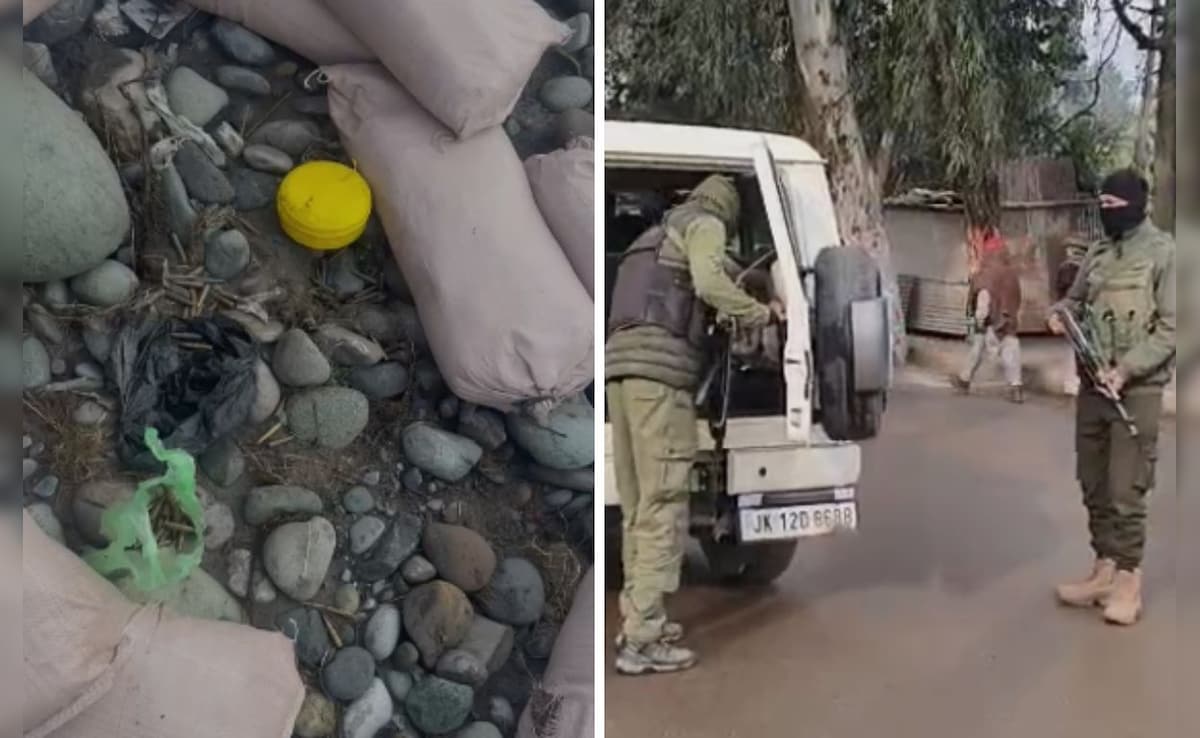
You don’t have permission to access “http://www.ndtv.com/india-news/explosives-ammunition-dropped-by-pak-drone-recovered-near-line-of-control-10166757” on this server.

Reference #18.2ef63717.1767256945.113652d6

https://errors.edgesuite.net/18.2ef63717.1767256945.113652d6


Source link

Vande Bharat sleeper to be launched in January! Ashwini Vaishnaw announces route & fares; check details & features of new train


Vande Bharat sleeper to be launched in January! Ashwini Vaishnaw announces route & fares; check details & features of new train

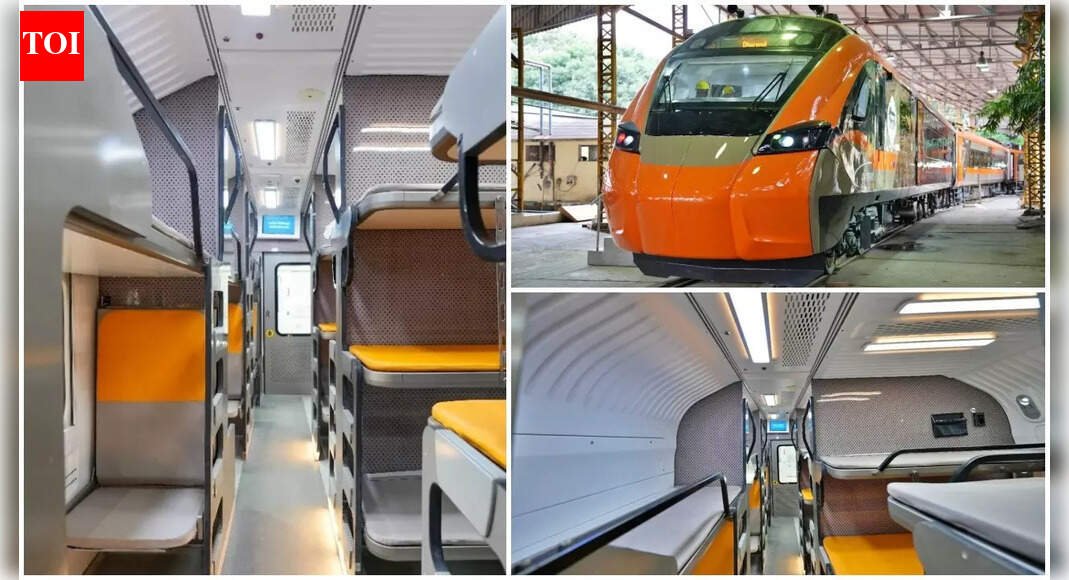
Vande Bharat sleeper train to be launched soon! In a big New year cheer for Indian Railways passengers, Railway Minister Ashwini Vaishaw has shared that the first Vande Bharat sleeper train will be launched this month. Prime Minister Narendra Modi is expected to flag off the Vande Bharat sleeper train in the second half of January 2026.Vande Bharat sleeper is a fully air-conditioned train set that has been manufactured by Indian Railways for long-distance routes and overnight journeys. According to Ashwini Vaishnaw, two Vande Bharat sleeper train sets are ready and have undergone successful trial runs. The new trains will be operated on 1,200-1,500 kmph routes of the national transporter.

Vande Bharat Sleeper Train Route Announced

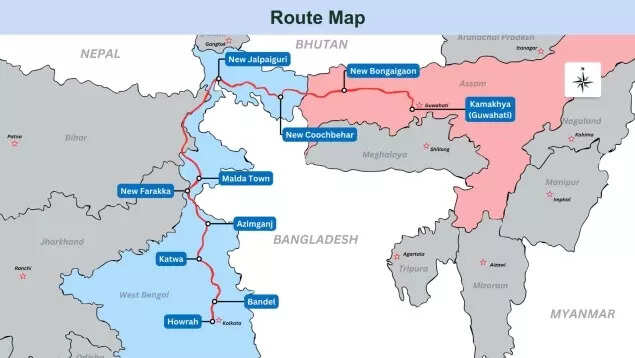
The first Vande Bharat sleeper train will run between Guwahati and Kolkata, Ashwini Vaishnaw announced on Thursday. Each Vande Bharat sleeper train has 16 coaches. The composition of the coaches is: 11 AC 3-tier, 4 AC 2-tier, and one AC 1st coach. The train can accommodate 823 passengers. Vaishnaw said that eight more Vande Bharat sleeper trains will be rolled out in the next six months, and the total will go up to 12 by year-end.

Vande Bharat sleeper route

Vande Bharat sleeper route

The new train is scheduled to run between Howrah and Guwahati (Kamakhya). According to Indian Railways, the following districts will be benefitted:

  • Assam: Kamrup Metropolitan, Bongaigaon
  • West Bengal: Coochbehar, Jalpaiguri, Maldah, Murshidabad, Purba Bardhaman, Hooghly, Howrah

Vande Bharat Sleeper Train Fares

According to Indian Railways, the fares of Vande Bharat sleeper train will start from Rs 2,300 for a one way fare between Guwahati and Kolkata.

  • Vande Bharat sleeper AC 3-tier fare: Rs 2,300
  • Vande Bharat sleeper AC 2-tier fare: Rs 3,000
  • Vande Bharat sleeper AC 1st fare: Rs 3,600

Ashwini Vaishnaw recently shared a video on X, formerly known as Twitter, showcasing the train undergoing high-speed trials on the Indian Railways network.During test runs conducted on the Kota–Nagda route, the Vande Bharat sleeper train achieved its top design speed of 180 kmph. A notable highlight from the trial was a stability demonstration in which glasses filled with water remained perfectly balanced without any water spilling even at over 180 kmph speed.“Vande Bharat Sleeper tested today by Commissioner ailway Safety. It ran at 180 kmph between Kota Nagda section. And our own water test demonstrated the technological features of this new generation train,” Ashwini Vaishnaw wrote in his post on X.

Vande Bharat Sleeper Train Features

Designed for overnight and long-haul journeys, the Vande Bharat sleeper train is the sleeping-class counterpart of the Vande Bharat chair car services already operating across the country. At present, two prototype rakes of the Vande Bharat sleeper train have been produced by BEML. Indian Railways is also gearing up for a broader transformation of long-distance travel, with plans to roll out more than 200 such sleeper trains in the coming years, supported by several ongoing manufacturing initiatives.

  • Built for semi-high-speed operations, the Vande Bharat sleeper is designed to run at speeds of up to 160 kmph, while trial runs have been carried out at 180 kmph. Actual service speeds will vary depending on track infrastructure across the rail network.
  • Inspired by European train design standards, the Vande Bharat sleeper train coaches will feature cushioned berths for added comfort, along with better access to upper berths to make movement easier for railway passengers.
  • Onboard facilities include soft night-time lighting, public address systems integrated with visual information displays, CCTV cameras, and modular pantry units.
  • The train will be equipped with advanced bio-vacuum toilets similar to those used in aircraft. Amenities will include toilets designed for persons with disabilities, a baby care area, and shower facilities with hot water in the air-conditioned first-class coach.
  • Safety enhancements include the indigenous KAVACH anti-collision system. Like the existing chair car variant, the sleeper version will also use regenerative braking to improve energy efficiency.
  • Coaches will have fully sealed gangways and automated inter-coach doors, helping maintain consistent air quality and stable cabin temperatures.
  • Each coach will be fitted with personal reading lights, power charging points, foldable snack tables, and interiors finished with GFRP panels. Train doors will operate automatically at designated stations.
  • A Centralised Coach Monitoring System is in place, along with emergency communication features that allow passengers to directly contact the locomotive pilot when required.

BEML is jointly producing 10 Vande Bharat sleeper train sets in partnership with the Integral Coach Factory. Another batch of 10 sleeper rakes is being built by Kinet, a joint venture involving Indian and Russian entities. In addition, a consortium led by Titagarh Rail Systems along with BHEL has secured an order to manufacture 80 sleeper-class trainsets. Separately, the Integral Coach Factory is also developing its own sleeper configuration of the Vande Bharat train as an internal project.


Source link

‘I met him on…’: Neelima Azeem reveals how her relationship with Rajesh Khatter began after Pankaj Kapur divorce |


Neelima Azeem divorced Pankaj Kapur in 1984 when Shahid was 3. No regrets 40 years later; cherishes sons Shahid and Ishaan. Met Rajesh Khatter on ‘Phir Vahi Talash’ sets, friendship turned romance. Remarried him, had Ishaan. Family shines in films: Shahid’s Deva, O’ Romeo; Ishaan’s Homebound. Shahid wed Mira (kids Misha, Zain); Ishaan dating Chandni.

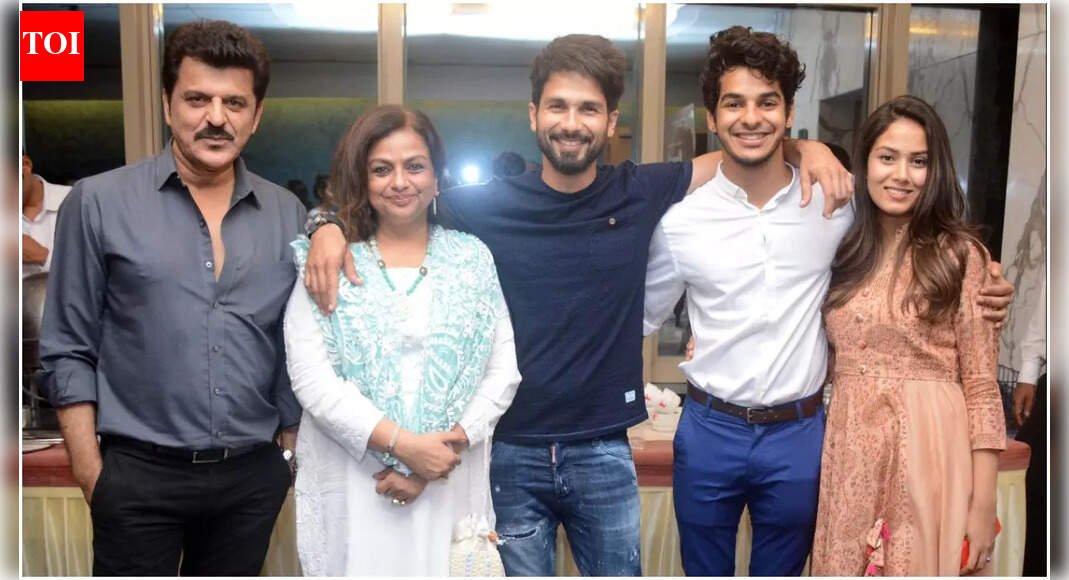
Shahid Kapoor was only three when his parents, Neelima Azeem and Pankaj Kapur, divorced back in 1984. Today, 40 years later, Neelima expresses no regrets about the decision, cherishing every moment with her sons Shahid Kapoor and Ishaan Khatter. Recently, in an interview, Neelima discussed her marriage to Rajesh Khatter after her divorce from Pankaj.

Discussing the first meeting with Rajesh Khatter

Talking to Vickey Lalwani, Neelima recalled the first meeting with Rajesh and said, “I met him on the sets of ‘Phir Vahi Talash’. He was brought into the series much later. His character entered much later. Unka zikar vikar hota raha, Captain Salim ka, but he actually became a part of the series physically much later. And I met him on the sets. There were a lot of actors who auditioned for that role, including Shah Rukh Khan, which is the interesting part. And we actually sat together and rehearsed together and he auditioned for it. But they felt that he’s not looking like an army captain. He’s looking very young. We were friends for a very long time. There was a very good working repo and later, it slowly moved into a relationship.”

Family with Rajesh Khatter

Post her divorce from Pankaj, Neelima remarried Rajesh Khatter, and they became parents to Ishaan Khatter. Pankaj thrives as a cinema legend today, with Shahid Kapoor and Ishaan making their marks as accomplished actors too. Shahid led the 2025 release ‘Deva’ and prepares for ‘O’ Romeo’ and ‘Cocktail 2’ ahead, while Ishaan took the spotlight in ‘Homebound’ and the series ‘The Royals’.

Shahid Kapoor and Ishaan Khatter’s projects

On the personal front, Shahid Kapoor is married to Mira Kapoor and has two kids, Misha and Zain. Meanwhile, Ishaan Khatter is said to be dating Malaysian model Chandni Bainz.


Source link

From Yuvraj Singh to Chris Gayle: Cricket fraternity extend New Year wishes to their fans and loved ones


As the clock struck midnight and the world ushered in 2026, the cricketing world didn’t stay behind in celebrating the dawn of a new year. From heartfelt family moments to playful social media updates, the fraternity came together to wish fans and followers a year filled with “maximums” and “clean bowls.”

While many players are currently grinding in the domestic circuit or preparing for upcoming international tours, they took a moment to reflect on 2025 and share their vision for the year ahead.

Virat Kohli’s wholesome start of 2026

The biggest headline of the morning came from none other than Virat Kohli. Known for his intensity on the field, Kohli showed his softer side by sharing a rare, candid photo with his wife, Anushka Sharma. The couple embraced a playful vibe to start the year, with Kohli sporting a Spider-Man face tattoo and Anushka rocking a colorful butterfly design.

“Stepping into 2026 with the light of my life,” captioned Kohli on Instagram.

Gautam Gambhir’s special wish

The India Men’s cricket team head coach Gautam Gambhir shared a heartwarming family picture, wishing the nation a year of progress and discipline.

“Entering 2026 hand in hand with my favourites! Happy New Year to all!” wrote Gambhir.

Chris Gayle’s heartwarming post for his fans

The ‘Universe Boss’ Chris Gayle kept it energetic as always, sending out “Big Love” to his global fanbase with his signature flair.

“Happy New Year Everyone! Hope 2026 will be a better one 🙏🏿 Wish Yall happiness and success,” wrote Gayle on X.

Official account for the BCCI also joined the festivities. For the Indian team, 2026 is a massive year, with the home series against New Zealand kicking off in just a few days on January 11 in Vadodara.

Also READ: Who is Khushi Mukherjee? The actress who made bold claims against Suryakumar Yadav

Here’s how others wished on New Year:

Also READ: Saeed Ajmal picks top 5 spinners of modern-day cricket


Source link

R Ashwin’s bold message to CSK on Sarfaraz Khan ahead of IPL 2026 | Cricket News


R Ashwin's bold message to CSK on Sarfaraz Khan ahead of IPL 2026
Sarfaraz Khan (Image credit: X)

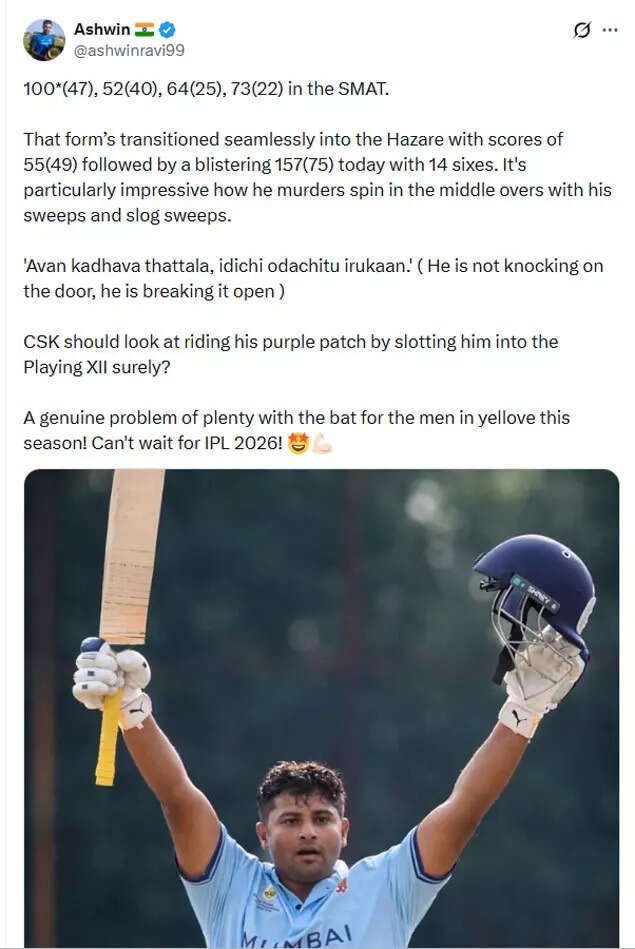
NEW DELHI: As Sarfaraz Khan continues his rich vein of form in domestic cricket, veteran off-spinner Ravichandran Ashwin has backed the right-hander to become a regular batter for Chennai Super Kings (CSK) in the Indian Premier League (IPL) 2026.Ashwin’s endorsement comes after Sarfaraz smashed a blistering 157 off 75 balls against Goa in the ongoing Vijay Hazare Trophy (VHT), an innings that included nine boundaries and 14 sixes and underlined his power-hitting prowess.

Why Mumbai’s iconic Azad Maidan is no longer safe for cricket | Bombay Sport Exchange

Sarfaraz brought up his hundred in just 56 balls in what was a breathtaking knock. Ashwin also highlighted the batter’s performances in the recently concluded Syed Mushtaq Ali Trophy (SMAT), where he amassed 329 runs in seven matches at a strike rate of 203.08 and an average of 65.80.In a post on X, Ashwin wrote, “100*(47), 52(40), 64(25), 73(22) in the SMAT. That form’s transitioned seamlessly into the Hazare with scores of 55(49) followed by a blistering 157(75) today with 14 sixes. It’s particularly impressive how he murders spin in the middle overs with his sweeps and slog sweeps. ‘Avan kadhava thattala, idichi odachitu irukaan.’ ( He is not knocking on the door, he is breaking it open ) CSK should look at riding his purple patch by slotting him into the Playing XII surely? A genuine problem of plenty with the bat for the men in yellow this season! Can’t wait for IPL 2026.”

.

Following his exploits in the SMAT, five-time IPL champions CSK secured the services of the right-handed batter for Rs 75 lakh at the IPL 2026 mini-auction earlier this month.Chennai Super Kings Squad: Ruturaj Gaikwad, MS Dhoni, Ayush Mhatre, Dewald Brevis, Urvil Patel, Anshul Kamboj, Gurjapneet Singh, Jamie Overton, Mukesh Choudhary, Nathan Ellis, Noor Ahmad, Ramakrishna Ghosh, Shivam Dube, Shreyas Gopal, Khaleel Ahmed, Sanju Samson Akeal Hosein, Prashant Veer, Kartik Sharma, Matthew Short, Aman Khan, Sarfaraz Khan, Matt Henry, Rahul Chahar, Zak Foulkes.


Source link

LPG price hike: Commercial cylinder becomes Rs 111 costlier — check new prices for major cities


LPG price hike: Commercial cylinder becomes Rs 111 costlier — check new prices for major cities

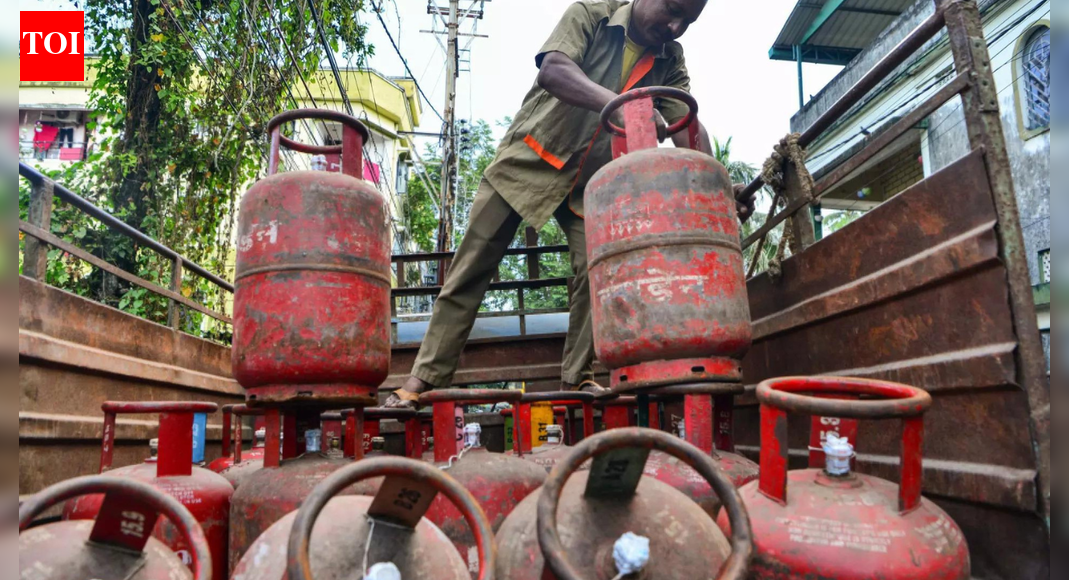
Oil marketing companies have raised the prices of commercial LPG cylinders from today, reversing recent reductions. The increase is set to push up operating costs for hotels, restaurants and other service providers across the country.The price of a 19-kg commercial LPG cylinder has been hiked by Rs 111 nationwide. In Delhi, the retail price now stands at Rs 1,691.50, up from Rs 1,580.50. Mumbai saw prices rise from Rs 1,531.50 to Rs 1,642.50, while Kolkata’s rate increased from Rs 1,684 to Rs 1,795. Chennai recorded a sharp rise in prices, climbing from Rs 1,739.50 to Rs 1,849.50. Prices of 5-kg free trade LPG (FTL) cylinders were also raised by Rs 27.The increase is expected to significantly impact operating expenses for businesses that rely heavily on cooking gas, particularly in the hospitality and catering sectors, which had seen some relief last month due to successive reductions.Household consumers, however, have been spared from the latest revision. Domestic LPG cylinder prices (14.2 kg) remain unchanged, continuing at Rs 853, where they have stayed since a Rs 50 hike in April last year.The hike comes after a phase of moderation in commercial LPG prices. Since April 2025, commercial cylinder rates had seen six reductions amounting to a cumulative cut of Rs 223 per cylinder, including small rollbacks in November and December. In contrast, Aviation Turbine Fuel (ATF) prices were reduced from January 1, offering some respite to airlines after months of elevated fuel costs. In Delhi, ATF prices were cut from Rs 864.35 to Rs 791.48 per kilolitre, a move expected to ease pressure on airline operating costs, where fuel accounts for nearly 40% of total expenses, according to ET. Indian Oil Corporation, Bharat Petroleum and Hindustan Petroleum revise LPG and ATF prices on the first day of every month, based on international fuel prices and currency movements.


Source link

Amazon makes rare exception for employees stranded in India due to US visa delays: Allows them to do what the company stopped in January 2025


Amazon makes rare exception for employees stranded in India due to US visa delays: Allows them to do what the company stopped in January 2025
Amazon is giving its India-based employees a temporary remote work pass until early March due to visa processing snags. But, there are strict rules: no coding, no big strategy talks, and definitely no chatting with customers. This shows how big tech companies are really feeling the pinch from H-1B visa backlogs, messing with their work and how much gets done.

Amazon is allowing employees stranded in India due to visa processing delays to work remotely until early March, marking a rare exception to CEO Andy Jassy’s strict five-day return-to-office policy that took effect in January 2025. The company informed affected workers through an internal memo that those in India as of December 13 and awaiting rescheduled visa appointments can work remotely until March 2, according to Business Insider, which obtained the document. However, the arrangement comes with significant restrictions: employees cannot code, make strategic decisions, or interact with customers.The move highlights how the Trump administration’s rapid changes to the H-1B visa program are forcing major tech companies to adapt their policies. New requirements mandating consular officers to review visa applicants’ social media posts before approval have created substantial processing delays, with some US embassies and consulates rescheduling appointments as far out as 2027.

India Flags H-1B Visa Delays With US As Indians Face Backlogs Scrutiny And Policy Uncertainty

Strict limitations apply to remote work arrangement

The temporary remote work permission includes extensive constraints that limit what employees can actually accomplish. Workers are barred from any coding activities, including troubleshooting and testing, and cannot work from or visit Amazon buildings. They also cannot negotiate contracts, make hiring decisions, or perform activities related to managing customer, partner, or vendor relationships.“All reviews, final decision making, and sign offs should be undertaken outside India,” the memo states, adding that “in compliance with local laws, there are no exceptions to these restrictions.”For technical employees whose roles center on coding and development, the limitations raise questions about productivity. One Amazon software engineer told Business Insider that 70-80% of their job involves coding, testing, deploying, and documentation—all prohibited under the remote work terms.

Amazon among largest H-1B program users facing delays

The visa delays pose particular challenges for Amazon, which filed 14,783 certified H-1B applications during the 2024 fiscal year, making it among the largest users of the program. The situation has prompted Google, Apple, Microsoft, and other tech companies to issue travel advisories warning US employees with visas to avoid international travel.Amazon’s normal policy allows employees traveling abroad for visa renewals to work remotely for up to 20 business days, but the memo doesn’t address employees whose appointments extend beyond March 2 or those stranded in other countries.


Source link

‘Reinforcing our strategic autonomy’: Defence minister Rajnath Singh extends greetings on DRDO Day | India News


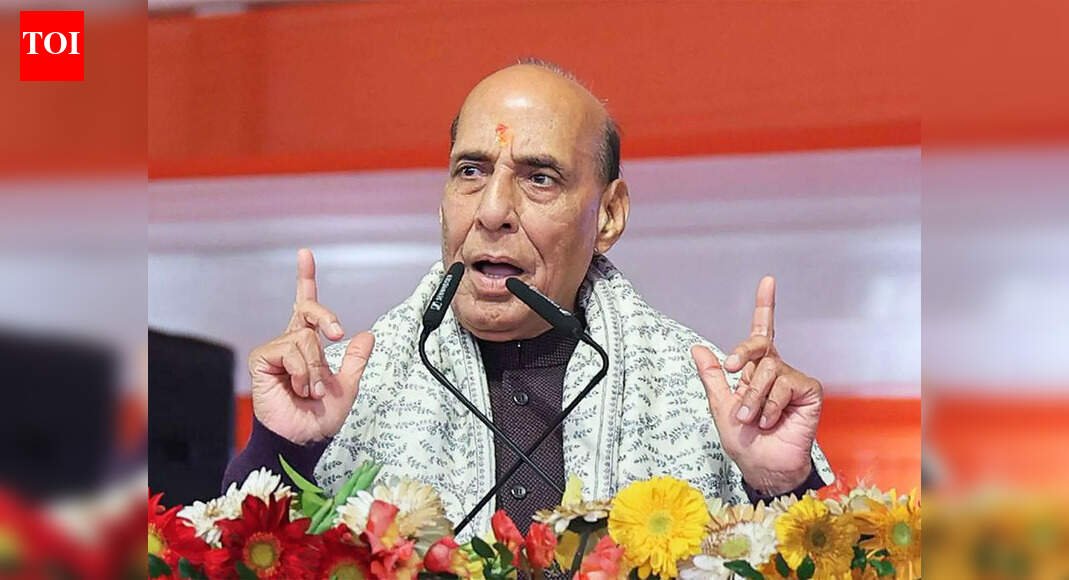
NEW DELHI: Defence minister Rajnath Singh on Thursday extended greetings for the DRDO Day to scientists, personnel, and their families, lauding their “commitment and scientific excellence.In an X post, the Defence Minister hailed the Defence Research and Development Organisation (DRDO), noting that developing indigenous technologies reinforces India’s “strategic autonomy.”He wrote, “On DRDO Day, I extend my heartfelt greetings to all @DRDO_India scientists, personnel and their families. Their unwavering commitment, scientific excellence and sense of national duty are vital to strengthening India’s defence preparedness and advancing Atmanirbhar Bharat in defence.”“By developing indigenous, future-ready technologies, DRDO is reinforcing our strategic autonomy and the confidence of our armed forces. I wish the entire DRDO family a year of meaningful breakthroughs and continued service to the nation,” the Union Minister added.January 1, 2026, marks the 67th Foundation Day of DRDO. According to the defence ministry, the DRDO was formed in 1958 from the amalgamation of the Technical Development Establishment (TDEs) of the Indian Army and the Directorate of Technical Development & Production (DTDP) with the Defence Science Organisation (DSO).Back then, DRDO was a small organisation with 10 establishments or laboratories. Over the years, it has grown multi-directionally in terms of the variety of subject disciplines, number of laboratories, achievements and stature.Chief of Army Staff (COAS) General Upendra Dwivedi also extended wishes to all DRDO personnel and their families on the occasion.“General Upendra Dwivedi, COAS and All Ranks of the Indian Army extend warm wishes and greetings to all DRDO personnel and their families on the occasion of DRDO Day,” ADG PI wrote on X.DRDO has marked several achievements in 2025, including the recent successful conduct of a salvo launch of two ‘Pralay’ missiles in quick succession from the same launcher off the coast of Odisha on Wednesday morning.According to a statement from the Ministry of Defence (MoD), the flight test at about 10:30 hrs was conducted as part of user evaluation trials. Both missiles followed the intended trajectory and met all flight objectives, as confirmed by tracking sensors deployed by the Integrated Test Range at Chandipur. The terminal events were confirmed by telemetry systems installed on board the ship, deployed near the impact points.‘Pralay’ is an indigenously developed solid propellant quasi-ballistic missile employing state-of-the-art guidance and navigation to ensure high precision. The missile is capable of carrying multiple types of warheads against various targets.


Source link