Breaking News
Here’s why MS Dhoni will miss the first two weeks of IPL 2026


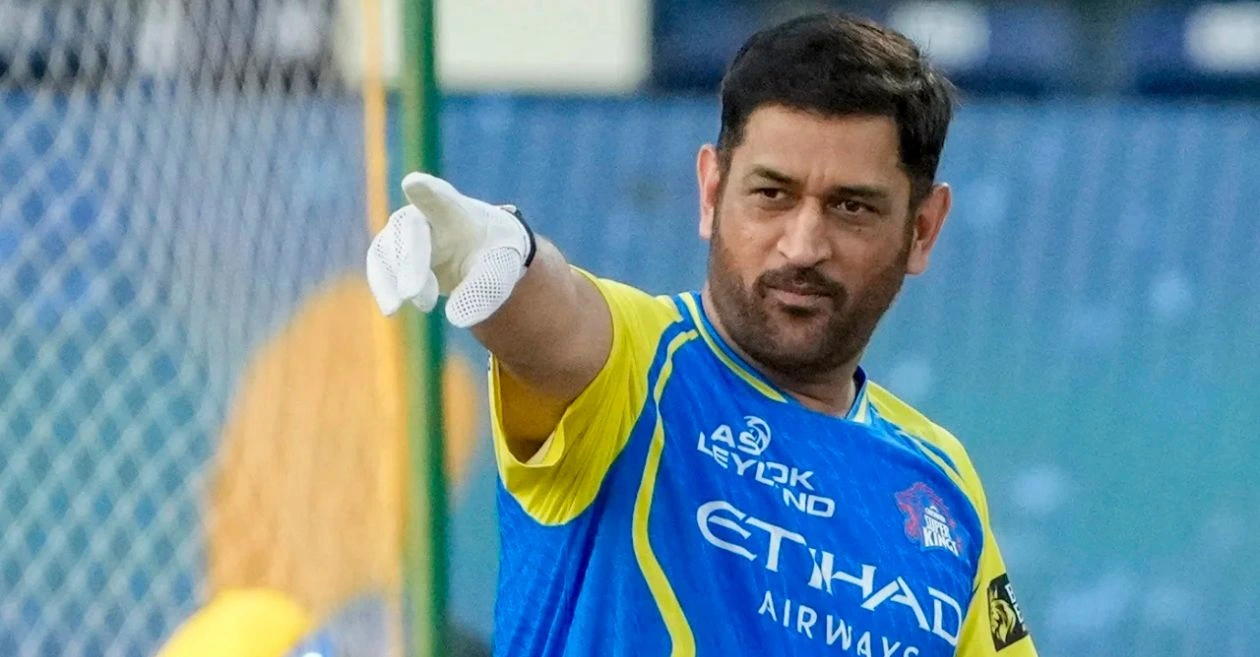
In a significant early setback for Chennai Super Kings (CSK), legendary cricketer MS Dhoni is expected to miss the opening two weeks of the Indian Premier League (IPL) 2026 season. The development comes just days before the tournament kicks off, leaving fans and the franchise adjusting to life without their talismanic leader at the start of the campaign.

Reason why MS Dhoni will miss the first two weeks of IPL 2026

The franchise issued an official statement on the morning of their season opener, confirming that Dhoni is currently undergoing rehabilitation for a calf strain. The update indicated that the veteran wicketkeeper-batter will likely remain sidelined for at least the first fortnight of the competition.

In a message shared on social media, CSK extended their support to the iconic cricketer, wishing him a speedy recovery. While the injury is not believed to be long-term, the timing is far from ideal, especially with a packed schedule awaiting the five-time champions.

“Official Statement . MS Dhoni is currently undergoing rehabilitation for a calf strain. As a result, he is likely to miss the first two weeks of TATA IPL 2026. Get well soon, Thala!” wrote CSK on X.

Crucial matches ahead without MSD

CSK’s campaign begins with a clash against Rajasthan Royals on March 30 in Guwahati. However, Dhoni’s absence is expected to stretch beyond just the opener. The team is set to face Punjab Kings, Royal Challengers Bengaluru, and Delhi Capitals within the first two weeks—fixtures that could play a key role in shaping their early momentum.

Without Dhoni’s on-field leadership and finishing prowess, CSK may need to rethink their combinations and strategy. His calm presence behind the stumps and tactical acumen have often been decisive in tight encounters, making his temporary absence a considerable challenge.

Despite the setback, CSK do have multiple wicketkeeping options in their ranks. The squad includes Sanju Samson, who recently joined from Rajasthan Royals, along with Kartik Sharma and Urvil Patel. Samson, with his experience and leadership credentials, could be a frontrunner to take up additional responsibilities during Dhoni’s absence. Team management will now be tasked with identifying the right balance, not just in terms of personnel but also leadership on the field. Filling Dhoni’s shoes, even temporarily, is no easy task given his influence on the team over the years.

Also READ: IPL 2026 Squads: Complete list of Indian and overseas players in all 10 teams

Dhoni’s legacy and fitness concerns

At nearly 45, Dhoni remains one of the most enduring figures in the IPL. With 278 matches to his name, he holds the record as the most capped player in the tournament’s history. Over recent seasons, he has managed persistent knee issues but continued to feature regularly, showcasing remarkable resilience.

His leadership was instrumental in guiding CSK to their fifth IPL title in 2023, further cementing his legacy as one of the greatest captains in franchise cricket. However, recurring fitness concerns have increasingly become part of his narrative in the later stages of his career.

Also READ: IPL 2026 Schedule, Broadcast and Live Streaming details: When and where to watch in India, Australia, USA, UK & other countries


Source link

Noida International Airport inauguration: Delhi-NCR gets new airport – all you need to know


Noida International Airport inauguration: Delhi-NCR gets new airport - all you need to know
PM Modi inaugurates Jewar airport

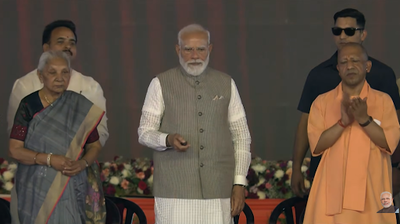
NEW DELHI: Prime Minister Narendra Modi on Saturday inaugurated Phase I of the Noida International Airport at Jewar in Uttar Pradesh, marking a significant milestone in India’s expanding aviation infrastructure.PM Modi was accompanied by Uttar Pradesh chief minister Yogi Adityanath and Governor Anandiben Patel. Developed at an investment of around Rs 11,200 crore under a Public–Private Partnership (PPP) model, the project is expected to enhance both regional and international connectivity for the National Capital Region (NCR).The airport is being positioned as a key addition to India’s aviation network, aimed at easing pressure on existing infrastructure while supporting the country’s ambition of becoming a global aviation hub.

Second international gateway for Delhi NCR

Noida International Airport has been developed as the second international gateway for Delhi NCR, complementing the existing Indira Gandhi International Airport, which currently handles the majority of the region’s air traffic.

.

.

With rising passenger demand and capacity constraints at IGI Airport, the new facility is expected to play a crucial role in distributing traffic more efficiently.Together, the two airports will function as an integrated aviation system, helping reduce congestion, improve connectivity, and enhance the region’s standing among leading global aviation hubs.

Phase I capacity and future expansion plans

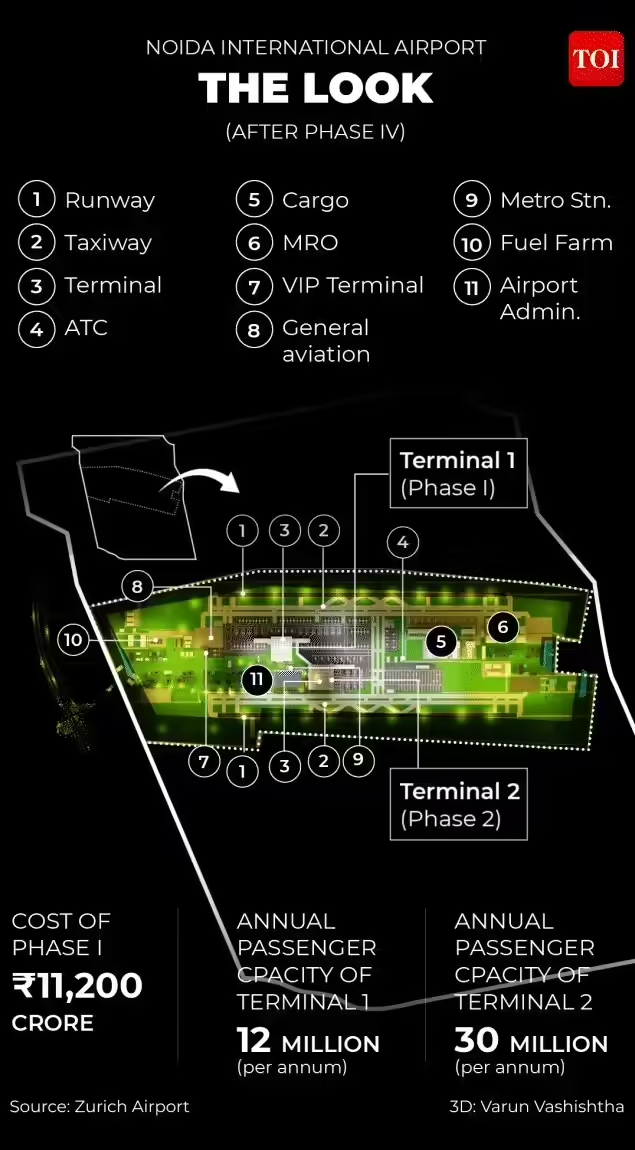
Phase I of the airport is designed to handle 12 million passengers per annum (MPPA), providing immediate relief to the region’s growing air travel demand.The project has been planned with scalability in mind, with provisions to expand capacity to 70 million passengers annually in subsequent phases. This long-term vision reflects the government’s strategy to future-proof infrastructure and accommodate sustained growth in air travel.

Modern infrastructure and all-weather operations

The airport features a 3,900-metre runway capable of handling wide-body aircraft, making it suitable for both domestic and international long-haul operations.

.

.

Equipped with advanced navigation systems such as the Instrument Landing System (ILS) and modern airfield lighting, the facility is designed to support efficient, all-weather, round-the-clock operations. These features ensure operational reliability even under challenging weather conditions.

Cargo hub and logistics ecosystem

In addition to passenger services, the airport includes a comprehensive cargo ecosystem aimed at strengthening logistics and trade.The Multi-Modal Cargo Hub comprises an Integrated Cargo Terminal and dedicated logistics zones, with an initial handling capacity of over 2.5 lakh metric tonnes annually. This capacity is expected to expand significantly to around 18 lakh metric tonnes in the future, positioning the airport as a major cargo and logistics centre in North India.

Dedicated MRO facility to enhance efficiency

A key component of the airport’s infrastructure is a 40-acre Maintenance, Repair and Overhaul (MRO) facility.This dedicated facility is expected to improve operational efficiency by enabling airlines to service and maintain aircraft locally, reducing turnaround times and operational costs. It also strengthens India’s capabilities in aviation maintenance services.

Watch

PM Modi To Inaugurate Noida International Airport Phase 1 On March 28: All You Need To Know

Sustainability and future-ready design

Noida International Airport has been designed as a sustainable and future-ready infrastructure project, with a focus on achieving net-zero emissions.The project incorporates energy-efficient systems and environmentally responsible practices, aligning with India’s broader climate goals. The airport’s development reflects a growing emphasis on green infrastructure in large-scale projects.

Architecture inspired by Indian heritage

Blending modern infrastructure with cultural aesthetics, the airport’s architectural design draws inspiration from traditional Indian elements such as ghats and havelis.This approach aims to create a distinctive identity for the airport while offering passengers a sense of place rooted in Indian heritage.

Strategic location and multi-modal connectivity

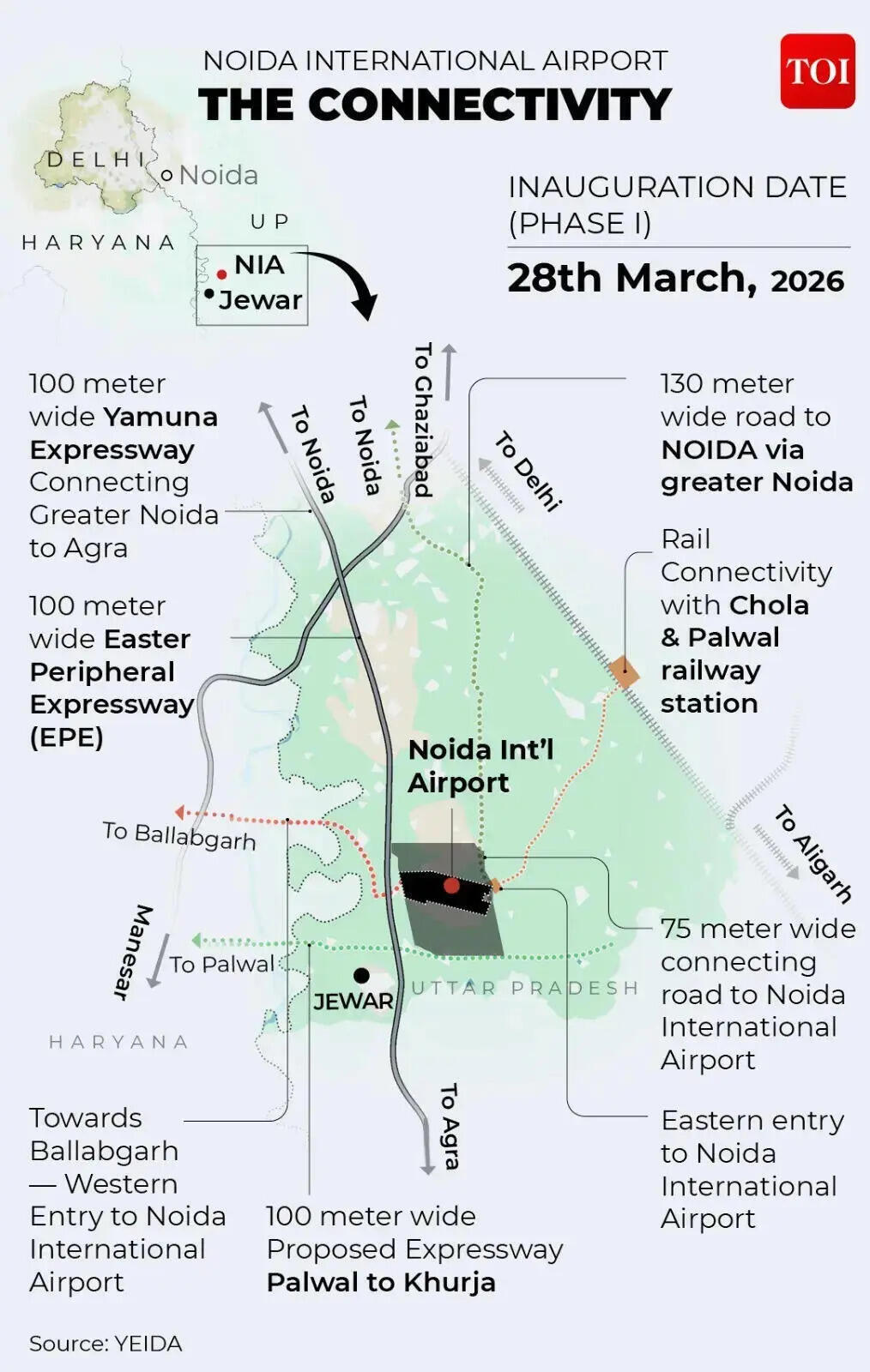
Strategically located along the Yamuna Expressway in Gautam Buddha Nagar district, the airport is planned as a multi-modal transport hub.It will feature seamless integration with road, rail, metro and regional transit systems, ensuring smooth connectivity for passengers and cargo.This connectivity is expected to significantly improve accessibility for travellers across Delhi NCR and neighbouring regions.

Boost to India’s aviation ambitions

The inauguration of Phase I of Noida International Airport is being seen as a major step in strengthening India’s aviation ecosystem.By expanding capacity, improving connectivity, and integrating modern infrastructure with sustainability, the project is expected to play a key role in positioning Delhi NCR as a major global aviation hub while supporting economic growth and regional development


Source link

Why Vaibhav Sooryavanshi being ‘not 14 anymore’ is a big deal | Cricket News


Why Vaibhav Sooryavanshi being 'not 14 anymore' is a big deal
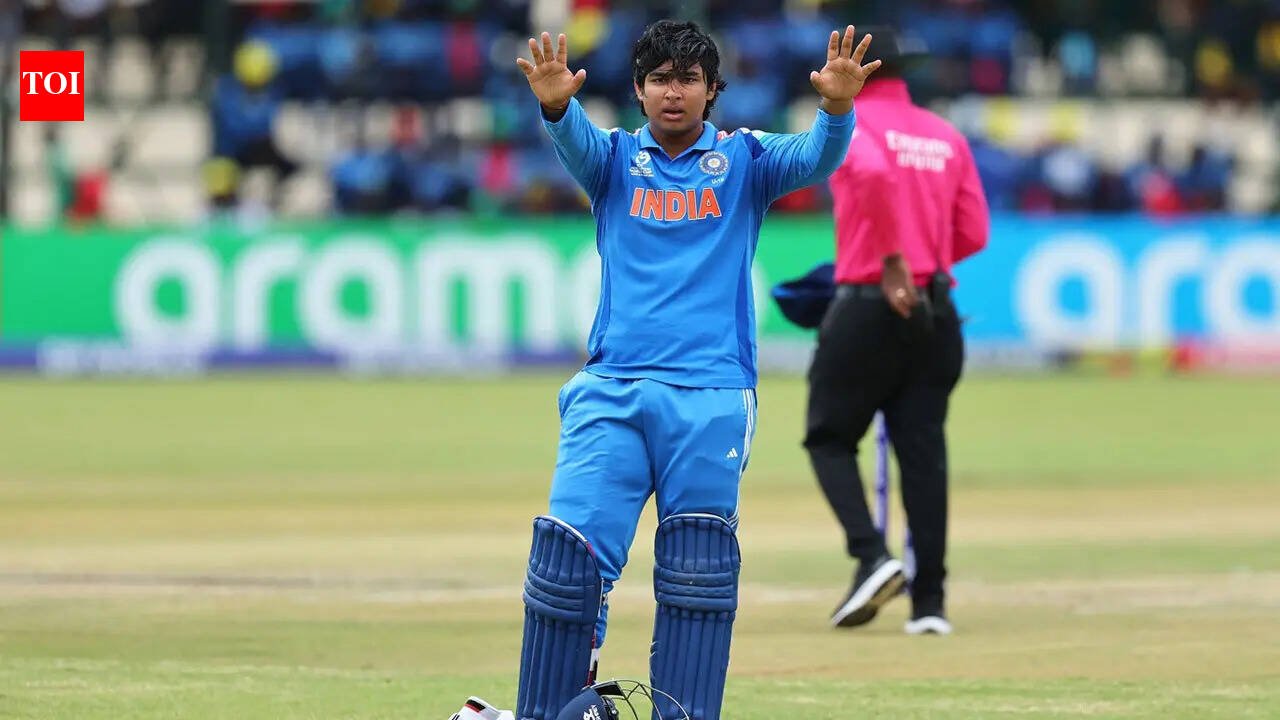
Vaibhav Sooryavanshi (Image credit: ICC)

NEW DELHI: Young batting sensation Vaibhav Sooryavanshi has made headlines time and again – and for good reason. With his swashbuckling batting style, brute power, effortless six-hitting, and ability to dismantle bowling attacks, he has become a fan favourite in no time.The past year, in particular, has been remarkable for the youngster. And heading into IPL 2026, there is a significant change – he is no longer 14.

Watch

Impact Player Rule: Game-changer or all-rounder killer?

Sooryavanshi turned 15 on Friday (March 27), celebrating his birthday just a day before the start of IPL 2026.Is he eligible to play for Team India (senior team)?Questions like – Is Sooryavanshi eligible to play for India’s senior team? Will he break into the side? When will he make his debut? – have been asked repeatedly.Now, with the youngster officially turning 15, he is eligible to feature in senior international cricket as per ICC’s player eligibility regulations (Article 4).According to INTERNATIONAL CRICKET COUNCIL PLAYER ELIGIBILITY REGULATIONS ARTICLE 4, ELIGIBILITY ON THE BASIS OF AGE 4.1 states, “ARTICLE 4 ELIGIBILITY ON THE BASIS OF AGE, “A Player will only be eligible to represent a National Cricket Federation in an International Match (including ICC Events and U19 Events) if he/she is aged 15 or over on the relevant squad submission date (in the case of ICC Events including U19 Events) or on the date of the first match of the series/tournament to the played (in the case of all other International Matches). “Following the introduction of these regulations in November 2020, the ICC made 15 the minimum age requirement for participation in international cricket (U19 level and above), keeping in mind the welfare and physical safety of minors, including during travel.Will an India call-up come soon for Sooryavanshi? That remains to be seen.The youngster grabbed global attention with his stellar performances in his debut IPL season in 2025.In just his second IPL match, he smashed a sensational 100 off 35 balls.His heroics in the U19 World Cup 2026, along with impressive outings in the Vijay Hazare Trophy 2025-26 and the Ranji Trophy 2025, were outstanding.Following his IPL success, Sooryavanshi was drafted into the India U19 setup, where he continued to shine.U19 World Cup 2026 (Player of the Tournament): Sooryavanshi led India to their sixth title, highlighted by a stunning 175 off 80 balls (including 15 sixes) in the final against England.Vijay Hazare Trophy 2025-26: He became the youngest player to score a List A century at 14 years and 272 days. During a blistering 190 off 84 balls against Arunachal Pradesh, he broke AB de Villiers’ record for the fastest 150 in List A cricket, reaching the milestone in just 59 balls.Ranji Trophy 2025-26: Named Bihar’s vice-captain at 14, he scored his maiden first-class fifty with a 67-ball 93 against Meghalaya, narrowly missing out on becoming the youngest Ranji centurion.Syed Mushtaq Ali Trophy 2025-26: He continued his white-ball dominance with an unbeaten 108 and a composed fifty (50 off 34 balls) against Maharashtra, showing improved maturity in pacing his innings.Rising Stars Asia Cup (Doha): Representing India A, he smashed a “whirlwind” 144 off 42 balls against the UAE.


Source link

IndiGo flight makes safe emergency landing at IGIA after engine failure


IndiGo flight makes safe emergency landing at IGIA after engine failure

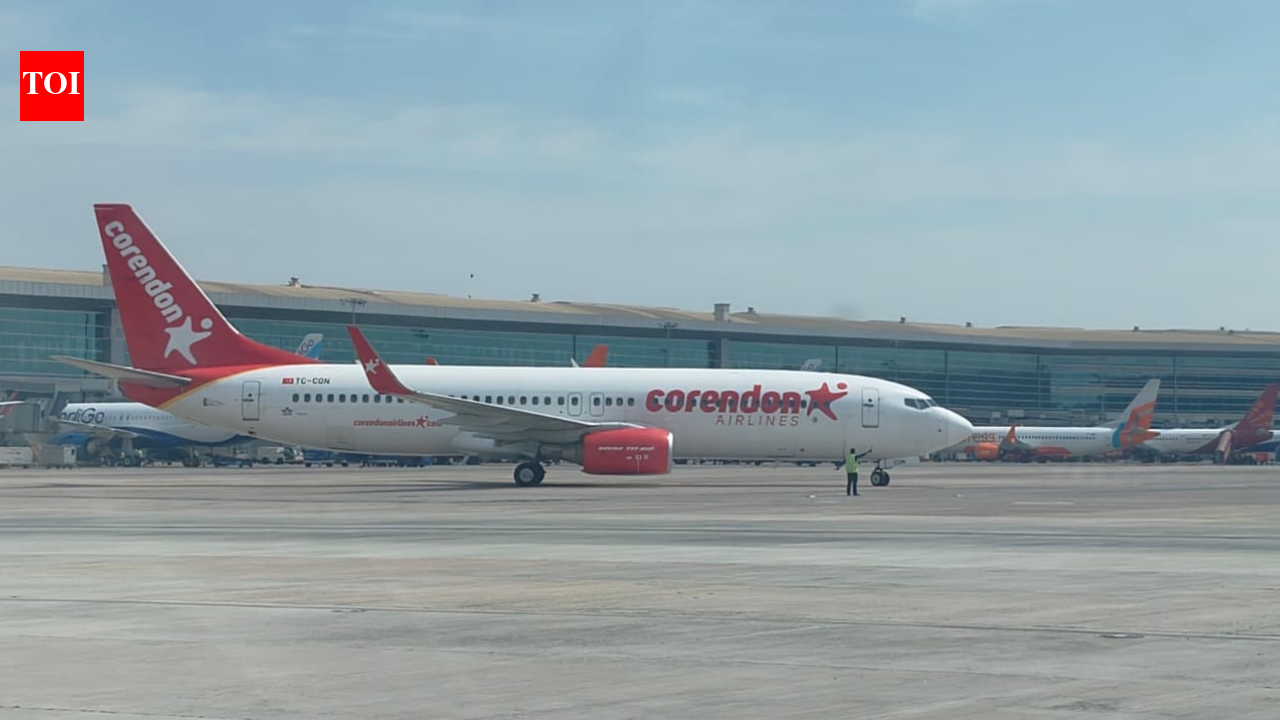
New Delhi: A 15-year-old Boeing 737 with about 170 people on board operating IndiGo flight 6E 579 from Vizag to Delhi made a safe emergency landing at IGIA on Saturday morning after suffering an engine failure. IndiGo has wet leased (hired with operating crew) the aircraft (TC-COR) from Corendon Airlines of Turkey. The emergency was declared at 10.39 am after which and DIAL made all emergency arrangements as per protocol. The aircraft landed safely on single engine at 10.54 am on IGIA’s runway 28.


Source link

Access Denied


Access Denied

You don’t have permission to access “http://www.ndtv.com/world-news/iran-war-1-month-on-where-us-israel-war-on-iran-stands-and-what-it-cost-so-far-11277624” on this server.

Reference #18.cdf5d217.1774681138.1258fa93

https://errors.edgesuite.net/18.cdf5d217.1774681138.1258fa93


Source link

Genius Sports: Genius Sports leads race for football rights with Rs 64.4 crore annual bid | Goa News


The bids have been submitted for a 15-year term with a provision for an additional five-year extension, with the bidder having the right of first refusal

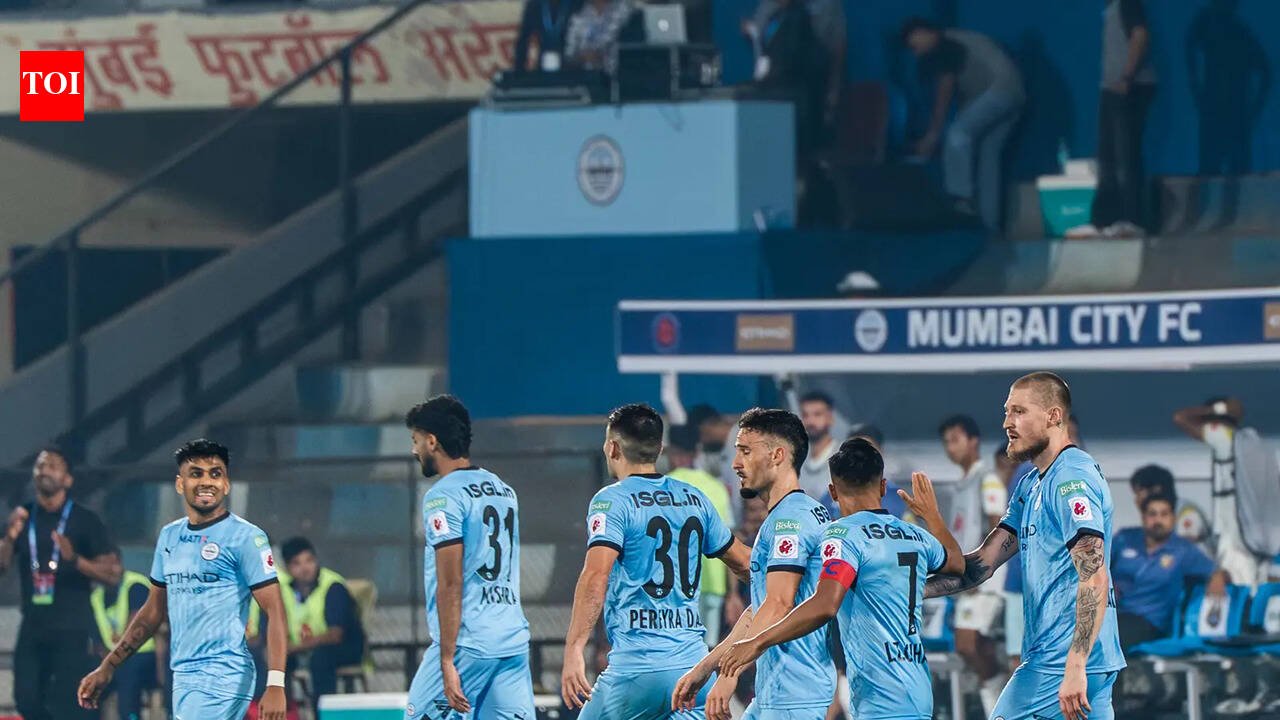
Panaji: The All India Football Federation (AIFF) is likely to accept a bid of Rs 64.4 crore annually with five percent increase every year — totalling approx. Rs 2,130 crore across 20 years — for commercial rights of the top-tier Indian Super League (ISL) and Federation Cup, the country’s premier cup competition.When bids for the two top properties in men’s football was opened on Friday, AIFF had two interested parties. London-based Genius Sports bid $7 million annually (approx. Rs 64.4 crore), while FanCode’s bid was for Rs 36.6 crore, both offering a similar five-year increment.The bids though were structured differently.“Genius are putting big money on the table, investing in the league, while FanCode is club-centric, focused on how clubs can get revenues faster,” said a senior club official.FanCode had secured the rights for the current ISL season for ₹8.6 crore. This season has a truncated league, played in a single-leg format with only 13 games for each team.Genius Sports reportedly works with English Premier League (EPL), National Football League (NFL, American football) and the NBA among others.“Genius is offering approximately Rs 2,130 crore over 20 years, while Capri Sports will pay approximately Rs 160 crore for the Indian Women’s League and IWL 2,” AIFF deputy secretary general M Satyanarayan told TOI on Friday. “We will now place the proposals before the executive committee (on Sunday) for a decision. We have informed the clubs too about the bids, and they have been asked to provide their feedback. Everything will be placed before the executive committee.When the bids were opened at the AIFF headquarters in Delhi, two club officials — Ravi Puskur (CEO, Goa) and Dhruv Sood (CEO, SC Delhi) — were present. Once the numbers were known, the AIFF had a quick call with all ISL clubs.“From the over Rs 2,000 crore that Genius Sports will invest, how much of it will go to the clubs? Nothing,” another club official said later in the day, “The clubs will discuss the proposal threadbare (on Saturday) and provide our feedback to the AIFF. It’s clear that there will be no central revenue share for the clubs. We also don’t have any assurance that the participation fee will be waived off (by AIFF).”GMR Sports, which attended the pre-bid meeting, did not submit a bid. A senior AIFF official told the clubs that the company behind multiple sporting ventures, including Delhi Capitals, “wanted a 90-day extension of the bid last date, which was not possible.”The bids have been submitted for a 15-year term with a provision for an additional five-year extension, with the bidder having the right of first refusal. The proposal also includes a five per cent increase in value every year over the duration of the agreement.As per the bid document, the bid winner will have to provide a fee “not less than 20% for administrative costs to the AIFF. The fee is “non-refundable and not contingent on any revenue accrual in favour of the bidder.”


Source link

Petrol, diesel prices today: With ongoing US-Israel-Iran war, what India’s fuel situation looks like – 10 things to know


Petrol, diesel prices today: With ongoing US-Israel-Iran war, what India's fuel situation looks like – 10 things to know

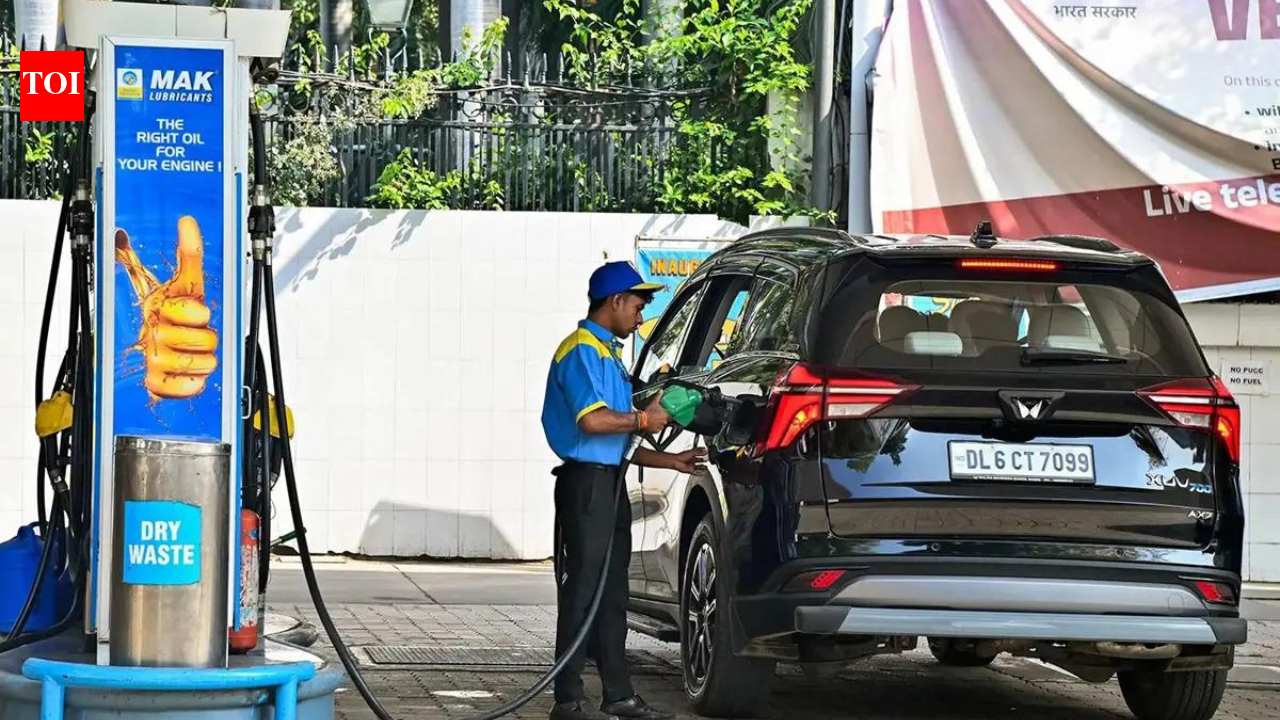
Petrol prices today: Petrol prices in New Delhi on Saturday remained unchanged at Rs 94.77 per litre, while diesel is steady at Rs 87.67 per litre. Similarly, Mumbai sees petrol at Rs 103.54 per litre and diesel at Rs 90.03, with no change from yesterday. Kolkata reported a slight fall in petrol prices to Rs 105.41 per litre from Rs 105.45, and diesel is at Rs 92.02 per litre. In Chennai, petrol rose marginally to Rs 101.06 per litre and diesel to Rs 92.61 per litre.The ongoing US-Iran conflict has disrupted oil supply chains and sent crude prices soaring worldwide.Here are top 10 things to know: Global oil price surge The conflict in West Asia has triggered sharp increases in international crude oil prices. Since February 28, when US and Israeli strikes targeted Iranian facilities, Brent crude briefly surged to $119 per barrel before easing to around $100. West Texas Intermediate (WTI) similarly rose from $70 pre-conflict to over $92, creating supply shocks globally.India’s oil dependenceIndia imports around 88% of its crude oil requirements, with nearly half transported through the Strait of Hormuz, a critical maritime strait located between Persian Gulf and Gulf of Oman.Any disruption here poses an immediate risk to domestic fuel availability. Tehran’s warnings to vessels and insurer withdrawals have complicated tanker movement, impacting supply.Excise duty cut by governmentTo shield consumers from rising global crude prices, the Centre slashed excise duty on petrol from Rs 13 to Rs 3 per litre and removed it entirely on diesel (from Rs 10). The reduction aims to maintain stable retail prices and prevent a direct burden on citizens.No immediate price reliefDespite the excise duty cut, petrol and diesel prices at the pump have largely remained unchanged. Oil marketing companies (OMCs) are absorbing the higher input costs, ensuring that retail prices do not spike amid global volatility.Financial implications of duty cutsThe excise duty reduction is expected to cost the government roughly Rs 1.75 lakh crore annually. This measure offsets potential increases of Rs 24 per litre for petrol and Rs 30 per litre for diesel that would have been necessary due to rising international crude prices.Cargo and export measuresThe government imposed export duties of Rs 21.5 per litre on diesel and Rs 29.5 per litre on ATF to ensure domestic availability and prevent windfall gains in international markets. Private retailer pricing variationsNayara Energy, India’s largest private fuel retailer, increased petrol by Rs 5 per litre and diesel by Rs 3 per litre at its 6,967 outlets to offset input costs. In contrast, Jio-BP, operating 2,185 outlets, has maintained retail prices despite significant losses.Strategic domestic measuresPrime Minister Narendra Modi speaking at the Rajya Sabha said that India maintains strategic reserves of 53 lakh metric tonnes of crude oil, with plans to expand to over 65 lakh MT.Ethanol blending has reduced crude oil imports by 4.5 crore barrels annually. Increased refining capacity, metro expansion and railway electrification have also reduced dependency on diesel, helping stabilize domestic fuel consumption.Diplomatic efforts and global sourcingPM Modi has been actively engaging with Iran, the US, and other countries to secure safe transit of oil and LPG tankers. India has diversified import sources from 27 to 41 countries and procured Russian crude to fill supply gaps. Government initiatives include a Rs 70,000-crore shipbuilding project and the constitution of seven empowered groups to manage fuel, supply chains, and logistics.Consumer protection and public assuranceThe government’s overarching objective is to ensure stable prices, uninterrupted fuel supply, and minimal hardship for consumers. Finance minister Nirmala Sitharaman and petroleum minister Hardeep Puri have emphasised a “people-centric” approach. PM Modi has reassured citizens that India has adequate fuel reserves and supply mechanisms, while strategic interventions will continue to absorb global price shocks.

Watch

Big Fuel Tax Cut By Centre, But No Price Relief: Why Petrol And Diesel Still Cost The Same In India


Source link

India’s remittance inflows double in a decade; US, UK, Canada, Australia drive surge


India’s remittance inflows double in a decade; US, UK, Canada, Australia drive surge

Rising remittance inflows to India have doubled in the past 10 years, with four advanced economies—the United States, the United Kingdom, Canada, and Australia—accounting for a growing share of the funds. Migration of higher-skilled Indians to these countries, combined with rising incomes among the diaspora, has helped reduce India’s dependence on any single region while enhancing financial resilience, according to a report by Indiaspora, a San Francisco-based NGO of global Indian-origin executives.“India’s diaspora sends home $138 billion annually, more than FDI inflows. The 35-million Indian diaspora generates over $700 billion in income globally,” Rajan Navani, a board member at Indiaspora, told ET.Beyond macroeconomic benefits, remittances play a key role at the household level. In states such as Kerala, for example, these funds are often directed toward housing upgrades, loan repayments, and education.Kerala receives about 20% of India’s total remittances despite accounting for just 3% of the 1.4 billion population.More than 70% of diaspora respondents expect transfers to India to either increase or remain stable over the next two years.Indian-origin professionals are also increasingly influencing the country’s start-up and philanthropic sectors. Over 75% of overseas angel investors backing Indian start-ups are of Indian origin, while Indian-origin leaders hold decision-making positions in more than half of the world’s largest foundations, collectively directing over $500 million annually to Indian non-profits.In the medical field, one in 10 physicians in the United States is of Indian origin. Indian-origin professionals are also leading major medical and pharmaceutical institutions, including the American Medical Association the Royal College of Physicians, and companies such as Novartis and Vertex Pharmaceuticals.


Source link

IPL 2026 Squads: Complete list of Indian and overseas players in all 10 teams


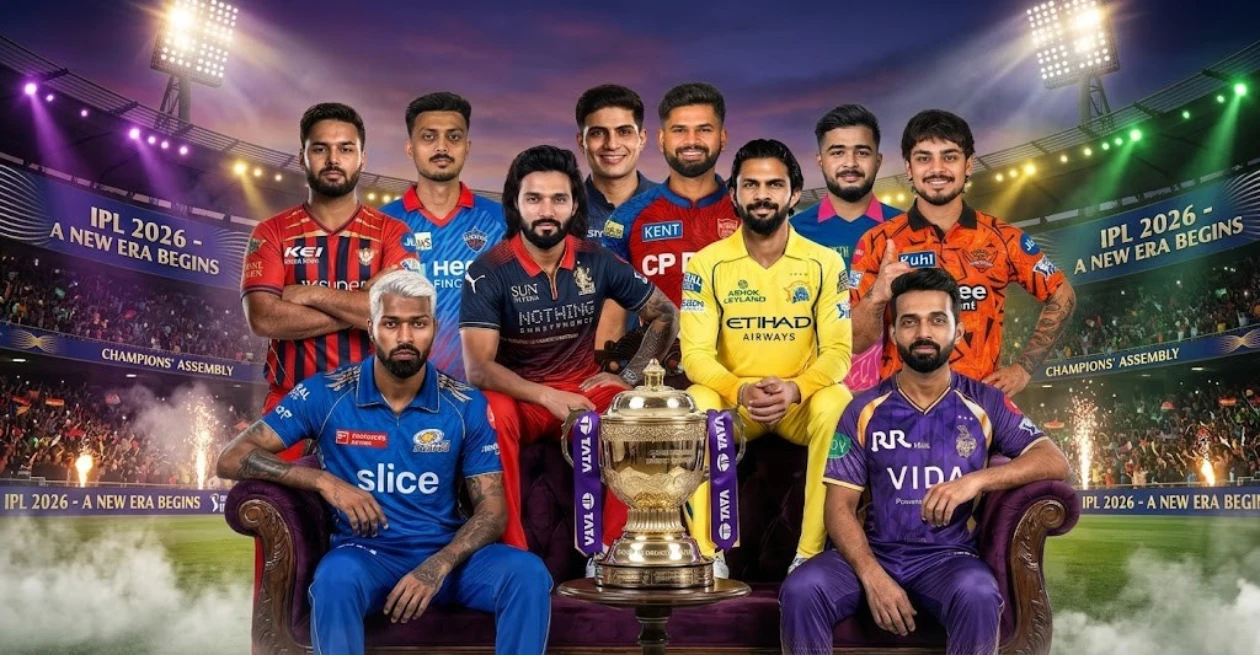
The squads for the Indian Premier League (IPL) 2026 reflect a perfect mix of proven match-winners and bold auction decisions, making this season one of the most exciting in recent years.

Defending champions Royal Challengers Bengaluru (RCB) have retained their core built around Virat Kohli and Rajat Patidar, while adding Venkatesh Iyer to strengthen their batting firepower. Kolkata Knight Riders (KKR) made headlines by investing ₹25.2 crore in Cameron Green, aiming to solidify their middle order alongside Rinku Singh and Varun Chakravarthy. Meanwhile, Chennai Super Kings (CSK) have taken a future-focused approach by bringing in Sanju Samson and backing young uncapped talents like Prashant Veer and Kartik Sharma.

Gujarat Titans (GT) continue to rely on their strong opening duo of Shubman Gill and Jos Buttler, supported by a lethal pace attack featuring Mohammed Siraj and Kagiso Rabada. Leadership dynamics still add intrigue this season, with Riyan Parag stepping up as Rajasthan Royals (RR) captain, while Rishabh Pant and Axar Patel continue in their leadership roles with Lucknow Super Giants (LSG) and Delhi Capitals (DC) respectively.

However, injuries have already shaken up several squads before the tournament begins. KKR will miss Harshit Rana, with Navdeep Saini coming in as a replacement. Sunrisers Hyderabad (SRH) have signed David Payne to replace Jack Edwards and will also start without Pat Cummins. RCB face concerns with Josh Hazlewood unavailable for initial few matches and Yash Dayal absent, while Mumbai Indians (MI) await clarity on Jasprit Bumrah’s fitness. Despite these challenges, IPL 2026 promises a thrilling and highly competitive season starting March 28.

IPL 2026 Squads

Chennai Super Kings

Ruturaj Gaikwad (captain), Ayush Mhatre, Sarfaraz Khan, Sanju Samson, MS Dhoni,, Urvil Patel, Kartik Sharma, Shivam Dube, Ramakrishna Ghosh, Shreyas Gopal, Aman Khan, Prashant Veer, Rahul Chahar, Khaleel Ahmed, Gurjapneet Singh, Anshul Kamboj, Mukesh Choudhary, Jamie Overton*, Dewald Brevis*, Matt Short*, Spencer Johnson*, Zak Foulkes*, Matt Henry*, Noor Ahmad*, Akeal Hosein*

Delhi Capitals

Axar Patel (captain), Prithvi Shaw, Karun Nair, Nitish Rana, Ashutosh Sharma, Sameer Rizvi, Sahil Parakh, KL Rahul, Abishek Porel, Vipraj Nigam, Auqib Nabi, Madhav Tiwari, T Vijay, Ajay Mandal, Kuldeep Yadav, Mukesh Kumar, T Natarajan, Mitchell Starc*, Pathum Nissanka*, Dushmantha Chameera*, Lungi Ngidi*, David Miller*, Tristan Stubbs*, Kyle Jamieson*

Gujarat Titans

Shubman Gill (captain), Sai Sudharsan, Shahrukh Khan, Anuj Rawat, Kumar Kushagra, Washington Sundar, Manav Suthar, Rahul Tewatia, Nishant Sindhu, Jayant Yadav, Arshad Khan, Sai Kishore, Mohammed Siraj, Prasidh Krishna, Gurnoor Brar, Ishant Sharma, Ashok Sharma, Kulwant Khejroliya, Jos Buttler*, Tom Banton*, Luke Wood*, Glenn Phillips*, Jason Holder*, Rashid Khan*, Kagiso Rabada*

Kolkata Knight Riders

Ajinkya Rahane (captain), Angkrish Raghuvanshi, Manish Pandey, Rahul Tripathi, Rinku Singh, Tejasvi Dahiya, Anukul Roy, Daksh Kamra, Ramandeep Singh, Sarthak Ranjan, Prashant Solanki, Varun Chakravarthy, Kartik Tyagi, Umran Malik, Vaibhav Arora, Saurabh Dubey, Navdeep Saini, Cameron Green*, Rovman Powell*, Sunil Narine*, Finn Allen*, Rachin Ravindra*, Tim Seifert*, Matheesha Pathirana*, Blessing Muzarabani*

Lucknow Super Giants

Rishabh Pant (captain), Abdul Samad, Ayush Badoni, Himmat Singh, Akshat Raghuwanshi, Mukul Choudhary, Arshin Kulkarni, Shahbaz Ahmed, Digvesh Rathi, M Siddharth, Akash Singh, Avesh Khan, Mohammed Shami, Mohsin Khan, Prince Yadav, Arjun Tendulkar, Mayank Yadav, Naman Tiwari, Matthew Breetzke*, Aiden Markram*, Anrich Nortje*, Nicholas Pooran*, Josh Inglis*, Mitchell Marsh*, Wanindu Hasaranga*

Mumbai Indians

Hardik Pandya (captain), Rohit Sharma, Suryakumar Yadav, Danish Malewar, Robin Minz, Shardul Thakur, Naman Dhir, Raj Bawa, Tilak Varma, Mayank Markande, Raghu Sharma, Ashwani Kumar, Deepak Chahar, Jasprit Bumrah, Mohammed Izhar, Mayank Rawat, Will Jacks*, Ryan Rickelton*, Quinton de Kock*, Corbin Bosch* Sherfane Rutherford*, Mitchell Santner*, Trent Boult* AM Ghazanfar*

Also READ: From AB de Villiers to Suresh Raina – Star Sports unveils elite list of commentators for IPL 2026

Punjab Kings

Shreyas Iyer (captain), Harnoor Singh, Nehal Wadhera, Priyansh Arya, Pyla Avinash, Prabhsimran Singh, Vishnu Vinod, Harpreet Brar, Musheer Khan, Shashank Singh, Suryansh Shedge, Praveen Dubey, Yuzvendra Chahal, Arshdeep Singh, Vijaykumar Vyshak, Vishal Nishad, Yash Thakur, Azmatullah Omarzai*, Ben Dwarshuis*, Cooper Connolly*, Marcus Stoinis*, Mitchell Owen*, Xavier Bartlett*, Marco Jansen*, Lockie Ferguson*

Rajasthan Royals

Riyan Parag (captain), Shubham Dubey, Vaibhav Suryavanshi, Yashasvi Jaiswal, Aman Rao, Dhruv Jurel, Ravi Singh, Ravindra Jadeja, Yudhvir Singh, Ravi Bishnoi, Yash Raj Punja, Vignesh Puthur, Sandeep Sharma, Tushar Deshpande, Sushant Mishra, Kuldeep Sen, Brijesh Sharma, Jofra Archer*, Lhuan-dre Pretorius*, Donovan Ferreira*, Kwena Maphaka*, Nandre Burger*, Adam Milne*, Shimron Hetmyer*, Dasun Shanaka*

Royal Challengers Bengaluru

Rajat Patidar (captain), Virat Kohli, Devdutt Padikkal, Jitesh Sharma, Venkatesh Iyer, Krunal Pandya, Swapnil Singh, Satwik Deswal, Kanish Chouhan, Vihaan Malhotra, Vicky Ostwal, Suyash Sharma, Bhuvneshwar Kumar, Rasikh Salam, Mangesh Yadav, Abhinandan Singh, Jacob Bethell*, Phil Salt*, Jordan Cox*, Josh Hazlewood*, Tim David*, Romario Shepherd*, Jacob Duffy*, Nuwan Thushara*

Sunrisers Hyderabad

Pat Cummins* (captain), Ishan Kishan (stand-in captain), Aniket Verma, R Smaran, Salil Arora, Abhishek Sharma, Nitish Kumar Reddy, Harshal Patel, Harsh Dubey, Shivang Kumar, Krains Fuletra, Zeeshan Ansari, Amit Kumar, Jaydev Unadkat, Shivam Mavi, Onkar Tarmale, Sakib Hussain, Praful Hinge, Liam Livingstone*, Brydon Carse*, David Payne*, Travis Head*, Heinrich Klaasen*, Kamindu Mendis*, Eshan Malinga*

* – Overseas players

Also READ: IPL 2026 Schedule, Broadcast and Live Streaming details – When and where to watch in India, Australia, USA, UK & other countries


Source link

Strait of Hormuz disruptions: India’s crude buys from Russia may double from January levels; reach 40% of oil imports


Strait of Hormuz disruptions: India's crude buys from Russia may double from January levels; reach 40% of oil imports
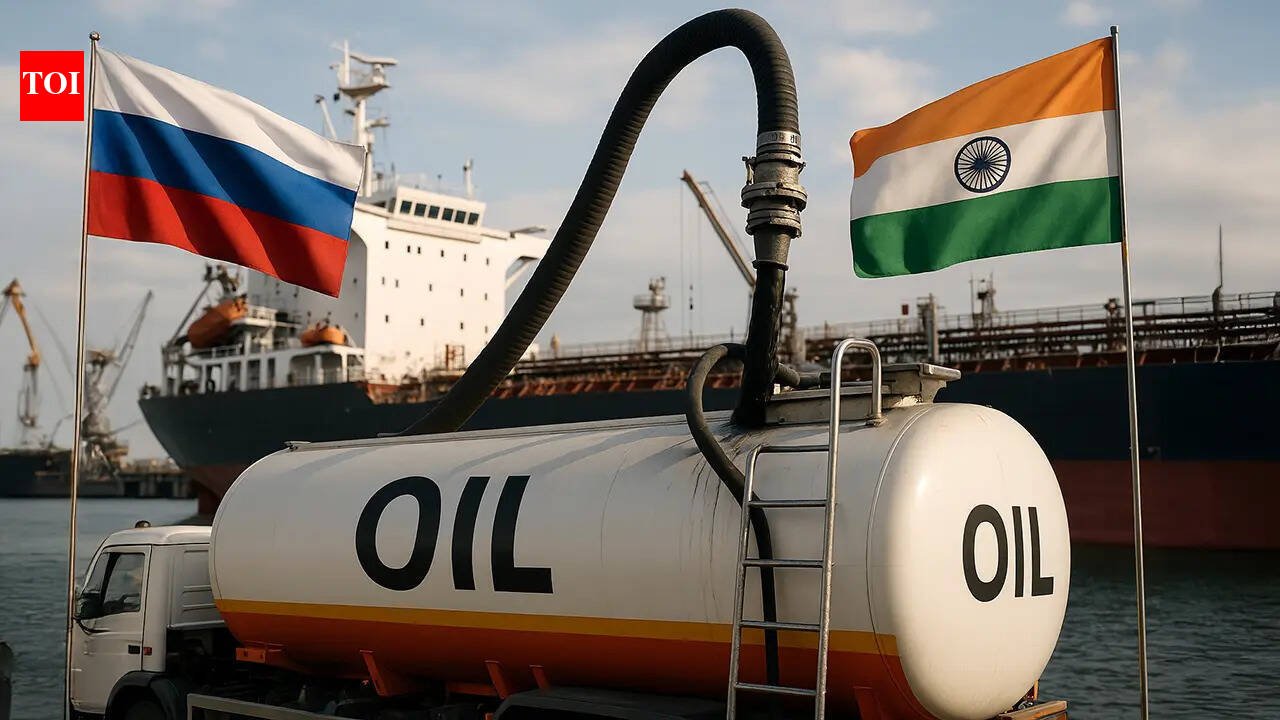
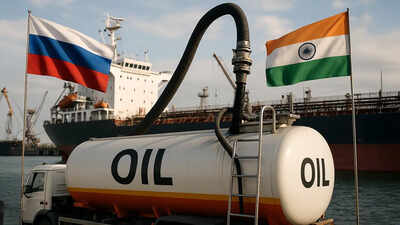
Russian oil supplies to India could rise sharply, potentially doubling from January levels to account for at least 40% of India’s total imports. (AI image)

As supply disruptions from the Strait of Hormuz continue due to the US-Iran war, India has stepped up its purchases of Russian crude oil. In fact, compared to the January levels, India’s procurement of Russian crude may actually double!Russian crude has once again taken centre stage amid the ongoing US-Iran conflict, as disruptions in global supply through the Strait of Hormuz have made it difficult for Middle Eastern producers to ship oil, driving prices sharply higher. This has had a significant impact on India, which depends on imports for nearly 90% of its crude oil needs.Traditionally, India has sourced most of its crude from the Middle East, particularly Iraq, Saudi Arabia and the UAE, owing to geographical proximity, established contracts and reliable shipping routes.

Russian Crude Imports May Double!

India and Russia are moving to strengthen their energy ties, with discussions underway to enable Moscow to restart direct liquefied natural gas sales to India for the first time since the Ukraine conflict began.According to a Reuters report, decisions on energy ties took place on March 19 in Delhi between Russian Deputy Energy Minister Pavel Sorokin and Petroleum and Natural Gas Minister Hardeep Singh Puri. Both sides explored expanding crude oil trade. According to three people aware of the deliberations, Russian oil supplies to India could rise sharply, potentially doubling from January levels to account for at least 40% of India’s total imports within about a month!Following the outbreak of the Russia-Ukraine war in 2022, Russia had emerged as a major supplier, accounting for about 35–40% of India’s crude imports at one point. However, by early 2026, sanctions led to a decline in these purchases. However, the situation has shifted again in March 2026 after the Donald Trump administration introduced a 30-day waiver allowing the purchase of Russian crude in an effort to stabilise global oil prices. While India never completely stopped importing Russian oil, volumes had dropped sharply after sanctions were imposed on major Russian producers.

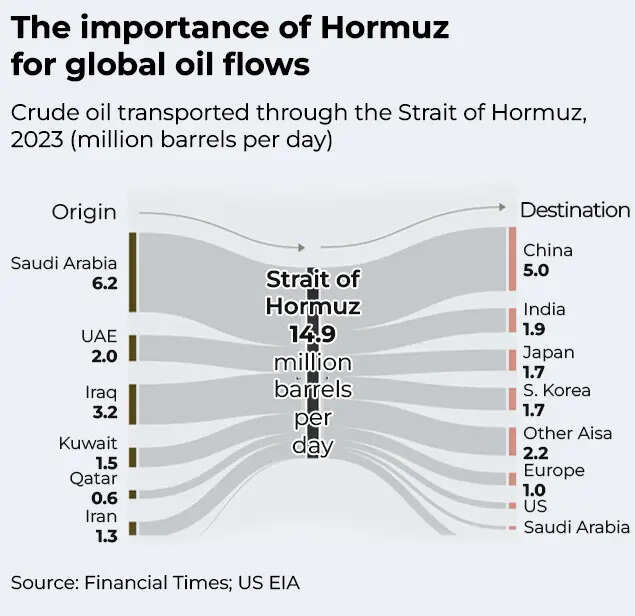
Importance of Hormuz for global oil flows

After Western sanctions following the Ukraine conflict limited Russia’s access to European markets, India increased its intake of Russian oil, attracted by discounted prices and compatibility with domestic refineries.Also Read | US-Iran war impact: India’s crude imports from Russia near all time highs; will such high numbers continue?This strategy helped lower import costs and diversify supply sources. However, towards the end of 2025 and into early 2026, India reduced purchases of Russian crude amid trade negotiations with the US and concerns over tariffs and sanctions. In August 2025, the US imposed a 25% tariff linked to India’s Russian oil imports, while sanctions on companies such as Lukoil and Rosneft further constrained procurement, leading to a gradual dip in volumes. That trend has now reversed.Data from Kpler indicates that India has already bought an estimated 45–50 million barrels of Russian crude since the onset of the Middle East conflict, with actual figures likely higher as April data is still pending. Current trends suggest that March imports could reach around 1.8 to 2.0 million barrels per day, marking one of the strongest months since India significantly increased purchases after the Ukraine war. This compares with earlier levels of about 1.0 million barrels per day.Historically, India’s peak monthly intake of Russian crude has been in the range of 2.0 to 2.1 million barrels per day since 2022. The latest surge indicates that imports are once again approaching those earlier highs, reversing the decline seen in recent months.


Source link