
First solar eclipse of 2026 is on February 17: Why the Moon won’t fully cover the Sun and how the ‘ring of fire’ appears |
[ad_1]
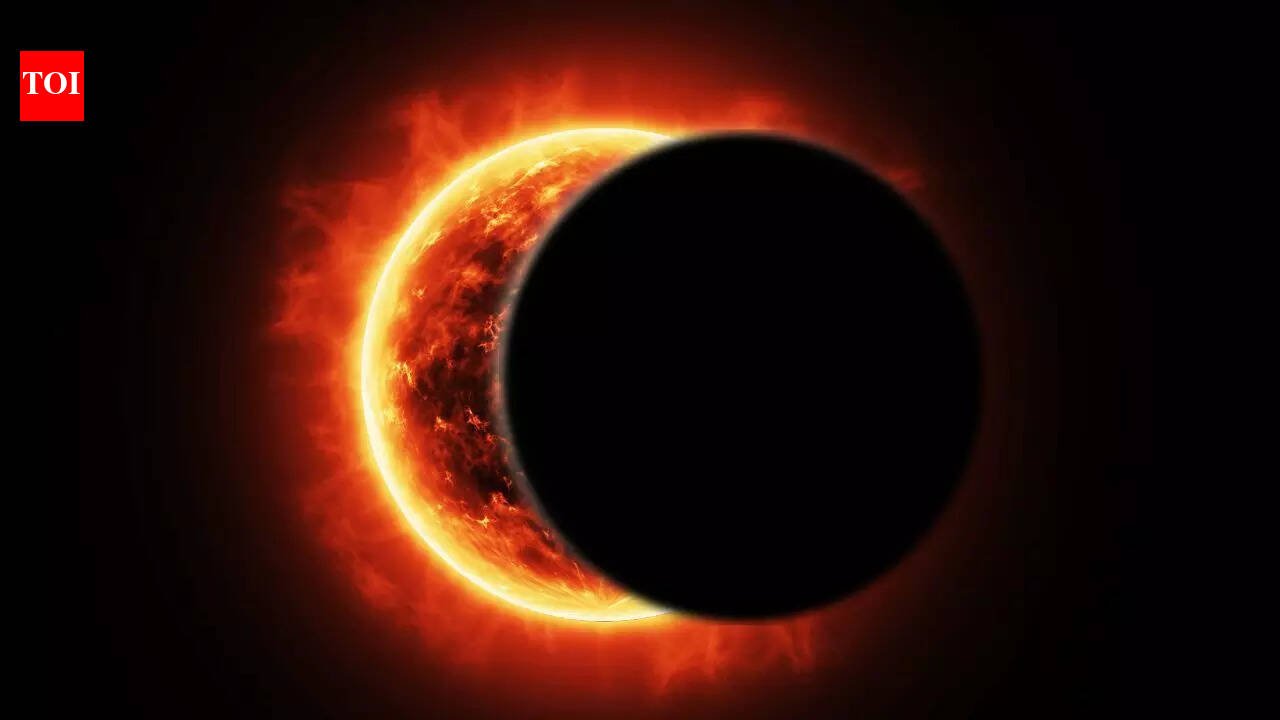
On 17 February 2026, skywatchers will get a chance to see one of the most striking types of solar eclipses: an annular eclipse, better known as a ‘ring of fire’. Unlike a total solar eclipse, where the Moon completely blocks the Sun, the Moon will leave a slim, glowing ring around its dark silhouette. The Moon doesn’t orbit Earth in a perfect circle. Its path is slightly oval, which means its distance from Earth constantly changes. When the Moon is closer, it can completely cover the Sun’s disc, creating a total eclipse. But tomorrow, the Moon is a bit farther away. Experts say it’s just far enough that it appears slightly smaller than the Sun in the sky. So when it slides in front of the Sun, it can’t cover it fully, as reported by the BBC.
How ‘ring of fire’ appears: Understanding annularity
Annularity is the term astronomers use to describe the moment the Moon is in front of the Sun but doesn’t fully obscure it. It comes from the Latin word annulus, which means ring. The Sun forms a thin, fiery ring around the Moon, giving the event its dramatic nickname, the ‘ring of fire’.During annularity, the Sun is not completely blocked, so the sky never goes fully dark. Experts say the light dims, shadows sharpen, and the atmosphere feels different. Some people describe it as twilight in the middle of the day. But unlike total eclipses, where temperatures drop, and stars can appear briefly, annular eclipses are subtler.The length of annularity depends on several factors:
- The Moon’s distance
- The Sun’s position
- The observer’s location on Earth
For tomorrow, the full ring is only visible from a narrow path across Antarctica.
Why only some places see the full eclipse
Every solar eclipse has a path.
- For total eclipses, it’s called the path of totality.
- For annular eclipses, it’s called the path of annularity.
It is basically the corridor on Earth where the Moon appears perfectly sized to create the ring. Outside that path, observers will only see a partial eclipse. Experts note that the path is narrow because the Moon’s shadow is cone-shaped. Antarctica happens to be in that perfect spot tomorrow, which is why only a handful of people and research station crews will witness the full effect.
Solar Eclipse 2026: Where and when to catch February’s ‘ring of fire’
Tomorrow, the sun will briefly transform into a stunning “ring of fire” during an annular solar eclipse. This happens when the moon moves between Earth and the sun, leaving only a slim outer ring of sunlight visible. At the peak of the eclipse, the fiery ring will be visible for up to 2 minutes and 20 seconds.Here’s how the eclipse will unfold, according to Time and Date:
- Partial eclipse begins — 4:56 am EST (0956 GMT)
- Maximum “ring of fire” — 7:12 am EST (1212 GMT)
- Partial eclipse ends — 9:27 am EST (1427 GMT)
The path of annulariy, where the moon will cover nearly all of the sun, is tiny and mostly over Antarctica, stretching roughly 2,661 miles long and 383 miles wide. Only observers within that narrow corridor will see the full “ring of fire.” People elsewhere in Antarctica, as well as parts of southern Africa and the southern tip of South America, will witness a partial eclipse, with much of the sun still visible.Quick tip: Never look directly at the Sun without proper solar eclipse glasses, even during annularity or partial phases. Ordinary sunglasses are not enough.
[ad_2]
Source link