Breaking News
Intel CEO Lip-Bu Tan replies to President Donald Trump’s post on ‘Made in America’ chips: ‘We bring…’

[ad_1]

Intel CEO Lip-Bu Tan replies to President Donald Trump’s post on ‘Made in America’ chips: ‘We bring…’

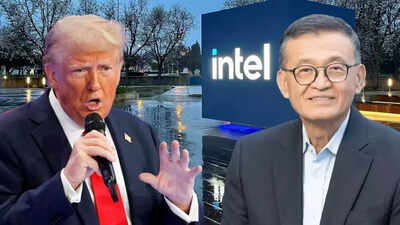
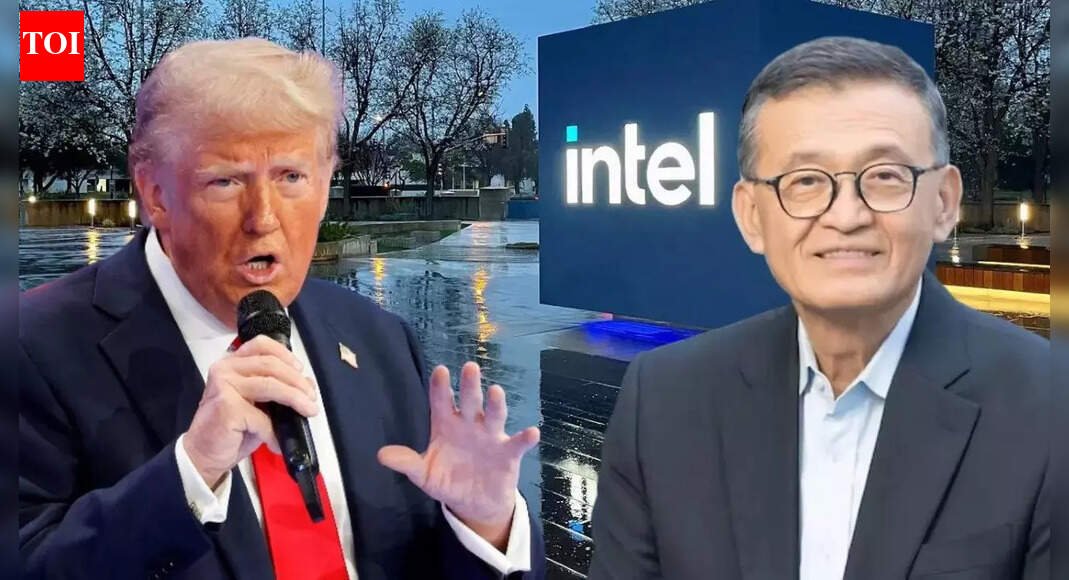
Intel CEO Lip-Bu Tan has thanked President Donald Trump for the support in helping the company ‘Make in America’. Tan’s message follows a high-level meeting with the President, who celebrated the ‘milestone’ in American semiconductor manufacturing by highlighting the first “sub-2 nanometer” CPU processors are now being designed, built and packaged entirely within the US.“I just finished a great meeting with the very successful Intel CEO, Lip-Bu Tan. Intel just launched the first SUB 2 NANOMETER CPU PROCESSOR designed, built, and packaged right here in the U.S.A. The United States Government is proud to be a Shareholder of Intel, and has already made, through its U.S.A. ownership position, Tens of Billions of Dollars for the American People — IN JUST FOUR MONTHS,” Trump said in a post on Truth Social.“We made a GREAT Deal, and so did Intel. Our Country is determined to bring leading edge Chip Manufacturing back to America, and that is exactly what is happening!!!” he added.In response, Tan thanked the Trump administration for backing the company.“Honored and delighted to have the full support and encouragement of @POTUS @realDonaldTrump and @CommerceGov Secretary @howardlutnick as we bring leading edge chip manufacturing back to America!” Tan said.“@intel is now shipping the latest Core Ultra Series 3 CPU processors – designed, manufactured and packaged with the most advanced semiconductor technology, right here in the USA,” he added.

Intel announces Core Ultra Series 3 as first built on Intel 18A process

At CES 2026, Intel launched its Core Ultra Series 3 processors – first AI PC chips manufactured on the Intel 18A process in the US. According to the company, the new lineup introduces high-performance X9 and X7 tiers, featuring integrated Intel Arc graphics and up to 50 NPU TOPS for AI tasks.“They are purpose-built for multitaskers that handle advanced workloads like gaming, creation and productivity on the go. The top SKUs feature up to 16 CPU cores, 12 Xe -cores and 50 NPU TOPS, delivering up to 60% better multithread performance, over 77% faster gaming performance and up to 27 hours of battery life,” Intel said.Intel said that the consumer laptops with these chips are expected to hit the market in Q2 2026. The pre-orders have already begun, with global shipping starting January 27.

[ad_2]

Source link

Rupee’s spectacular fall: Why RBI isn’t targeting a price band, but inflation — the ‘Impossible Trilemma’ explained

[ad_1]

Rupee’s spectacular fall: Why RBI isn't targeting a price band, but inflation — the 'Impossible Trilemma' explained

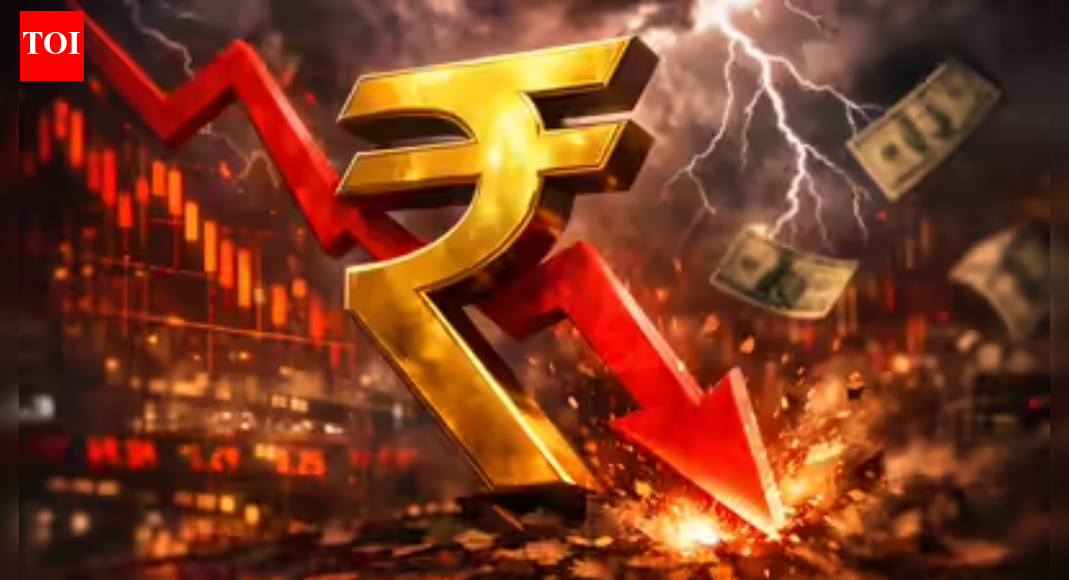
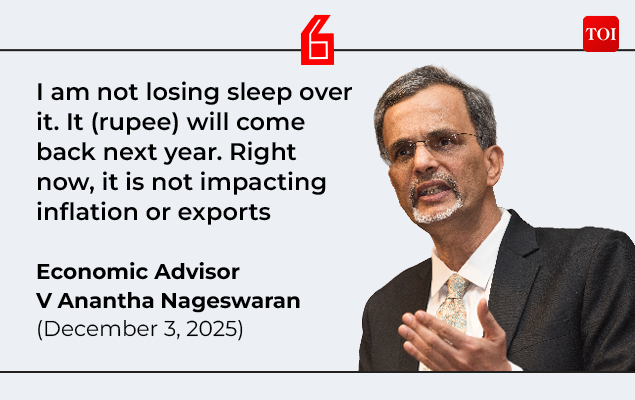
In early December 2025, the Indian rupee reached a key milestone when it surpassed Rs 90 per dollar for the first time. The rupee had been falling steadily throughout the year, as foreign investors sold off Indian stocks and US tariffs made Indian exports less competitive.However, on December 5, 2025, Reserve Bank of India Governor Sanjay Malhotra delivered a clear message”We don’t target any price levels (of rupee) or any bands. We allow the markets to determine the prices.”On the rupee’s slide, Chief Economic Adviser V. Anantha Nageswaran told reporters that the government wasn’t “losing sleep” over the currency’s decline. The falling rupee, he insisted, was “not affecting inflation or exports” and should “improve next year (2026).”

-

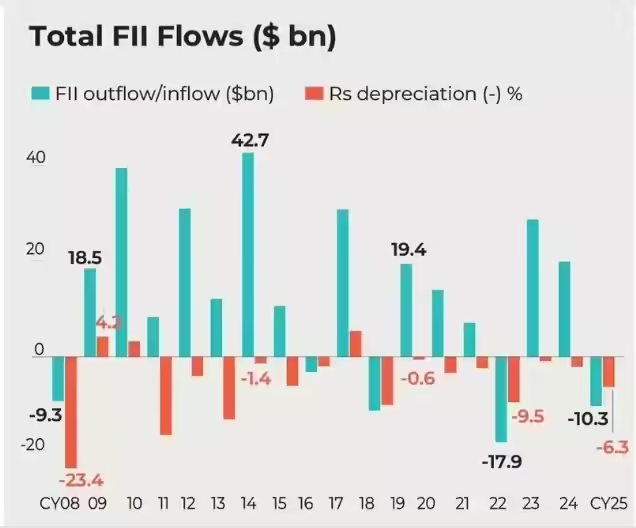
These weren’t throwaway lines. They reflected a fundamental economic framework – the impossible trilemma – that constrains every modern central bank and explains why India prioritizes inflation control over defending arbitrary currency levels. The rupee’s approximately 6% depreciation in 2025 wasn’t a policy failure. It was the deliberate price of maintaining monetary independence.

The Impossible Trilemma: India’s two-out-of-three choice

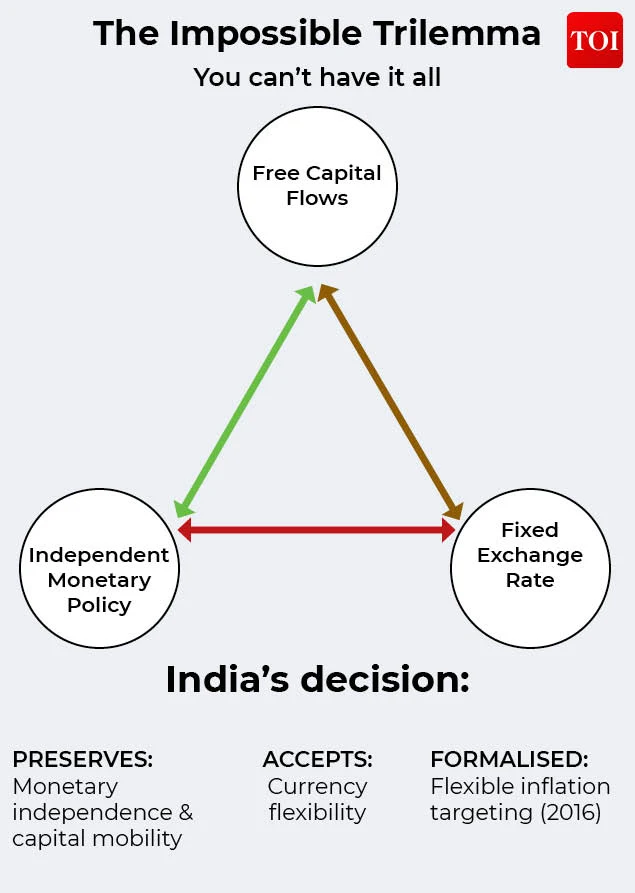
The impossible trilemma, explained by economists Robert Mundell and Marcus Fleming in the early 1960s, presents one of the most fundamental constraints in international economics.It states that it is impossible to have all three of the following at the same time:

  1. Free capital flows – allowing money to move across borders without restrictions
  2. Independent monetary policy – setting interest rates based on domestic needs
  3. Fixed exchange rate – keeping the currency stable against foreign currencies

As Paul Krugman famously summarized: “The point is that you can’t have it all: A country must pick two out of three.”

-

Understanding each corner of the trilemma

Free Capital Flows: This means allowing capital—both foreign and domestic—to move in and out of a country without restrictions. Investors can buy Indian bonds or stocks, and Indians can invest abroad without facing capital controls. The benefit is access to global capital markets, which can fund growth and development. The risk is volatility—hot money can rush in during good times and flee during crises.Independent Monetary Policy: This is the central bank’s ability to set interest rates based purely on domestic economic conditions—inflation, growth, unemployment—without worrying about external pressures. If inflation is rising domestically, the RBI can raise rates. If growth is slowing, it can cut rates. This independence is crucial for managing the domestic economy.Fixed Exchange Rate: This means committing to maintain the currency at a predetermined level against another currency (usually the US dollar) or within a narrow band. The benefit is predictability for trade and investment. The cost is the loss of flexibility to respond to economic shocks.

The mechanism: Why you can’t have all three

If a country wants to maintain a fixed exchange rate while allowing capital to flow freely across its borders, it must sacrifice control over its monetary policy. Here’s why:Suppose India tried to fix the rupee at Rs 80 per dollar while keeping borders open to capital flows. If the RBI increased interest rates to fight domestic inflation, higher returns would attract foreign capital, creating demand for rupees and pushing the exchange rate below Rs 80—say, to Rs 78. To maintain the Rs 80 peg, the RBI would have to sell rupees and buy dollars, increasing money supply and negating the interest rate hike’s anti-inflationary effect.Conversely, if the RBI cut rates to stimulate growth, capital would flee to higher-yielding assets abroad, weakening the rupee beyond Rs 80– say, to Rs 82. To defend the peg, the RBI would have to sell dollars and buy rupees, reducing money supply and negating the rate cut’s growth-boosting effect.In both cases, the attempt to maintain a fixed exchange rate forces the central bank to intervene in ways that undo its monetary policy actions. The interest rate becomes a tool for managing the exchange rate, not the domestic economy.As Ranen Banerjee, Partner and Leader, Economic Advisory Services & Government Sector Leader at PwC India, told TOI “The trilemma refers to making a monetary policy choice between first having fixed or floating interest rates, second free or restricted capital mobility and third having an independent capability to set interest rates. A monetary policy of a country has to make a choice of any two of these and cannot make a choice to have all three.

India’s choice: Monetary Independence and Capital Mobility

India’s choice has been clear since the 1990s economic liberalization: prioritize monetary policy independence and capital account openness, accepting exchange rate flexibility as the necessary trade-off.“In the case of India, we have made a choice of having independence in setting interest rates and having free capital mobility,” says Ranen Banerjee. “Thus, we will not have the ability to control exchange rates and it has to be floating. If we attempt to control the exchange rate, we will have to make a compromise on either our ability to set interest rates or bring in capital flow controls. Hence in the current policy choices made in the monetary policy, the rupee will find its own level with the Reserve Bank interventions being only for management of volatility as stated in its policy.In 2016 a flexible inflation-targeting framework was adopted, which made price stability—targeting consumer price inflation at 4% with a tolerance band of ±2 percentage points—the RBI’s primary statutory objective.

India’s currency regime: Managed float in practice

While India officially follows a “market-determined” exchange rate system, in practice it operates what economists call a “managed float” regime. The RBI doesn’t target a specific exchange rate level, but it does intervene to manage excessive volatility.

How RBI interventions work

The RBI’s forex interventions typically occur through:

  • Spot market operations: Directly buying or selling dollars in the spot market. When the rupee weakens too sharply, the RBI sells dollars (buying rupees), increasing dollar supply and supporting the rupee. When the rupee strengthens too much, it buys dollars (selling rupees), building reserves.
  • Forward market operations: The RBI also operates in the forward market, where it can buy or sell dollars for future delivery. This affects forward premiums—the cost of hedging currency risk—without immediately impacting spot rates.
  • Swap operations: The RBI occasionally conducts buy/sell swaps, where it simultaneously buys and sells dollars for different tenures. In December 2025, it announced a $10 billion dollar-rupee buy/sell swap to absorb excess dollar liquidity and cool elevated forward premiums.

The key distinction: These interventions aim to smooth volatility, not defend a specific rate. As Governor Malhotra clarified, “We don’t target any price levels or any bands.”

The reserves buffer

India’s foreign exchange reserves—currently around $686.8 billion (as of January 2, 2025)—provide the ammunition for these interventions. However, using reserves comes with costs. Each dollar sale drains reserves, and aggressive defence can deplete this buffer, leaving the country vulnerable during a genuine crisis.Sachchidanand Shukla, Group Chief Economist at Larsen & Toubro, points to another constraint: “RBI’s large net FX short forward positions act as a drag on the INR. While the RBI can roll over on maturity dates, it risks making it cheaper for speculators to fund long-USD positions and giving delivery would adversely impact durable liquidity, which could impact monetary transmission and weigh on the FX reserves.”

Why Inflation takes priority over exchange rate

India’s inflation-targeting framework, adopted in 2016, mandates the RBI to prioritize price stability. The framework defines this as targeting Consumer Price Index (CPI) inflation at 4% with a tolerance band of 2-6%, according to Inflation targeting framework 2016. In 2025, inflation has remained extraordinarily low, dropping below even the 2% lower tolerance band for three consecutive months (September-November).This success wasn’t accidental. It required consistent focus on domestic price stability, sometimes at the expense of currency stability. Between May 2022 and February 2023, the RBI raised the repo rate by 250 basis points (from 4% to 6.5%) to combat post-pandemic inflation, even as this widened interest rate differentials with other economies and put upward pressure on capital outflows. As Ranen Banerjee notes, maintaining this independence is crucial: “Hence in the current policy choices made in the monetary policy, the rupee will find its own level with the Reserve Bank interventions being only for management of volatility as stated in its policy.”

When the trilemma breaks: Historical lessons

History is evident with crises where nations tried to “have it all” and failed spectacularly:

1992 UK (Black Wednesday)

The UK tried to maintain the pound’s peg to the Deutsche Mark within the European Exchange Rate Mechanism while allowing capital flows. When economic conditions diverged—Germany needed high rates to fight reunification inflation while the UK needed lower rates to combat recession—the peg became unsustainable.Speculators, most famously George Soros, bet against the peg. On September 16, 1992, the Bank of England spent billions defending the pound and raised interest rates from 10% to 15% in a single day – but since it failed the implementation never happened. The UK was forced to exit the mechanism, devalue the pound, and abandon the peg. Soros reportedly made over $1 billion, according to Investopedia.The lesson: No amount of reserves can defend an overvalued peg against determined market forces when fundamentals don’t align.

1997 Asian Financial Crisis

Thailand, Indonesia, and South Korea attempted to maintain currency pegs with open capital markets while their economies overheated. When the Thai baht came under speculative attack in July 1997, Thailand spent its reserves defending the peg before finally floating.The baht collapsed 50% within months. The crisis spread to Indonesia (rupiah fell 80%), Malaysia, and South Korea. The IMF had to arrange bailout packages. Millions lost jobs, incomes, and savings.The lesson: Fixed pegs with open capital accounts become untenable when underlying economic fundamentals—current account deficits, asset bubbles, private sector debt—turn unfavorable.

2001 Argentina

Argentina maintained a 1-to-1 dollar peg for a decade while allowing relatively free capital flows. When the economy slipped into recession in 1998-1999 and capital began fleeing, Argentina should have either floated the peso, imposed capital controls, or implemented painful deflation to restore competitiveness.It did none of these decisively. Reserves drained, confidence collapsed, and in December 2001, Argentina froze bank deposits, defaulted on $95 billion in sovereign debt, and abandoned the peg, according to Cato Institute. The peso eventually fell to 4-per-dollar. GDP contracted 20%, unemployment hit 25%, and poverty soared. . In 2001, the debt-to-GDP ratio was 55 percent, although the figure increased to 150 percent after the depreciation since most of the debt was denominated in foreign currency, according to a Brooking study. The lesson: Trying to maintain all three corners of the trilemma during a crisis only delays and amplifies the eventual collapse.

The Rupee in 2025

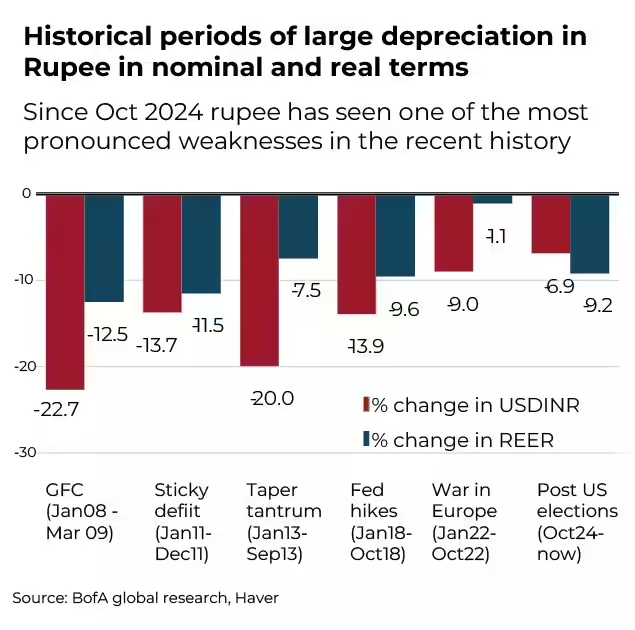
The rupee’s performance needs context. While it depreciated approximately 6% in 2025—becoming one of Asia’s weaker currencies—this follows a year of relative stability. Why the Rupee weakened in 2025Multiple factors converged to pressure the rupee in 2025:

1. Monetary policy divergence

At the other end of the spectrum, India has already seen rate cuts along with other easing measures, which have significantly narrowed its interest rate differential with regional peers and put downward pressure on the rupee, an analysis by Haver Analytics said “This has significantly reduced India’s interest rate differential with regional peers and placed downward pressure on the Indian rupee.” Meanwhile, the US Federal Reserve kept rates elevated for longer than expected, widening the US-India rate differential.

2. Foreign portfolio outflows

Foreign institutional investors turned net sellers of Indian equities and debt in 2025. The outflows were driven by:

  • High US treasury yields making dollar assets attractive
  • US tariff threats on Indian exports

-

Source – BofA

3. Current account pressures

India’s current account deficit—though still modest at 1.1% of GDP (December 2025)—reflects ongoing import demand, particularly for oil. As Sachchidanand Shukla notes: “The absence of positive newsflow on the India-US trade deal and expectations of a larger BOP [balance of payments] deficit continue to hurt INR.
-

Source- BofA

4. RBI intervention

“This backdrop forces RBI to prioritize monetary independence and open capital account as inflows, especially FDI are important, and hence it allows INR to be flexible/gyrate,” explains Sachchidanand Shukla. “Also, an aggressive defense of the INR at the current juncture could be futile.”

The strategic rationale: Why flexibility matters

Allowing the rupee to depreciate, rather than spending reserves to defend arbitrary levels, serves multiple strategic purposes:

1. Preserving Firepower

“An aggressive defense of the INR at the current juncture could be futile,” argues Sachchidanand Shukla. “Instead, two-way movement in INR can be used to absorb some of the global pressures, preserve FX buffers and allow market-driven adjustments that boost export competitiveness in a volatile world.”India’s forex reserves, while substantial at $696.6 (dec 26, 2025) billion, are finite. The Asian Financial Crisis showed that reserves can be depleted quickly when defending unsustainable levels. By allowing gradual depreciation, the RBI preserves reserves for genuine emergencies.

2. Export Competitiveness

A weaker rupee makes Indian exports cheaper in dollar terms, potentially offsetting some impact of US tariffs. With the REER having peaked at 108.14—indicating significant overvaluation—allowing depreciation helps restore competitiveness.Chief Economic Adviser Nageswaran emphasized this point, noting the falling rupee was “not affecting inflation or exports” negatively. In fact, a more competitive exchange rate could support export-oriented sectors like IT services, textiles, and pharmaceuticals.

3. Maintaining monetary autonomy

Most crucially, allowing currency flexibility preserves the RBI’s ability to set interest rates based on domestic needs. With inflation falling to historic lows (0.25% in October 2025), the RBI had justification to cut rates to support growth. Attempting to defend the rupee at a fixed level would have required keeping rates high despite low inflation—sacrificing domestic economic goals for an arbitrary currency target.

4. Two-way movement deters speculation

“Two-way movement in INR can be used to absorb some of the global pressures,” notes Sachchidanand Shukla. When the rupee only weakens (one-way movement), it becomes a profitable one-way bet for speculators. If they know the RBI will prevent strengthening but allow weakening, they can short the rupee risk-free.Two-way movement—allowing both appreciation and depreciation—makes speculation riskier and more expensive, naturally deterring some of it.

The road ahead: What this means for Rupee

Looking ahead, the rupee’s trajectory will depend on factors some of which are outside the RBI’s control:External Factors:

  • US Federal Reserve policy and dollar strength
  • US-India trade negotiations and tariff outcomes
  • Global commodity prices, especially oil
  • Geopolitical tensions and risk sentiment

Domestic Factors:

  • India’s growth trajectory and FDI inflows
  • Inflation dynamics and RBI’s rate path
  • Fiscal discipline and current account management
  • Structural reforms affecting competitiveness

What won’t change is the framework. India will continue prioritizing monetary independence and capital openness, accepting exchange rate flexibility as the price. The RBI will intervene to manage volatility, not defend specific levels.As Ranen Banerjee summarizes: “In the current policy choices made in the monetary policy, the rupee will find its own level with the Reserve Bank interventions being only for management of volatility as stated in its policy.”The impossible trilemma isn’t a theoretical abstraction. It’s a practical constraint that shapes decisions about interest rates, capital flows, and exchange rates. Understanding it is essential to understanding why the RBI responds to currency movements the way it does—and why allowing the rupee to find its level, rather than defending arbitrary bands, is not policy failure but policy by design.
[ad_2]

Source link

Telecom relief: Vi to pay Rs 1,144 crore over next 10 years for frozen Rs 87,695 crore AGR dues; bulk repayments start March 2036

[ad_1]

Telecom relief: Vi to pay Rs 1,144 crore over next 10 years for frozen Rs 87,695 crore AGR dues; bulk repayments start March 2036

Vodafone Idea (Vi) will pay the government Rs 1,144 crore over the next 10 years, with the remaining adjusted gross revenue (AGR) dues — frozen at Rs 87,695 crore — to be paid in instalments starting March 2036, the company said on Friday, reported PTI.The Union Cabinet has frozen Vi’s AGR dues at Rs 87,695 crore, with repayments to begin from FY2031-32 and continue until FY2040-41. In addition, the government has granted the telco six years, from FY2025-26 to FY2030-31, to clear AGR dues pertaining to 2017-18 and 2018-19 without any change.Vi said the entire AGR liability — comprising principal, interest, penalty and interest on penalty for the period from 2006-07 to 2018-19 as of December 31 — will be frozen and repaid in tranches.“Maximum Rs 124 crore to be paid annually over next six years i.e. March 2026 to March 2031; Rs 100 crore to be paid annually over four years i.e. March 2032 to March 2035; the remaining AGR dues, has to be paid in equal instalments annually over six years, i.e. March 2036 to March 2041,” the company said in a regulatory filing.The relief provides a fresh lease of life to the debt-laden operator, which would otherwise have had to pay around Rs 18,000 crore by March 2026 and a similar amount every year for the next six years without government support.Earlier, Vi had informed the Department of Telecommunications (DoT) that its total liabilities to the government were about Rs 2 lakh crore, including Rs 1.19 lakh crore towards spectrum dues. The company said that without support, the Centre would face significant losses, including no recovery of spectrum dues, erosion of equity value worth Rs 53,083 crore, and no recovery of AGR dues.Vi’s annual liabilities were more than double its operational cash generation, which has ranged between Rs 8,400 crore and Rs 9,200 crore over the last three years.The company also said a DoT-appointed committee will reassess the AGR dues, with its decision to be final. “Thereafter, the reassessed amount is to be repaid between March 2036 and March 2041 in equal annual instalments,” the filing said.Analysts said the relief could ease funding pressures. A Citi report said the move could “fast-track the completion of Vi’s Rs 250 billion (Rs 25,000 crore) bank debt raise” and potentially pave the way for another equity raise, while improving confidence in the company’s ability to continue as a going concern and revive network investments.Ambit Capital said decisive government action and possible upside from reassessment would help Vi raise bank funding needed for survival capex. It added that a favourable Supreme Court verdict had already enabled Vi to raise Rs 3,300 crore through non-convertible debentures recently.

[ad_2]

Source link

‘Inaccurate’: MEA rebuts Trump aide’s ‘PM didn’t call’ remarks; cites 8 Modi-Trump calls in 2025 | India News

[ad_1]

'Inaccurate': MEA rebuts Trump aide's 'PM didn't call' remarks; cites 8 Modi-Trump calls in 2025

NEW DELHI: The ministry of external affairs on Friday termed the remarks made by US secretary of commerce Howard Lutnick that “PM Modi’s reluctance to call Trump” was the reason behind the delay in the trade deal between the United States and India, as “inaccurate.In a media briefing MEA spokesperson Randhir Jaiswal said, “PM Modi and President Trump have spoken on eight occasions in 2025.”

‘No Call From PM Modi’: Trump Aide Lutnick’s Shocker On India-US Trade Deal Amid Tariff Threats

While responding to a question about the claims made by Lutnick in a podcast where he had blamed the delay in the US-India trade agreement on New Delhi, saying that the States waited for PM Modi‘s call for too long, Jaiswal dismissed the claims as “inaccurate characterizations.”He mentioned the multiple rounds of negotiation between the two countries and how on several occasions a “deal was close.”Also read: Between the staircase and the see-saw; Did PM Modi’s reluctance to call Trump cost India a trade deal?“We have seen the remarks, India and the United States were committed to a bilateral trade agreement as far back as February 13, 2025. Since both sides have had multiple rounds of negotiations to arrive at a mutually beneficial deal. On several occasions we have been close to a deal. The characterisation of these discussions in reported remarks is not accurate,” Jaiswal said.He further went on to say India remains committed to a mutually ‘beneficial’ trade agreement, also rebutting Lutnick’s claims. “We remain committed to mutually beneficial deal between two complementary economies. Incidentally, PM Modi and President Trump have spoken on eight occasions in 2025, covering different aspects of our wide ranging partnership,” he said.Speaking at the All-In Podcast, hosted by Chamath Palihapitiya, Lutnick said, “Let’s be clear, it’s his deal. He’s the closer. He does the deal. So I said, you got to have Modi. It’s all set up. You have to have Modi…they were uncomfortable doing it.”Also read: ‘Hug hug na raha’- Congress takes dig at PM Modi; reacts to stalled India–US trade deal “So Modi didn’t call,” he claimed. This statement comes after US President on Thursday, approved a bill that can impose at least 500 per cent tariffs for countries buying Russian oil, aiming to “punish them.” US senator Lindsey Graham said that the bill would give US tremendous leverage against countries like China, India and Brazil to incentivize them to stop buying the cheap Russian oil.

[ad_2]

Source link

Union Budget 2026: PLI scheme should be extended to new tech sectors like AI, robotics; here’s what EY India recommends

[ad_1]

Union Budget 2026: PLI scheme should be extended to new tech sectors like AI, robotics; here's what EY India recommends

EY India has recommended to extend the existing Production-Linked Incentive (PLI) scheme to new technology sectors such as AI, space, and robotics, while urging the FY27 Budget to focus on sustaining growth and ensuring tax certainty through a dedicated Customs dispute resolution mechanism. The firm said a forward-looking policy approach would be key to strengthening investor confidence and encouraging greater participation from the private sector. Highlighting the need to stimulate private investment, EY India National Tax Leader Sameer Gupta said the current PLI framework could be widened to support new-age technologies. “Additionally, public infrastructure investments in futuristic areas, including AI, GenAI, robotics, and space technology, may induce growth of private investment in these sectors. Targeted incentives for the emerging industries will be crucial in driving innovation and attracting both domestic and foreign investors,” Gupta told PTI. On taxation, EY said businesses continue to seek a firm commitment from the government towards tax certainty and simpler compliance mechanisms. Addressing indirect taxes, the firm proposed the introduction of a one-time settlement scheme under Customs law to help resolve long-pending disputes. It said the initiative could be modelled on the ‘Sabka Vishwas (Legacy Dispute Resolution) Scheme, 2019’, which helped unlock revenue tied up in litigation. EY also stressed the need to simplify the existing customs tariff structure to ease the compliance burden on importers. It suggested sector-wise rationalisation of customs duties and aligning tariff rates with global standards to ensure that Indian goods remain competitive in global markets. On the rollout of the new Income Tax Act, 2025 from April 1, EY said that the government should issue detailed guidelines and frequently asked questions to reduce confusion during the transition from the Income Tax Act, 1961. “This is crucial to avoid litigation and ensure a smooth transition for taxpayers. Certainty and predictability: Establishing a stable tax environment by minimising frequent changes in tax rates is essential,” the firm said. EY further stated that a stable and predictable tax policy is crucial for trust and encourages compliance, playing a key role in boosting revenue collection.

[ad_2]

Source link

‘Cousin thought I died’: Jemimah Rodrigues recalls horrific ‘church’ incident | Cricket News

[ad_1]

'Cousin thought I died': Jemimah Rodrigues recalls horrific 'church' incident
Jemimah Rodrigues (AP Photo)

NEW DELHI: Indian women’s cricket team batter Jemimah Rodrigues recently shared a scary yet funny story from her childhood that left everyone shocked at the time. The incident happened when she was just eight years old, long before she became a World Cup hero for India.Jemimah recalled that she was at a church programme with her cousins. The kids were playing outside an auditorium while the adults were busy inside. Like most children, they were full of energy and mischief.

India vs New Zealand ODIs preview: Captain Shubman Gill, vice-captain Shreyas Iyer in focus

They started playing a game where they threw chappals and crocs at each other for fun.While speaking on Breakfast With Champions, Jemimah explained how things suddenly went wrong.“We were in an auditorium where we had a church program. All the kids were outside. We were playing chappal fight over there. (I was like eight) My cousin threw her crocs and it was like you had to jump the other side to get it,” Jemimah said.Trying to act brave, young Jemimah decided to retrieve the shoe herself. What followed was a moment that scared her cousins badly.“I, like a full hero, said that I would get it. I fell from the first floor. Luckily, someone was sitting down, and I fell on her head. My cousins thought I died,” Jemimah said.Thankfully, she escaped without any injury. The fall looked serious, but luck was on her side. What could have been a tragedy turned into a story the family still remembers.Today, Jemimah’s life looks very different. She has had a dream 2025 in cricket. She played a huge role in India’s ICC Women’s World Cup victory. Her unbeaten 127 runs against Australia in the semi-final was one of the best knocks of the tournament.Recently, Jemimah was also named the new captain of Delhi Capitals for the 2026 Women’s Premier League. Reacting to the honour, she said, “It is an absolute honour to be named captain of the Delhi Capitals, and I am deeply grateful to the owners and the support staff for placing their faith in me to lead this team.”“It has truly been a dream year for me and my family, winning the World Cup and now being entrusted with this wonderful opportunity at a franchise that has held a very special place in my heart since the very first season of the WPL,” she added.

[ad_2]

Source link

Mutual funds trends: Equity funds see 6% dip to Rs 28,054 crore in December; debt outflows hit AUM

[ad_1]

Mutual funds trends: Equity funds see 6% dip to Rs 28,054 crore in December; debt outflows hit AUM

Equity mutual fund inflows declined by over 6% to Rs 28,054 crore in December, even as investor interest in equities and gold remained intact amid heavy redemptions from debt schemes, data released by industry body AMFI showed on Friday.The moderation in equity inflows came from Rs 29,911 crore in November, though collections were still higher than Rs 24,690 crore recorded in October, PTI reported. The sharp sell-off in debt funds pulled the mutual fund industry into net outflows of Rs 66,591 crore during the month.Reflecting the impact of large debt withdrawals, the industry’s total assets under management (AUM) dipped to Rs 80.23 lakh crore in December from Rs 80.80 lakh crore in November.Among equity categories, most segments continued to attract net inflows, barring ELSS (equity-linked saving schemes) and dividend yield funds. Flexi-cap funds led the pack with net inflows of Rs 10,019 crore in December, up from Rs 8,135 crore in the previous month, underlining their appeal amid uncertain market conditions.Mid-cap funds followed with inflows of Rs 4,176 crore, while large and mid-cap funds attracted Rs 4,094 crore and small-cap funds Rs 3,824 crore. Large-cap funds saw net inflows of Rs 1,567 crore during the month.In contrast, ELSS funds recorded net outflows of Rs 718 crore, while dividend yield funds saw redemptions of Rs 254 crore, pointing to profit-booking and seasonal tax-related adjustments.Debt mutual funds bore the brunt of redemptions, witnessing massive net outflows of Rs 1.32 lakh crore in December, compared with outflows of Rs 25,692 crore in November.Gold exchange-traded funds (ETFs), meanwhile, saw a sharp rise in investor interest, with net inflows jumping to Rs 11,647 crore in December, from Rs 3,742 crore in November and Rs 7,743 crore in October.Commenting on the trend, Akhil Chaturvedi, Executive Director and Chief Business Officer at Motilal Oswal Asset Management Company, said “Equity gross sales increased by nearly 7% month-on-month to Rs 72,808 crore, while hybrid gross sales grew ~17% to Rs 16,548 crore, indicating sustained participation in market-linked products. Flexi Cap funds were the key contributors, supported by NFO-led inflows, while Multi Asset Allocation funds recorded their peak gross sales in December 2025 at ~Rs 9,000 crore. Despite elevated redemptions, equity funds posted healthy net inflows of ~Rs 29,500 crore in December, reflecting profit-taking rather than risk aversion, with hybrid funds also remaining net positive. Gold & Silver oriented funds also have witnessed over Rs 10000cr of inflows.”

[ad_2]

Source link

Iran Protests: Economic Collapse Sparks Uprising – A Turning Point for the Islamic Republic | World News

[ad_1]

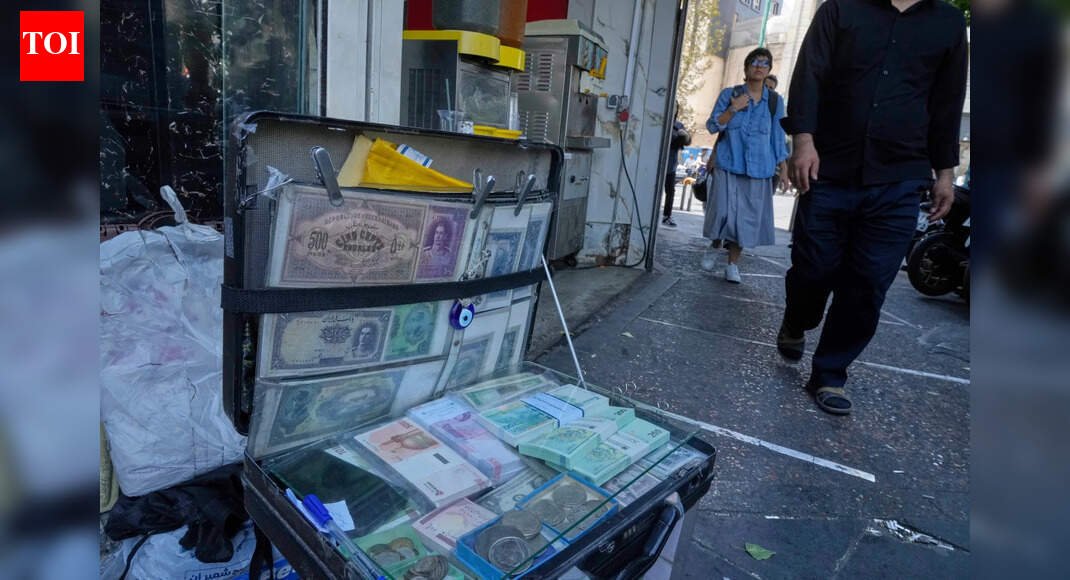
1 USD = 1,400,000 IRR: Iran on edge - why this is the most dangerous uprising yet
Iran’s latest protests, sparked by a devastating economic collapse and a plummeting currency, are unlike previous unrest. This wave sees a broader social coalition, including merchants, demanding regime change. Unlike past uprisings, the trigger is not a single outrage but the daily futility of a broken economy, making this a critical legitimacy crisis for Tehran.

In Iran, protests follow a familiar rhythm. They rise, they spread, they are crushed. What is unsettling about current demonstrations is not their scale alone but the sense that the old pattern may be breaking down.TL;DR: Driving the newsIran’s latest wave of nationwide protests, which began in late December 2025, is not simply another chapter in the Islamic Republic’s long cycle of unrest. What distinguishes this moment is not just scale or slogans, but the trigger: a total breakdown of economic credibility that has turned daily life into an exercise in futility and pushed once-cautious social groups into open revolt.The immediate spark was the collapse of the Iranian rial to roughly 1.4 million per US dollar, a historic low that coincided with inflation climbing past 50%, food prices surging more than 70% year-on-year, and wages losing value almost overnight. Protests began not on university campuses or around social restrictions, but in Tehran’s Grand Bazaar – the symbolic and practical heart of Iran’s economy – before spreading rapidly to all 31 provinces.Why it matters

  • This uprising strikes at the economic foundations of consent, not just the regime’s ideological legitimacy.
  • Iran’s leadership has survived repeated legitimacy shocks – from the 2009 Green Movement to the 2019 fuel protests to the 2022–23 “Woman, Life, Freedom” uprising – by combining repression, selective concessions and fear. But many analysts cited by Foreign Policy, the Economist, and others argue that those tools work best when the economy, however battered, still functions.
  • This time, money itself has stopped making sense.
  • When shopkeepers cannot price goods, importers cannot plan, and wages evaporate before payday, the state loses its ability to arbitrate daily life. As Alex Vatanka of the Middle East Institute told Reuters, “The collapse is not just of the rial, but of trust.” In Iran’s political history, that is a dangerous place for any government to be.

Zoom in: What’s genuinely new about this protest wave1) The trigger is economic collapse, not a single outrageThe 2022 protests followed the death of Mahsa Amini and centered on dignity, bodily autonomy and generational rebellion. Those grievances remain unresolved, but the 2025–26 protests erupted because commerce itself broke down. The Times of Israel described the moment bluntly: Iranians revolted when they realized that “money no longer works.”That distinction matters. Moral outrage can be compartmentalized or delayed. Economic paralysis cannot.2) The social coalition is broader – earlierAccording to Foreign Policy, the current protests have already mobilized bazaar merchants, students, urban professionals, laborers, women and ethnic minorities in their opening phase. In 2022, protests initially clustered in major cities and among youth. This time, smaller towns and economically marginalized areas joined quickly, reflecting how deeply inflation and currency collapse have penetrated Iranian society.3) The center of gravity has shifted toward regime changeWhile “Woman, Life, Freedom” remains symbolically powerful, slogans heard across Tehran, Isfahan, Mashhad and beyond increasingly call for the end of the Islamic Republic itself. Reuters and AP documented chants praising the former monarchy and calling for the return of Crown Prince Reza Pahlavi – rhetoric that once would have guaranteed swift execution.The shift does not signal consensus on what should replace the system. It does signal exhaustion with reform as an option.Between the lines: Why Iran isn’t Syria – and why that may be worseComparisons to Syria surface whenever Middle Eastern protests escalate. But Michael Rubin of the Middle East Forum argues that Iran’s trajectory could be more chaotic, not less.Syria’s civil war eventually hardened along ethnic and sectarian lines, creating de facto safe zones. Assad’s Alawite base retreated to Latakia. Kurds controlled the northeast. Rebel groups carved out enclaves elsewhere. Iran has no such geographic or sectarian escape valves.The Islamic Republic is multi-ethnic, its ruling elite draws from multiple communities, and even Supreme Leader Ali Khamenei himself is Azerbaijani. If the center collapses, there is no obvious periphery to absorb the shock.Rubin also highlights a structural risk: fragmentation within the security forces. The Islamic Revolutionary Guard Corps is not monolithic. Some members joined for economic security; others are ideologues shaped from childhood. If central authority weakens, different units could compete rather than coordinate. As Rubin writes, “It is unlikely that either the Guard Corps or the Iranian Army is unified enough to appoint an influential leader.That dynamic raises the specter not of a clean transition, but of elite infighting and nationwide instability.

I have let them know that if they start killing people, which they tend to do during their riots — they have lots of riots — if they do it, we are going to hit them very hard

Donald Trump during an interview with conservative radio host Hugh Hewitt

What they are sayingIran’s leadership is reaching for familiar language – and finding it less effective.Supreme Leader Ayatollah Ali Khamenei has acknowledged economic grievances, echoing his approach during the 2022 protests when he said Mahsa Amini’s death “deeply broke my heart.” In his latest remarks, he again recognized public suffering before pivoting to claims of Western “soft war.”“What turned the tide of the protests was former Crown Prince Reza Pahlavi’s calls for Iranians to take to the streets at 8pm on Thursday and Friday,” Holly Dagres, a senior fellow at the Washington Institute for Near East Policy, told AP. “Per social media posts, it became clear that Iranians had delivered and were taking the call seriously to protest in order to oust the Islamic Republic.”On the streets, that message is not landing. Protesters are increasingly linking domestic misery to Tehran’s regional ambitions. A 25-year-old woman in Lorestan told Reuters: “I just want to live a peaceful, normal life … Instead, they insist on a nuclear program and supporting armed groups.”From abroad, the rhetoric has grown sharper. US President Donald Trump warned that if Iranian authorities “start killing people,” Washington would respond forcefully, saying the US was “locked and loaded and ready to go.” Iranian officials now cite those statements as evidence of foreign interference – even as everyday Iranians struggle to buy food.Israeli Prime Minister Benjamin Netanyahu commended the demonstrations, describing them as “a decisive moment in which the Iranian people take their futures into their hands”.The big picture: A legitimacy crisis with fewer shock absorbersThis protest wave unfolds as Iran’s external position is weaker than at any point in decades.

The latest protests diverge from the old pattern in two ways. One is that the bankruptcy of the regime (both literal and figurative) is in full view. Iran has endured a year of economic collapse, war and environmental crisis; its leaders have no solutions for these woes. The other difference is the prospect of foreign intervention, by either Israel or America. After the American raid to seize Nicolás Maduro from Venezuela on January 3rd, many Iranians wondered if their country might be next in Donald Trump’s crosshairs.

An article in the Economist

In 2022, Tehran could still point to its regional influence and nuclear leverage as buffers against internal dissent. In 2025–26, those buffers have eroded. Bashar al-Assad is no longer in power in Syria. Israeli and US strikes in 2025 badly damaged Iran’s nuclear infrastructure. Proxies from Gaza to Lebanon have been degraded too.At home, the regime’s time-tested formula – repression paired with tactical concessions – is losing traction. Analysts cited by Reuters say crackdowns still instill fear, but no longer restore confidence. Cosmetic changes, such as reshuffling economic officials or promising dialogue, ring hollow to a population that understands where real power lies.As the Economist observed, what sets this moment apart is that “the bankruptcy of the regime (both literal and figurative) is in full view.” Add the unprecedented talk of possible foreign intervention, and uncertainty multiplies.What’s next

  • In the short term, Tehran is likely to intensify repression.
  • But Iran’s protests are different this time because they are rooted in economic collapse, not a single injustice – and because they arrive when the regime is poorer, weaker abroad, and facing a population that increasingly sees no path forward within the system.
  • History offers little comfort. Illegitimate regimes do not always fall, and when they do, they rarely fall cleanly. North Korea was once assumed to be a “zombie state.” It survived. Syria collapsed into catastrophe.
  • Iran now sits uncomfortably between those outcomes. The protests have shattered what remained of the regime’s moral and economic credibility. Yet the opposition remains fragmented, the security forces armed, and the stakes for insiders existential.
  • As Reuters quoted one analyst, “Change now looks inevitable; regime collapse is possible but not guaranteed.”

(With inputs from agencies)

[ad_2]

Source link

Stock market crash today: Why has Sensex plunged over 2,000 points, Nifty down over 2% in 5 days? Top 5 reasons explained

[ad_1]

Stock market crash today: Why has Sensex plunged over 2,000 points, Nifty down over 2% in 5 days? Top 5 reasons explained
The steady exit of overseas funds has intensified the weakness in benchmark indices. (AI image)

Stock market crash: Equity benchmark indices, Nifty50 and BSE Sensex, have plunged by over 2% in the last few trading sessions, with both indices seeing the fifth consecutive day of crash on Friday. Concerns over global trade tensions and political developments in Washington have disrupted investor sentiment, adding to caution.Over the past five trading sessions, the BSE Sensex has shed over 2,100 points, falling from its January 2 close of 85,762.01 to an intraday trough of 83,506.79 on Friday. During the same period, the NSE Nifty 50 has declined to levels below 25,700.

Why is the stock market crashing?

1. FIIs sell-off: Ongoing foreign investor outflows have added to the pressure on equities during the prolonged slide. Foreign institutional investors sold shares worth Rs 3,367.12 crore on Thursday, January 8, marking the fourth straight session of net selling following a brief respite on January 2.The steady exit of overseas funds has intensified the weakness in benchmark indices, deepening losses amid an uncertain global backdrop and reinforcing a risk-averse stance among investors already navigating unfavourable external conditions.2. Trump trade & tariff uncertainty: Equity markets have remained under strain after US President Donald Trump indicated that tariffs on Indian exports could be increased over New Delhi’s continued purchases of Russian crude. A new bill proposing 500% tariffs on countries buying Russian oil has been given a nod by Trump.A proposed bilateral trade agreement between the two countries remains unresolved despite six rounds of discussions held since March. Speaking on the All-In Podcast, US Commerce Secretary Howard Lutnick suggested the talks lost momentum after Prime Minister Narendra Modi did not place a call to Trump. The Trump administration has already imposed tariffs of up to 50% on Indian goods, including a 25% levy linked to India’s imports of Russian oil, among the steepest applied to any trading partner. India has termed these measures “unfair, unjustified and unreasonable”.The uncertainty has intensified ahead of a pending ruling by the US Supreme Court on the legality of Trump’s tariff actions. If the court finds the levies unlawful, Washington could be required to return close to $150 billion to importers, a decision that would have far-reaching implications for global trade.“After the sharp correction yesterday triggered by the possibility of about 500% tariff on India under the provisions of the Russia Sanctioning Act approved by President Trump, the market will be focused on the verdict expected today from the US Supreme Court on the legality of Trump tariffs,” said Dr. VK Vijayakumar, Chief Investment Strategist at Geojit Investments.“There is a high probability of the verdict going against Trump. But the details are significant: that is, whether it would be a partial striking down of the tariffs or completely declaring the tariffs illegal. The market reaction would depend on the details. If the Supreme Court declares Trump tariffs illegal, there would be a rally in India since India has been the worst affected by the 50% tariffs,” Vijayakumar added.He noted that the recent sharp selloff has dragged down even stocks unlikely to be directly affected by any punitive US measures. According to him, sectors such as financials, consumer discretionary and industrials, which have corrected due to broader market weakness, now offer opportunities for long-term investors to accumulate.3. Muted global signals: Soft cues from overseas markets have reinforced the cautious mood in Indian equities. Stocks across Asia slipped as investors awaited a key US employment report and prepared for a US Supreme Court decision on the validity of President Donald Trump’s broad tariff measures, a ruling that could once again unsettle global markets.4. Rising crude prices weigh on sentiment: Firming oil prices have added another layer of pressure on Indian markets, given the country’s significant reliance on imported crude. Prices moved higher amid lingering geopolitical risks, with investors closely monitoring developments in Venezuela following the capture of President Nicolás Maduro by US forces in a high-profile military operation in Caracas over the weekend.5. Technical signals point to continued weakness: Chart indicators have strengthened the bearish undertone, with key benchmarks breaking below important support levels during the recent decline.“Technically, the market breached the 20-day SMA (Simple Moving Average) support zone, and post-breakdown, selling pressure intensified,” said Shrikant Chouhan, Head Equity Research at Kotak Securities according to an ET report.“On daily charts, it has formed a long bearish candle, indicating further weakness from the current levels,” Chouhan said. He added that “We are of the view that as long as the market is trading below 26,000/84500, weak sentiment is likely to continue on the downside, and the market could slip till 25,750-25,700/84000-83700. On the flip side, if it moves above 26,000/84500, the pullback could continue till 26,075-26,100/84800-85000.Geojit Investments also flagged caution, citing stretched technical readings. “Short term oscillators being oversold, and being in the vicinity of 30 December’s low, it will not be surprising if a turn high is attempted, as long as 25878 is not penetrated by much margin,” the brokerage said.“Alternatively, slippage past 25776 would have to be taken as a sign that Nifty is coming off a sideways trading range that has been on since November 2025, prompting us to consider possibilities of sharper fall, with 200 day SMA positioned deep at 25039 now.”(Disclaimer: Recommendations and views on the stock market, other asset classes or personal finance management tips given by experts are their own. These opinions do not represent the views of The Times of India)

[ad_2]

Source link

Google cofounders Sergey Brin and Larry Page are ‘cutting ties’ with America’s Silicon Valley

[ad_1]

Google cofounders Sergey Brin and Larry Page are 'cutting ties' with America's Silicon Valley

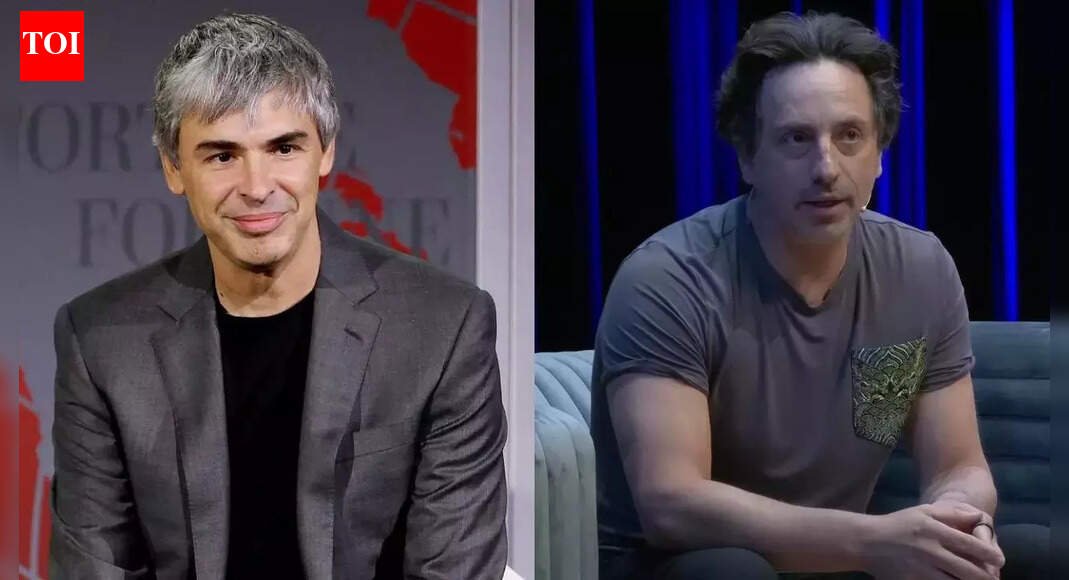
Google founders Sergey Brin and Larry Page have now shifted an entity tied to them out of California, beating the deadline on a proposed wealth tax targeting the state’s richest residents. As reported by Business Insider, the fillings revealed that T-Rex LLC, formed in 2006 and long managed from Palo Alto is converted into a Delaware-based company called T-Rex Holdings on December 24, 2025. The new filling reviewed by Business Insider also lists Reno, Nevada as its principal office with Brin and Page remaining managers. This move from Brin and Page comes as California is considering a 5% one-time tax on billionaires, a ballot measure slated for November 2026. If the California wealth tax gets approved then a tax would apply retroactively to residents as of January 1, 2026. Attorney’s for wealth clines have warned Governor Gavin Newsom that the Billionaire wealth tax proposal could lead to an ‘exodus of capital and innovation’ from the state.

Google Founder Larry Page already relocated other entities

Earlier this week, a report by Business Insider revealed that Larry Page has severed ties with California by covering his family office into a Delaware entity. Along with this, Page has also incorporated other ventures in Delaware, including those funding influenza research and flying car projects. On the other hand, Brin still remains tied to various California-based entities, such as the Sergey Brin Family Foundation and Bayshore Global Management, though filings show no other exits linked to him.For those unaware, Brin and Page cofounded Google nine years ago 1998 and are among world’s wealthiest individuals. As per the Bloomberg Billionaires Index, Page is the second-richest person globally and Brin the fourth, each with net worths exceeding $250 billion.

LinkedIn founder Reid Hoffman calls California Billionaire tax a horrendous idea

Recently, LinkedIn founder Reid Hoffman joined the list people opposing the proposed California wealth tax. Hoffman has strongly opposed California’s proposed 5% wealth tax on billionaires. In a post shared on social media platform X (formerly known as Twitter), Hoffman said that the California’s Billionaire tax is ‘badly designed’ and comes with ‘massive flaws’ and there are chances that it will become ‘horrendous’ for innovation. Hoffman further revealed that Rep. Ro Khanna had reached out to discuss the proposal and Hoffman made his opposition clear. “One well‑documented example is the horrendous idea to tax illiquid stock in the proposal,” Hoffman wrote. “Poorly designed taxes incentivize avoidance, capital flight, and distortions that ultimately raise less revenue.”

[ad_2]

Source link