Breaking News
Foreign brokerages cut India Inc’s earnings, index targets

[ad_1]

Foreign brokerages cut India Inc’s earnings, index targets

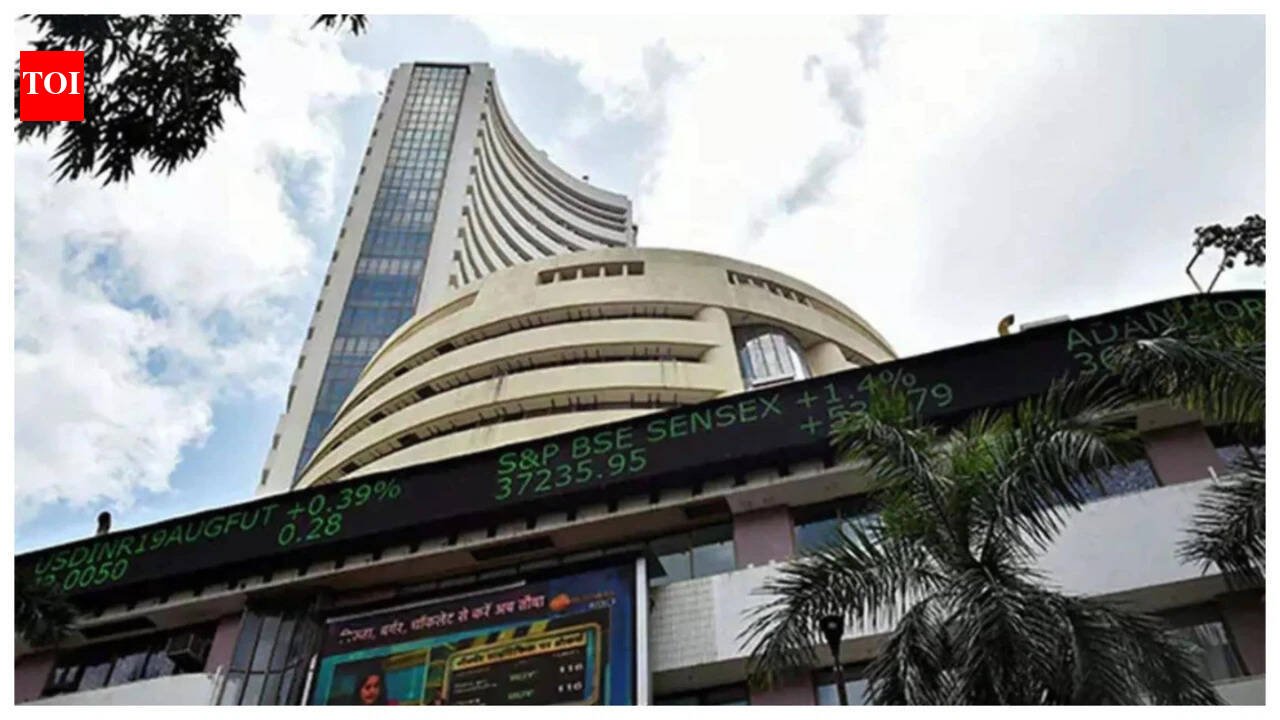
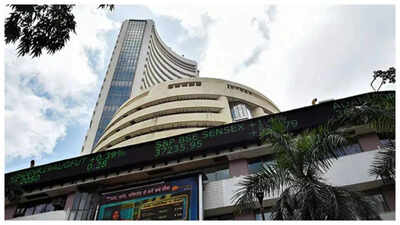
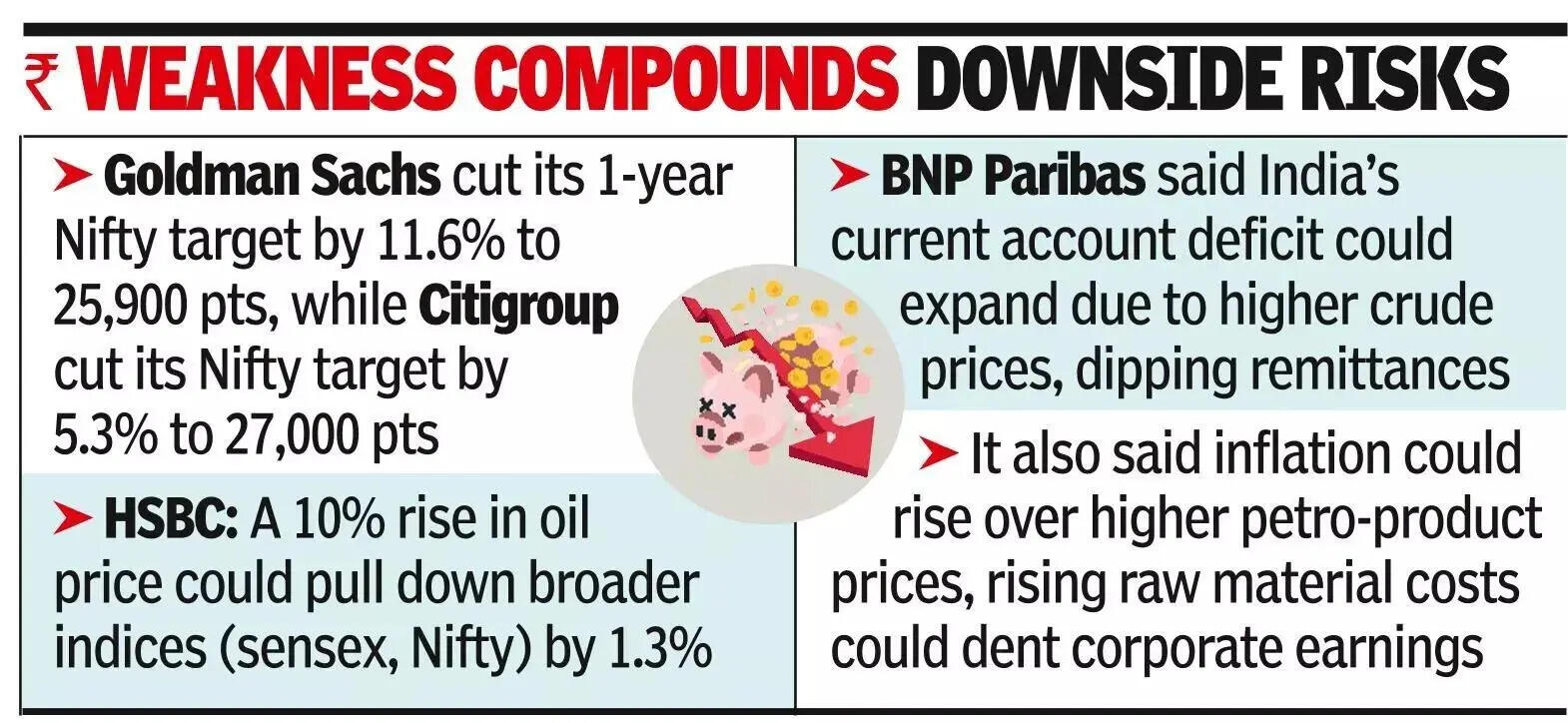
MUMBAI: Thanks to the war in West Asia and the ensuing oil price-led shock that the Indian economy is currently facing, top foreign brokerages and analysts have cut earnings estimates for India Inc as well as targets for Nifty by nearly 12%. They also warned that if the war continues for long and the oil price surges to a new all-time peak, the impact on the economy and the market could be severe.Foreign broking major Goldman Sachs has cut the Nifty target to 25,900 points from 29,300 points earlier while Citigroup has revised down their target for the index to 27,000 points from 28,500 points earlier. On its part, HSBC said that historical trend shows that a 20% rise in oil price could drag down earnings of India Inc by 1.3 percentage points. Since the war started crude oil prices are up about 50-55%.
Foreign brokerages cut India Inc’s earnings, index targets.

Rs weakness compounds

Goldman Sachs downgraded India to ‘market weight’ from ‘overweight’ on a less attractive risk-reward matrix compared to some of the other Asian markets, amid worsening macro and slowing earnings growth, a note from the financial services major said. Analysts expect India Inc would show earnings growth of 8% in 2026 and 13% in 2027. “We see risks tilted to the downside in the next three to six months, as we think the market may not be pricing in the full extent of earnings cuts. (The potential) upside catalysts include earlier-than-assumed resumption of oil flows, and a clear recovery in India’s earnings cycle.”In its report, HSBC said that data shows a 10% supply-driven rise in oil price has led to about a 1.3% decline in the broader Indian equity index, with consumer discretionary, tech services, and financials typically more exposed. “The risk gets compounded by currency weakness: A 1% (rupee) depreciation tends to translate into a further 1% market drag. These relationships are broadly consistent with recent performance: oil has risen about 55% since the outbreak of the conflict, while the (rupee) has depreciated about 3.5%, this implies an overall market impact of around 11%.The BNP Paribas report said that “A 10% increase in oil price leads to about 35 basis points (bps) rise in current account deficit (CAD).” It also noted that with the war continuing, remittances from West Asia could slow down, further impacting CAD.

[ad_2]

Source link

India accounts for 1 in 10 global maternal deaths: Lancet report | India News

[ad_1]

India accounts for 1 in 10 global maternal deaths: Lancet report

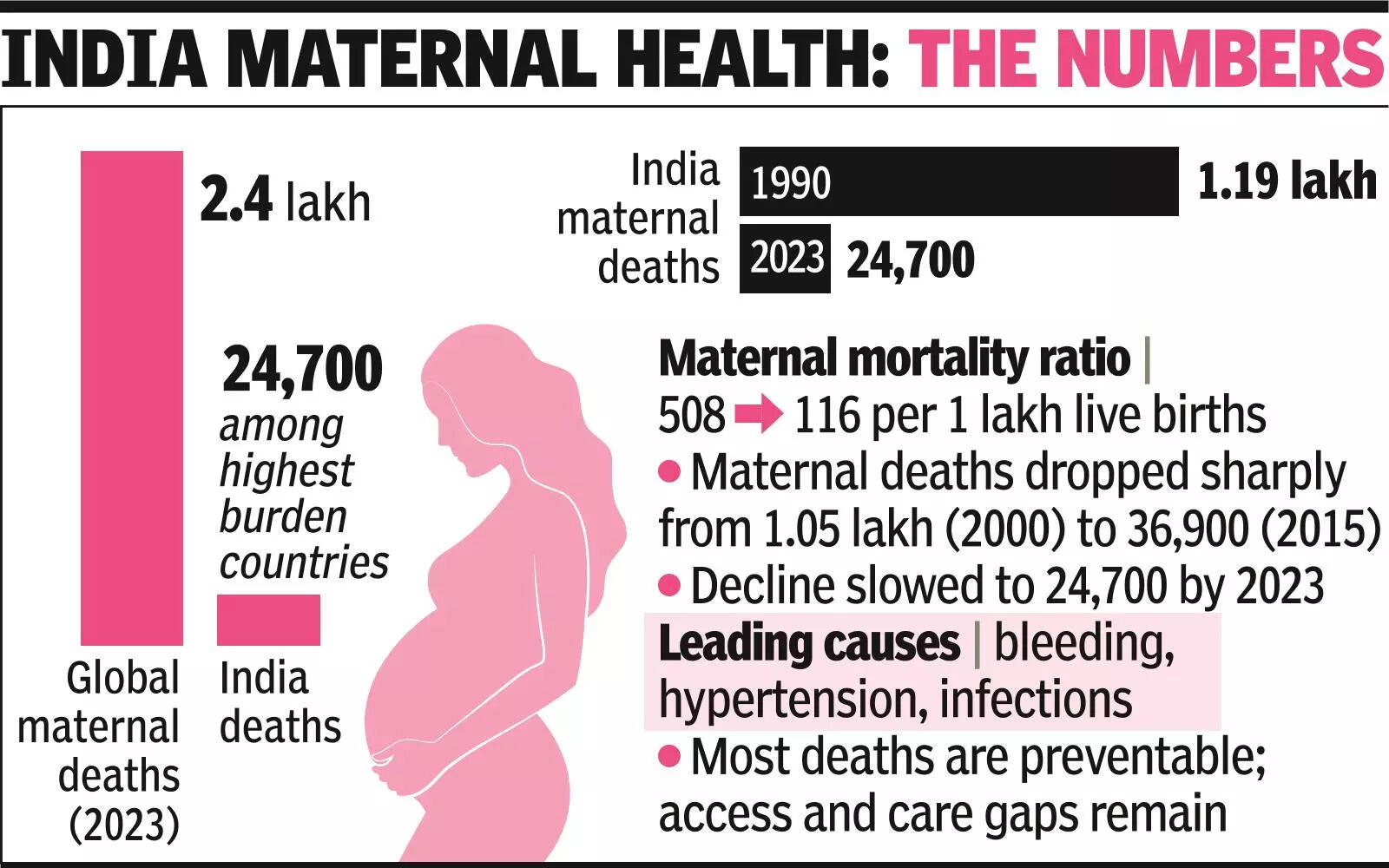
NEW DELHI: India remains among the countries with the highest number of maternal deaths globally, a major study published in The Lancet Obstetrics, Gynaecology & Women’s Health has found, with progress slowing down post 2015 after years of rapid decline.Around 2.4 lakh women died globally in 2023 due to pregnancy and childbirth-related causes, the study estimates. India accounted for about 24,700 of the 2.4 lakh deaths, placing it among the highest-burden countries alongside Nigeria, Pakistan and Ethiopia.India’s long-term numbers reflect both progress and persistent gaps. Maternal deaths fell sharply from about 1.19 lakh in 1990 to 36,900 in 2015 and further to 24,700 in 2023. And the maternal mortality ratio declined from 508 in 1990 to 116 per one lakh live births in 2023, indicating substantial gains but also unfinished work.

India accounts for 1 in 10 global maternal deaths: Report

Deaths Continue To Be Driven By Largely Preventable Causes, Says Study Published In The Lancet

“Maternal mortality has declined significantly since 1990 due to better awareness, institutional deliveries and govt programmes, although progress remains uneven across states, with some like Kerala and Tamil Nadu nearing global targets while others such as Uttar Pradesh, Bihar and Madhya Pradesh continue to report higher maternal mortality,” said Dr Abha Majumdar, director, Centre of IVF & Human Reproduction, Sir Ganga Ram Hospital.The steepest decline happened between 2000 and 2015, driven by expanded institutional deliveries, improved antenatal care and wider public health interventions. However, the pace has slowed down in recent years, pointing to systemic challenges that are harder to address.The study points to a persistent pattern in India, where deaths continue to be driven by largely preventable causes such as haemorrhage, hypertensive disorders, infections and complications linked to pre-existing conditions. Delays in receiving care, gaps in quality of services and uneven access across regions remain key concerns.Globally, the maternal mortality ratio stood at 190 deaths per one lakh live births in 2023, still far above the Sustainable Development Goal target of fewer than 70. More than half of the countries have not reached this level yet. Researchers also flagged the impact of the Covid-19 pandemic, which disrupted maternal health services and contributed to additional deaths in several regions during peak years.Experts say the findings underline the need for India to sustain gains in maternal health, strengthen public health systems and improve quality of care, particularly for high-risk pregnancies and underserved populations. With progress slowing down and risks persisting, the study warns that without renewed focus, countries may fall short of the 2030 goal of making childbirth safer for all women.

[ad_2]

Source link

BJP drops ‘Greater Kashmir’ charge, backs J&K reorganisation bill | India News

[ad_1]

BJP drops 'Greater Kashmir' charge, backs J&K reorganisation bill

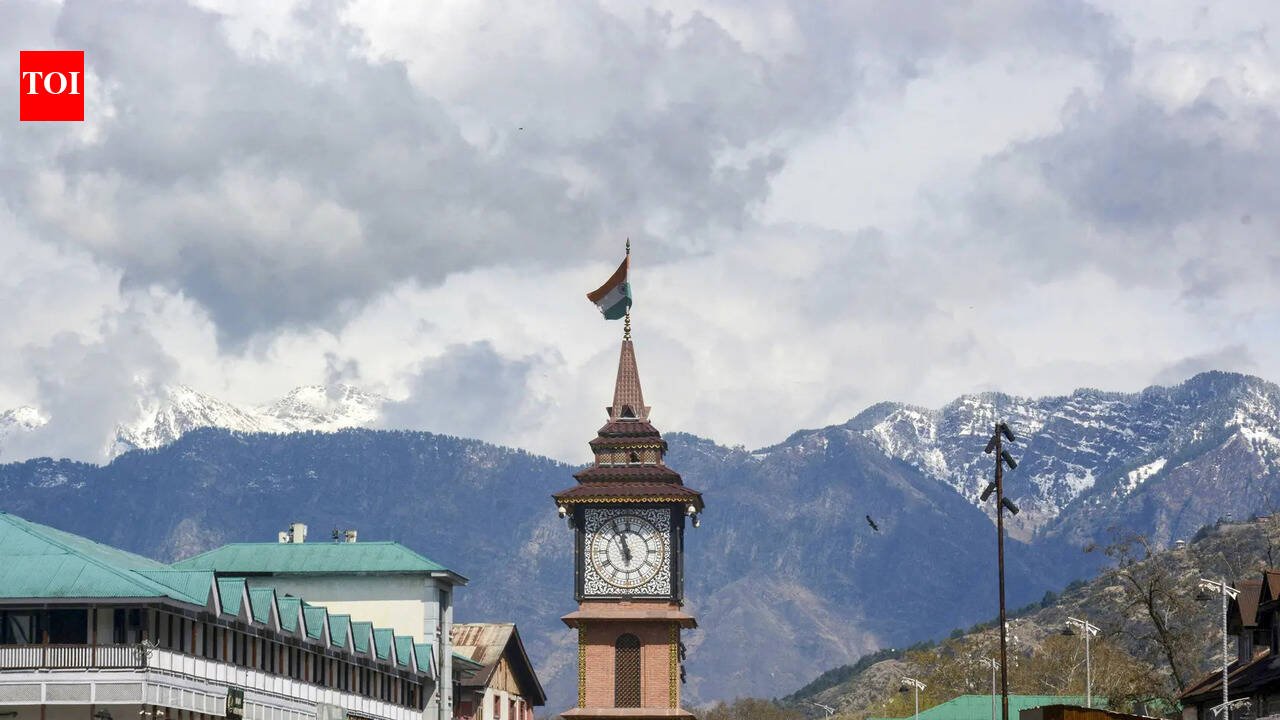
SRINAGAR: BJP dropped Sunday its earlier “Greater Kashmir” charge and backed a PDP-sponsored territorial reorganisation bill for J&K, while National Conference remained non-committal, calling the proposal a “publicity stunt”.The proposal by PDP legislator Waheed Parra seeks 16 new districts across J&K and two additional divisions in Jammu. J&K currently has two divisions — Jammu and Kashmir — with 10 districts each.BJP said the bill should be tabled for debate, flagging objections only to names “Pir Panjal” and “Chenab Valley” for proposed Rajouri–Poonch and Doda–Kishtwar–Ramban divisions.“There is no harm in creating additional districts and divisions,” BJP MLA Sham Lal Sharma said. BJP would push for a third new division combining Udhampur and Reasi, taking the total in Jammu to four, he added.The shift marks a departure from BJP’s earlier position when spokesperson Altaf Thakur had called the bill a conspiracy aimed at turning J&K into “Greater Kashmir”, stressing what he called Pakistan’s 1990s design.NC signalled caution. Spokesperson Tanvir Sadiq said both Union govt and J&K administration have frozen administrative boundaries till 2027 through a 2025 order. “We support regional empowerment, but any reorganisation must be transparent, data-driven and aligned with census and delimitation,” he said.

[ad_2]

Source link

Indian Stock Markets: Stock market holidays: Dalal Street heads for holiday-shortened week amid Mahavir Jayanti, Good Friday

[ad_1]

Stock market holidays: Dalal Street heads for  holiday-shortened week amid Mahavir Jayanti, Good Friday

Indian stock markets will remain closed on Tuesday, March 31, for Mahavir Jayanti and again on Friday, April 3, for Good Friday, giving investors a holiday-shortened trading week.Trading on the NSE and BSE will be suspended on both days across segments, including equity, equity derivatives, currency derivatives, securities lending and borrowing (SLB) and other market-linked instruments. The week will therefore have only three full trading sessions on Dalal Street.

Two market holidays next week

The National Stock Exchange of India and BSE have both listed March 31 and April 3 as official trading holidays for Mahavir Jayanti and Good Friday, respectively.The timing is also notable because March 31 marks the end of the financial year 2025-26, which means the holiday will fall on the final day of the fiscal year.

MCX open only in evening on Mahavir Jayanti, fully shut on Good Friday

Commodity traders will see a slightly different schedule.The Multi Commodity Exchange of India (MCX) will remain closed during the morning session (9 am to 5 pm) on Mahavir Jayanti, but trading will resume in the evening session from 5 pm to 11:30 pm.On Good Friday, however, MCX will remain shut for both the morning and evening sessions, in line with several global markets that also close for the occasion.The National Commodity & Derivatives Exchange (NCDEX), meanwhile, will remain closed in both sessions on these holidays.There are 16 stock market holidays scheduled for 2026. With the two next week, several more closures are still lined up across the rest of the year.The next market holiday after Good Friday will be Dr Baba Saheb Ambedkar Jayanti on April 14, followed by Maharashtra Day on May 1 and Bakri Id on May 28, as per the report.

[ad_2]

Source link

Google does do want to pay lawyers’ fee in Canada’s Competition Commissioner case it lost; says: Fee is so big that it would …

[ad_1]

Google does do want to pay lawyers' fee in Canada's Competition Commissioner case it lost; says: Fee is so big that it would ...

Google is reportedly arguing that it should not be made to pay about $370,000 in legal fees and other costs the Competition Commissioner is seeking. This comes after the tech giant lost a constitutional challenge in Canada. According to a report in Western Investor, the battle over legal fees comes a few weeks after the Competition Tribunal dismissed a constitutional challenge that formed part of a broader case where Google has been accused by the bureau of causing harm through an allegedly outsized hold on the online advertising world. Now, having lost the challenge, Google wants to avoid paying any fees or at least, see them greatly reduced.In a recent filing made with the Competition Tribunal, Google said that it should be spared from paying the money because of the public interest element of this case. Google argued that the fee is so big that it would violate the company’s constitutional rights, a stand that the bureau disputes.In its submission, Google has pointed to a previous tribunal ruling which waived costs for credit card company Visa because it advanced a “novel” argument. “Without parties like Google who are willing to bring novel challenges, ‘[g]aps in our law and policy will not be identified or remedied,'” Google said. Google cited in part the ruling Visa’s company’s case. If the tribunal decides Google should have to pay the fees, the company says they should be “significantly reduced” because of its public interest argument and acting commissioner Jeanne Pratt’s failure to prevail on one of her primary arguments.Google also said that any fees should be lower than those featured in other cases “to strike a fair and reasonable balance between compensating a successful party and not unduly burdening an unsuccessful party.”

Competition Bureau to Google: You should pay the fees

On their part, the Competition Bureau’s lawyers claimed in submission that Google should have to pay $370,096.88 in fees for the watchdog’s legal representation, experts, transcripts and printing because they are “reasonable, necessary and justified.” Google’s motion alone totalled more than 10,000 pages, included 29 volumes with four affidavits and two expert reports, the bureau said. The Commissioner’s motion was made up of 11 volumes with a single affidavit and expert report. The motion took five cross-examinations, and a hearing spanned 3 1/2 days.Judge Andrew Little took the bureau’s side, ruling that the fine the company could face is “hypothetical at best” but “may be necessary to deter non-compliance.”In this case, Google’s failed challenge took aim at a $91 billion penalty that the company would have to pay if the tribunal eventually sides with the Competition Bureau, which alleges that the tech firm abused its dominant position in online advertising.The Competition Bureau says in its own submission that Google should have to pay because “responding to the motion was also substantially more work for the commissioner than a motion of average or usual complexity.”As for Google’s take that the fees should be reduced because one of the commissioner’s arguments didn’t sway even little, the bureau’s lawyers said, “a successful party should not be penalized simply because not all the points advanced by that party have found favour with the court.”The bureau under Pratt’s predecessor Matthew Boswell launched its broader fight against Google in November. A lawsuit Boswell filed claimed Google unlawfully tied together its ad tech tools — DoubleClick for Publishers, AdX, Display & Video 360 and Google Ad — to maintain its market dominance and lessen competition.In the case Google lost, the search giant maintained that ad buyers have plenty of choice despite the hold it has on the market.

[ad_2]

Source link

KPMG UK puts nearly 600 audit jobs at risk as cost pressure deepens; advisory cuts also hit

[ad_1]

KPMG UK puts nearly 600 audit jobs at risk as cost pressure deepens; advisory cuts also hit

KPMG’s UK arm has told nearly 600 employees in its audit business that their roles are at risk, as the Big Four firm moves to cut costs in a tougher market.The proposed shake-up is expected to lead to up to 440 exits if the redundancy process goes ahead.The affected staff have been informed that they could be laid off, subject to a formal consultation, Bloomberg reported, citing a memo sent to employees and people familiar with the matter.

Up to 440 audit exits possible after consultation

According to Bloomberg, the proposed cuts are centred on assistant managers who are qualified accountants and affect roughly 6 per cent of KPMG UK’s 7,100-strong audit division.KPMG UK confirmed on Saturday that it plans to reduce staff in its audit business, after Bloomberg first reported the potential scale of the move. However, the firm did not specify how many jobs could ultimately be cut.KPMG UK said the decision was being driven by unusually low staff turnover in parts of its audit practice.“Current market conditions mean our attrition rates are very low within certain parts of our audit population, which is why we are proposing to right size those areas,” a KPMG UK spokesperson said in a statement to Bloomberg.“This isn’t a decision we take lightly.”The consultation on the audit cuts is expected to run until mid-May, reported the Financial Times.

Advisory arm also facing fresh redundancies

According to The Financial Times, KPMG has also separately told staff in its advisory business that it plans to cut around 120 roles, while hundreds more could also be considered for possible redundancies.Most of the advisory job losses are expected to fall in the enterprise risk division, which advises companies on governance, risk and compliance. Some back-office roles and staff in an economics team are also said to be affected.One person familiar with the advisory cuts told the FT that the latest round had been “pretty devastating”, especially for employees who had already been through similar disruption last year.Another person was cited by FT as saying that senior leaders were under pressure to meet budgets during a prolonged slowdown, saying the firm had carried “a large bench” of unassigned consultants for around six months and had seen fewer projects in the pipeline.A separate person said the changes would affect just over 2 per cent of the advisory business.KPMG confirmed that it was “launching proposals to reduce roles in some areas” of its advisory arm.“While the firm continues to experience growth in some areas, we are always looking at the shape of our business to stay in step with client demand and to support sustainable growth,” the firm said, as quoted by the FT.

Consulting slowdown and AI transition add pressure

The job cuts highlight the continuing strain across professional services firms, which have been trying to rein in costs after a sharp post-pandemic expansion and a subsequent slowdown in demand for consulting work.Other major firms have also turned to layoffs. McKinsey & Co. has discussed cutting about 10 per cent of headcount in non-client-facing teams, potentially amounting to several thousand jobs over the next 18 to 24 months.KPMG’s latest move comes as firms across the sector try to adjust to weaker client demand while also reshaping their operations for an AI-driven environment.KPMG’s audit cuts are somewhat unusual because earlier Big Four redundancy rounds have generally been concentrated in consulting or support functions, given the more stable nature of audit work. However, low attrition has swelled the number of junior staff, and PwC cut 175 junior auditors last year, the newspaper reported.

Profits rise despite weaker advisory performance

KPMG employs about 16,700 people in the UK. While the firm does not break out staff numbers by division, the advisory arm accounts for close to half of annual sales.According to the FT, KPMG’s advisory business shrank 3 per cent last year, in line with revenue declines at the consulting units of EY, PwC and Deloitte, even as the firm’s overall profitability improved.KPMG’s profit before tax rose 14 per cent to £576 million last year, which the firm attributed to “careful cost management in response to the economic cycle”.UK chief executive Jonathan Holt, who recently lost the race to become KPMG’s next global chief, has been boosting profitability through cost cuts, pay and promotion freezes, and lower headcount. It added that UK partners received an average £880,000 for the 12 months to September, up 11 per cent, marking the first time in more than a decade that KPMG’s UK partners were paid more than those at PwC and EY.

[ad_2]

Source link

Pakistan deputy PM Ishaq Dhar falls while welcoming Egyptian FM to Middle East peace talks, video goes viral

[ad_1]

Pakistan deputy PM Ishaq Dhar falls while welcoming Egyptian FM to Middle East peace talks, video goes viral
Pak deputy PM falls (Screengrab from video posted on X)

Pakistan’s deputy prime minister, foreign minister Ishaq Dar fell on the red carpet on Sunday while receiving Egypt’s foreign minister Badr Abdelatty in Islamabad, ahead of the Middle East de-escalation talks.The incident took place at the ministry of foreign affairs as Dar stepped forward to greet the visiting dignitary. In a clip, being circulated on social media, Dhar moves toward the Egyptian leader but loses his footing and falls. He’s immediately assisted by security personnel.Pakistan is hosting two-day talks with Turkey, Egypt and Saudi Arabia focused on de-escalating the Iran war, with early discussions centred on proposals to reopen the Strait of Hormuz and restore global shipping flows. The waterway, a key route for oil and LNG, has seen disruptions after Iran halted traffic in response to US and Israeli strikes. Notably, neither the United States nor Israel is part of the discussions.Countries involved have floated ideas to Washington, including mechanisms to ensure safe maritime passage and even a possible consortium to manage oil flows through the strait.

[ad_2]

Source link

Airlines must offer 60% seats free from April 20, DGCA says amid row over seat selection charges

[ad_1]

Airlines must offer 60% seats free from April 20, DGCA says amid row over seat selection charges

Passengers flying within India will be able to choose a larger share of seats without paying extra from April 20, after aviation regulator DGCA directed airlines to offer at least 60 per cent of seats on every flight free of charge.The move follows concerns over airlines charging steep fees for seat selection, with the civil aviation ministry announcing on March 18 that it had asked the regulator to ensure fairer access for passengers.

New rule raises free seat quota from 20% to 60%

Acting on the ministry’s direction, the Directorate General of Civil Aviation (DGCA) issued an amended Air Transport Circular on March 20, which will come into force 30 days later, effectively from April 20.Under the revised rules, airlines must ensure that at least 60 per cent of seats on any flight are available for selection without any additional charge. At present, only around 20 per cent of seats are generally offered free, while the rest attract a fee.The DGCA has also told airlines to keep their seat allocation policies transparent and clearly show the availability of free seats, along with any applicable conditions, on their booking platforms.“Airlines should maintain transparent seat allocation policies and clearly communicate the availability of free seats and applicable conditions on their booking interfaces,” the regulator said in the revised circular dated March 20.

Families on same booking should be seated together where possible

The regulator has further said that passengers travelling on the same PNR (Passenger Name Record) should, as far as practicable, be seated close to one another, which would ordinarily mean adjacent seats in the same row.An official cited by news agency PTI said that airlines are now preparing to implement the new directive.Seat selection charges currently range from Rs 200 to Rs 2,100, depending on factors such as front-row placement and extra legroom.

Airlines object, warn of possible fare hikes

The new rule comes against the backdrop of growing criticism over airlines levying hefty charges for add-on services, especially seat selection.However, the move has faced strong resistance from carriers. As per PTI, IndiGo, Air India and SpiceJet objected to the decision last week, arguing that forcing airlines to make at least 60 per cent of seats free would hurt revenues and could eventually push up airfares.In a letter sent to the civil aviation ministry on March 20, the Federation of Indian Airlines (FIA), which represents the three carriers, urged the government to withdraw the decision.

Other optional service charges must also be clearly shown

Apart from seat selection, the DGCA has also directed airlines to display all charges for optional services such as carrying sports equipment or musical instruments in a clear and unambiguous manner on websites and booking portals.The regulator said airlines must also disclose any liability conditions in case of damage linked to such items.The change comes at a time when Indian airports are handling more than five lakh passengers daily, underlining the wide impact the new rule could have across the country’s fast-growing aviation market.DGCA chief Faiz Ahmed Kidwai recently said the regulator is trying to simplify rules for airlines while also protecting passenger rights. Speaking at the Indian Chamber of Commerce Aviation and Tourism Summit, he said the aim is to strike a balance between supporting airline growth and safeguarding travellers.“India’s aviation market is one of the fastest-growing in the world, but airlines are currently dealing with several operational hurdles,” Kidwai said, as quoted by news agency IANS.

[ad_2]

Source link

Gold, silver outlook: Bullion markets brace for volatile week as Middle East tensions and Fed cues weigh

[ad_1]

Gold, silver outlook: Bullion markets brace for volatile week as Middle East tensions and Fed cues weigh

Precious metals are likely to remain in a corrective phase in the coming week, with investors expected to closely track developments in the Middle East and a packed calendar of global economic data for fresh cues.Analysts cited by news agency PTI said that speeches by US Federal Reserve Chair Jerome Powell on Monday, along with comments from other Fed officials later in the week, will be watched closely for signals on interest rates, which could shape demand for gold and silver.

Middle East tensions and macro data to set the tone

Pranav Mer, vice president, EBG – commodity & currency research at JM Financial Services Ltd, told PTI that geopolitical developments will remain central to market sentiment.“In the week ahead, focus will remain on developments in the Middle East — any sign of escalation and de-escalation may drive the financial market lower or higher,” Mer said.He added that investors will also keep an eye on manufacturing PMI data from major economies, CPI readings from Germany and the Eurozone, as well as key US indicators including consumer confidence, nonfarm payrolls and broader employment data due later in the week.Trading volumes may also stay muted as domestic commodity markets will remain shut on March 31 for Shri Mahavir Jayanti and April 3 for Good Friday, resulting in a shortened trading week.

Gold slips, silver rises in domestic market

In the domestic market, gold futures ended marginally lower at Rs 1.44 lakh per 10 grams over the past week, while silver closed higher by Rs 1,182, or 0.52 per cent, at Rs 2.27 lakh per kilogram on the Multi Commodity Exchange.Mer said domestic bullion continued to find support from the rupee’s weakness against the dollar.“The bullion prices in the domestic market have remained supported by persistent weakness in the Indian rupee against the dollar. Last week, the rupee fell more than 1 per cent to close near 94.80,” he said.He also noted that the recent decline in bullion was driven by ETF liquidation, soft physical demand, a stronger dollar, and elevated US Treasury yields.

Global gold falls nearly 2%; silver rebounds

In international markets, gold settled nearly 2 per cent lower at $4,492.5 per ounce, while silver edged higher to $69.79 per ounce by the end of the week.Choice Broking said silver staged a notable weekly recovery after a long spell of weakness, tracking a sharp rebound in global prices.“Silver posted a strong weekly recovery after a prolonged decline, tracking gains in the global markets where prices rebounded sharply”.“Weakness in US equity markets boosted safe-haven demand, though gold’s traditional appeal showed signs of moderation amid rising Treasury yields and elevated oil prices,” Choice Broking said.Analysts told PTI that geopolitical tensions remained a major driver, with the worsening conflict in the Middle East adding to volatility in bullion prices.They added that while there was temporary relief after US President Donald Trump signalled a 10-day pause on Iran’s energy infrastructure attacks, the dollar index stayed near 100, limiting gains in precious metals.For the week ahead, Choice Broking said gold is likely to remain sideways-to-bullish during the shortened Easter week as traders assess key US economic data.Silver, meanwhile, is also drawing support from strong Chinese physical demand. China’s silver imports rose to an eight-year high of 206.76 metric tonnes in the first two months of 2026, up 49 per cent month-on-month and a sharp 5,910 per cent year-on-year, tightening global supply and lending support to prices.

[ad_2]

Source link

‘Complaints of palpitations’: A day after arrest, Ex Nepal PM Oli admitted to hospital

[ad_1]

'Complaints of palpitations': A day after arrest, Ex Nepal PM Oli admitted to hospital

NEW DELHI: Former Nepal Prime Minister KP Sharma Oli was admitted to a hospital a day after he was arrested in connection with a culpable homicide case linked to the alleged suppression of the September Gen Z protests.According to the hospital, Oli was admitted following complaints of palpitations.“Former Prime Minister and Chairman of the Nepal Communist Party (UMI) KP Sharma Oli was admitted to TU Teaching Hospital on 2082-12-14 with complaints of palpitations,” a statement from the hospital read.“He is a post-renal transplant patient with hydronephrosis, diabetes mellitus, hypertension, hypothyroidism, atrial fibrillation with APC (on treatment), and cholelithiasis. Currently, he is under observation and monitoring in bed no. 501 of Annex 1 and is being managed by our medical team,” it added.Earlier on Saturday, Oli was taken into custody from his residence in Gundu, Bhaktapur, following a formal complaint filed by the home ministry, which led to an investigation and the issuance of arrest warrants.Authorities said the action was taken to implement the recommendations of a commission led by former Special Court judge Gauri Bahadur Karki.The commission also suggested legal action against several other officials, including then home secretary Gokarna Mani Dawadi, Armed Police Force chief Raju Aryal, former National Investigation Department head Hutaraj Thapa, and then Kathmandu chief district officer Chhabi Rijal.The commission attributed the violent crackdown on youth-led protests to criminal negligence and recklessness, citing a failure to act on prior intelligence warnings about possible escalation. A total of 77 people were killed during the protests, and property worth billions was destroyed.The arrests came a day after Balendra Shah was sworn in as Nepal’s Prime Minister. The 35-year-old leader, who heads the Rastriya Swatantra Party, assumed office under Article 76(1) of the Constitution after his party emerged as the largest in the March 5 parliamentary elections.His swearing-in ceremony was held at the President’s Office in Sheetal Niwas and was administered by President Ramchandra Paudel. Shah, the youngest Prime Minister of Nepal and the first from the Madheshi community to hold the post, has risen to prominence through his strong stance against the federal establishment and his focus on governance reforms.

[ad_2]

Source link