Breaking News
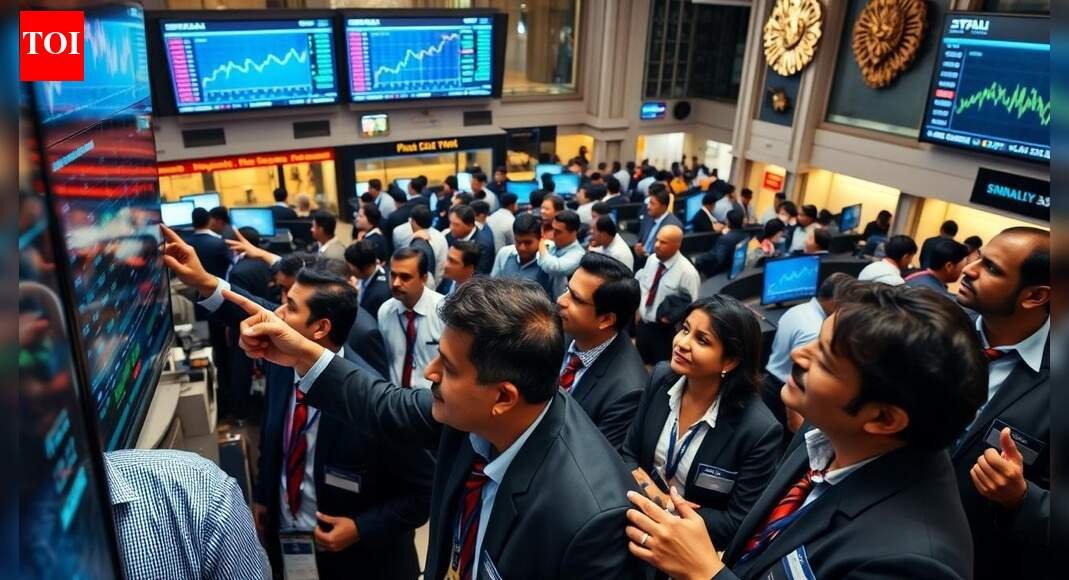
Indian equities outlook: ICICI Prudential flags stable macro backdrop; warns valuations already price in optimism

[ad_1]
Indian equities outlook: ICICI Prudential flags stable macro backdrop; warns valuations already price in optimism

The broader macro backdrop for Indian equities remains stable heading into 2026, supported by healthier corporate balance sheets and early signs of an earnings recovery across sectors, according to ICICI Prudential Alternate Investments. However, after a long market upcycle and widespread rerating, much of the optimism on growth and profits is already reflected in stock valuations, the report cautioned.In its report titled “Outlook 2026: Beyond Narratives”, ICICI Prudential said that while the opportunity set in Indian equities continues to look attractive, market returns are likely to be more moderate going forward.It added that broad, index-led gains may give way to outcomes driven by selective stock picking rather than sweeping macro narratives.“After an extended market cycle and a rerating across many parts of the market, much of this macro and earnings optimism is already reflected in valuations,” the report said, adding that execution and company-specific fundamentals are expected to matter more than themes. “We believe going ahead, execution is likely to trump narratives, and disciplined micro research is likely to outweigh broad macro views,” it noted.Looking at the wider economy, the report said India appears to be in “good shape” as it moves deeper into the 21st century. A favourable demographic profile, with a large working-age population entering the labour force, places India in a stronger position compared with economies grappling with ageing populations.While foreign capital inflows have been lower than historical levels, the report said India’s growth prospects could still attract overseas investors over time. It also pointed out that the government’s fiscal position is on a consolidation path.Corporate financials have strengthened notably, with operating cash flows, profit after tax and investing cash flows growing at compound annual rates of 18 per cent, 15 per cent and 14 per cent respectively between FY19 and FY25, compared with single-digit growth in the earlier period, as per news agency ANI.The report also sees scope for faster economic growth alongside a normalisation in inflation. It added that improvements in geopolitics and trade ties with major partners such as the US, China and Europe could act as catalysts, potentially boosting sentiment and positioning India favourably in emerging global supply chains.

[ad_2]

Source link
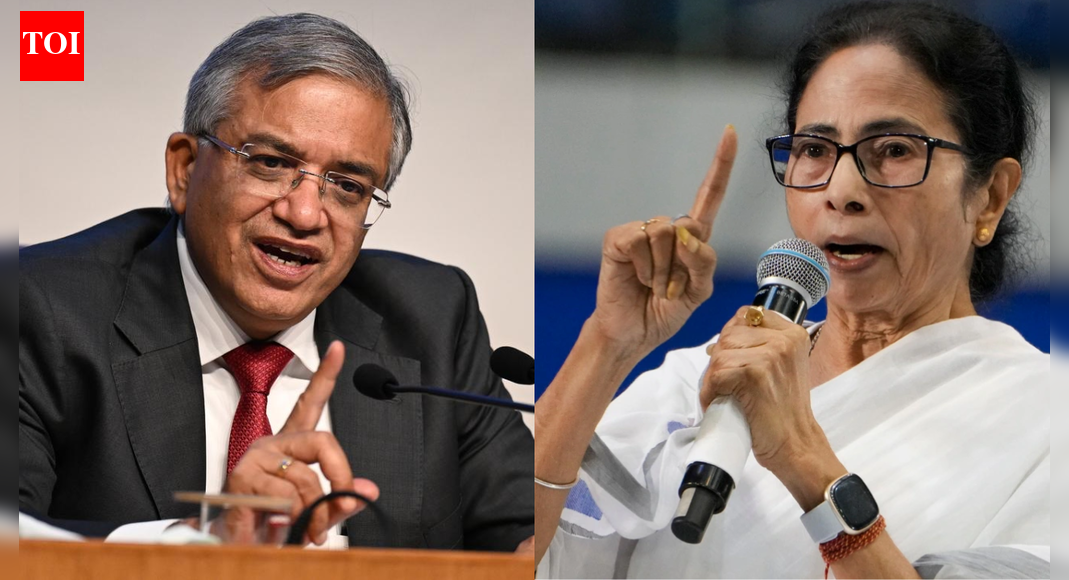
‘Rectify the glitches, or …’: CM Mamata writes of CEC; urges to stop ‘unplanned’ Bengal SIR | India News

[ad_1]

'Rectify the glitches, or ...': CM Mamata writes of CEC; urges to stop 'unplanned' Bengal SIR
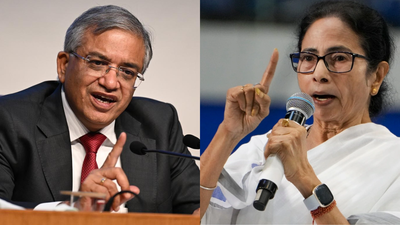
CEC Gyanesh Kumar and Mamata Banerjee (File photo)

NEW DELHI: West Bengal chief minister Mamata Banerjee on Saturday wrote to Chief Election Commissioner (CEC) Gyanesh Kumar, criticising the “procedural violations” and “administrative lapses” in the Special Intensive Revision (SIR), which is currently under way in the poll-bound state.Mamata Banerjee called the exercise “unplanned, arbitrary and adhoc” and urged the poll body chief to stop the SIR if glitches remain unattainted.“I am once again constrained to write to you in order to place on record my grave concern regarding the serious irregularities, procedural violations, and administrative lapses being witnessed during the ongoing Special Intensive Revision (SIR) of the electoral rolls in West Bengal,” she wrote in a letter. She also expressed apprehension about the large-scale disenfranchisement of eligible voters, which she said would be a “direct assault on the foundational principles of democratic governance”.“I strongly urge you to immediately address and rectify the glitches, address the flaws and make the necessary corrections, failing which this unplanned, arbitrary and adhoc exercise must be halted. If allowed to continúe in its present form, it will result in irreparable damage, large-scale disenfranchisement of eligible voters, and a direct assault on the foundational principles of democratic governance, ” she further wrote.

[ad_2]

Source link

Housing inventory: Unsold homes rise 4% across top cities; new supply continues to outpace demand

[ad_1]

Housing inventory: Unsold homes rise 4% across top cities; new supply continues to outpace demand

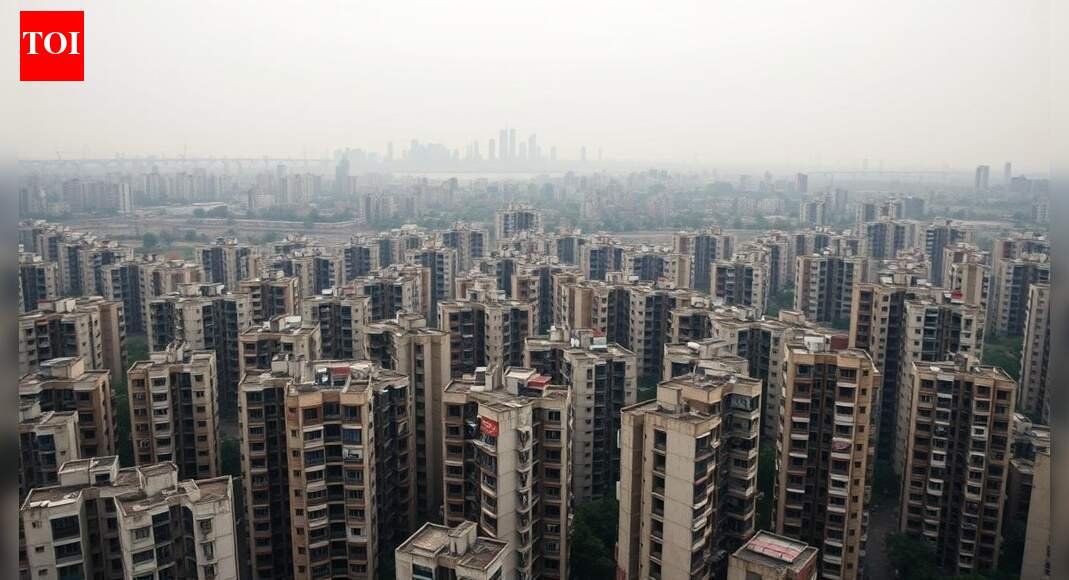
Unsold housing inventory across India’s top seven cities increased by 4 per cent last year, as the supply of new homes continued to exceed buyer demand, according to data released by real estate consultant Anarock.The total number of unsold residential units in the primary market stood at 5,76,617 at the end of 2025, compared with 5,53,073 units a year earlier. Anarock said the rise was mainly driven by slower sales momentum and higher additions to new supply during the year.“Annually, unsold inventory in the top seven cities rose 4 per cent by 2025-end, largely because of tapered demand and increased new supply in the year,” Anarock said, explaining the trend.Housing sales across these major urban markets declined sharply over the year. As per the data, home sales fell 14 per cent year-on-year to 3,95,625 units in 2025. In contrast, the launch of new homes edged up by 2 per cent to 4,19,170 units, widening the gap between supply and absorption.City-wise data showed a mixed picture. Unsold inventory declined in the Mumbai Metropolitan Region (MMR) and Hyderabad, while other key cities saw a build-up in stock.In Delhi-NCR, unsold housing stock rose 5 per cent to 90,455 units at the end of 2025, up from 85,901 units in the previous year. Bengaluru recorded one of the sharpest increases, with unsold homes jumping 23 per cent to 64,863 units from 52,807 units.Pune also saw a rise, with inventory increasing 3 per cent to 83,491 units from 80,672 units a year earlier. Chennai posted an 18 per cent rise in unsold units, which stood at 33,434 at the end of last year compared with 28,423 units at the end of 2024.Kolkata’s unsold housing stock grew by 9 per cent to 29,007 units from 26,542 units over the same period, the data showed.On the other hand, the Mumbai Metropolitan Region saw a marginal improvement. Unsold homes in MMR dipped by 1 per cent to 1,79,228 units at the end of 2025, down from 1,80,964 units a year earlier. Hyderabad also recorded a small decline, with unsold inventory falling 2 per cent to 96,140 units from 97,765 units.Looking ahead, Anarock said the outlook for housing demand could improve if borrowing costs soften. The consultant noted that lower interest rates on home loans could help revive buyer interest, provided residential property prices remain within reasonable limits.The data suggests that while select markets are beginning to see some easing in inventory, overall pressure on unsold stock remains, largely due to the imbalance between new launches and actual sales, as per PTI.

[ad_2]

Source link

Cigarette tax hike: Experts warn of surge in illicit trade; fear major revenue losses for government

[ad_1]

Cigarette tax hike: Experts warn of surge in illicit trade; fear major revenue losses for government

A sharp increase in taxes on cigarettes, along with a new excise duty structure on tobacco products, could trigger a surge in illicit trade and lead to significant revenue losses for the government, experts have warned.Earlier this week, the finance ministry notified amendments to the Central Excise Act, introducing a fresh excise duty ranging from Rs 2,050 to Rs 8,500 per 1,000 cigarette sticks, depending on their length. The new excise duty, which comes into effect from February 1, will be levied in addition to the existing 40 per cent Goods and Services Tax (GST).This change implies an overall tax hike of around 60–70 per cent, varying by cigarette length, compared with the current overall tax incidence of about 50–55 per cent. The move marks a transition from the GST compensation cess to an excise-based regime for demerit goods.The unexpected nature of the tax increase has raised concerns about higher smuggling and illegal trade in tobacco products. According to news agency PTI, Ranganath Tannir, secretary general of Think Change Forum, said the steep rise could prove counterproductive. “Public finance theory is clear that excessive taxation of inelastic goods fuels illicit trade, not compliance,” he said, adding that cigarettes in India are already among the least affordable globally based on World Health Organization affordability indicators. Making them more expensive is unlikely to curb demand, but could push consumers towards illegal and smuggled products, undermining tax collections, he noted.Brokerage reports have echoed similar concerns. According to JPMorgan’s Asia Pacific Equity Research, a higher tax rate for the King Size Filter Tip (KSFT) segment increases the risk of consumers downtrading to cheaper options and may also lead to higher consumption of illicit cigarettes.Illicit tobacco already accounts for about 26 per cent of India’s total tobacco market, making the country the fourth-largest market globally for smuggled tobacco, PTI reported.Nomura, in its research note, said that while higher taxes are aimed at reducing consumption, they often have unintended consequences. “High taxes on cigarettes… fuel the growth of illicit cigarettes and push consumers towards cheaper, non-tax paid smuggled cigarettes,” the brokerage said.Jefferies, citing a report by the Tobacco Institute of India (TII), said the industry body has urged the government to review the proposed excise structure. A wider gap between legal and illegal prices could benefit non-duty-paid cigarettes and result in higher tax leakage, the report noted.Experts also pointed to international experience to underline the risks. Australia’s repeated tobacco tax hikes between 2012 and 2020 led to a sharp rise in cigarette prices and were followed by a jump in illicit tobacco consumption from under 2 per cent to around 14 per cent of the market.Calling the proposed excise levies “unprecedented”, an analyst said there is still time to reassess the decision before it comes into force. “Since they take effect from February 1, 2026, the government has an opportunity to revisit and rectify them before they spawn a much larger problem of uncontrollable illicit networks,” the analyst warned, as per PTI.

[ad_2]

Source link

Venezuelan President Maduro flashes peace sign while in custody — watch

[ad_1]

Venezuelan President Maduro flashes peace sign while in custody — watch

Nicolás Maduro, Venezuela’s deposed leader, has been seen for the first time in clear footage under federal custody in the United States after arriving in New York City, according to videos obtained by TMZ. The outlet reported that it secured two clips filmed shortly after Maduro’s arrival, showing him appearing calm despite facing US drug-trafficking charges. In one video, Maduro is escorted from a vehicle by law-enforcement officials and briefly flashes a peace sign as he passes the camera. Another clip shows a heavy security detail walking him across an airport tarmac and into an unmarked building.The White House also released a clip of Maduro’s perp walk, showing two DEA agents leading him down a hallway while he wished onlookers a happy new year.CNN reported it saw a person believed to be Maduro disembark from a plane earlier in the day, but the video was taken from high above and it was hard to make out much of him in the crowd of law enforcement officers. TMZ reported he was then flown by helicopter to a secondary location, where the videos it obtained were taken.President Donald Trump announced Maduro and his wife Cilia Flores were arrested after a large-scale military action in Venezuela. President Trump said the United States will “run” Venezuela “until such time that we can do a safe, proper and judicious transition.”Maduro was being held in MDC Brooklyn, a prison that held Diddy during his sex trafficking trial and currently held Luigi Mangione.

[ad_2]

Source link

Insurance mis-selling: Irdai flags sharp rise in unfair practice complaints; asks insurers to fix root causes

[ad_1]

Insurance mis-selling: Irdai flags sharp rise in unfair practice complaints; asks insurers to fix root causes

Mis-selling continues to be a key concern in the insurance sector, with the regulator asking insurers to dig deeper into the root causes behind such practices, according to the latest annual report of the Insurance Regulatory and Development Authority of India (Irdai).While the total number of grievances against life insurers remained largely unchanged at 1,20,429 in 2024-25 compared to 1,20,726 in the previous year, complaints related to Unfair Business Practices (UFBP) rose sharply. Grievances under UFBP increased to 26,667 in FY25 from 23,335 in FY24, pushing their share in overall complaints to 22.14 per cent from 19.33 per cent earlier, the report showed.Mis-selling typically refers to the sale of insurance products without proper disclosure of terms, conditions or suitability for customers. Highlighting corrective measures, Irdai said insurers have been advised to assess product suitability, put in place distribution channel-specific controls and develop structured plans to address mis-selling grievances. This includes carrying out periodic root cause analysis, the regulator noted in its annual report for 2024-25.The finance ministry has also repeatedly cautioned banks and insurance companies against mis-selling insurance products, stressing the need to maintain strong corporate governance standards, reported PTI.The regulator pointed out that mis-selling often results in customers paying higher premiums, which eventually leads to lower policy renewals and a rise in policy lapses.On sector development indicators, insurance penetration in India remained unchanged at 3.7 per cent in FY25, significantly below the global average of 7.3 per cent. Life insurance penetration declined marginally to 2.7 per cent from 2.8 per cent a year earlier, while non-life insurance penetration stayed flat at 1 per cent.Insurance density showed a modest improvement, rising to $97 in FY25 from $95 in FY24. Life insurance density increased to $72 from $70, while non-life density remained unchanged at $25. Irdai noted that insurance density has shown a consistent upward trend since 2016-17.Insurance penetration reflects premiums as a share of GDP, while insurance density measures per capita premium spend, the report explained.

[ad_2]

Source link

Markets this week: PMI data, geopolitics & more – What will drive Dalal Street?

[ad_1]

Markets this week: PMI data, geopolitics & more - What will drive Dalal Street?

Indian equity markets are likely to take cues from a busy calendar of macroeconomic data, global developments and foreign investor activity in the week ahead, according to market analysts Markets are entering a data-heavy phase both in India and overseas, coinciding with the early part of the earnings season. Ajit Mishra, SVP, Research at Religare Broking Ltd, said that investors will closely monitor the final readings of the HSBC Services PMI and Composite PMI to assess domestic business conditions. “This week is expected to be data-heavy, both domestically and globally, as markets enter the early phase of the earnings season. In India, investors will track the final readings of the HSBC Services PMI (Purchasing Managers’ Index) and Composite PMI. Globally, key US macro data and releases from China will be closely watched for signals on growth, demand, and inflation trends,” Mishra said. Equities ended last week on a strong note, with the BSE benchmark rising 720.56 points, or 0.84%, while the NSE Nifty gained 286.25 points, or 1.09 per cent. The 50-share index touched a fresh all-time high of 26,340 on Friday. Attention is now expected to shift towards corporate earnings, with traders positioning selectively ahead of results from major index constituents. Ponmudi R, CEO of Enrich Money, said upcoming Services and Composite PMI data would offer further clarity on business momentum and employment trends. “Market’s focus is set to shift toward the Q3 earnings season, with traders likely to build positions selectively ahead of results from key index heavyweights. Domestically, Services and Composite PMI data will provide further insights into business momentum and employment trends…,” he said. On the global front, Ponmudi noted that US non-farm payrolls and unemployment figures would be key, as they could influence expectations around the Federal Reserve’s interest rate trajectory and overall risk appetite. While short-term volatility around major data releases cannot be ruled out, he added that the broader market structure remains positive as 2026 unfolds. The December-quarter earnings season is set to begin on January 12, with Tata Consultancy Services and HCL Technologies scheduled to announce their results. Ravi Singh, Chief Research Officer at Master Capital Services Ltd, said Indian markets appear constructively placed at the start of 2026, with domestic growth and global economic conditions shaping sentiment. “The outlook for Indian markets this week appears constructively positioned as markets enter 2026 with focus on domestic growth momentum and global economic health shaping investor sentiment for the year ahead. “While global cues particularly trends in US interest rates, currency movements, and geopolitical developments will continue to influence short-term sentiment, the primary driver for Indian markets is increasingly domestic fundamentals, including earnings visibility, government spending and consumption trends,” Singh said. Foreign Institutional Investors turned net buyers on Friday, purchasing equities worth Rs 289.80 crore, according to exchange data. Investors are also expected to keep an eye on the rupee’s movement against the US dollar and trends in Brent crude oil, the global benchmark. Vinod Nair, Head of Research at Geojit Investments Ltd, said global labour market data from the US will remain a key focus in the coming days. “For the week ahead, investors will give attention to US payroll and unemployment data for global market direction. Overall sentiment is expected to stay constructive, though markets may move within a steady range as participants wait for clearer earnings-led triggers and clarity on the India-US trade deal,” he said. Meanwhile, Pravesh Gour, Senior Technical Analyst at Swastika Investmart Ltd, pointed out that Indian equities have started 2026 on a strong footing, defying the usual January trend. “The Indian equity market has commenced 2026 on a stellar note, with the Nifty scaling fresh all-time high. While January has historically been a month of consolidation or bearishness, the current momentum suggests a decisive break from this seasonal trend. Supported by robust underlying factors and positive sentiment, the market structure remains firm,” Gour said.

[ad_2]

Source link

Why one of America’s biggest investor who predicted 2008 financial crisis thinks Nvidia may make America lose AI race to China: Nvidia chips are not …

[ad_1]

Why one of America's biggest investor who predicted 2008 financial crisis thinks Nvidia may make America lose AI race to China: Nvidia chips are not ...

One of America’s biggest investor Michael Burry has warned the country on Nvidia. Michael Burry is the same investor who hit headlines with his correct prediction on 2008 housing crisis in the US and the ensuing global economic slowdown. According to Burry, China’s rapidly accelerating power-generation buildout gives it a structural edge in artificial intelligence race if the industry continues relying on increasingly energy-intensive chips. Burry said that Nvidia has a “death grip” on AI development in the US, citing its extensive investments and agreements with many major AI companies and startups.In a series of posts on X, formerly Twitter, Burry said that America is on the wrong path if its AI strategy continues to rely on increasingly energy-intensive Nvidia Corp chips. “Power hungry Nvidia chips are not the way forward,” he wrote. He shared a chart that showed China’s installed electricity generation capacity that has surged far beyond that of America and Europe since the early 2000s. “It is not just the total power advantage,” Burry wrote. “It is the slope.”

Nvidia Makes History: First Company to Hit $4 Trillion Market Cap

Why Nvidia, according to Michael Burry, is hurting America

Michael Burry shared ‘Why China will win AI in one chart’. He wrote: Power hungry Nvidia chips are not the way forward for the US. It is not just the total power advantage. It is the slope. In a follow-up post, Burry argued that Nvidia’s dominant role in AI computing across the US has locked the industry into a path of higher power consumption. “Nvidia’s development roadmap is essentially a power consumption roadmap,” he stated, adding that innovation has increasingly become about “how to power and to cool bigger, hotter silicon.He said that efficiency improvements have failed to keep pace with the sheer growth in computing being deployed, pushing electricity needs ever higher.Burry contrasted this to China’s infrastructure push. “U.S. transmission grid development is actually decelerating due to permitting issues, while China is building transmission at will to match power output,” he said.That mismatch, he warned, leaves U.S. companies investing heavily in an AI arms race they are “structurally positioned to lose” if power-hungry scaling remains the dominant strategy.Burry said that the U.S. must pivot away from brute-force approaches centered on massive data centers and instead focus on more efficient designs. “The U.S. needs to get away from bigger and bigger power-hungry chips and innovate with AI-tuned ASICs like nobody’s business,” he wrote.

Michael Burry is betting against AI

In its quarterly 13-F filing released in November, Burry’s Scion Asset Management revealed that it has acquired put options, which secure the right to sell an asset at a given price by a certain date, on a pair of AI heavyweights: Nvidia (NVDA) and Palantir (PLTR). According to the filing, Scion now owns the right to sell 5 million Palantir shares and 1 million Nvidia shares, which at the time of filing had a combined value of just shy of $1.1 billion.Responding to the news in an interview to CNBC, Palantir CEO Alex Karp called the idea of shorting Palantir and Nvidia “bats— crazy,” as they are two of the only companies “making all the money” in the AI sector. “Alex Karp blasts ‘Big Short’ investor Michael Burry as ‘bats— crazy’ for bets against Palantir, Nvidia.” Karp said that those engaging in shorts of Palantir, like Burry, may be engaging in “market manipulation.

[ad_2]

Source link

Market recap of the week: Seven of top 10 firms add Rs 1.23 lakh crore in mcap; Reliance leads gains

[ad_1]

Market recap of the week: Seven of top 10 firms add Rs 1.23 lakh crore in mcap; Reliance leads gains

Last week, Indian equity markets ended on a firm note, pushing up the combined market value of seven of the country’s ten most-valued companies by Rs 1,23,724.19 crore. The rally was led by Reliance Industries, which emerged as the biggest wealth creator during the period. The positive sentiment was reflected in the benchmark indices as well, with the BSE Sensex rising 720.56 points, or 0.84%, over the week. Gains were recorded by Reliance Industries, HDFC Bank, Bharti Airtel, ICICI Bank, State Bank of India, Larsen & Toubro and Hindustan Unilever. However, Tata Consultancy Services, Infosys and Bajaj Finance moved in the opposite direction, seeing a decline in their market valuations. Reliance Industries added the most value, with its market capitalisation jumping by Rs 45,266.12 crore to Rs 21,54,978.60 crore. State Bank of India followed, posting a rise of Rs 30,414.89 crore to reach a valuation of Rs 9,22,461.77 crore. Engineering and construction major Larsen & Toubro saw its market value increase by Rs 16,204.34 crore to Rs 5,72,640.56 crore, while Hindustan Unilever’s valuation climbed by Rs 14,626.21 crore to Rs 5,51,637.04 crore. HDFC Bank recorded an increase of Rs 13,538.43 crore, taking its market capitalisation to Rs 15,40,303.87 crore. ICICI Bank’s valuation rose by Rs 3,103.99 crore to Rs 9,68,773.14 crore, and Bharti Airtel added Rs 570.21 crore to reach Rs 12,01,262.53 crore. On the other hand, IT majors faced selling pressure. TCS saw its market value decline by Rs 10,745.72 crore to Rs 11,75,914.62 crore, while Infosys lost Rs 6,183.25 crore, ending the week at Rs 6,81,635.59 crore. Bajaj Finance also saw a drop, with its valuation falling by Rs 5,693.58 crore to Rs 6,16,430.43 crore. At the end of the week, Reliance Industries remained as the top of country’s most valuable companies. It was followed by HDFC Bank, Bharti Airtel, TCS, ICICI Bank, State Bank of India, Infosys, Bajaj Finance, Larsen & Toubro and Hindustan Unilever.

[ad_2]

Source link

Bangladesh announce T20 World Cup squad amid Mustafizur Rahman controversy | Cricket News

[ad_1]

Bangladesh announce T20 World Cup squad amid Mustafizur Rahman controversy
Mustafizur Rahman (AP Photo)

NEW DELHI: The Bangladesh Cricket Board (BCB) on Sunday announced a 15-member squad, with Litton Das named captain, for next month’s T20 World Cup, hours after it was instructed by the country’s sports ministry to seek the shifting of the team’s league games from India to Sri Lanka.The BCB has been told by the sports ministry to request the relocation of Bangladesh’s T20 World Cup league matches from India to Sri Lanka due to “concerns about players’ safety” following Mustafizur Rahman’s ouster from the IPL on BCCI instructions.

India ODI squad review | Iyer returns, Pant gets the nod, Shami misses out again

Bangladesh’s four league games are scheduled against West Indies (February 7), Italy (February 9) and England (February 14) in Kolkata, followed by their final match against Nepal (February 17) in Mumbai. The T20 showpiece will be jointly hosted by India and Sri Lanka from February 7 to March 8.Das continues as captain, while pacer Taskin Ahmed returned to the side after missing the recent Ireland series. Ahmed will partner Mustafizur Rahman — who was also, as expected, named in the squad — in the pace department.“The Bangladesh Cricket Board (BCB) has announced the national squad for the ICC Men’s T20 World Cup 2026, to be jointly hosted by India and Sri Lanka from 7 February to 8 March,” the BCB said on ‘X’.Following the BCCI’s diktat, Shah Rukh Khan co-owned IPL franchise Kolkata Knight Riders (KKR) on Saturday released Rahman, who was bought for Rs 9.20 crore after a bidding war at last month’s auction in Abu Dhabi.The development prompted Bangladesh government advisor Asif Nazrul to instruct the BCB to ask the Jay Shah-led ICC to shift Bangladesh’s four league games to Sri Lanka. However, a BCCI source insisted that such a move is next to impossible with just a month remaining before the tournament.Although the BCCI did not explicitly cite the current political situation in Bangladesh for seeking Rahman’s release, it said the decision was triggered by “what’s been happening all around.”BANGLADESH SQUAD:Litton Das (Captain), Mohammed Saif Hassan (Vice Captain), Tanzid Hasan, Mohammad Parvez Hossain Emon, Tawhid Hridoy, Shamim Hossain, Qazi Nurul Hasan Sohan, Shak Mahedi Hasan, Rishad Hossain, Nasum Ahmed, Mustafizur Rahman, Tanzim Hasan Sakib, Taskin Ahmed, Md Shaifuddin, Shoriful Islam

[ad_2]

Source link