Breaking News
Fast food outlets at railway stations? Haldiram, WoW Momos & more —snack giants expect strong ROI, better growth

[ad_1]

Fast food outlets at railway stations? Haldiram, WoW Momos & more —snack giants expect strong ROI, better growth

You might soon be able to grab your favourite bites from that one fast-food giant—right at your local railway station!Leading global and Indian restaurant and food chains have began approaching Indian Railways to seek clarity over the rules for setting up premium food and beverage outlets at railway stations. The fast food chains believe that sales potential at railway stations could outstrip that of airports, according to officials and industry executives. Last month, according to ET, government announced that established brands such as McDonald’s, KFC, Haldiram’s, Wow Momo and Baskin Robbins would be permitted to open outlets at railway stations. Officials said the first of these premium outlets are expected to become operational in 2026. “We want to bring the passenger experience at railway stations at par with airports,” a senior railway official told ET. He said the Catering Policy 2017 of the national transporter was amended last month to allow premium brand catering outlets at stations.‘Strong ROI’ While airports may deliver higher average order values, railway stations offer unmatched scale, said Sagar Daryani, president of the National Restaurants Association of India (NRAI). “With the right model, railway outlets can generate very strong returns on investment, driven by volume-led sales, faster TAT (turnaround time) and hopefully lower entry costs,” he said, as cited by ET. The government has announced that restaurant chains will be allotted five-year licences through e-auctions at more than 7,000 railway stations. Brands will be allowed to operate either company-owned or franchise stores. “Premium food outlets will have to maintain significantly improved quality of food and service while also paying a fixed licence fee for occupying space in stations,” the railway official said. Zonal railways will also be allowed to frame “special conditions” to ensure the feasibility of these restaurants while balancing passenger interests. According to a recent study by retail group IRHPL, beverages dominate food and beverage sales at airports, with soft drinks, coffee, juices and alcohol accounting for about 70% of airport F&B revenue. Executives said companies are expecting similar demand patterns to emerge at railway stations. “This policy unlocks massive potential for the industry, and we definitely see many upsides to opening restaurants at railway stations,” a spokesperson for Haldiram’s said. “There are small details that need to be ironed out, and we are working with the government to do this…if done right, this is going to be the next big QSR business opportunity as people of all ages and SEC (social-economic) groups travel via trains.‘Major growth engine’ Daryani, who is also cofounder of Wow! Momo, said organised food brands could increasingly look at railways as a growth platform. “As operational frameworks mature, railways will become a major growth engine for organised food brands,” he said. The addition of premium food outlets is expected to support Indian Railways’ efforts to raise non-fare revenue, which currently contributes about 3% of its total income. A Niti Aayog assessment has highlighted significant untapped potential, noting that non-fare revenue accounts for around 30% of railway income in developed countries. Indian Railways reported non-fare revenue of Rs 588.07 crore in FY24, which increased to Rs 686.9 crore in FY25.

[ad_2]

Source link

A hidden Arctic world: Methane mounds and life found 3.6 km below the Greenland Sea |

[ad_1]

A hidden Arctic world: Methane mounds and life found 3.6 km below the Greenland Sea

Deep down, beneath the icy edges of the Greenland Sea, a remarkable and previously undiscovered geological and biological complex has been found by scientists. The existence of this topographic anomaly deep down in the sea, where light, high pressure, and low temperature are prevalent factors, extends our understanding of what is known about the oceanography of the Arctic. The findings are especially pertinent in light of recent increased scientific interest in the Earth’s poles in relation to increased understanding of global climate processes. The observation of a level of biological and geological interaction in one of the most remote ocean regions on Earth contributes important information on what is known about the physical characteristics of the Arctic.

Why methane hydrate mounds forming deep beneath the Arctic Ocean

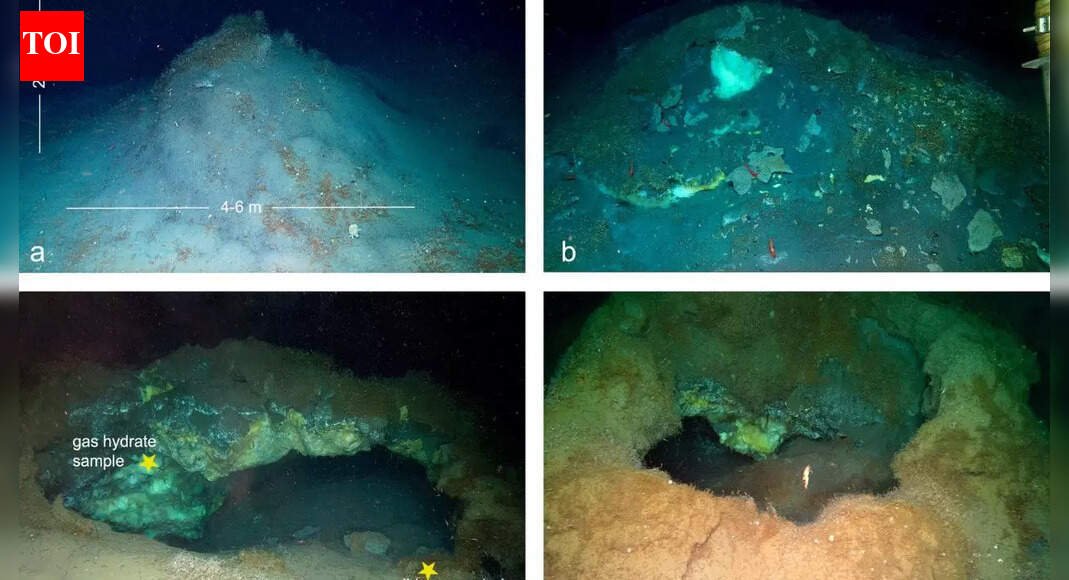
The most notable aspect of the discovery is that it consists of a number of gas hydrate mounds along the Molloy Ridge, a tectonic boundary that lies deep beneath the Greenland Sea. A gas hydrate is a molecule that consists of a large amount of trapped methane, all held together with crystalline ice. The existence of these hydrates at a depth of some 3,640 meters is one of the deepest known hydrate formation sites that have been discovered so far. According to the research paper that was published in Nature Communications, high-resolution images that included the extent of these hydrate mounds along the ridge have been discovered with the help of a remotely operated robotic vehicle. Gas hydrates have until now been thought to be largely associated with continental slopes and the shallower margins of the Arctic.

How life survives without sunlight on the Arctic sea floor

The ecologists surrounding the hydrate mountains recorded the existence of a dense population of chemosynthetic organisms. Such organisms receive energy from chemicals instead of sunlight. Based on the fact that the area is lightless, the organisms receive energy from the methane seeping from beneath the seafloor. The organisms form the base of the food chain, in turn supporting other life forms. Scientists recorded tube worms, crustaceans, as well as a dense mat of microbes aggregated in areas surrounding the seeps. The organisms exhibit specific adaptations in order to withstand high pressures as well as near-freezing temperatures. The organisms’ metabolism is specifically attuned in order to take advantage of the methane as well as sulphide compounds seeping from the sediments. The finding shows the existence of life in the deepest parts of the Arctic Ocean utilizing available energy in the area.

What role does the Molloy Ridge play in deep Arctic sea floor processes?

The Molloy Ridge is recognised as one of the deepest mid-ocean ridges in the world and is characterised by tectonic plates that are gradually drifting apart. The tectonic activities in this process result in the creation of cracks and channels in the Earth’s crust that facilitate methane gas to flow from deeper to upper layers. When methane gas reaches lower temperatures close to the ocean floor, it either gets trapped in its hydrate form or seeps out gradually. The process that is observed in this tectonic interaction is directly related to biological activities occurring on the ocean floor. The mid-ocean ridge functions both as a channel and as a supporting structure that determines hydrate and biologically active zones. The process of interaction in this study is very helpful in gaining an understanding of deep-sea ecosystems’ maintenance at a deeper level for extended periods.

What this discovery means for Arctic methane stability

Methane has a crucial role within the carbon cycle, and what happens to methane under the ocean floor is closely tracked because methane can affect the climate. The methane hydrate mounds under the Greenland Sea support a long-term trap that holds methane under stable conditions. At present, the conditions on the Molloy Ridge support a stable environment to retain methane, hindering massive amounts of methane from entering the water body. Still, recognising such systems is critical to predict their reaction to potential warming within the ocean currents or temperatures. The findings provide scientists a chance to observe and measure methane within a system that has been underrepresented within climate models to predict climatic changes. The findings confirm the essence of the deep basins within the Arctic to control carbon beneath the Earth and within the ocean.

Why the deep Arctic Ocean is becoming a focus of scientific research

The discovery of hydrate mounds and their ecosystems in the Greenland Sea is one such finding that showcases the effect that advances in technology are having on deep oceanography. The use of remotely operated vehicles with sophisticated sensors and imaging systems is enabling scientists to explore regions that were hitherto unexplored. With every new expedition, new layers of complexity are being found under the Arctic Ocean, from unexpected topographical features to new ecosystems. The Molloy Ridge finding indicates that perhaps such regions are to be found elsewhere on deep tectonic margins, waiting to be located and studied.Also Read | A step toward time travel? Physicists reverse waves in time

[ad_2]

Source link

India engaged with US to find mutually beneficial trade pact: Kwatra

[ad_1]

India engaged with US to find mutually beneficial trade pact: Kwatra

India remains very constantly engaged with the United States to find a mutually beneficial and balanced trade arrangement as early as possible, India’s Ambassador to the US Vinay Mohan Kwatra said.“On trade and tariff…we remain very constantly engaged with the United States Trade Representative (USTR) with the hope to find a mutually beneficial and a balanced trade arrangement as early as possible,” Kwatra told PTI in an exclusive interview here.“Our effort all along, right through this whole year, the tone for the relationship was set during Prime Minister’s visit in early February. We agreed to a very, very significant and substantial outcome document across range of areas. Space was one of them,” he said.

‘India Got Out Of The Gates Faster Than Most Nations’, Says US Expert As Trade Deal Talks Nears End

Kwatra termed India’s successful launch of an American communication satellite on Wednesday as a “very important and big day” for partnership between Washington and New Delhi, saying it caps a series of achievements in 2025 in bilateral space cooperation between the countries.In a historic achievement, Indian Space Research Organization’s (ISRO) heaviest rocket LVM3-M6 successfully placed the next-generation commercial communication satellite BlueBird-6 (Block-2), developed by AST SpaceMobile, USA, into its precise intended orbit. LVM3 carried the heaviest commercial satellite ever launched from Indian soil, underscoring LVM3’s growing capability as a reliable heavy-lift launch vehicle.Prime Minister Narendra Modi had visited the US in February this year for a bilateral meeting with US President Donald Trump, their first meeting within weeks of Trump’s inauguration for a second term in the White House.In the joint statement issued after the meeting, the two leaders had hailed 2025 as a “pioneering year” for US-India civil space cooperation, with plans for a NASA-ISRO effort through AXIOM to bring the first Indian astronaut to the International Space Station (ISS), and early launch of the joint ‘NISAR’ mission, the first of its kind to systematically map changes to the Earth’s surface using dual radars.The leaders had called for more collaboration in space exploration, including on long duration human spaceflight missions, spaceflight safety and sharing of expertise and professional exchanges in emerging areas, including planetary protection.The leaders also committed to further commercial space collaboration through industry engagements in conventional and emerging areas, such as connectivity, advanced spaceflight, satellite and space launch systems, space sustainability, space tourism and advanced space manufacturing.Kwatra referred to the Axiom-4 Mission, which had carried Indian Air Force Group Captain Shubhanshu Shukla to the International Space Station, marking India’s first human spaceflight mission to the ISS. He also noted the ISRO-NASA NISAR mission for advanced Earth observation, now successfully realised, launched, and operationalised.“And if you look at the areas which we have plotted in the field of space, you can easily see 10 months down the line, they have mostly, if not all of them, achieved really. We continue to work very, very proactively in other areas also including in the fields of trade, science and technology, artificial intelligence,” Kwatra said.“We have been working with a range of stakeholders in the US, both in the private sector, the government sector, in the think tank circle for a very substantial participation of theirs in the upcoming AI Action Summit in February,” he said.India will host the AI Impact Summit on February 19-20 in New Delhi, the first time an AI summit will be hosted in the Global South, after similar Global AI Summits in Bletchley Park (UK), Seoul and Paris.Kwatra added that “technology has been a very principal domain of our engagement.”

[ad_2]

Source link

India to miss $1 trillion exports target? Exports struggle despite the FTA push — Here’s what’s happening

[ad_1]

India to miss $1 trillion exports target? Exports struggle despite the FTA push — Here’s what’s happening

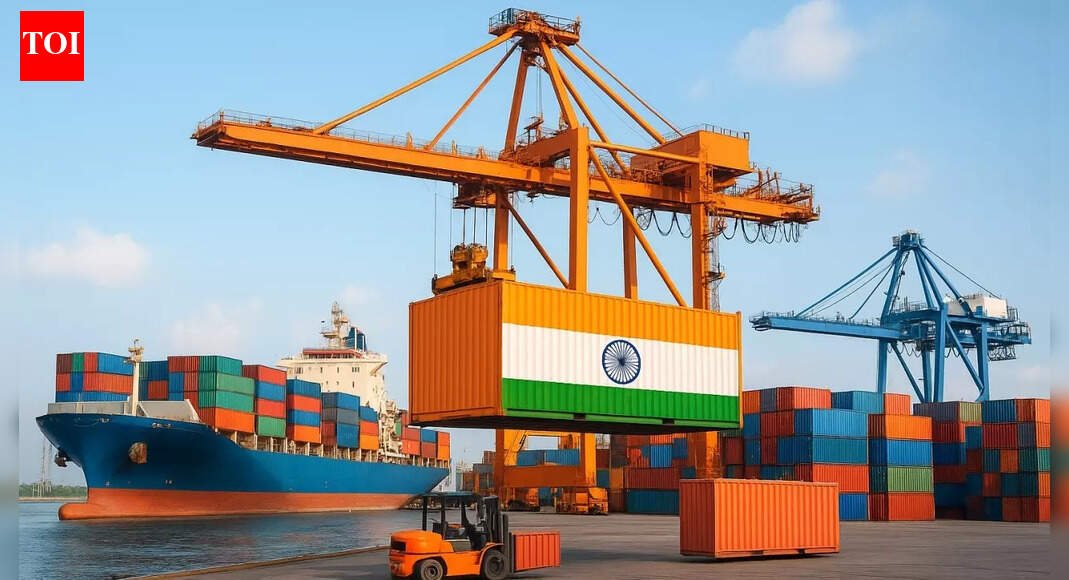
India’s ambition of exporting goods and services worth $1 trillion by the end of FY26 is likely to remain out of reach, Global Trade Research Initiative (GTRI) predicted in its latest report on Thursday, pointing to weak merchandise shipments due to weak global demand and increasing protectionist trends.Ajay Shrivastava, founder of the economic think tank, said that India is expected to record flat increase in exports this year with goods outflows showing almost no growth. Total exports in FY26 are expected to rise only to almost $850 billion, missing the $1 trillion number by $150 billion. The think tank predicted that services exports might be able to cross $400 billion, providing “the only meaningful growth cushion for India’s trade,” as the overall growth struggles with weak global demand. Meanwhile, Shrivastava highlighted that the target may be achieved if India succeeds in sealing major trade deals. “That I think we may achieve once our trade deal with the US and EU comes. That is maybe next year, not this year,” he said.While exports face sustained pressure, Shrivastava said that domestic economic conditions remain stable. “The domestic economy is working fine,” he said, adding, “The GDP numbers are telling; low inflation numbers are telling. The only pressure on the GDP will be the pressure on the export side.”

India’s trade with US and EU — a different picture

Despite the overall slowdown, recent trade figures suggest that India has begun to diversify its export destinations. Shrivastava pointed out that exports to the United States declined sharply between May and November, even as shipments to other regions rose.Exports to the US dipped almost 21% amid President Donald Trump’s 50% tariffs imposition on Indian shipments.“We have seen that between May and November, our exports to the US are down by 20.7%” he said. The report added that unless Washington rolls back the extra 25% duties on India or locks in a trade deal, “exports to India’s largest market risk further erosion.”For India’s trade with the European Union, the think tank highlighted a difference with exports dropping even before duties came into play with the bloc’s compliance and reporting requirements dragging down the country’s steep shipments by almost 24%.EU will “activate its Carbon Border Adjustment Mechanism (CBAM) on January 1, 2026, effectively imposing a carbon tax on imports.” From the next year, 2026, EU importers will lable Indian goods inclusive of the CBAM costs, “with payments settled through certificate surrender in 2027.”

India is diversying its export destinations

Shrivastava said, “During this time, our exports to the rest of the world increased by 5.5%. That means diversification already started happening in a small way.”However, he cautioned that geographical diversification must be accompanied by changes in the composition of India’s exports. “For more diversification, for more exports to these countries, we have to focus on diversifying our export basket also,” Shrivastava said. “Right now, our export basket needs inclusion of more medium to high-tech products.” The think tank said that while the country has already signed 18 FTAs and more possible in 2026, India’s priority must change, going from signing agreements to “making FTAs deliver real export gains, especially in electronics, engineering and textiles.”

What should be India’s strategy for 2026?

  • For the next year, India’s export strategy needs to focus inward, as there is limited influence over global geopolitics.
  • Export growth will depend on improving product quality, improving the value chain and bringing production costs down.
  • Electronics, engineering and textiles will emerge as the strongest opportunities, as higher value addition can sustain exports when the global trade environment is hostile.
  • Using trade agreements effectively.
  • Execution of policies and schemes should be in focus, with emphasis on operationalising the Export Promotion Mission, simplifying regulations and improving ease of doing business.

The think tank cautioned that tariffs, climate-related taxes and geopolitical uncertainty will continue to weigh on global trade conditions. Export survival and growth will depend on competitiveness at home, including better products, deeper manufacturing capabilities and lower costs.Back in FY25, India’s overall exports stood at $825 billion, including $438 billion in merchandise outflows and $387 billion in services.

[ad_2]

Source link

Income tax refund: Your refund may be delayed if revised return not filed by December 31, 2025 deadline – here’s why

[ad_1]

Income tax refund: Your refund may be delayed if revised return not filed by December 31, 2025 deadline - here’s why
The December 31, 2025 deadline is significant as it marks the last date for filing both revised and belated income tax returns. (AI image)

Income tax refund status: The Income Tax Department has stepped up scrutiny for tax returns and several taxpayers have not received their income tax refunds this year. The delay in tax refunds is a result of greater vigilance on tax deductions and exemptions that have been claimed by taxpayers.Ahead of the December 31, 2025 deadline for filing an updated or belated return, the Income Tax Department has also launched a NUDGE (Non-intrusive Usage of Data to Guide and Enable) campaign, urging taxpayers to file updated tax returns since their exemptions, deduction and refund claims have been found to be ineligible.

ITR December 31, 2025 Deadline Important For Tax Refunds

According to an ET report, the income tax refunds for those taxpayers may face a delay if they fail to file a revised Income Tax Return by the December 31, 2025 deadline for Assessment Year 2025-26, particularly in cases where errors or missing information have resulted in incorrect refund claims or data mismatches.The Income Tax Department has begun sending emails and SMS to taxpayers who have claimed what the tax department has called ‘ineligible’ deductions or exemptions they are not entitled to. These taxpayers have been asked to correct the errors if any, and submit a revised return by December 31, 2025.Also Read | ITR filing: Received ‘nudge’ from Income Tax Department for tax return & refund claims? Here’s what you need to do The December 31, 2025 deadline is significant as it marks the last date for filing both revised and belated income tax returns. Once a return is processed by the Centralised Processing Centre, any discrepancies or mistakes that are flagged and communicated to the taxpayer will invite detailed scrutiny. However, if the return is processed only after the deadline, the intimation highlighting the error may also be received after December 31, leaving the taxpayer without the option to revise the return, the ET report said.As a result, taxpayers whose returns contain mistakes that are identified after the deadline may have to face further verification or assessment proceedings, even if the error was unintentional.

Nudge Campaign

Nudge Campaign

Chartered Accountant Suresh Surana was quoted as saying, “Accordingly, once this date has elapsed, a taxpayer can no longer revise the return of income to correct errors or omissions, even if the return has not yet been processed by the Centralised Processing Centre.”Income tax refunds are at the risk of being delayed for taxpayers who fail to file a revised Income Tax Return by the December 31, 2025 deadline, particularly salaried employees whose tax filings contain mismatches with employer records.Abhishek Soni, CEO & co-founder, Tax2win, said many salaried individuals have received intimation notices from the Income Tax Department. These cases largely involve employees who claimed deductions such as those under Sections 80C, 80D or House Rent Allowance in their returns but did not disclose these claims to their employers at the time tax was deducted at source.Maneesh Bawa, Partner, Nangia Global, noted that these mismatches are common and can occur when tax has been deducted under the new regime, but the return is filed under the old regime with deductions claimed.Jigar Suba, founder of JC Suba & Associates told ET that such intimations may be triggered by a range of errors, including incorrect or excessive deduction claims, mismatches in income reported against data reflected in the Annual Information Statement or Tax Information Summary, and discrepancies between the Income Tax Return and Form 26AS. Other common reasons include incorrect House Rent Allowance or leave travel claims, unsupported deductions for life or medical insurance, and ineligible donations claimed for charitable trusts or political parties.He added that failure to disclose income beyond salary is another major trigger, with omissions often relating to the sale of mutual funds, equity shares, crypto assets, as well as other capital gains or interest income.Abhishek Soni said that such intimations are significant as they indicate that the Income Tax Department has identified a mismatch in the return and that its data does not fully support the deductions claimed. He warned that ignoring the notice could result in tax demands, interest liabilities or further communications from the department.Maneesh Bawa said that if the Income Tax Department has identified an error, taxpayers should file a revised return within the permitted timeline, which is currently open until December 31, 2025. He cautioned that ignoring a genuine discrepancy may lead to disallowance of claims and could invite closer scrutiny, resulting in additional tax liabilities along with interest and penalties.

[ad_2]

Source link

Indian commercial vehicle industry poised for upcycle as replacement demand builds: Nomura

[ad_1]

Indian commercial vehicle industry poised for upcycle as replacement demand builds: Nomura

The Indian medium and heavy commercial vehicle (M&HCV) industry appears to be entering the next upcycle, with industry volumes estimated to grow by around 8 per cent year-on-year in FY26 and 10 per cent in FY27, following a period of modest growth, according to a report by Nomura.The report highlighted that improving industry fundamentals are likely to support demand over the medium term. It added that rising freight rates, lower GST-led affordability and a high average age of trucks–currently estimated at around 10 years, are expected to drive replacement demand, particularly during FY27-28.It stated “M&HCV industry appears to be entering the next upcycle……. we believe these are still early stages of a CV upcycle”.These factors together are improving fleet operator economics and supporting a recovery in volumes.Nomura’s analysis points to a clear improvement in fleet operator profitability, driven by better freight rates and the benefits of GST-related cost efficiencies.As a result, fleet operators are witnessing stronger cash flows, which is translating into improved replacement demand and higher confidence in new vehicle purchases.The report said it remains positive on the commercial vehicle sector, citing strong potential for a cyclical upturn and improving demand visibility.The report also noted that the current phase still represents the early stages of a CV upcycle, as industry volumes have not yet crossed the peak levels seen in FY19.According to Nomura, industry growth in FY27 could be much stronger if economic growth accelerates, supported by higher consumption and lower interest rates.Addressing concerns around the impact of the Dedicated Freight Corridor (DFC), Nomura said demand risks from the DFC remain limited. The Eastern and Western DFCs are now around 96 per cent operational, but non-bulk cargo–which accounts for nearly 30 per cent of total freight–continues to rely heavily on road transportation.Given the large and diversified freight base served by commercial vehicles, the report does not expect any significant impact on overall truck demand.However, Nomura cautioned that some normalisation could be seen in specific sub-segments. Tractor-trailers, which compete directly with bulk rail movement, have seen a sharp increase in their share of the industry mix, rising from about 9 per cent in FY21 to 22 per cent in FY25.Overall, the report highlighted that structural drivers such as replacement demand, improving fleet economics and supportive macro conditions position the Indian M&HCV industry for a sustained recovery in the coming years.

[ad_2]

Source link

‘National Total War’: America’s Growing Vulnerability Amid China’s Military Ascent | World News

[ad_1]

'National total war': How China's military buildup up is making US more vulnerable
A new Pentagon report reveals China’s military buildup increasingly threatens the US homeland. Beijing is developing capabilities for direct attacks on critical infrastructure, cyber systems, and space assets, aiming to disrupt American decision-making during a Taiwan crisis. This signifies a shift from regional deterrence to direct homeland vulnerability, fundamentally altering US defense calculations.

For the first time, a Pentagon report says plainly what had long been implied. China’s “historic military buildup” has made the US homeland “increasingly vulnerable.” The phrase appears early in the Defense Department’s 2025 annual assessment of China’s military power, and it is not rhetorical flourish. It marks a shift in how the US government wants Americans to understand the problem Beijing poses. This is no longer only about aircraft carriers in the Pacific or missile ranges around Taiwan. It is about the United States itself as a target.The report, formally titled Military and Security Developments Involving the People’s Republic of China, describes a Chinese military that is no longer content with regional deterrence. The People’s Liberation Army is now measuring its capabilities against what it calls the “strong enemy,” an unmistakable reference to the United States. In doing so, it is building ways to pressure American decision-making directly, including through cyber access to critical infrastructure, long-range conventional and nuclear strikes, and attacks on the space systems that underpin US military power.The effect, the report argues, is a new vulnerability equation. Washington must now think not only about whether it can intervene in a conflict near Taiwan, but whether it can do so while absorbing disruption at home.Why it matters

  • The Pentagon’s core point isn’t just that China is getting stronger. It’s that Beijing is building multiple ways to shape US decision-making in a crisis-by threatening the homeland directly while also complicating US military intervention in the Indo-Pacific.
  • That shift widens the problem from “Can the US win near Taiwan?” to “Can the US sustain domestic stability, critical infrastructure, and space-enabled warfighting while intervening?” The report’s framing of vulnerability is deliberately multi-domain. The latest benchmark: 2027
  • The report says the PLA is making “steady progress” toward its 2027 goals, including achieving “strategic decisive victory” over Taiwan and building “strategic counterbalance” against the US in nuclear and other strategic domains. Then it translates the implication plainly: “China expects to be able to fight and win a war on Taiwan by the end of 2027.”
  • To get there, the report says the PLA is refining options to force unification, including “most dangerously” an amphibious invasion, “firepower strike,” and possibly a maritime blockade-testing “essential components” through 2024 exercises, including striking sea/land targets and striking US forces in the Pacific.

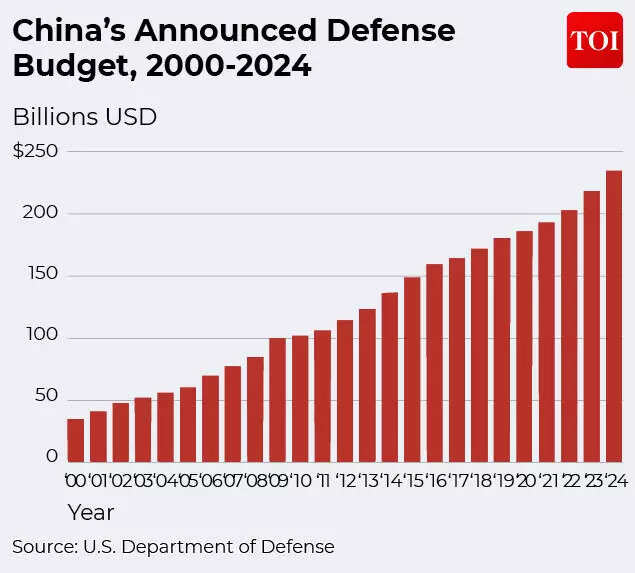
‘National total war’The most striking doctrinal shift described in the report is Beijing’s embrace of what Chinese military writings call “national total war.” The idea treats future conflict not as a discrete military contest but as a clash between entire national systems. Political authority, economic resilience, civilian infrastructure, information control, and military power are all part of the same battlefield.The Pentagon links this thinking directly to China’s long-term political goal of “national rejuvenation” by 2049 and to its nearer-term military benchmarks. Defense spending has nearly doubled since Xi Jinping took power. Civil-military integration reforms are designed to ensure that commercial sectors and local governments can be rapidly mobilized in wartime. Chinese planners, the report notes, have studied the war in Ukraine closely, drawing lessons about industrial capacity, sanctions resistance, and the risks of a prolonged fight.

China defence budget over the years

This is not abstract theory. The report repeatedly emphasizes integration. China’s “core operational concept,” known as Multi-Domain Precision Warfare, is built around fusing data from space, cyber, air, sea, and land sensors into a single targeting system. The aim is to identify weak points in an adversary’s operational system and strike them quickly, at scale, and in coordination.

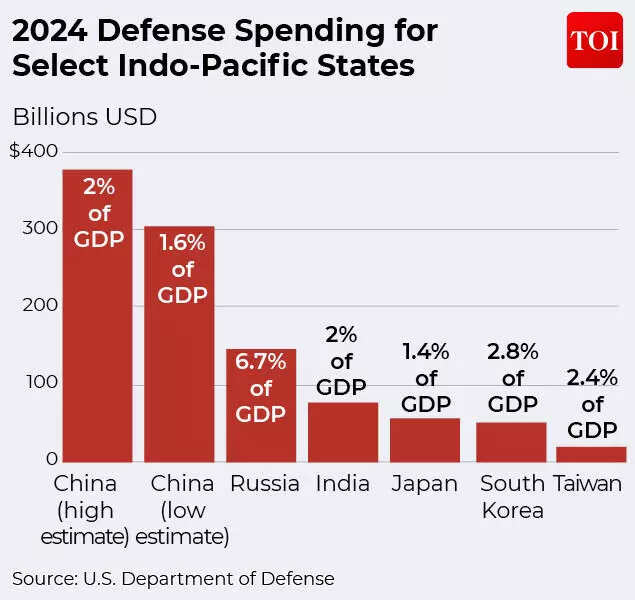
Defence budget: China and other Asian powers

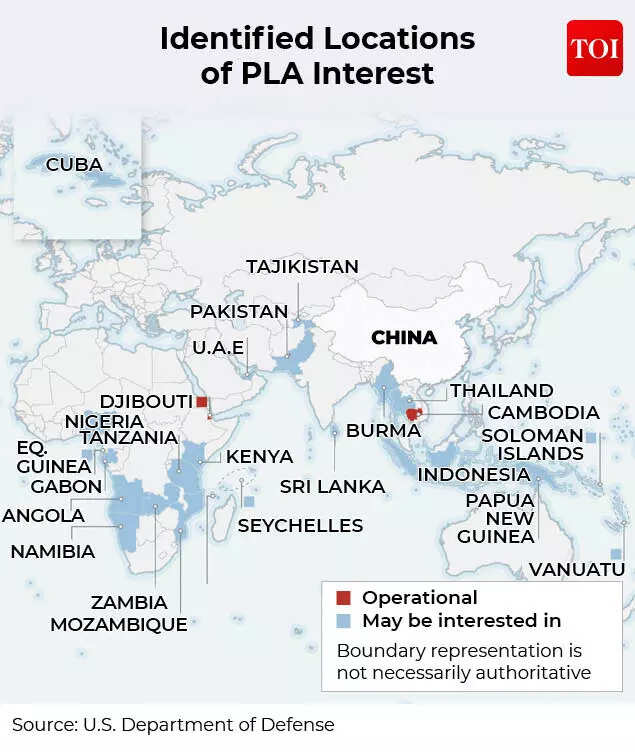
Taiwan as the pacing scenarioEverything in the report ultimately bends back toward Taiwan. The Pentagon reiterates that the PLA is making “steady progress” toward its 2027 goals, which are explicitly tied to the ability to force unification with the island. The assessment translates the implication without hedging: China expects to be able to “fight and win” a war over Taiwan by the end of 2027.To get there, Beijing is refining multiple military options. A maritime blockade. A joint firepower strike campaign. A full-scale amphibious invasion. In 2024, the PLA’s “JOINT SWORD” exercises rehearsed the encirclement of the island, simulated strikes on sea and land targets, and practiced blocking key ports. These were not symbolic displays. They were stress tests of command-and-control, logistics, and coordination under realistic conditions.Crucially, Taiwan planning is inseparable from counter-intervention. The PLA’s growing missile forces can now range 1,500 to 2,000 nautical miles from China’s shores. In sufficient volume, the report warns, those strikes could seriously disrupt US operations across the western Pacific. Chinese units train against professional “blue forces” that replicate US equipment and tactics. The point is explicit preparation for a fight with American forces, not a generic regional contingency.Cyber as a homeland leverIf Taiwan is the likely trigger, cyber operations are the lever that reaches home. The report calls China the most persistent cyber threat to US government, military, and civilian networks in 2024. What distinguishes the current assessment is its emphasis on pre-positioning.Chinese cyber actors associated with campaigns such as “Volt Typhoon” have “burrowed into US critical infrastructure,” the report says. These intrusions go beyond espionage. They demonstrate the ability to disrupt systems during a crisis, including those needed to mobilize and deploy US forces. Likely targets include military command networks and civilian infrastructure with political or economic significance.The Pentagon’s language is careful but unsettling. Disruptions might be localized and temporary, lasting days or weeks. But the strategic effect could be outsized. Interruptions to pipelines, power, or telecommunications during a Taiwan crisis could slow military response and generate public pressure at home. Another campaign, known as “Salt Typhoon,” targeted US telecommunications providers in 2024, highlighting vulnerabilities in the backbone of American communications.Taken together, cyber operations are portrayed as a way to impose costs below the nuclear threshold while shaping the domestic environment in which US leaders make decisions.The ‘kill chain’The report is equally blunt about space. China sees space superiority as decisive. Its intelligence, surveillance, and reconnaissance satellite fleet has more than tripled since 2018, reaching over 359 systems by early 2024. That constellation dramatically improves China’s ability to track US aircraft carriers and expeditionary forces across the Pacific.These satellites are not passive observers. They are integral to closing what the military calls the kill chain: finding targets, tracking them, and delivering long-range precision strikes. Without space-based sensors and communications, that chain breaks.China is therefore building multiple ways to sever its adversary’s access to space. The report describes kinetic antisatellite missiles capable of destroying satellites in low Earth orbit, with ambitions to reach higher orbits. It highlights “dual-use” satellites equipped with robotic arms, such as Shijian-21, that can grapple and reposition other satellites. Ground-based lasers can disrupt or damage sensors. Jammers target military satellite communications across frequency bands.Cyber plays a role here too. Chinese actors have been implicated in attacks on foreign satellite networks, particularly those of the United States. The goal is not necessarily to destroy everything, but to degrade enough systems to slow decision-making and blunt operational advantage at the outset of a conflict.Nuclear growth and signalingOverlaying all of this is a rapidly expanding nuclear force. China’s warhead stockpile remained in the low 600s through 2024, the report says, but it is on track to exceed 1,000 by 2030. New silo fields in western China, a growing fleet of mobile intercontinental ballistic missiles, and advances in early warning systems point to a shift toward higher readiness.The report also notes Chinese interest in lower-yield nuclear weapons, suggesting a strategy that contemplates limited nuclear use rather than only massive retaliation.The effect is to thicken the strategic layer. Nuclear expansion does not replace cyber or conventional pressure. It sits alongside them, complicating escalation dynamics and shortening decision timelines.Ships, reach, and presenceNaval power provides the endurance behind this posture. China’s third aircraft carrier, Fujian, completed its first sea trials in 2024. The navy aims to field six carriers by 2035, for a total of nine. In October, China’s two operational carriers conducted their first dual-carrier operations, a milestone in integrated combat capability.The relevance to homeland vulnerability is indirect but real. Maritime power supports blockade options around Taiwan and sustained airpower projection. It also helps keep US forces at distance while other tools apply pressure elsewhere.China’s ambitions are not confined to the Indo-Pacific. The report details a growing global logistics network, from Djibouti to Cambodia’s Ream Naval Base, with potential future sites in Africa and the Pacific islands. Access to the Atlantic, the Pentagon warns, would pose new challenges for US planners.

PLA is continuously expanding its interest areas

Russia and the outer perimeterChina’s partnership with Russia adds another layer. Combined bomber patrols near Alaska, joint coast guard operations in the Bering Sea, and expanded exercises signal a shared interest in countering the United States. These activities are not decisive on their own, but they stretch attention and resources, reinforcing the report’s central theme of multi-directional pressure.What the warning really meansThe Pentagon’s core message is not simply that China is stronger. It is that Beijing is building an integrated system designed to shape US choices in a crisis. The question is no longer only whether the United States can prevail militarily near Taiwan. It is whether it can do so while managing cyber disruption at home, threats to space systems, and a more complex nuclear backdrop.China is not betting on a single knockout blow. It is constructing multiple pressure points, many of them far from the Taiwan Strait, to raise the cost and uncertainty of American intervention.The report does not offer easy solutions. It does, however, make clear that the era in which the US homeland could be treated as a sanctuary in great-power conflict is ending. The competition, as Beijing’s own doctrine suggests, is becoming a contest between entire systems. And in that contest, distance alone is no longer protection.

[ad_2]

Source link

Tier-2, Tier-3 cities to drive next phase of India’s premium housing growth

[ad_1]

Tier-2, Tier-3 cities to drive next phase of India's premium housing growth

India’s premium and luxury housing segment is undergoing a structural expansion, with demand steadily moving beyond traditional metropolitan markets into Tier-2 and Tier-3 cities, according to industry reports and developers.As per Magicbricks, India the country’s luxury housing market is projected to grow at a compounded annual growth rate (CAGR) of 35 per cent, expanding from nearly USD 17 billion in 2024 to over USD 103 billion by 2030. This positions luxury housing as one of the fastest-growing segments within India’s residential real estate market.Data from ANAROCK further indicates sustained momentum in premium housing demand, driven by rising household incomes, lifestyle upgrades and a growing preference for larger, better-designed homes across emerging urban centres.While metros such as Mumbai, Delhi-NCR and Bengaluru continue to dominate high-value residential transactions, the Magicbricks report highlights a clear shift in buyer interest towards non-metro markets, including Panchkula, Mohali, Raipur, Bilaspur and select peripheral city clusters. These locations are benefiting from infrastructure upgrades, lower population density and greater land availability, enabling the development of low-density premium projects.According to ANAROCK, premium and luxury homes now account for a significantly higher share of new residential launches in several Tier-2 cities, underscoring developers’ confidence in sustained end-user demand in these markets.Industry stakeholders note that luxury housing in India is increasingly being defined by lifestyle considerations rather than size alone. Buyers are prioritising privacy, exclusivity, wellness and experiential living, leading to higher demand for gated communities, independent floors and lifestyle-led developments.Aakash Ohri, Joint Managing Director and Chief Business Officer, DLF Homes, said, “Families seeking a more peaceful and fulfilling lifestyle are drawn to the serene embrace of places like Panchkula. Additionally, homebuyers are looking for exclusive addresses and a resort-like living experience as they value privacy, comfort, and a luxurious lifestyle with many amenities and facilities.”He added that there has been a noticeable rise in non-resident Indian (NRI) interest in these markets. “We have also observed significant interest and investment from NRIs in the region’s real estate market. Many NRIs view current conditions as a favourable opportunity to invest… Over the past three years, there has been a surge in demand for DLF’s low-rise independent floors in Panchkula,” Ohri said.Echoing similar trends, Prakhar Agarwal of Rama Group said, “The next phase of India’s premium housing growth is clearly moving beyond metros into Tier-2 and Tier-3 cities. In regions like Chhattisgarh, particularly Raipur and Bilaspur we are seeing growing demand for well-designed premium homes with modern amenities.”He further noted, “Infrastructure development, rising local affluence, and increasing professional migration are accelerating this shift. At Rama Group, we are focused on creating premium residential experiences in these emerging markets.”Rohit Kishore, CEO, Hero Realty, pointed to Mohali as a key emerging destination, stating, “Real estate in Tier-2 cities is changing rapidly, with more investors exploring options beyond major metros. Mohali stands out as an attractive choice due to urbanization, improved infrastructure, and a desire for a better quality of life.”Both Magicbricks and ANAROCK indicate that the rise of premium housing beyond metros reflects a long-term structural shift rather than a cyclical trend. As wealth creation expands geographically and lifestyle aspirations evolve, premium housing is expected to play a defining role in India’s next phase of urban development, with the market firmly on track to cross USD 103 billion by 2030.

[ad_2]

Source link

Hymns, carols, morning prayers: How PM Modi celebrated Christmas — see pics, watch video | India News

[ad_1]

Hymns, carols, morning prayers:  How PM Modi celebrated Christmas — see pics, watch video

NEW DELHI: Prime Minister Narendra Modi on Thursday extended Christmas greetings to people across the country, wishing for the festival to be filled with “peace, compassion and hope.” He also called for the strengthening and harmony in our society.The PM also attended the Christmas morning service at The Cathedral Church of the Redemption in Delhi along with a large congregation of Christians of Delhi and North India.

PM Modi attends Morning prayer

The service included prayers, carols, hymns and a special prayer for the Prime Minister by Rt Rev Paul Swarup, the Bishop of Delhi.PM’s message entailed the enduring values of love, service and brotherhood associated with the teachings of Jesus Christ, and their relevance in fostering social harmony and mutual respect. In a post on X, the PM said, “Wishing everyone a joyous Christmas filled with peace, compassion and hope. May the teachings of Jesus Christ strengthen harmony in our society.” Referring to the service he attended, he added, “Attended the Christmas morning service at The Cathedral Church of the Redemption in Delhi. The service reflected the timeless message of love, peace and compassion. May the spirit of Christmas inspire harmony and goodwill in our society.”Over the last few years, PM Modi has been regularly attending programmes that have connected with the Christian community.

.

During Easter 2023, PM Modi attended an Easter programme at the Sacred Heart Cathedral in Delhi. Later that year, he hosted a Christmas programme at his official residence at 7, Lok Kalyan Marg.In 2024, the PM attended a Christmas dinner at the residence of minister of state George Kurian and also participated in a programme organised by the Catholic Bishops’ Conference of India (CBCI).(WIth inputs from agency)

[ad_2]

Source link

Gold & silver price prediction: Gold, silver at new highs – where are prices heading in next few days?

[ad_1]

Gold & silver price prediction: Gold, silver at new highs - where are prices heading in next few days?
On the upside, MCX Gold has potential to advance toward the 145,000 level in the upcoming sessions. (AI image)

Gold and silver price prediction: Gold prices are likely to maintain their uptrend and silver too is showing signs of strength, says Abhilash Koikkara, Head – Forex & Commodities, Nuvama Professional Clients Group. He shares his views on gold and silver:

MCX Gold Outlook

MCX Gold remains in a strong uptrend, consistently forming higher highs and higher lows, highlighting the current bullish momentum. This price action reflects sustained buying interest on declines and indicates that the broader trend continues to stay firmly upward. As long as this structure remains intact, the outlook for MCX Gold remains positive.From a technical standpoint, immediate support is seen near the 134,500 level, which has served as a strong base in recent price action, with buying interest repeatedly emerging on minor dips. Any pullback toward this zone is likely to invite fresh buying, helping to limit downside risk in the near term. Sustaining above this support level keeps the bullish structure firmly intact.On the upside, MCX Gold has potential to advance toward the 145,000 level in the upcoming sessions. This objective is in line with the ongoing trend and highlights the strength of the prevailing momentum. A sustained breakout above intermediate resistance levels could further fuel the upward move.Overall, unless there is a clear and decisive break below the 134,500 support, MCX Gold is likely to retain its positive bias. The broader technical setup continues to favour trend continuation, with further upside potential as long as momentum and market sentiment remain supportive.

MCX Gold Trading Strategy

  • CMP: 138200
  • Target: 145000
  • Stop Loss: 134500

MCX Silver Outlook

MCX Silver has delivered a decisive breakout from a consolidation phase, signalling a strong positive technical development and pointing toward the continuation of the uptrend. Consolidation periods usually reflect a temporary balance between buyers and sellers, and a breakout from such formations often results in an accelerated price move as momentum picks up. The latest price action in MCX Silver indicates that buyers have taken control, reinforcing a bullish outlook.From a technical perspective, the breakout signals renewed strength in the trend and increases the likelihood of further upside. If prices remain above the breakout zone, the bullish bias is expected to stay intact. Immediate key support is seen near the 215,000 level, which now serves as a solid base. Any pullback toward this zone could draw fresh buying interest, helping to stabilize prices.On the upside, MCX Silver has the potential to reach the 240,000 level in the near to medium term. This target is based on the height of the consolidation range and is in line with the prevailing momentum. Overall, if prices stay above the 215,000 support, MCX Silver is likely to maintain its positive trajectory, with further upside achievable as bullish sentiment continues to strengthen.

MCX Silver Trading Strategy

  • CMP: 223301
  • Target: 240000
  • Stop Loss: 215000

(Disclaimer: Recommendations and views on the stock market, other asset classes or personal finance management tips given by experts are their own. These opinions do not represent the views of The Times of India)

[ad_2]

Source link