Breaking News
What is SHANTI Bill 2025? Top things to know about the new nuclear energy bill & what it means

[ad_1]
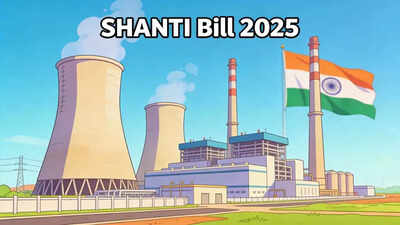
What is SHANTI Bill 2025? Top things to know about the new nuclear energy bill & what it means

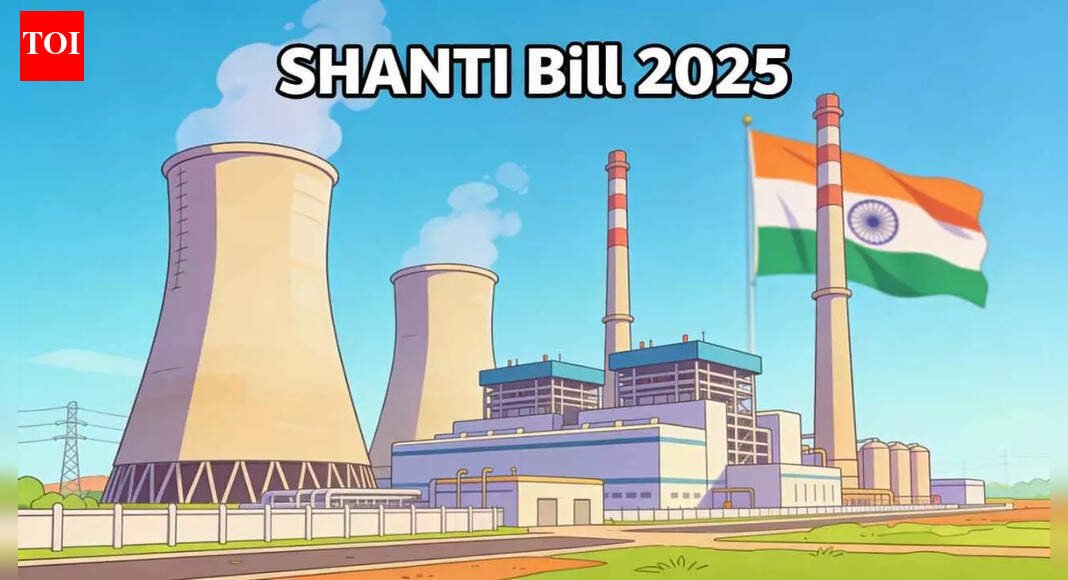
The Lok Sabha on Wednesday passed the Sustainable Harnessing and Advancement of Nuclear Energy for Transforming India Bill (SHANTI), 2025, clearing the way for a major overhaul of India’s civil nuclear framework. The Bill was approved by voice vote during the ongoing Winter Session amid a walkout by most opposition members. Introduced earlier this week by minister of state for the department of atomic energy Jitendra Singh, the legislation marks a significant policy shift by opening parts of the nuclear energy sector to private participation for the first time.According to Singh, the Bill is intended to “modernise India’s nuclear framework in line with contemporary technological, economic and energy realities, while retaining and strengthening core safety, security and regulatory safeguards that have been in place since the Atomic Energy Act of 1962”.The government pointed to gaps in the current regime, including inadequate safety coverage across the nuclear lifecycle, limited regulatory powers and a post-accident focus on compensation rather than prevention. The SHANTI Bill introduces a consolidated legal structure that brings regulation, enforcement, civil liability and dispute resolution under a single statute.

Here’s what you need to know about the SHANTI Bill

Accelerate nuclear power growth: The Bill aims to promote the growth of nuclear energy and its applications across a range of sectors, aligning with the country’s target of achieving 100 GW of nuclear power capacity by 2047. Private firms allowed to enter: A major change under the bill is the entry of private enterprises into civil nuclear operations, which was, till now, reserved for government entities,. The Bill allows private companies and joint ventures to get authorisation for establishing and operating nuclear facilities, as well as transport nuclear fuel. However, the government pointed out that sensitive operations such as uranium enrichment, spent fuel handling and heavy water manufacturing will still remain exclusively under the control of the Central government. Similarly, oversight of radioactive materials and radiation-producing equipment will also continue under the Centre to ensure that safety standards are maintained.Statutory regulator: The Atomic Energy Regulatory Board (AERB) will be given statutory status, giving it the power to inspect facilities, investigate incidents, issue binding directions and suspend or cancel operations that fail to meet safety standards.Licensing reforms: A clear licensing regime will define who can build and operate nuclear facilities, strengthening accountability, ET reported.Embeds safety measures: Safety oversight will be legally embedded across the entire lifecycle of nuclear facilities, from construction and operation to transport, storage, decommissioning and waste management. Activities involving radiation exposure will require explicit safety authorisation in addition to operational licences. The Bill also introduces a specialised nucleartribunal to resolve disputes. Changes to nuclear liability provisions: Another significant aspect of the Bill is the modification of the nuclear liability framework to encourage investment while limiting risks. The law removes the clause related to the liability of suppliers of nuclear equipment. Singh said that the Bill provides for “a pragmatic civil liability regime for nuclear damage” and does not dilute compensation to victims. He said operator liability has been rationalised through graded caps linked to reactor size, aimed at encouraging newer technologies such as small modular reactors, while ensuring full compensation through a multi-layered mechanism. He added that supplier liability was removed after considering global practices and advances in reactor safety, while negligence and penal provisions would continue to be enforceable under the law.

[ad_2]

Source link
Adani group bets big on aviation! Plans to invest Rs 1 lakh crore in next 5 years; will bid ‘very aggressively’ for 11 more airports

[ad_1]

Adani group bets big on aviation! Plans to invest Rs 1 lakh crore in next 5 years; will bid 'very aggressively' for 11 more airports

The Adani Group plans to invest Rs 1 lakh crore in its airports business over the next five years, betting on strong and sustained growth in India’s aviation sector, according to Jeet Adani, director of Adani Airports. Speaking to news agency PTI ahead of the launch of commercial operations at Navi Mumbai International Airport, he said the group remains highly bullish on the industry’s long-term prospects.“On the airport side, Rs 1 lakh crore in the next five years,” Jeet Adani was quoted by news agency PTI, adding that India’s aviation ecosystem could grow at 15–16 per cent annually for the next decade or more. He pointed to low per-capita air travel in India compared to China, noting that even reaching Chinese levels would require the sector to expand across multiple cities.Navi Mumbai International Airport is set to begin commercial operations on December 25, marking a major expansion of the group’s airport portfolio. The project is being developed by Navi Mumbai International Airport Ltd, in which the Adani Group holds a 74 per cent stake. Built at an initial cost of Rs19,650 crore, the airport’s first phase will be able to handle 20 million passengers a year, with capacity planned to scale up to 90 million passengers over time.Jeet Adani said the new airport would ease pressure on Mumbai’s existing Chhatrapati Shivaji Maharaj International Airport, which has faced capacity constraints for years. “Mumbai Airport was supply constrained from 2016 onwards and wasn’t able to service the additional demand that was coming through,” he said, adding that the commissioning of Navi Mumbai would finally bring some relief.Calling the opening a landmark moment for Indian aviation, he said the project still has significant room to grow. “There is four times growth still left to do,” he noted.Beyond Mumbai, the Adani Group operates six other airports, Ahmedabad, Lucknow, Guwahati, Thiruvananthapuram, Jaipur and Mangaluru, and had earlier acquired Mumbai airport from the GVK Group. Jeet Adani said the group plans to bid “very aggressively” for all 11 airports identified for the next round of privatisation.On investments in aircraft services such as MRO and flight simulation training centres, he said it was too early to commit numbers, though the group remains deeply invested in expanding its expertise. “We want to keep growing our expertise and our depth,” he said.Through Adani Airport Holdings Ltd, the group is now India’s largest airport infrastructure operator, controlling about 23 per cent of passenger traffic and roughly 33% of cargo movement nationwide. Alongside capacity upgrades, the company is also expanding non-aeronautical services and city-side developments, as it looks to build diversified revenue streams.

[ad_2]

Source link

Winter session ends: OM Birla meets MPs as Parliament concludes; PM Modi, Priyanka in attendance | India News

[ad_1]

Winter session ends: OM Birla meets MPs as Parliament concludes; PM Modi, Priyanka in attendance

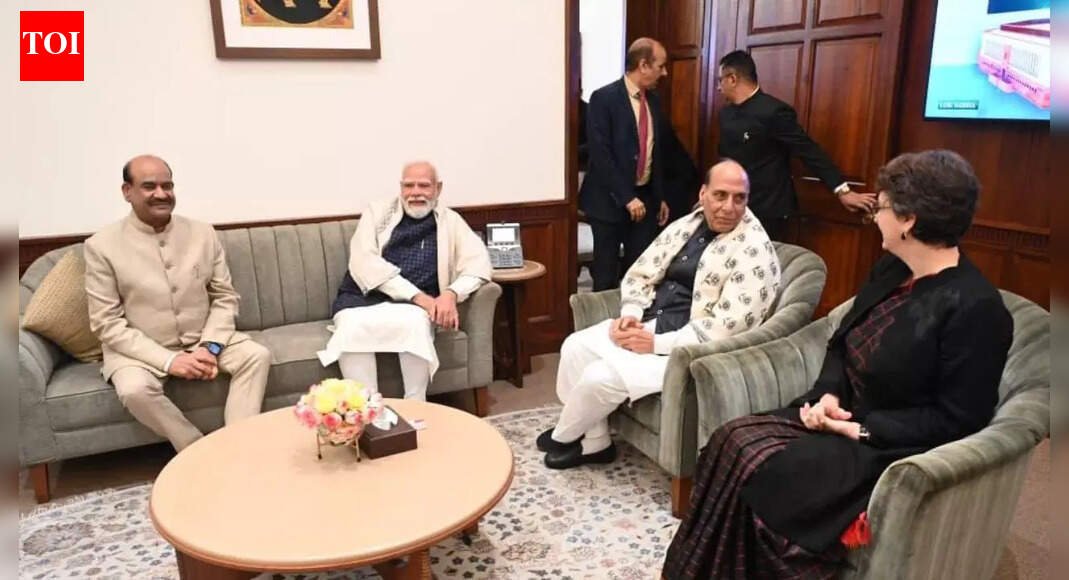
NEW DELHI: Lok Sabha Speaker Om Birla on Friday held a meeting with leaders of political parties and Members of Parliament in his chamber at Parliament House, marking the conclusion of the Winter Session of Parliament 2025.Prime Minister Narendra Modi, defence minister Rajnath Singh, Congress leader Priyanka Gandhi and several other opposition leaders were present at the meeting.Earlier in the day, amid continued opposition protests over the passage of the Viksit Bharat Guarantee for Rozgar and Ajeevika Mission (Gramin) (VB-G RAM G) Bill, Lok Sabha was adjourned sine die.Prime Minister Modi, who returned on Thursday from a three-nation foreign visit, was present in the House during the adjournment.With this, the 19-day-long Winter Session, which had 15 sittings, formally came to an end. Several key Bills were passed during the session, and the Lok Sabha recorded a productivity of 111 per cent, reflecting what the Speaker described as strong legislative engagement by members.Rajya Sabha was also adjourned sine die on the day. Chairman C P Radhakrishnan read out a summary of the legislative and other business conducted during the session before the National Song was played.Radhakrishnan also criticised disruptions during proceedings, saying, “The conduct of members during the Minister’s reply yesterday, which included protesting and tearing of papers, was unbecoming of the House.”Opposition parties continued to oppose the VB-G RAM G Bill even after the session ended. They also staged a protest outside Parliament, while Trinamool Congress MPs continued their demonstration on the steps near the House entrance.Overall, the House functioned for around 92 hours during the Winter Session, achieving a productivity of 121 per cent. During this period, 58 starred questions, 208 Zero Hour submissions and 87 special mentions were taken up.The Winter Session of Parliament began on December 1. Adjournment sine die, Latin for “without a day,” means that a House is suspended indefinitely without fixing a date for its next sitting.

[ad_2]

Source link

Boom or skewed spike? India’s exports to China jump 90% – but why there is little reason to cheer

[ad_1]

Boom or skewed spike? India’s exports to China jump 90% - but why there is little reason to cheer
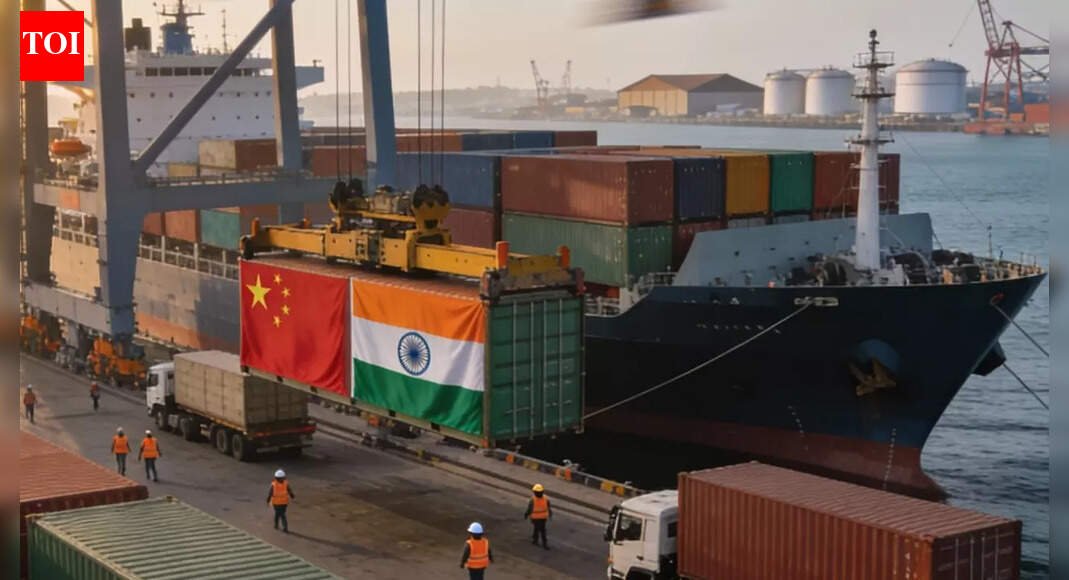
According to GTRI, India’s trade relationship with China has entered a phase of sharp contrasts. (AI image)

India’s exports to China surged 90% in November to hit $2.2 billion! However, the remarkable year-on-year spike masks the truth of how volatile India’s exports to China are, and the growing dependence on the neighbouring country for imports, according to a new report by Global Trade Research Initiative (GTRI). From April to November, exports grew by 33%, touching $12.2 billion, up from $9.2 billion the previous year. According to GTRI, India’s trade relationship with China has entered a phase of sharp contrasts. “Overall, India’s export growth to China is not broad-based. It is concentrated mainly in naphtha and a few atypical electronics products, rather than across India’s traditional export basket,” said GTRI, striking a cautious note.

Why did India’s exports to China surge?

According to GTRI founder Ajay Srivastava, the spike in exports is largely driven by a limited range of products. Naphtha is the largest contributor, with exports rising by 512% in October and 172% from April to October – totaling a whopping $1.4 billion, due to strong Chinese demand for petrochemical feedstocks. Electronics also saw unusually sharp increases. Exports of printed circuit boards surged to $296.5 million in October, an 8,577% year-on-year increase, while shipments from April to October rose over 2,000% to $418 million.Exports of mobile phone components also increased by 82% to $362 million, which is unusual given India’s significant imports of these items from China. In contrast, exports of iron ore continued to decline, dropping by 1.2% in October and 30% from April to October, while shrimp exports showed only modest growth. Devil in Details?India’s exports of its leading three products to China—naphtha, iron ore, and shrimps—have seen huge fluctuations from year to year, indicating that these exports are more influenced by Chinese demand than by a stable export strategy, notes GTRI.Naphtha exports increased from $1.83 billion in FY2022 to $1.91 billion in FY2023, but then sharply declined to approximately $1.26 billion in FY2024. They remained unchanged in FY2025.Iron ore exports were even more erratic, dropping from $2.49 billion in FY2022 to $1.40 billion in FY2023, then rising to $3.64 billion in FY2024, before falling again to $1.89 billion in FY2025. Shrimp exports have been relatively more stable but still showed variations, increasing from $823 million in FY2022 to $924 million in FY2023, then decreasing to $798 million in FY2024 and $773 million in FY2025. “This uneven pattern shows that India’s key exports to China lack consistency and largely rise or fall with shifts in Chinese demand, prices and policy, rather than reflecting sustained market access or diversification,” says the GTRI analysis.

What is India importing from China?

India’s imports from China are heavily concentrated in four main categories: machinery, electronics, plastics, and organic chemicals – these make up nearly 80% of the total.From January to October 2025, electronics led the imports, at $38 billion. This included mobile phone components ($8.6 billion), integrated circuits ($6.2 billion), laptops ($4.5 billion), solar cells and modules ($3.0 billion), flat-panel displays ($2.6 billion), lithium-ion batteries ($2.3 billion), and memory chips ($1.8 billion). Machinery imports were next at $25.9 billion, with transformers alone making up $2.1 billion. This indicates India’s reliance on Chinese capital goods for power and industrial projects. Organic chemicals imports touched $11.5 billion – this was largely due to $1.7 billion in antibiotics. This highlights China’s strong position in the pharmaceutical intermediates sector.Plastics imports were $6.3 billion, including $871 million in PVC resin, while steel and steel products totaled $4.6 billion, and medical and scientific equipment added $2.5 billion. Together, these figures show that India’s import bill from China is anchored in electronics, machinery, chemicals and materials that are difficult to substitute quickly, explaining the persistence of a large bilateral trade deficit despite efforts to diversify supply chains, says GTRI.

India-China Trade Deficit Mounting – and it’s a cause for worry!

The GTRI report notes that India’s trade gap with China is touching new records, reflecting a skewed trade relationship that warrants a closer look. As GTRI points out – India’s trade with China remains extremely imbalanced, and it is characterized by weak exports, increasing imports. A record trade deficit is expected this year.Exports have decreased from $23.0 billion in 2021 to $15.2 billion in 2022, remained low at $14.5 billion in 2023, and increased slightly to $15.1 billion in 2024. In 2025, exports are projected to rise to $17.5 billion – but this is still considerably below levels seen before.Importantly, imports have risen much more rapidly—from $87.7 billion in 2021 to $102.6 billion in 2022, $91.8 billion in 2023, and $109.6 billion in 2024. In 2025, they have surged to around $123.5 billion. This has widened India’s trade deficit with China substantially – from $64.7 billion in 2021 to $94.5 billion in 2024 – with an expected $106 billion in 2025.What’s even more worrying is that data from China actually indicates an even larger gap! China’s own estimates put India’s exports to it in 2025 at about $19.1 billion, while imports are pegged much higher at $134.3 billion, resulting in a trade deficit of $115.2 billion.This gap highlights how sharply the trade imbalance between the two countries has widened. A closer look at the numbers also shows noticeable differences between data released by China Customs and India’s DGCI&S, even though both sets broadly point in the same direction. For example, in November 2025, China recorded India’s exports at $1.9 billion, compared with $2.2 billion reported by Indian authorities. Over the January–November period, China’s data showed exports of $17.5 billion, while India’s figures were lower at $16.0 billion. Import data shows a similar divergence: China reported $11.1 billion of exports to India in November and $123.1 billion for the first eleven months of the year, exceeding India’s own estimates of $10.3 billion and $113.2 billion, respectively.For the entire year of 2025, China’s data suggests Indian exports of $19.1 billion and imports of $134.3 billion, compared to India’s data showing $17.5 billion in exports and $123.5 billion in imports.“Normally, import values are higher than export values because imports include freight and insurance (CIF), while exports are recorded on an FOB basis. On that logic, India reporting lower imports from China than China reports as exports is unusual, and may point to under-invoicing of imports to reduce customs duties—an issue that warrants investigation,” says GTRI.“Taken together, the data shows that India’s recent export gains to China are narrow, volatile and heavily dependent on shifts in Chinese demand, rather than on durable market access or a diversified export base,” it says.“Without a sustained strategy to expand competitive manufacturing, reduce import dependence in key sectors, and strengthen trade monitoring, short-term export spikes will do little to alter the fundamentally imbalanced nature of India–China trade,” it concludes.

[ad_2]

Source link

Watch: Violence erupts after Colombia Cup final – 59 injured, trophy ceremony cancelled in Medellin chaos | Football News

[ad_1]

Watch: Violence erupts after Colombia Cup final - 59 injured, trophy ceremony cancelled in Medellin chaos
59 injured in clashes after Colombia football final. (Video grab)

At least 59 people, including seven police officers, were injured after violent clashes erupted between rival football supporters following Colombia’s Copa Colombia final in Medellin on Wednesday night, authorities said, in scenes that overshadowed Atletico Nacional’s title triumph.Go Beyond The Boundary with our YouTube channel. SUBSCRIBE NOW!The unrest broke out moments after the final whistle at the Atanasio Girardot Stadium, where Atletico Nacional edged past city rivals Deportivo Independiente Medellin 1-0 to lift the trophy. What should have been a night of celebration quickly descended into chaos as fans from both sides stormed the pitch, hurled projectiles and clashed with security forces.

Lionel Messi Shares India Tour 2025 Video Montage

Videos of the violence circulated widely on social media, showing dozens of supporters invading the field and confrontations breaking out in different sections of the stadium. Riot police were forced to intervene to restore order as the situation spiralled out of control in front of a crowd of around 43,000 spectators.Medellin’s security secretary Manuel Villa confirmed that 52 fans were treated for injuries sustained during the clashes, while police said seven officers were also hurt. No arrests were reported, but Villa said authorities were reviewing CCTV footage from inside and around the stadium to identify those responsible.The violence had immediate consequences for the event, with officials cancelling the post-match trophy presentation and medal ceremony for Atletico Nacional players due to safety concerns.In Colombia, visiting fans are typically barred from attending high-risk fixtures to prevent crowd trouble. However, Medellin city hall had allowed Atletico Nacional supporters — officially designated as the visiting side — to attend the final as part of an initiative to promote peaceful coexistence in football.Medellin mayor Federico Gutierrez strongly condemned the incidents, describing those involved as “criminals” and “misfits” who do not represent the sport.

[ad_2]

Source link

RRP Semiconductor Ltd: Why this stock’s 55,000% rally in India is fuelling AI bubble fears

[ad_1]

RRP Semiconductor Ltd: Why this stock’s 55,000% rally in India is fuelling AI bubble fears
A combination of online hype, a small free float, and India’s growing number of retail investors fueled 149 consecutive limit-up sessions. (AI image)

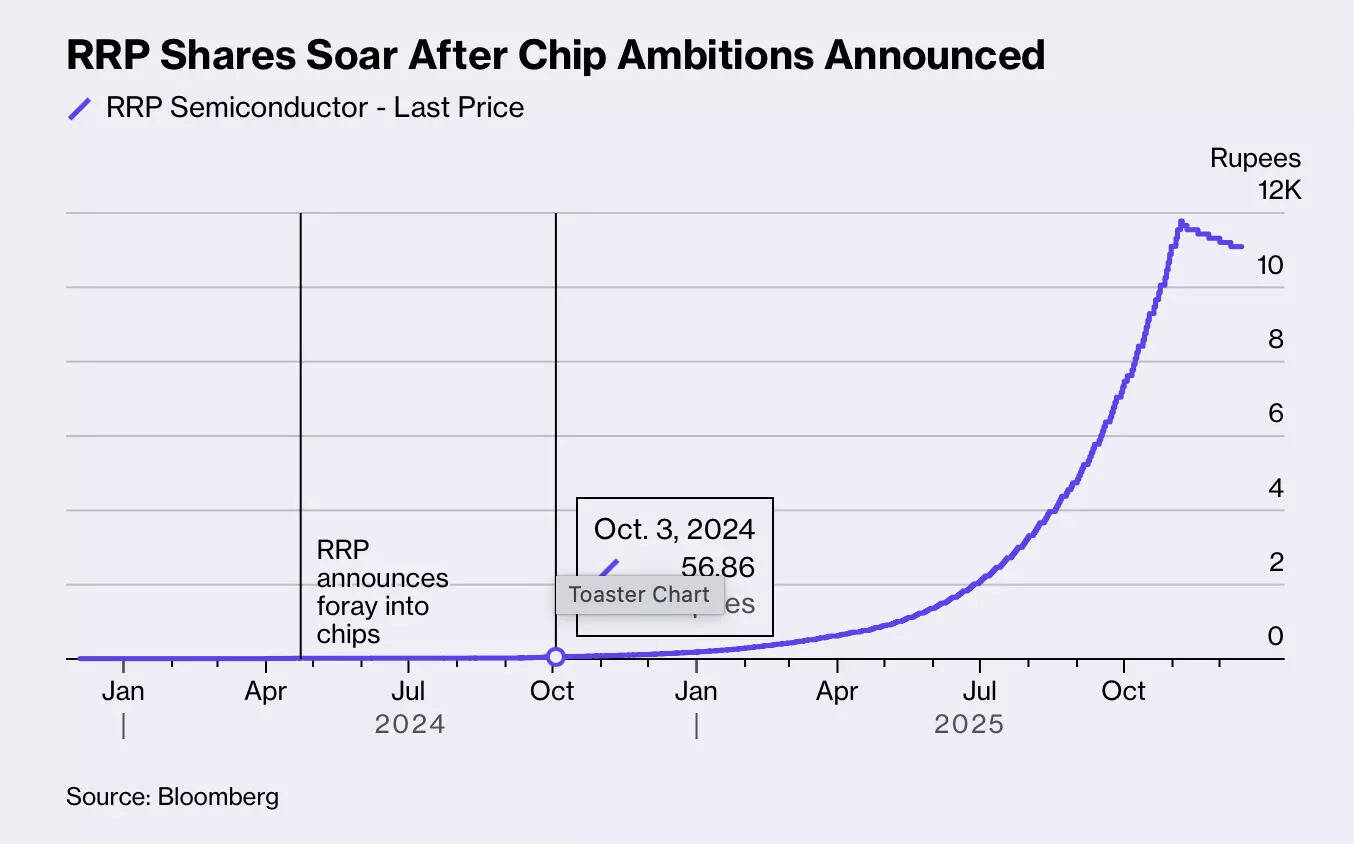
RRP Semiconductor Ltd has become a social media sensation – imagine a stock that surges 55,000% in just 20 months! But, the focus on the world’s top-performing stock is particularly evident now, as it serves as a warning for investors seeking large returns from the artificial intelligence surge.RRP Semiconductor Ltd., previously little-known even in India, has seen the biggest global gain among companies with a market value of over $1 billion. The surge comes despite the company reporting negative revenue in its latest financial results, having only two full-time employees in its most recent annual report, and maintaining a weak connection to the semiconductor spending boom after moving away from real estate in early 2024, according to a Bloomberg report.

Why is RRP Semiconductor Ltd stock in focus?

A combination of online hype, a small free float, and India’s growing number of retail investors fueled 149 consecutive limit-up sessions, even as exchange officials and the company have warned investors. The rally is now showing signs of weakening, prompting regulators to take a closer look. The Securities and Exchange Board of India has started investigating the surge in RRP’s shares for potential misconduct, Bloomberg reported. The $1.7 billion stock, recently limited by its exchange to trading only once a week, has dropped by 6% from its peak on November 7. While RRP’s path is unlikely to significantly impact the broader AI rally that has added trillions of dollars in value to global giants like Nvidia Corp., it illustrates how extreme gains have become in certain market segments—especially in India, where the lack of listed chipmakers has left retail investors waiting for any indirect exposure to the global boom. For some, this case also highlights the challenge regulators face in protecting retail investors from speculative excess.

RRP shares soar after chip ambitions announced

RRP shares soar after chip ambitions announced

“Semiconductors have been really hot and people are willing to buy any name given India has limited stocks to offer” Sonam Srivastava, founder of Wryght Research & Capital Pvt told Bloomberg. However, with global concerns about AI valuations, situations like RRP’s suggest that investors may not be quick to invest in these stocks.In Asia, exchanges and chipmakers are cautioning investors about the risks of pursuing popular AI trades. In Shanghai, Moore Threads Technology Co., a newly listed AI-chip startup, saw a 13% drop in shares on December 12 after warning about trading risks, although the stock is still up over 500% since its debut earlier this month. In South Korea, SK Hynix Inc. saw a decline after the main exchange issued a risk alert on December 11, following a more than threefold increase in its shares in 2025.A spokesperson for BSE Ltd., where RRP is listed, said that all surveillance actions regarding the stock were communicated through market circulars. RRP’s transformation began in early 2024 when Group founder Rajendra Chodankar, known for offering niche products like thermal imaging systems and weapon-drone cameras, made a deal to take over G D Trading and Agencies Ltd. by repaying an 80 million-rupee loan for equity. On April 23, the board authorized the sale of shares to him and several others at 12 rupees each, which was 40% below the market price. This decision resulted in Chodankar acquiring 74.5% ownership, while the founders’ stake dropped to less than 2%. The company also decided to change its name to RRP Semiconductor.Two months ago, Chodankar had established RRP Electronics Pvt. to create an outsourced semiconductor assembly and testing facility in Maharashtra, a connection that may have contributed to the narrative surrounding the listed company and his private venture. At a September 2024 event for RRP Electronics’ new unit in Navi Mumbai, Chodankar stated during a media briefing: “India is going to be a superhuman, it’s established beyond doubt.” Maharashtra Chief Minister Devendra Fadnavis and cricket legend Sachin Tendulkar were also in attendance, as shown in YouTube videos posted by RRP.Prime Minister Narendra Modi’s 2021 initiative to boost the semiconductor industry — a 760 billion-rupee incentive program — has attracted $18 billion in announced investments from companies like Foxconn, Micron Technology, Tata Group, and HCL Technologies.RRP Semiconductor identifies RRP Electronics as a related party because both are owned by Chodankar, although it does not have any direct ownership stake, according to exchange filings.

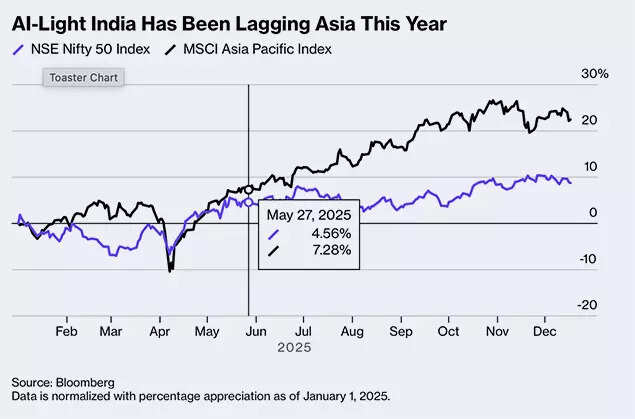
AI-Light Has Been lagginf Asia This Year

AI-Light Has Been lagging Asia This Year

Despite this, some investors began to see RRP Semiconductor as a potential beneficiary of the chip industry boom. This enthusiasm overshadowed the fact that very little of its stock is actively traded: about 98% of shares are held by Chodankar and a small group of associates, many of whom are also involved in other RRP-related companies, such as RRP Defense, Indian Link Chain Manufacturers, RRP Electronics, and RRP S4E Innovation, according to filings with the BSE and the corporate affairs ministry.In April of this year, the exchange revoked approval for the company’s share sale, a decision that RRP has contested in an appeals court, with the outcome still pending. In October, it issued a warning to investors a year after placing the stock under its strictest surveillance.In September 2024, SEBI reminded the company that it was barred from accessing the securities market due to its connection with the founder group of Shree Vindhya Paper Mills. This firm was delisted by the BSE in 2017 for non-compliance, resulting in a 10-year market ban.A source told Bloomberg that BSE saw an “internal lapse” while processing the company’s offering and might seek SEBI’s advice on whether to extend the lock-in period on the shares until the appeal is settled.A BSE spokesperson noted that in RRP’s initial application, the company claimed that neither it nor its founders and directors were barred from market access, directly or indirectly. The exchange’s approval was based on this information.Since the stock rose from 20 rupees in April 2024, the company’s largest shareholder, Chodankar, stepped down from the board, and the chief financial officer resigned before returning as the company secretary. RRP also filed a police complaint against a social media influencer for allegedly spreading rumors about its supposed connections to cricketer Tendulkar and state-allocated land for chipmaking.In a November 3 exchange filing, the company stated it “has yet to start any sort of semiconductor manufacturing activities,” has not applied for any government programs, and denied any celebrity associations.The company’s financials were concerning. RRP reported a negative revenue of 68.2 million rupees and a net loss of 71.5 million rupees for the quarter ending in September. The negative revenue resulted from reversing sales recorded in the December 2024 quarter from a 4.4-billion-rupee order secured in November from Telecrown Infratech Pvt. The order was later canceled due to “contractual disagreements,” and the company also reversed 80 million rupees of revenue in the March quarter.These weak financials come at a challenging time for the stock. With the excitement around AI diminishing and regulatory scrutiny increasing, the risks now lie with investors who have invested heavily, as well as with Chodankar, who has nearly the entire stock float.

[ad_2]

Source link

Asian stocks today: Markets inch higher as US inflation remains low; Nikkei adds over 1%, HSI trades flat

[ad_1]

Asian stocks today: Markets inch higher as US inflation remains low; Nikkei adds over 1%, HSI trades flat

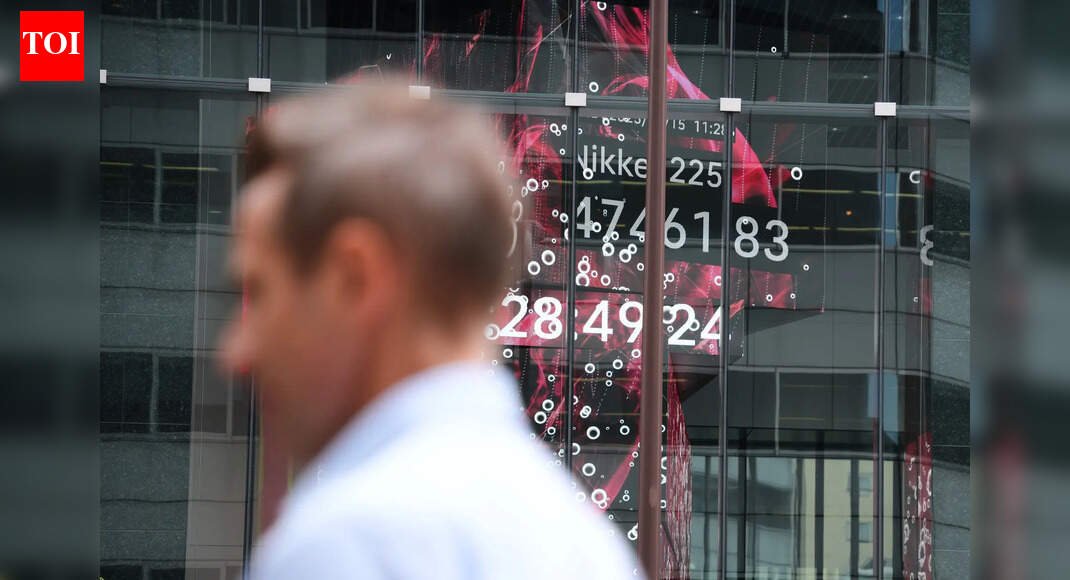
Asian equities inched higher on Friday after as investors relieved after softer reading of US inflation, expecting another interest rate cut as early as next month. Optimism was further supported by strong earnings from US chipmaker Micron Technology, which eased fears that the rally in technology stocks may be overstretched.Hong Kong’s HSI is trading at 25,645, up 147 points or 0.58%. Nikkei reached 49,567, adding 566 points or 1.16%. Shenzhen and Shanghai also added 0.75% and 0.42%, respectively. South Korea’s Kospi also inched 33 points to 4,028 at 11:03 AM IST. Data released overnight showed US inflation slowed last month to its lowest level since July and came in well below market expectations. The figures helped steady investor sentiment after concerns grew in recent weeks over the outlook for monetary easing following the Federal Reserve’s policy decision last week. While traders had earlier scaled back expectations of a fourth straight rate cut in January, the latest data revived hopes of further easing. According to Bloomberg News, markets are now pricing in a 20 percent chance of a rate cut next month, with two reductions expected by the end of 2026. However, analysts cautioned that the inflation figures may not present a clear picture. The data was collected during the longest-ever US government shutdown, which ended in mid-November, potentially skewing the results. Economists at Bank of America said “we recommend taking (the) report with a large grain of salt”, pointing to “shutdown-related distortions”. Even so, Wall Street reacted positively, with all three major indices closing higher. US stocks have been under pressure recently as investors question when returns will materialise from the vast amounts of capital poured into artificial intelligence, fuelling talk of a possible bubble in the technology sector. Those concerns were partly soothed on Thursday after Micron Technology reported a sharp surge in profits, with quarterly earnings nearly tripling to $5.2 billion. The company said it was benefiting from the AI boom and also delivered a positive outlook for the current quarter.Tokyo added over 1% as attention turned to the Bank of Japan’s policy decision later in the day. The central bank is widely expected to raise interest rates to their highest level in 30 years. The anticipated move follows data showing inflation in Japan remained steady at three percent in November. Japanese government bond yields have climbed in recent weeks amid concerns over budget discipline under Prime Minister Sanae Takaichi, who took office in October, while the yen has weakened. Takaichi has pledged to prioritise the fight against inflation. The yen showed little movement against the dollar on Friday, though analysts expect the currency to strengthen as US rates fall and Japanese rates rise.

[ad_2]

Source link

Donald Trump hypes UFC White House fight with candid shout-out to Dana White: “It’ll be the greatest champion fighters” | International Sports News

[ad_1]

Donald Trump hypes UFC White House fight with candid shout-out to Dana White: “It’ll be the greatest champion fighters”
Dana White and Donald Trump. Image via: Getty Images

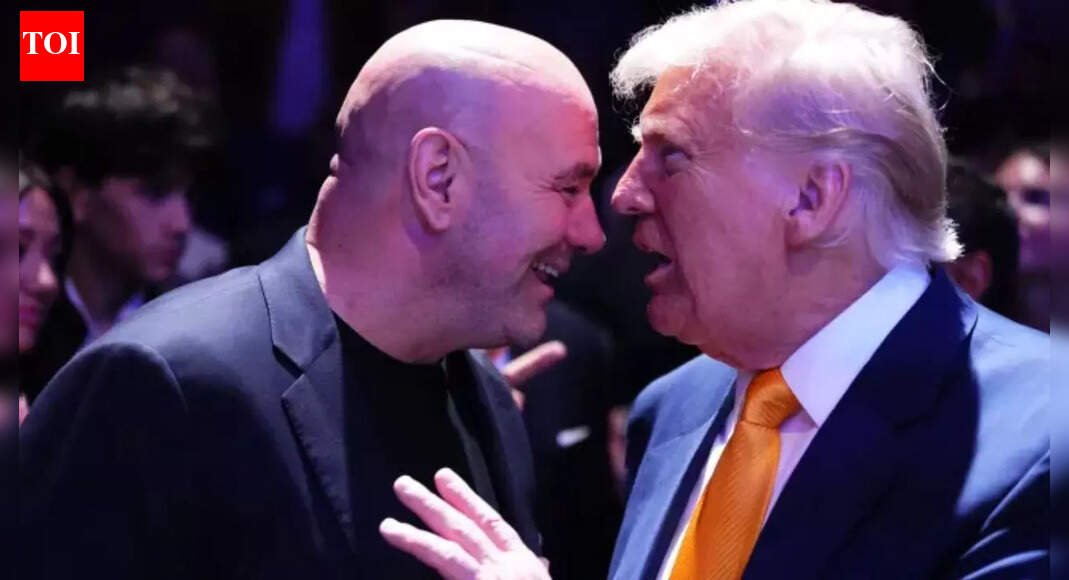
President Donald Trump hypes up the unprecedented UFC fight at the White House as part of America’s 250th anniversary celebrations. Speaking during a video announcement outlining plans for 2026, Trump spotlighted the South Lawn as a future fight venue and gave a direct nod to UFC CEO Dana White. He framed the event as a global moment for combat sports and American pageantry.The proposed bout, set for Flag Day on June 14, also coincides with Trump’s birthday. It would mark the first sporting event of its kind ever held at the White House. The announcement arrived alongside a broader rollout of “Freedom 250,” a multi-week slate of events designed to commemorate the nation’s founding with scale.

Donald Trump unveils UFC White House fight plans

Donald Trump described the UFC showcase in sweeping terms. He promised elite competition under an iconic backdrop. “We’ll have one of a kind UFC event here at the White House. It’ll be greatest champions in the world, all fighting that same night. The great Dana White is hosting and it’s gonna be something special but all of this is just a beginning. 2026 will be a celebration of America,” Trump said.The president has long aligned himself with the UFC and its fan base. He frequently attended events and maintained a close relationship with White.

Dana White role highlights scale of Freedom 250 celebrations

The UFC event sits within a packed schedule stretching from late June through early July 2026. According to the White House, Freedom 250 will include a Spirit of America parade honoring fallen soldiers, a Great American State Fair featuring all 50 states, and a massive fireworks display on the National Mall billed as the largest in the world.Trump also announced the launch of the Patriot Games, a four-day athletic competition featuring top high school athletes from every state and territory. “Frankly, you’ll never see anything like it and you’ll never see anything like it again,” Trump said while promoting the scope of the festivities.Beyond events, the president highlighted major construction initiatives tied to the anniversary, including plans for a triumphal arch near Arlington National Cemetery. Trump emphasized that these projects, like the UFC fight, are intended to leave a lasting mark. “All of this is just the beginning. 2026 will be a celebration of America like no other,” he said.Dana White is set to host, and the South Lawnis poised to transform into an octagon setting. The UFC White House fight has quickly become one of the most talked-about elements of Trump’s anniversary vision.Also Read: Boos rain down on Jake Paul at Anthony Joshua weigh-in before final face-off

[ad_2]

Source link

Rupee continues to rebound! Currency makes its way back from the 90 level; reaches 89 against US dollar

[ad_1]

Rupee continues to rebound! Currency makes its way back from the 90 level; reaches 89 against US dollar

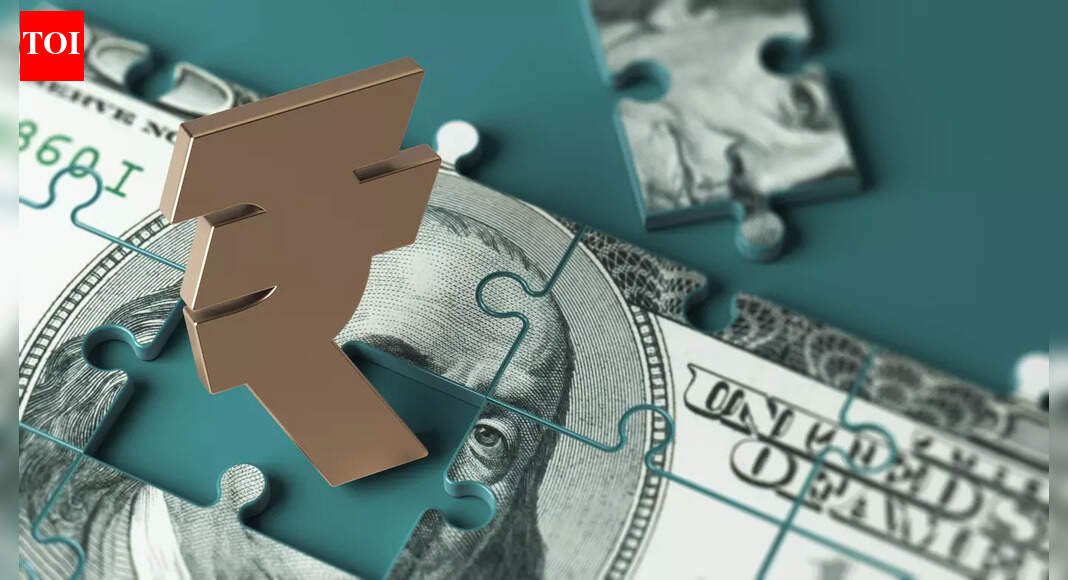
Rupee continued its upward rally against the US dollar on Friday, strengthening past its 90 mark to reach 89.96 against US dollar in early trade. The currency opened at 90.1325 per dollar, up about 0.1% from its previous close of 90.20 against US dollar. This comes after Rupee made a tentative recovery after sliding to record lows earlier this week, even depreciating to the 91 level against US dollar.This rebound was largely attributed to intervention by the Reserve Bank of India (RBI), which stepped in to sell dollars after the currency came under intense and sustained pressure. Bankers said the apex bank’s intervention was aimed at disrupting the one-way depreciation that had built up in the market, triggering unwinding of bearish positions. Market participants noted that the RBI’s latest move was similar to its approach in October and November. Back then, it had intervened multiple times to counter persistent weakness in the currency, selling dollars heavily in both the spot and non-deliverable forward (NDF) markets. Meanwhile, State Bank of India (SBI) has also projected a strong rebound in rupee in the latter half of the next financial year, expecting the recovery to take shape between October 2026 and March 2027, according to its latest report. The country’s largest lender said that its outlook is based on historical currency trends and internal analysis, which suggest that the current phase of weakness is not structural. The report noted that rupee has undergone multiple cycles of depreciation and appreciation in the past and is likely to move out of the present downtrend in the second half of the next fiscal year.

[ad_2]

Source link

Stock market today: Nifty50 opens in green; BSE Sensex up around 350 points

[ad_1]

Stock market today: Nifty50 opens in green; BSE Sensex up around 350 points
Analysts suggest that the market’s short-term trend remains volatile with a weak bias. (AI image)

Stock market today: Indian equity benchmark indices, Nifty50 and BSE Sensex, opened in green on Friday on positive global cues. While Nifty50 went above 25,900, BSE Sensex was up around 350 points. At 9:16 AM, Nifty50 was trading at 25,913.10, up 98 points or 0.38%. BSE Sensex was at 84,830.34, up 349 points or 0.41%.After experiencing weakness, the Nifty index appeared to stabilize with a slight downward trend on Thursday. Analysts suggest that the market’s short-term trend remains volatile with a weak bias.Dr. VK Vijayakumar, Chief Investment Strategist, Geojit Investments Limited says, “FIIs stopping selling during the last two days, though positive from the market perspective, doesn’t indicate a directional change in the market. A lot will depend on the Bank of Japan’s rate decision today. It is almost certain that BoJ will raise rates by 25bp and, therefore, such a decision is unlikely to impact the market. What the market is looking for is commentary from the Japanese central bank regarding future rate action in the context of inflation in Japan. If the BoJ chief sends a hawkish message indicating more rate hikes, that would impact the market since the market will fear further unwinding of the yen carry trade, triggering more FII outflows from markets like India. Therefore, watch out for the BoJ commentary.” “Meanwhile, cooling inflation in the US ( November core inflation has come at 2.6%, lower than the estimate of 3%) is imparting resilience to the US economy and markets. This augurs well for global equity markets as 2025 draws to a close.”Asian stocks rose on Friday following a report of cooling US inflation, which bolstered the case for potential interest rate cuts by the US Federal Reserve. This, along with easing concerns in the tech sector, supported gains in US stocks.On Wall Street, the main indexes ended higher on Thursday. A soft inflation report fueled expectations for Federal Reserve interest rate cuts, while a strong forecast from chipmaker Micron indicated robust demand for AI technology.The Consumer Price Index showed that consumer prices rose less than anticipated over the year to November. The Labor Department’s Bureau of Labor Statistics did not release month-to-month CPI changes due to the 43-day government shutdown, which disrupted the collection of October data.On Thursday, foreign portfolio investors purchased shares worth Rs 596 crore. Domestic institutional investors were also net buyers, acquiring shares worth Rs 2,700 crore.(Disclaimer: Recommendations and views on the stock market, other asset classes or personal finance management tips given by experts are their own. These opinions do not represent the views of The Times of India)

[ad_2]

Source link