Breaking News
Musk’s Starlink lists premium satcom prices for India, then pulls them back saying ‘glitch’ made ‘dummy test data’ visible

[ad_1]

Musk’s Starlink lists premium satcom prices for India, then pulls them back saying 'glitch' made 'dummy test data' visible

NEW DELHI: Elon Musk’s Starlink on Monday announced inaugural prices for its satellite venture in India and, as expected, these were many times more than a regular high-speed broadband connection that is currently being provided by terrestrial providers such as Airtel and Reliance Jio.The company put a Rs 8,600 monthly tariff for its satcom services in India, with a hefty additional Rs 34,000 as one-time charge for the requisite hardware.However, as its premium pricing started to create hectic chatter on social media, especially when it’s still some time before it can launch services as the govt continues work on satcom spectrum allocation and its charges, the company withdrew the announcement from its website, blaming a “glitch” for making “dummy test data visible. “The Starlink India website is not live, service pricing for customers in India has not yet been announced, and we are not taking orders from customers in India. There was a config glitch that briefly made dummy test data visible, but those numbers do not reflect what the cost of Starlink service will be in India,” Lauren Dreyer, VP of Starlink Business Operations, said on X. “The glitch was quickly fixed. We’re eager to connect the people of India with Starlink’s high-speed internet, and our teams are focused on obtaining final government approvals to turn service (and the website) on,” she said.Earlier in the day, the company said its India services will “work in all weather” with an “over 99.9% uptime”. It promised that the services are easy to initiate. “Just plug in and start using,” the company said, while promising to provide “unlimited data” and a 30-day trial period.However, the prices – if true – would be a far cry to the dirt-cheap tariffs that Indian internet consumers are used to.On mobile phones, the price per GB of data is less than Rs 10, and monthly packages are under Rs 400 for unlimited 5G mobile data, for example on Airtel. For home broadband on optical fibre, the Sunil Mittal-led company charges just Rs 499 per for a connection which comes with a speed of 40MBPS. Not only this, at Rs 599 per month, they also offer 29 OTT streaming services. The installation charges for home broadband are just Rs 1,500 on Airtel, which itself is an advance payment and can be adjusted in future payments.On the other hand, Reliance Jio’s up to 30 MBPS speed entry-level plan for home broadband costs Rs 399 (excluding GST), with a one-time installation charge of Rs 2,500 (of which Rs 1,500 is refundable security).For Starlink, these are early days and despite giving out the consumer prices (though withdrawn now), the company is not in a position to talk about when it will begin services. This is because there is still no clarity on when the spectrum for satellite communications will be provided by the govt.There are currently discussions, and differences of opinion, between regulator Trai and the department of telecom (DoT) — the nodal ministry on communications matters — regarding the charges that satcom companies need to pay to the govt. Until these issues are resolved, there is no chance of a satcom service beginning consumer services in the country.Starlink, however, is in the process of doing the groundwork for beginning services. It has started hiring in India before services begin commercially while also starting work on setting up the requisite ground infrastructure. Also, it needs to get a final approval from the law-enforcement agencies regarding its infrastructure, including mandated interception and data privacy rules, before beginning any commercial operation.It is believed that while having an aspiration to build its business in India’s urban centres, Starlink will initially find higher takers in rural and mobile unserved areas, apart from specialised use cases in strategic areas such as defence, mining, maritime, and enterprises.


[ad_2]

Source link

Govt may give 5% of IndiGo flight share to other airlines | India News

[ad_1]

Govt may give 5% of IndiGo flight share to other airlines
Amidst ongoing flight disruptions, the government is weighing the option of cutting IndiGo’s flight schedule by 5%, with plans to redistribute these time slots to other carriers. IndiGo has acknowledged the issues, attributing them to recent duty requirements and changes in their winter travel timetable.

NEW DELHI: IndiGo may have its schedule cut by 5% and the same – roughly about 110 daily flights – could be given to other airlines that have the resources to add capacity. A livid government is mulling incremental cuts to the schedule starting with 5%, followed by another 5% in coming days if need be, say sources, adding that other actions are also being considered in the wake of the severe disruptions caused by flight cancellations.Meanwhile, a “profusely apologetic” IndiGo has in its reply to the DGCA’s show-cause notice blamed a combination of five factors, including new flight duty time limitation (FDTL) rules and winter schedule-related changes, for its massive flight disruptions.The airline said given the scale of its operations, it is “realistically not possible to pinpoint the exact cause(s)” in the time given. It sought more time for a “comprehensive root-cause analysis”, citing DGCA’s manual that allows a 15-day response time.

DGCA may scale down IndiGo ops to make room for others

DGCA is in the process of examining the response and enforcement action as deemed appropriate will be taken in due course,” the aviation ministry said regarding the responses submitted at 6.01pm Monday by CEO Pieter Elbers and COO Isidre Porqueras, who is also the accountable manager.Given the public anger at aviation authorities, it remains to be seen whether IndiGo will be granted more time. The DGCA could now scale down IndiGo’s flights in proportion to its crew strength and make the slots available to other airlines depending on their resource availability. Apart from a hefty financial penalty, the top executives, who are approved by the DGCA, including the airline’s accountable manager (the COO), may face action. The airline, too, may either seek resignations or sack key people seen as responsible for the huge mess.The airline has attributed the disruption to the “compounding effect of multiple factors which coincided in lesser or greater measure” in an “unfortunate and unforeseeable confluence”. It listed these as minor technical glitches; schedule changes linked to the start of the winter season; adverse weather conditions; increased congestion in the aviation system; and implementation of and operation under the updated crew rostering rules (FDTL phase II) that came into force on Nov 1, 2025.“IndiGo notes they had been engaging with the DGCA regarding challenges in implementing FDTL phase II and were seeking variations, exemptions or extensions. The disruptions began in early Dec when the compounding factors resulted in a lower on-time network performance, which affected crew availability,” the aviation ministry said.IndiGo termed the Dec 5 large-scale cancellations, when over 1,000 IndiGo flights – almost half its daily schedule – were affected, as a “drastic measure” of “rebooting” the network “to recover stranded customers, ease airport congestion, and reposition crew/aircraft”.Meanwhile, the four-member DGCA panel probing IndiGo disruption, headed by joint DG Sanjay Brahamane, could summon CEO Pieter Elbers and COO Isidre Porqueras. This panel has been mandated to pinpoint the root cause of this disruption and will examine manpower planning, rostering and IndiGo’s preparedness to implement the new FDTL rules.


[ad_2]

Source link

Explain Kashmir book ban, HC tells LG admin, Centre | India News

[ad_1]

Explain Kashmir book ban, HC tells LG admin, Centre

SRINAGAR: Jammu and Kashmir high court has given the Union Territory administration and the Centre three months to respond to petitions challenging a ban on 25 Kashmir-related books, an official in the additional advocate-general’s (AG) office said.The ban was clamped by the home department under lieutenant-governor (LG) Manoj Sinha on Aug 5 this year on the sixth anniversary of abrogation of Article 370, with the order claiming the books promoted a “false narrative” and “secessionism”. The elected govt of CM Omar Abdullah is not a party to the case as it did not issue the order.The HC has constituted a three-judge full bench to hear petitions challenging the bar on books, including Azadi by Booker Prize winner Arundhati Roy. The HC has directed the LG Sinha-headed administration and the Centre to file replies by Feb 11, 2026. UT authorities are expected to explain the grounds for prohibiting the books, many of which were seized in police raids on shops.The petitions, filed by journalist David Devadas, Mohammad Yousuf Tarigami of CPI(M), retired Air Vice Marshal Kapil Kak, advocate Shakir Shabir and others, contend that the ban violates constitutional guarantees of free speech. They have challenged the home department’s notification ordering forfeiture of such books under Section 95 of CrPC.The books include Kashmir: The Case for Freedom by Tariq Ali and Pankaj Mishra; Confronting Terrorism by Stephen P. Cohen, Independent Kashmir by Christopher Snedden, Between Democracy and Nation by Seema Kazi, Contested Lands by Sumantra Bose, In Search of a Future by journalist and author David Devdas, A Dismantled State: The Untold Story of Kashmir After Article 370 by Anuradha Bhasin and Colonizing Kashmir by Hafsa Kanjwal.The home department’s ban order cited “credible intelligence” that a significant driver behind youth participation in violence and terrorism was “systematic dissemination of false narratives and secessionist literature, often disguised as historical or political commentary”.


[ad_2]

Source link

Home loan relief: Banks cut MCLR, RLLR and RBLR after RBI repo rate trim; here’s how your EMIs may fall

[ad_1]

Home loan relief: Banks cut MCLR, RLLR and RBLR after RBI repo rate trim; here’s how your EMIs may fall

Home loan borrowers are set to get relief as several major banks have started cutting lending rates after the Reserve Bank of India lowered the repo rate by 25 basis points to 5.25% on December 5, 2025. Following the repo rate cut from 5.50%, lenders have moved to reduce MCLR-, RLLR- and RBLR-linked rates, paving the way for lower equated monthly instalments (EMIs) or shorter loan tenures for eligible borrowers, depending on individual loan terms. HDFC Bank has reduced its Marginal Cost of Funds-based Lending Rates (MCLR) by up to 5 basis points across tenures. After the revision, HDFC Bank’s MCLR now ranges between 8.30% and 8.55%, compared with 8.35% to 8.60% earlier, benefiting borrowers with loans linked to this benchmark, according to an ET report. Punjab National Bank has cut its Repo Linked Lending Rate (RLLR) from 8.35% to 8.10%, inclusive of a 10 basis point Benchmark Spread Premium, with effect from December 6, 2025. In a notification to the BSE, the bank said the revision followed the RBI’s repo rate cut announced on December 5. Bank of Baroda has revised its Benchmark Retail Loan Lending Rate (BRLLR), lowering it from 8.15% to 7.90%, according to a disclosure on the BSE website, offering marginal relief on retail loan interest costs. Indian Bank has also reduced its repo-linked benchmark lending rate, cutting RLLR from 8.20% to 7.95%. The revised rates came into force on December 6, 2025, and apply across the bank’s assets portfolio, as per an official press release. Bank of India announced a reduction in its Repo Based Lending Rate (RBLR) from 8.35% to 8.10%, effective December 5, 2025. In a regulatory filing, the bank said the rate cut was in response to the RBI’s downward revision of the repo rate. Bank of Maharashtra has lowered its retail loan rates as well, slashing home loan interest rates from 7.35% to 7.10% and car loan rates from 7.70% to 7.45%. The bank has also waived processing fees on these loans, reducing upfront costs for borrowers, as per a post shared on X by the lender. With multiple banks realigning lending rates after the RBI’s policy move, borrowers linked to floating-rate home and retail loans can expect EMIs to ease in the coming months as the rate cuts reset across loan benchmarks.


[ad_2]

Source link
The trillion-dollar shock: What tariff? How Xi Jinping beat Trump in trade war

[ad_1]

The trillion-dollar shock: What tariff? How Xi Jinping beat Trump in trade war
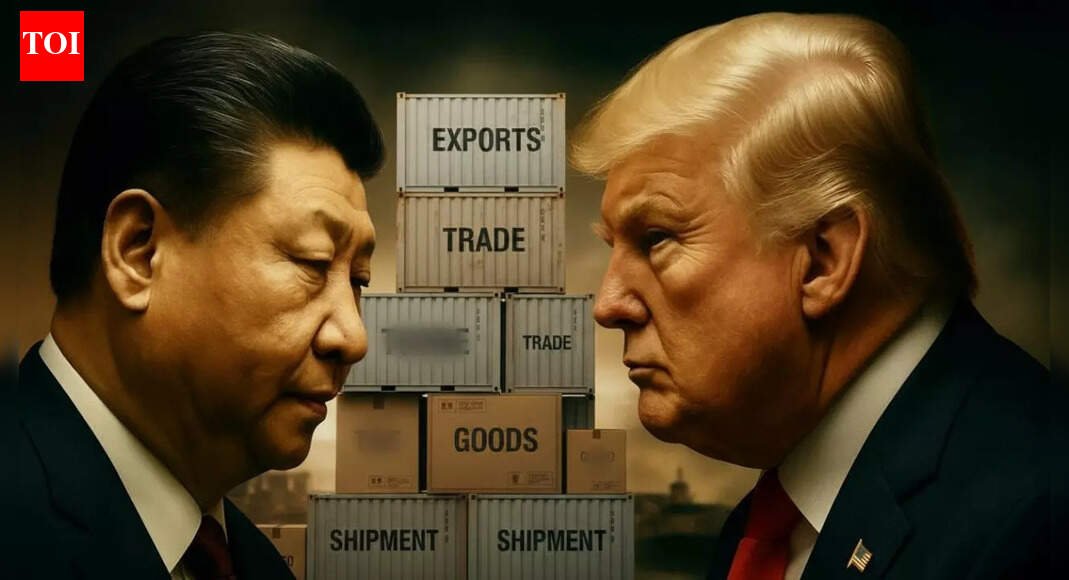
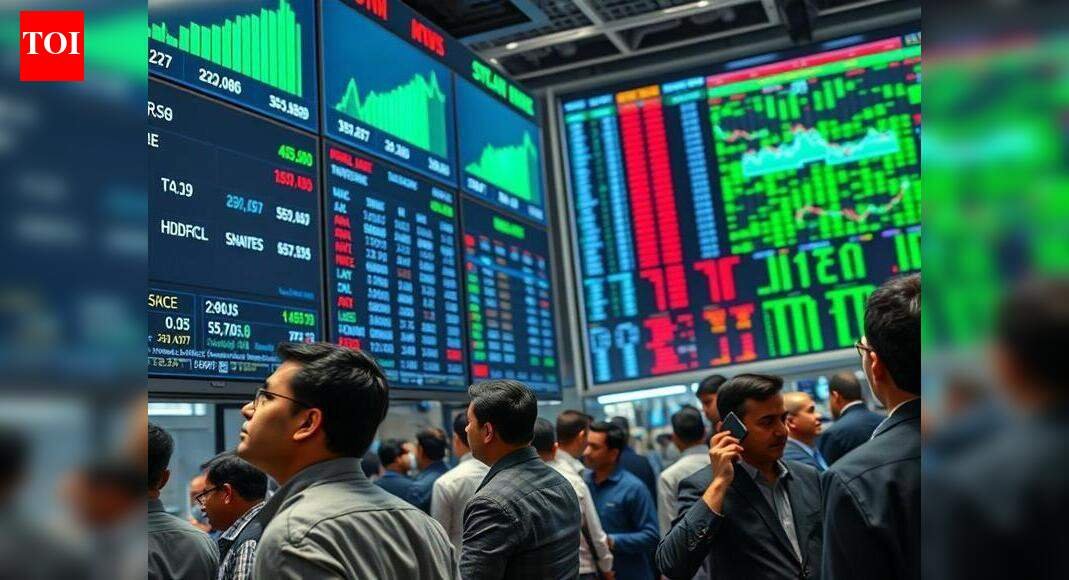
President Trump’s trade war strategy – featuring sweeping tariffs – has not curtailed China’s export machine. (AI image)

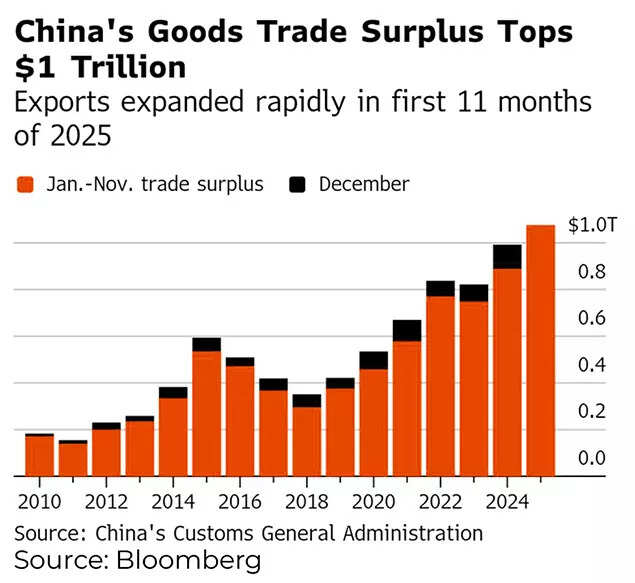
Driving the news:Despite nearly a decade of US tariffs under President Donald Trump, China’s trade surplus has exploded, hitting $1.08 trillion through November – the highest ever recorded globally and a level China didn’t reach until year-end just last year.The record, announced by China’s customs agency this week, represents a 21.7% increase over the same period in 2024 and underscores China’s rising dominance in global exports. “They should not be surprised that China is able to find markets outside of the advanced economies,” Mary Lovely, senior fellow at the Peterson Institute for International Economics, told the New York Times.

China's Goods Trade Surplus Tops $1 Trillion

China’s Goods Trade Surplus Tops $1 Trillion

Why it mattersPresident Trump’s trade war strategy – featuring sweeping tariffs, tough rhetoric, and promises to rebuild US manufacturing – has not curtailed China’s export machine.Instead, China has restructured, rerouted, and retooled, pushing more goods into emerging markets, Europe, and Southeast Asia – often by moving final assembly outside its borders to dodge tariff barriers. “Despite persistent trade tensions… we believe China will gain more share in the global goods export market,” said Morgan Stanley’s Chetan Ahya.This surge positions China not only as the world’s dominant supplier of goods but also as a geopolitical force, leveraging exports to build ties – and dependencies – across the Global South.Zoom inHere’s how China’s $1.08 trillion trade surplus was built:Diversified markets

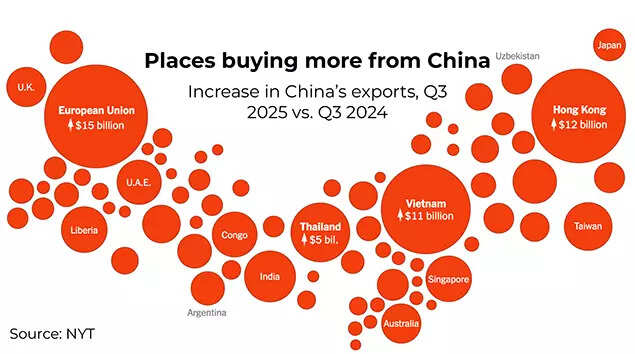
  • Exports to Africa rose 42%, to Europe 15%, and to Latin America by double digits.
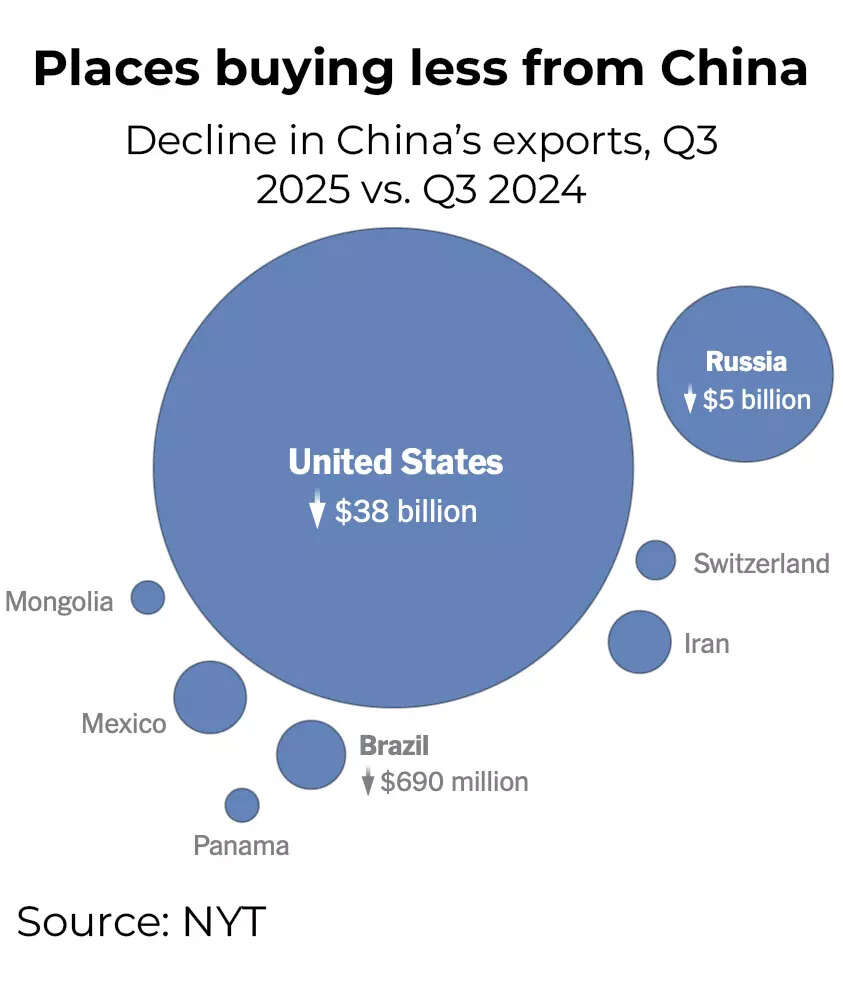
  • US-bound shipments fell 29% year-over-year in November, marking the eighth straight month of double-digit declines.
  • But sales to France, Germany and Italy boomed – all reporting double-digit growth.
Places buying more from China

Places buying more from China

Manufacturing shifts:* Chinese companies moved parts of their supply chain to Southeast Asia, Mexico, and Africa, which then export to the US – effectively bypassing Trump-era tariffs.* These “trans-shipping” tactics allowed Chinese firms to continue supplying American retailers while masking origin.

Places buying less from China

Places buying less from China

Currency advantage

  • The renminbi has weakened significantly, particularly against the euro, making Chinese goods even cheaper abroad.
  • Prices in China are falling, while those in the US and Europe are rising – supercharging competitiveness.

“With the renminbi undervalued by 30% against the euro… it will be exceedingly difficult… to compete against Chinese manufacturers,” said Jens Eskelund, president of the EU Chamber of Commerce in China .Between the linesTrump’s tariffs, once seen as a bold bid to reshore jobs and production, have created only limited disruption to China’s trajectory.

  • Exports of toys, electronics, and plastic goods to the US are down, but the loss has been overcompensated by booming sales elsewhere.
  • China is intentionally selling at low margins to emerging markets to gain long-term geopolitical and economic influence.

“The margins may not be as high,” Ilaria Mazzocco of the Center for Strategic and International Studies told the NYT. “But for those markets, it’s entirely transformational”.Meanwhile, US importers are increasingly turning to India, Vietnam, and Taiwan – but many of those supply chains still begin in China.The big picturePresident Trump’s trade war was meant to reduce America’s reliance on Chinese goods and give US factories a competitive edge.But instead, China has shown it can reorient its export model, reclaim global market share, and sidestep tariff pressure – faster than Washington anticipated.

  • China is now the world’s largest producer of electric vehicles, batteries, solar panels, and consumer electronics.
  • In many African countries, Chinese vehicles and tech – once nearly absent – now dominate markets.
  • Sales of Chinese-made EVs and solar panels to Nigeria and Algeria have multiplied, disrupting local industries.

This transformation was no accident. It’s the result of years of top-down industrial planning from Beijing – and decades of underinvestment in manufacturing capacity across the West.

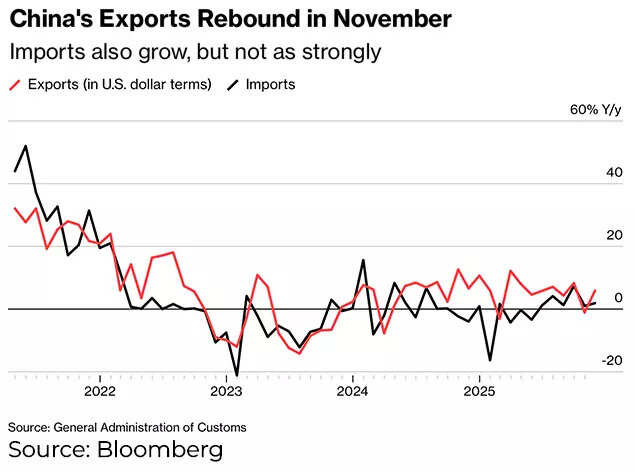
China's exports rebound in November

China’s exports rebound in November

“China’s trade surplus in factory goods is even bigger… than the US after World War II,” notes the New York Times.The Trump factorEven as President Trump agreed to a one-year trade truce with Xi Jinping in October, his administration continues to weigh additional tariffs, particularly on industries like pharmaceuticals and drones, where China dominates.And while he reduced some tariffs, they still hover at 45% – historically high levels.But critics argue that Trump’s trade war mostly reconfigured supply chains, rather than revitalizing American industry.What they’re saying“November’s stronger-than-expected export growth demonstrates the resilience and competitiveness of China’s exporters,” said David Qu, chief China economist at Bloomberg Economics.“The rebound of export growth in November helps to mitigate the weak domestic demand,” added Zhiwei Zhang of Pinpoint Asset Management.But while exports are thriving, consumer spending at home remains weak, and factory activity has now contracted for eight straight months, raising concerns about the sustainability of export-led growth.What’s nextThe International Monetary Fund is in China this week to assess its currency practices, including whether the renminbi is being kept artificially low to boost exports. A preliminary report is expected Wednesday.At the same time, calls are growing inside China to allow the currency to appreciate – a move that would:

  • Make foreign imports cheaper
  • Increase household purchasing power
  • But hurt exporters by reducing the value of foreign earnings

“To expand domestic demand, it is necessary to minimize the trade surplus,” said Zhang Jun of Fudan University .What to watch:Global pushback: As China’s exports flood markets, the EU is considering new anti-dumping measures. Other regions – including India and Brazil – are exploring safeguard tariffs.Slowdown risk: Despite strong export performance, China’s economy is losing momentum heading into 2026, and export growth may not be enough to offset weak domestic demand.Policy pivot: At a recent Politburo meeting, President Xi emphasized domestic demand as China’s top priority for 2026, signaling a longer-term effort to rebalance the economy away from exports .The bottom line:Trump’s tariffs were loud, but China’s strategy was louder.Through currency policy, transshipment, and industrial strength, China has not only survived the trade war – it has thrived, with a record-smashing $1.08 trillion trade surplus to show for it.If the US wants to challenge China’s dominance, it may need more than tariffs. It will require reinvestment, innovation, and allies – and a serious reevaluation of what a “win” in global trade even looks like.(With inputs from agencies)


[ad_2]

Source link

‘Very, very strict action’: Aviation minister vows to ‘set an example’ after IndiGo fiasco; what he said in Rajya Sabha | India News

[ad_1]

'Very, very strict action': Aviation minister vows to 'set an example' after IndiGo fiasco; what he said in Rajya Sabha

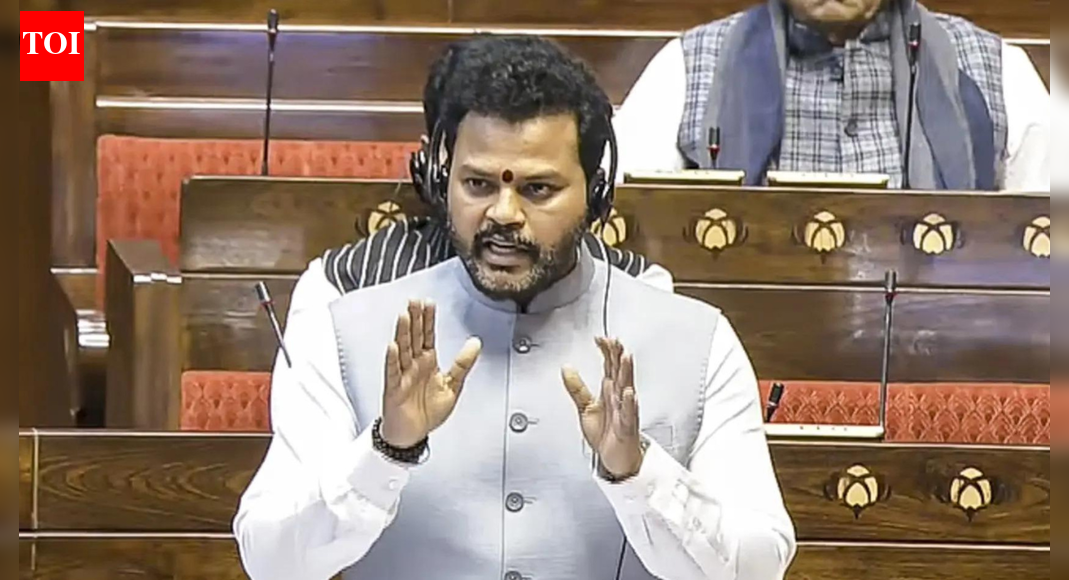
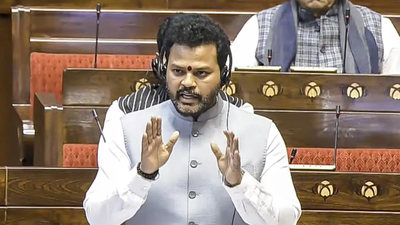
NEW DELHI: The aviation minister K Rammohan Naidu vowed in Rajya Sabha on Monday that the government will take “very, very strict action” against Indigo over the recent fiasco to “set an example” across the industry.Speaking during question hour, Naidu said the disruption was a result of IndiGo’s internal lapses. Blaming the carrier for failing to manage its crew and duty roster, the minister said, “We are not taking this situation easily. We are doing an inquiry. We will take very, very strict action not only for this situation but also as an example.”

Aviation Meltdown Escalates As IndiGo Cancels 400 Flights And Government Enforces Fare Controls

Responding to a query from Congress MP Pramod Tiwari, who sought to know whether the cancellations stemmed from a malfunction in the automatic message switching system (AMSS) – the glitch that hit flight operations in early November 2025 – Naidu clarified that the two incidents were unrelated. The IndiGo crisis, he said, arose from “anomalies and mismanagement” in the airline’s crew roster system.The minister also outlined the timeline of the revised flight duty time limitations (FDTL), introduced after a high court order in April 2025. Of the 22 guidelines, 15 were implemented on July 1 and the remaining seven on November 1. He stressed that multiple consultations were held with all stakeholders, including IndiGo, and that the rules had to be followed “without any compromise on safety.” Naidu said the directorate general of civil aviation has been in continuous discussions with airlines since FDTL came fully into force, and had granted limited exemptions based on operational variations and safety assessments. Noting that the crisis erupted “almost one whole month” after the final phase of FDTL implementation, he pointed out that IndiGo did not flag any imminent issues during a meeting with the ministry on December 1.“This is a day-to-day operation – something that Indigo should have maintained. Indigo was supposed to manage the crew, roaster through its day-to-day operations,” he said.Reiterating that accountability is non-negotiable, Naidu added: “If there is any mis-compliance, non-compliance, non-adherence for any single person, entity and organisation, or any operator functioning in this civil aviation, we will take very, very strict action so that we set an example in the industry.”

Indigo crisis enters seventh day

Indigo’s operational crisis entered into its seventh consecutive day of chaos on Monday. With more 500-large scale flight cancellations continuing across major airports. According to the civil aviation ministry, IndiGo is scheduled to operate 1,802 flights across 137 of its 138 destinations on Monday. The ministry also said the airline has already returned around 4,500 misplaced bags to passengers and aims to deliver the remaining 4,500 within the next 36 hours.Separately, the Supreme Court refused to entertain a petition seeking judicial intervention over the large-scale flight cancellations, noting that the matter did not warrant its involvement at this stage.(With inputs from agencies)


[ad_2]

Source link

The stocks you must never touch! Most big losses don’t come from bad luck – they come from buying wrong kind of stocks

[ad_1]

The stocks you must never touch! Most big losses don’t come from bad luck - they come from buying wrong kind of stocks

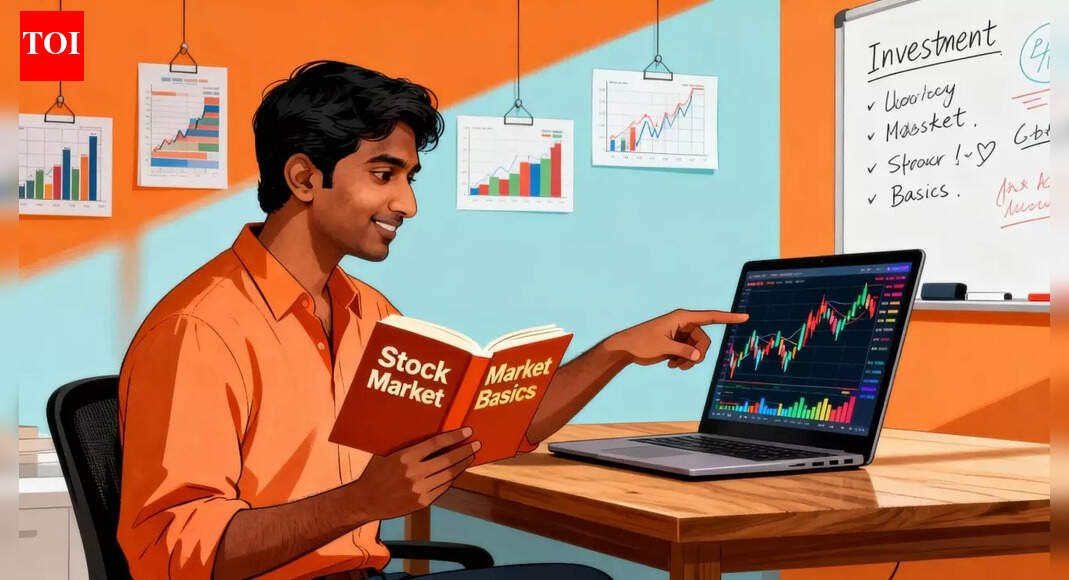
When people tell me about their stock market disasters, the story is almost always familiar. It’s rare, “I bought a solid company at a sensible price, held it for years, and it went to zero.” What I usually hear is closer to, “I bought stock based on this story… this penny stock… this F&O trade I didn’t really understand… and then it crashed.”In other words, most big losses don’t come from bad luck. They come from buying the wrong kind of stocks in the first place.That’s why, before we talk about what to buy, it’s more important to be very clear about what not to buy at all. At Value Research Stock Advisor (VRSA), this is actually where we begin. We have a clear sense of universes we simply don’t touch. You can—and should—do the same with your own money.Take penny stocks. The temptation is obvious. “It’s only Rs 2. How much can I lose?” The honest answer is: you can lose 100 per cent. A stock trading at Rs 2 is not more “affordable” than one trading at Rs 2,000. The absolute price means nothing by itself. A Rs 2 stock can be horribly overvalued; a Rs 2,000 stock can be genuinely cheap for the quality of the business.Penny stocks come with a standard set of problems. They are often thinly traded, which means you can happily buy, but you may find no one to sell to when you want to get out. Information is scarce and unreliable. A handful of players can push prices around. If your main reason for buying is “it’s so cheap, I can buy thousands of shares,” that’s not investing. That’s buying a lottery ticket. In VRSA, we simply avoid this low-quality, illiquid corner of the market. We want to study real businesses, not play with scraps just because the sticker price looks small.This is where a real-life example is useful. Think of a once-hyped penny stock like SecureKloud Technologies in the small cap IT space. At one point in 2016, it traded around Rs 900 after a wave of promotional stories and “multibagger” claims. A few years later, as the reality of weak profits and poor governance emerged, it fell to below Rs 50 by 2019 and currently trades at around Rs 25. Anyone who bought in near the top is now sitting on a loss of roughly 95 per cent—even though the stock always looked “cheap” in rupee terms. This is exactly the pattern we try to help investors avoid.Then there are the “story stocks” and permanent “turnaround” stories. These are companies that always have a narrative to sell. They’ll tell you they are entering a hot new sector, or that they will be a leader in some buzzword industry in three years, or that they’re on the cusp of a massive turnaround. The story keeps changing; the profits do not.Indian investors have seen this many times. Think of some of the real estate and infrastructure favourites during the 2007-08 boom that never recovered, even ten years later. Think of the supposed “next Infosys” names that went nowhere. Think of the “conglomerates” that kept announcing new ventures and funding them with more and more debt. At the peak, each of these had an attractive story. Today, many of those stocks trade at a fraction of their old prices, if they are even alive.Take the case of Suzlon Energy, which once promised to be “the next big thing” in renewable energy space has surged 4-5x multiple times on hope and headlines, and then slid back when the promised turnaround never showed up in earnings. The story was exciting, but the business never improved and to this date trades below its listing price which dates back to 2005.When we look at a potential idea in VRSA, we never start with the story. We begin with the track record and the numbers. If the economics are poor, a clever story doesn’t change anything. A good narrative sitting on top of a bad business does not get past our filters.And then there’s the new favourite: F&O punting dressed up as “investing”. Let me be blunt here. Buying random options or taking leveraged futures positions because someone said “this is a sure shot” is not investing in stocks. It is a leveraged bet on short-term price movement.F&O is dangerous because small price moves can magnify into big gains or losses. Positions expire, which means time is always working against you. You can lose fifty to a hundred per cent of your position very quickly, even when the underlying business is perfectly fine. If you like trading F&O and know exactly what you’re doing, that’s your personal choice. Just don’t confuse it with long-term equity investing.In our world at Value Research, F&O doesn’t feature at all when we talk about stocks. We mean owning slices of real businesses for years, not renting volatility for a few days.You might ask, if these things are so obviously dangerous, why do so many people still get sucked in? The answer is simple. These traps promise speed, excitement and simplicity. They promise that something will double in six months. They give you something to talk about every day. They tell you not to overthink—just act now.Real investing is the opposite. It’s often slow and sometimes boring. It doesn’t give you new bragging rights every evening. It asks you to think carefully about businesses, risks and your own behaviour. At VRSA, we deliberately choose boredom over drama. We are perfectly comfortable if nothing spectacular happens to a stock for three to five years, as long as the business quietly keeps compounding underneath.You don’t need advanced jargon to protect yourself. A few personal rules will do the job. If the main pitch is “it’s only Rs 10, buy a lot of shares,” walk away. If you can’t explain in a couple of sentences what the company does and how it earns money, walk away. If the story around the business keeps changing every year, walk away. And if the idea depends on leverage, exotic products, or you being forced to “act today”, again, walk away.The market will always have something thrilling to offer you. Your job is not to chase everything that sparkles. Your job is to protect your capital and let it grow steadily. That begins with cleaning up your investment universe. If you simply stop buying the wrong kind of stocks, you’ve already taken a huge step towards becoming a better investor. The rest—how many stocks to own, how to size them and how to diversify—is actually much easier once this first step is in place.(Ashish Menon is a Chartered Accountant and a senior equity analyst in Value Research’s Stock Advisor service.)


[ad_2]

Source link

How bhadralok Dharmendra had a strong Bengali connection |

[ad_1]

How bhadralok Dharmendra had a strong Bengali connection

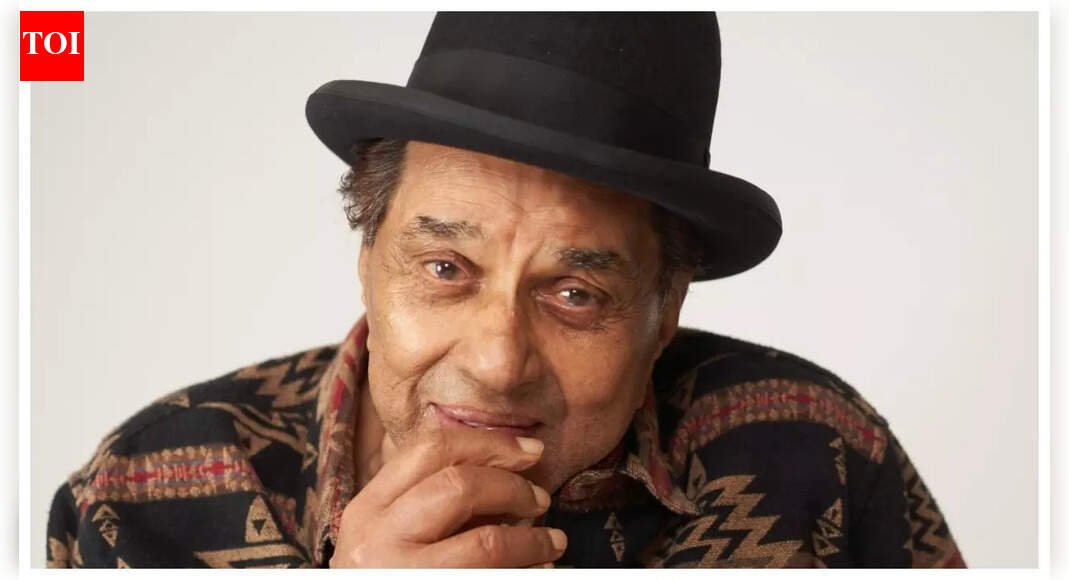
They called him the He-Man. Most of his major solo hits – ‘Phool Aur Patthar’ (to a lesser extent), ‘Ankhen’, ‘Mera Gaon Mera Desh’, ‘Jugnu’, ‘Pratigya’ – were breathless action yarns. These movies made Dharmendra a star of the masses. Audiences would stand in queues for hours to watch him snarl and scream, “Ek ek ko chun chun kar maroonga.” Dialogues like these became a template repeated over countless movies in a career that spanned nearly six and a half decades.It is, therefore, quite interesting that Bollywood’s action hero also played a range of genteel and refined characters, especially in the first two decades of his career. And one is not referring only to botany professor Parimal Tripathi in Hrishikesh Mukherjee’s ‘Chupke Chupke’ (1975), or, for that matter, the Sanskrit teacher who teaches Kalidas’ Abhigyan Shakuntalam in Basu Chatterjee’s ‘Dillagi’ (1978) — a rare film in which Dharmendra gets beaten up by the bad guys. Director Basu da once told this reporter that distributors were nervous at the film’s release because in the posters, Dharmendra held a rose, not a gun.

Dharmendra’s Ashes Immersed In Ganga At Haridwar!

There are many other films where Dharmendra didn’t play a cop or an outlaw. Instead, he played a poet, a writer, a trade unionist or a journalist. A majority of these films were directed by Bengali filmmakers.In 1966, Dharmendra played a struggling poet in Hrishikesh Mukherjee’s Anupama. At the time, the image of a celluloid poet was largely defined by Guru Dutt’s Vijay in ‘Pyaasa’ — hungry, unshaven and pessimistic. Dharmendra too described himself as one of “khoon, pasina aur aansoo” (blood, sweat and tears). But he looked the exact opposite. At one point, the script in ‘Anupama’ even provided an explanation for his well-nourished body. If you compare the picturization of “Jaane woh kaise log thhe jinko” (Pyaasa) with “Ya dil ki suno duniya walon” (‘Anupama’), there are distinct stylistic similarities. Both are filmed in an indoor mehfil. Guru Dutt is dressed in dhoti-kurta with a shawl, while Dharmendra wears kurta-pyjama with a shawl. Both songs are rendered by Hemant Kumar, and both create a similar mood.In Shahid Lateef’s ‘Baharen Phir Bhi Aayengi’ (1966), the Punjab da puttar played a conscientious journalist. This was originally a Guru Dutt project. After the maker of Pyaasa and Kaagaz Ke Phool passed away, many thought Dev Anand would step in — but it was Dharmendra who did. The film is largely forgotten now, though songs such as “Aap Ke Haseen Rukh Par” (singer: Mohd Rafi; music: O.P. Nayyar; lyrics: Anjaan) are appreciated to this day.Dharmendra’s tryst with literary characters continued in the Seventies. In Pramod Chakraborty’s ‘Naya Zamana’ (1971), he was a morally upright writer who believes that books can change the world. The poet in Devendra Goel’s ‘Ek Mahal Ho Sapnon Ka’ (1975) is unable to sell his work. When he finally does, it is at the cost of his identity — much like Vijay in ‘Pyaasa’.The audience was first introduced to a celluloid version of the bhadralok Dharmendra in Bimal Roy’s ‘Bandini’ (1964). His portrayal of the kind-hearted doctor earned Dharmendra notice as an actor of promise. Another Bengali director, Phani Majumdar, cast him as a trade union leader in ‘Akashdeep’ (1965). And he was a college professor in Asit Sen’s romantic drama, ‘Sharafat’ (1970).Interestingly, Bengali directors also cast him in mainstream masala films. For example, ‘Jugnu’ (1973) was directed by Pramod Chakraborty and ‘Pratigya’ (1975) by Dulal Guha.Few know that Dharmendra also wrote poetry. During an interview with TOI, he once recited a few lines from his poem “Main Kaun Hoon”: “Pyar, mohabbat, duayein aapki sejte hain jazbaat mere / Isi liye aaj bhi jawan hoon main / Khata agar ho jaye, baksh dena yaaron /Galtiyon ka putla aakhir ek insaan hoon main.” (“Your love, affection and prayers nurture my emotions / That’s why I’m still young / Please forgive me if I’ve ever erred / After all, I am only human.”)Dharmendra also played the male lead in ‘Dulhan Ek Raat Ki’ (1970), a romantic tragedy based on Victorian writer Thomas Hardy’s evocative novel, ‘Tess of the D’Urbervilles’.


[ad_2]

Source link
Asian stocks today: Markets trade mixed ahead of Fed rate cut decision; HSI dips over 1%, Nikkei flat adding over 40 points

[ad_1]

Asian stocks today: Markets trade mixed ahead of Fed rate cut decision; HSI dips over 1%, Nikkei flat adding over 40 points

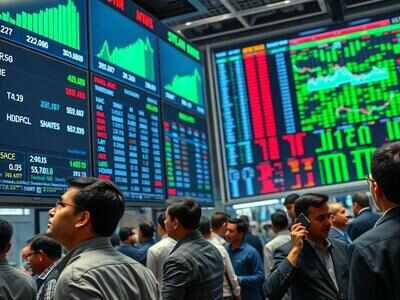
Stock markets across Asia traded mixed on Monday as investors await an interest rate cut decision from the US Federal Reserve, scheduled for later this week.In Hong Kong, HSI dropped over 255 points, nearing 1% loss to trade at 25,829.Nikkei, meanwhile, added 44 points to 50,535. Shanghai and Shenzhen also gained 0.8% or 1.74%, respectively. South Korea’s Kospi also traded in green, adding 0.71% to 4,129.Geopolitics remained a drag on sentiment. Rising tensions between two Asian giants, Japan and China also dragged the markets in red. According to officials, Chinese military aircraft locked radar on Japanese fighter jets, an escalation that followed weeks of heightened friction after a remark about Taiwan by Japanese Prime Minister Sanae Takaichi.Japan’s defence minister Shinjiro Koizumi said the government had lodged a formal protest and denounced the incident as “an extremely regrettable” act and “a dangerous” one that “exceeded the scope necessary for safe aircraft operations.”The episode did little to help Japanese shares. Domestic data added to investors’ caution: revised figures released on Monday showed Japan’s economy shrinking at an annual pace of 2.3% during July–September, worse than the previously reported 1.8% contraction. Chinese markets also painted a split picture. Chinese leaders are due to convene a major annual conference to map out economic policy in the coming days.A handful of corporate movers stood out. Ulta Beauty climbed 12.7% after beating expectations on quarterly profit and revenue, while Victoria’s Secret & Co. jumped 18% following a quarterly loss that was milder than analysts predicted. Warner Bros. Discovery rallied 6.3% after Netflix announced plans to buy Warner Bros. for $72 billion in cash and stock once the company completes its separation from Discovery Global. Netflix shares slipped 2.9% and Paramount Skydance — previously viewed as a leading contender to snap up Warner Bros. — dropped 9.8%.Attention now turns squarely to Washington. Traders mostly believe the Federal Reserve will cut interest rates on Wednesday to support the slowing US job market, which would mark the third cut this year. Lower rates tend to lift financial markets and economic activity, but they also risk aggravating inflation, which remains above the Fed’s 2% target.Oil prices were slightly firmer in early Monday trading, with US benchmark crude adding 11 cents to $60.19 per barrel and Brent gaining the same amount to $63.86. In currency dealings, the dollar eased to 155.09 Japanese yen from 155.30 yen late Friday, while the euro strengthened to $1.1651 from $1.1639.


[ad_2]

Source link
2017 abduction and rape case: Kerala actor Dileep acquitted; Pulsar Suni among 5 found guilty | Kochi News

[ad_1]

2017 abduction and rape case: Kerala actor Dileep acquitted; Pulsar Suni among 5 found guilty

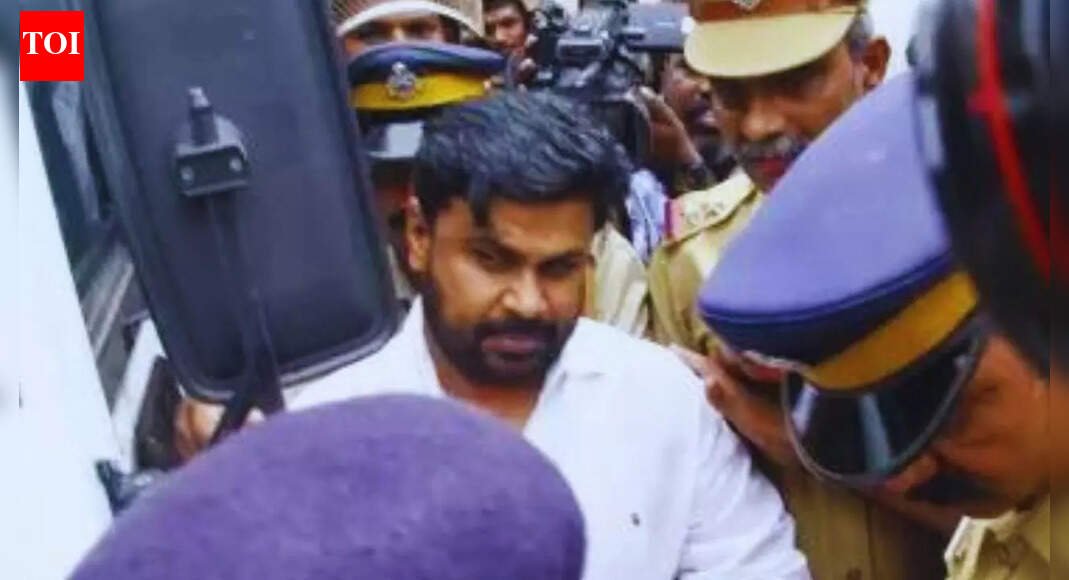
KOCHI: The Ernakulam principal sessions court on Monday acquitted Actor Dileepin the high-profile 2017 abduction and rape case.The court found six others, including the prime accused Sunil N S, popularly known as Pulsar Suni, guilty for directly committing the crime.The court also acquitted three other persons in the case. The verdict was delivered by Ernakulam Principal Sessions Judge Honey M Varghese, who had concluded the hearing in the prolonged trial on November 25. The 2017 assault on the actress, who has appeared in Tamil, Telugu, and Malayalam films, shook Kerala’s society. She was allegedly abducted in her car for two hours, during which several persons forced their way into the vehicle before escaping in a crowded area. The ten accused who faced trial were Sunil N S alias Pulsar Suni, Martin Antony, Manikandan B, Vijesh V P, Salim H, Pradeep, Charly Thomas, actor Dileep (real name P Gopalakrishnan), Sanil Kumar alias Mesthri Sanil, and G Sarath. Police arrested several accused soon after the incident and filed the first chargesheet against seven individuals in April 2017. During the ongoing investigation, Dileep was arrested on July 10, 2017, after authorities alleged that Suni had sent him a letter from jail. He was later granted bail on October 3, 2017.The actress-victim, who has appeared in Tamil, Telugu, and Malayalam films, was abducted and allegedly molested in her car for two hours on the night of February 17, 2017, while traveling from Thrissur to Kochi.


[ad_2]

Source link