Breaking News
IndiGo fiasco: The real cost of a flight that never took off

[ad_1]
IndiGo fiasco: The real cost of a flight that never took off
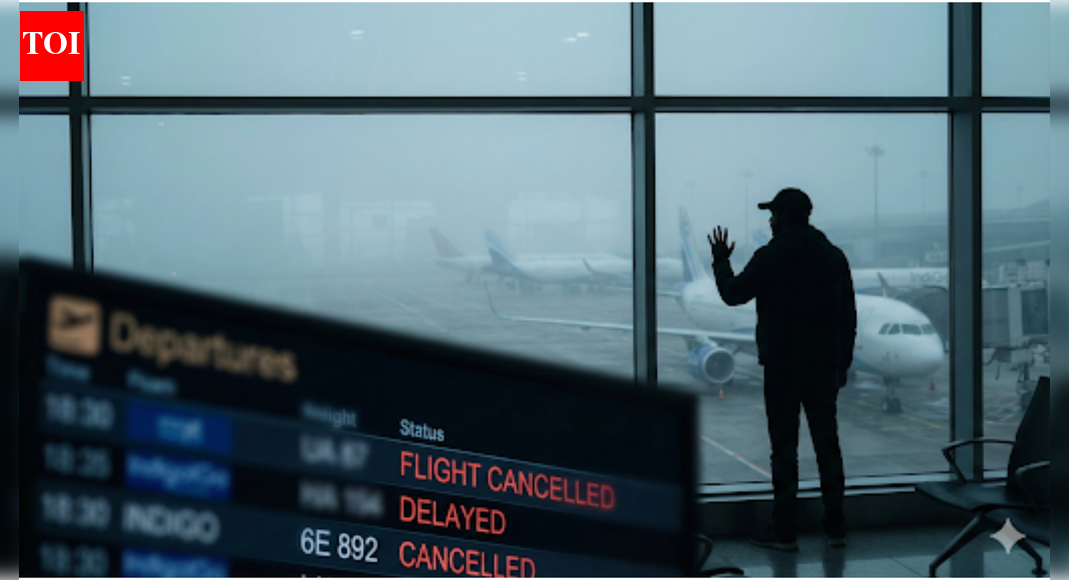
AI image (Picture credit: Gemini)

At airports, there was a time when a crackling announcement – “This is the last call for …” – meant panic, urgency, a frantic dash through terminals. When a voice reverberating in mechanical voice announced, “your flight has been delayed”, it was no less than a nightmare as it tested the patience. However, today, for IndiGo passengers, now these same words land like reassurance. It means the flight exists. It means the crew showed up. It means travel is still possible. In a week when cancellations ran into four digits a day, travellers like Soubik Majumder clung to every announcement not as a warning, but as hope because silence, not sound, has become the true alarm. With abrupt cancellations running into hundreds, sometimes even over 1,000 flights a day in the last week, the news of a delay has, ironically, offered some relief.Majumder had booked an IndiGo flight in advance from Delhi to visit Agartala for his brother’s wedding.
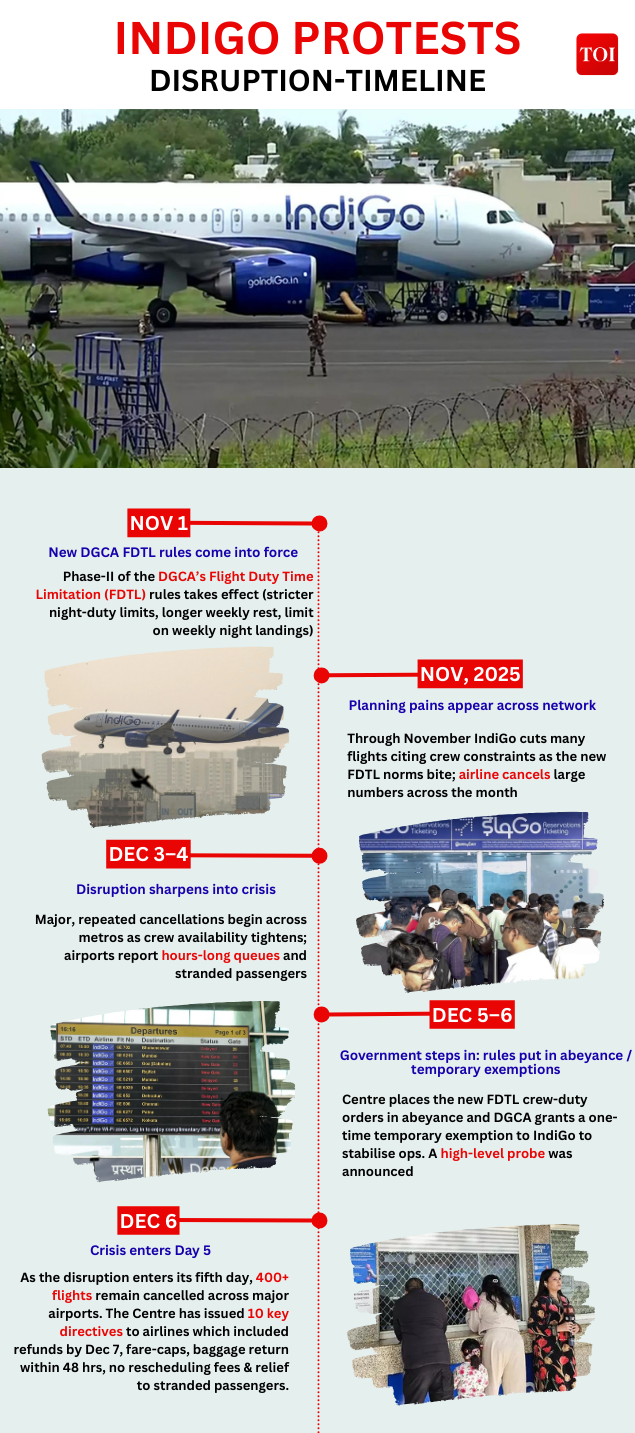
IndiGo disruption timeline

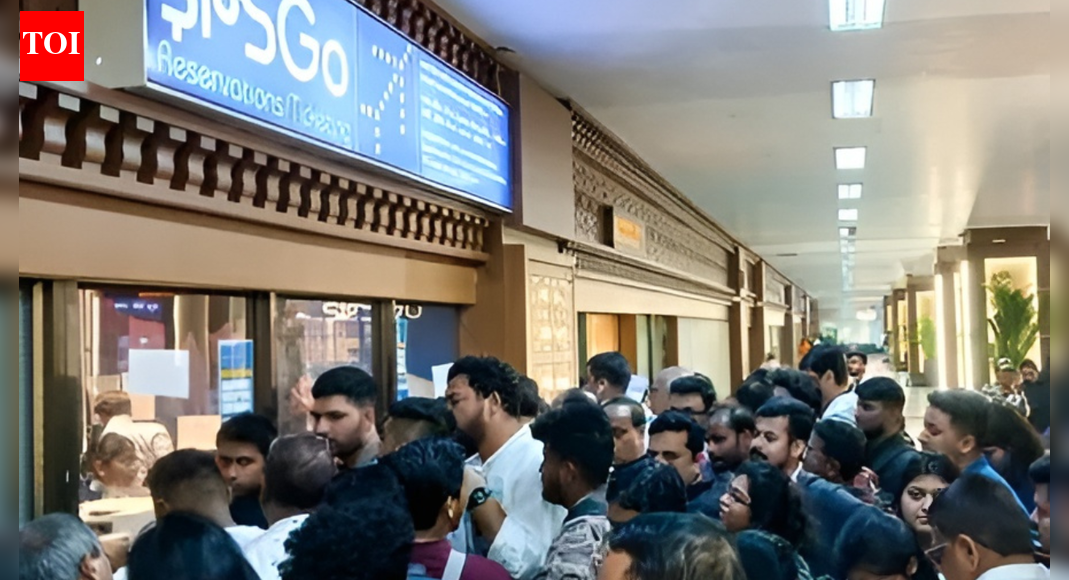
However, what should have been a pleasant ride home turned into a desperate hunt for buses, trains and anything that moved, all in a bid to reach the ceremony on time.He had booked the tickets one month before his actual flying date but the ongoing chaos and disruptions left him with nothing but a cancelled flight. “I booked my ticket almost a month in advance so that I wouldn’t have to face any hassle. But because of the changes that happened later due to the new aviation law, I am now facing problems for the same ticket that I booked one month earlier,” he told TOI.Delays came first, followed by endless queues and cancellations and gradually, everything erupted into utter chaos, turning airports into scenes similar to a fish market, with suitcases scattered everywhere. IndiGo’s flight disruption worsened on Friday as the airline cancelled over 1,000 flights across major cities. After remaining silent for three days during the crisis, CEO Pieter Elbers finally issued a video apology, expressing regret for the inconvenience caused to passengers.Delhi bore the brunt with 235 cancellations, followed by Mumbai with 104, Bengaluru with 102 , and Hyderabad with 84 cancelled flights.

Now boarding – Frustration

For many passengers, the trouble began long before the cancellation alert flashed on screens. Vaishnavi Shree, travelling from Tirupati to Delhi, recalled the confusion that unfolded in real time.“There’s only one direct flight from Tirupati to Delhi, it departs at 9 am and usually lands by around 11.30 pm. We completed all the usual procedures, but while going through security, I overheard a guard mention that the Delhi flight might be cancelled. No one seemed sure, so we continued to the gate,” she said.The uncertainty only grew. “The flight was delayed first by one hour, then two and finally it was cancelled,” she said.Passengers were offered two choices: reschedule for the next day with hotel accommodation and meals, or cancel their tickets. But those who urgently needed to reach Delhi were left stranded, with connecting routes via Hyderabad, Bengaluru or Chennai either fully booked or cancelled.Playback singer and performer Abhijit Ghoshal told TOI, ‘I paid around Rs 14,000 for my flight. It wasn’t cancelled, but it was delayed by nearly six hours. After landing in Mumbai at 8.51 pm, it took 40 minutes just for the doors to open, and I received my luggage only at 10.45 pm.”
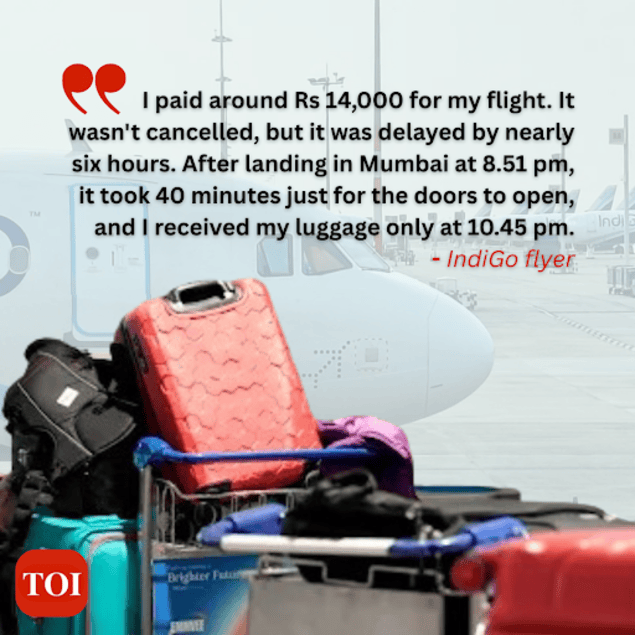
IndiGo crisis

Sunil D Shaligram said his son remained stuck at the airport for over 14 hours. “Despite repeated requests, we received no assistance,” he told PTI.Another parent, S Arora, said the airline “should have foreseen the chaos their decisions would trigger.”Several passengers said they were asked to deboard after being told there was “no pilot available.”Stranded travellers are now demanding clearer communication from the airline and better arrangements to deal with disruptions of this scale.

Refunds … but at what cost?

To support affected passengers, IndiGo announced automatic refunds for cancelled flights.The airline said, “All refunds for cancelled flights will be processed automatically to your original mode of payment. Additionally, we are offering a full waiver on all cancellations and reschedule requests for bookings between 5 and 15 December 2025.”However, frustration runs far deeper than refunds, with passengers now facing fares nearly ten times higher than their original bookings. Many received cancellation alerts just hours before departure.“My flight was at 9.00 am and I got the message at 4.00 am,” Majumder said. “In a way, it was slightly helpful that I didn’t have to go to the airport … but when you find out four to five hours before your flight that it’s cancelled, you can’t do much urgently.”Talking about the refunds, he added, “IndiGo is covering the amount I originally paid, yes, but that doesn’t solve the problem … I can’t find anything below Rs 50,000–70,000, and even then only connecting flights, no direct options.”After spending roughly Rs 8,000 for his tickets, Majumder believed his plans were set, until the chaos left him scrambling. “They are charging ten times that now … it feels like the aviation industry is taking advantage of the public,” he said.
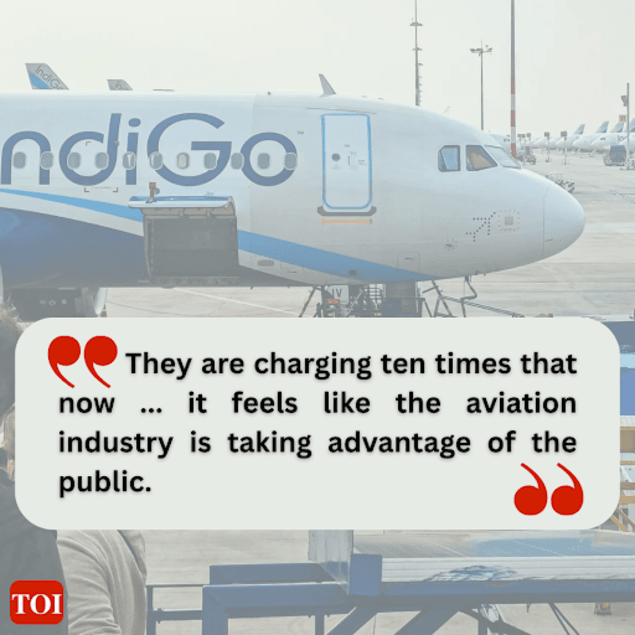
IndiGo crisis

Despite already missing part of the family wedding, he insisted he would try every possible route to attend the remaining ceremonies.Nomad Travel CEO and former Travel Agents’ Association of India president Ajay Prakash told PTI, “If a Rs 10,000 ticket is being sold at Rs 60,000 … I would call it black marketing, profiteering.” He argued the sector is now driven “purely by profit motives,” with IndiGo’s 64–65% market share giving it near-monopoly power.Fare spikes followed the chaos: after 1,000 flights were cancelled, a one-way economy ticket on SpiceJet from Kolkata to Mumbai touched Rs 90,000, while Air India’s Mumbai–Bhubaneswar fare hit Rs 84,485.It wasn’t just airfares that shot up. Ghoshal said even cab prices had tripled. “My usual fare … is between Rs 550 and Rs 650, but yesterday … it was showing Rs 1,871.”He added the crisis has hit livelihoods. “Many of my peer musicians have missed their concerts … We artists usually fly on the day of the performance itself,” he said, calling the situation “ridiculous” and deserving serious action if caused by mismanagement.Another passenger, Ritik Jha, also told TOI how his entire travel plan collapsed.“Initially the flight was scheduled for December 3 at 9.15 am, booked much in advance — in October — and was cancelled a few hours before take-off,” he said. Jha had booked four tickets at Rs 8,855 per person, but the last-minute cancellation forced him to look for alternatives that were 300–400% higher than his original fare.“Air India was charging Rs 33,353 per person for two of us in the morning, while Akasa was Rs 22,532 per person in the afternoon — which again caused delays for a planned event,” he said, adding that the entire schedule went haywire, leading to “inflated costs, delays, and complete chaos.”Jha also mentioned that an international client travelling with him faced similar issues. “He was supposed to fly from Pune to Bengaluru with IndiGo, but the last-minute cancellation made him take a connecting flight via Chennai, again costing much higher and causing delays and chaos.”

What the airline has offered

Beyond refunds, IndiGo has been providing accommodation and meals to stranded passengers. Shree said, “We were provided accommodation and food at Fortune Grand ITC.”“We got the cab that they (IndiGo airline) provided, and the food is there, three meals a day, and the hotel and everything is good.”For Ghoshal, however, the experience was far less satisfying.“On December 2, when I flew from Ranchi to Delhi and it was delayed in the Delhi–Prayagraj sector, they offered very meagre food. The quantity of food for delayed passengers was almost 30% of a usual thali. But at Prayagraj airport on December 4, IndiGo did give snacks, packets and tasty food (lunch) at around 3 pm.”

No hellos, no goodbyes!

The disruption at IndiGo, India’s largest airline by market share, has not just crippled aviation operations, it has pushed passengers into deep emotional distress. Weddings, work commitments, medical emergencies and even final goodbyes now hang in uncertainty.In Guwahati, one passenger described the agony, “I have come all the way from Shillong this morning. My husband passed away, and I have come here to transport the casket to Kolkata so he can be buried in his hometown.”“We booked an IndiGo flight, and till now there is no information on whether it will take off. I don’t know if the flight will be cancelled or if it will actually depart,” the flyer told ANI.Another flyer from Delhi reached the airport at 2 in the afternoon, excited to attend an important wedding function, waited all day at the airport, only to return back home after spending almost 12 chaotic hours at the airport, and no flight in sight.

IndiGo feels the heat

InterGlobe Aviation, also known as IndiGo, is reeling from the disruption not just on the ground, but also at Dalal Street. In the past 5 trading sessions, the airline’s stock price has tumbled down by over 7%.The company’s stock has been under pressure for four consecutive sessions, slipping 7.23% on the Bombay Stock Exchange and 7.30% on the NSE over the period. On Friday, it closed 1.22% lower at Rs 5,371.30 on the BSE after falling as much as 3.15% intraday to Rs 5,266, while on the NSE it ended 1.27% down at Rs 5,367.50. Since December 1, the firm’s market capitalisation has eroded by Rs 16,190.64 crore to Rs 2,07,649.14 crore.IndiGo’s on-time performance also collapsed amid worsening operational disruptions, plunging to just 8.5% on Thursday, according to data from the civil aviation ministry.The decline has been sharp, as the airline’s OTP dropped from 35% on Tuesday to 19.7% on Wednesday before hitting single digits a day later, a major setback for an airline that has long positioned punctuality as its key strength.

What’s next

The government on Saturday intervened to control spiralling ticket prices as IndiGo’s operational crisis entered another day, triggering widespread cancellations, passenger unrest and uncertainty over return travel.The ministry of civil aviation said it had taken “serious note of unusually high airfares being charged by certain airlines during the ongoing disruption” and invoked its regulatory powers to ensure “fair and reasonable fares across all affected routes.”
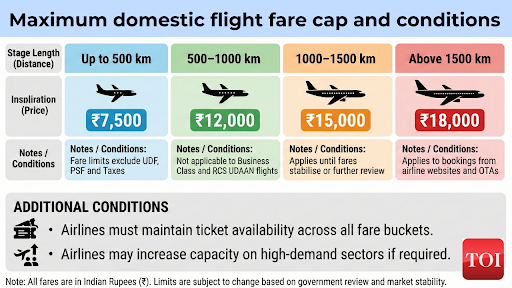
Maximum domestic flight fare cap and conditions

The ministry has also instructed IndiGo to promptly process all outstanding passenger refunds. It has been mandated that refunds for all cancelled or disrupted flights must be completed by 8:00 pm on Sunday, December 7. Additionally, airlines have been directed not to charge rescheduling fees to passengers whose travel arrangements were impacted. The ministry cautioned that any delays or failure to comply with the refund processing will result in immediate regulatory measures.Meanwhile, passengers who have even travelled one way are still worried about their return plans. Hardik Sharma, who was one of the lucky ones who got to board their scheduled flight from Delhi to Vizag, is now feeling anxious about his return journey.“Thankfully, my flight was on time, but there’s still uncertainty about my return flight to Delhi on Sunday night”, he said.With thousands stranded nationwide, Delhi airport released a statement on Saturday afternoon saying operations were gradually improving, “We are glad to update that IndiGo flight operations are now steadily resuming and getting back to normalcy following the brief disruption. Please check the status of your booking and flight before leaving home.”In order to help passengers with no travel options, the South Central Railway announced four special trains to Chennai, Mumbai and Shalimar (Kolkata) to clear the extra rush. The move followed long queues and overcrowding at the airport due to the large-scale grounding of flights.Union civil aviation minister Ram Mohan Naidu Kinjarapu said restoring normalcy across airports “remains the immediate priority”. He added that authorities are closely monitoring the airline’s scheduling network and compliance with pilot duty and rest norms. “The immediate priority for us is to bring back normalcy and provide all the support to the passengers. We are deeply observing this, and observing the FDTL norms, scheduling network. We will thoroughly look into this and ensure that all airlines follow due diligence,” he said.IndiGo, which usually operates around 2,300 flights a day, has been cancelling services to manage the worsening operational disruptions tied largely to crew shortages, causing massive distress for passengers and triggering knock-on effects across the aviation and railway networks.How long it will take for IndiGo to resolve the ongoing disruptions remains uncertain, but one thing is clear: passengers will end up paying a price far beyond just their airfares.Even if this chaos resolves within the coming days and normalcy returns soon, it is certain that neither the emotional damage caused to passengers can be undone nor the trust shaken in the reliability of the airline can be restored in the near future.IndiGo will fix its roster, the ministry will probe and issue new directives, and eventually airports will go back to being temples of impatience, not despair. But until then, every time a speaker crackles, passengers will inhale sharply – not worried they’re late, but relieved they’re still on the list. In a week when ‘delay’ became the new ‘on time,’ travellers learned the hardest lesson of all – that in aviation, the most expensive seat isn’t business or premium economy. It’s certainty.


[ad_2]

Source link

Power as ‘currency’: Experts say data centre growth lifts demand; India poised for global leadership

[ad_1]

Power as ‘currency’: Experts say data centre growth lifts demand; India poised for global leadership

India’s expanding data centre and artificial intelligence ecosystem could position the country as a global leader in power trade, with experts pointing to surplus electricity capacity and rapid reforms in the power distribution sector, according to speakers at a national conference on energy and technology.Speaking at the National Conference on AI and Machine Learning based solutions in the power sector, Jitendra Srivastava, chairman and managing director of REC Limited, said the rapid rise of AI and data centres is creating a new era where electricity itself becomes a strategic asset, according to ANI.“With the exploding growth of artificial intelligence, with the exploding growth of data centres, with the sheer amount of power required to function these places…We are going to see an era when power will be the currency and we are uniquely placed with its huge potential with its already surplus status. We are poised to become world leaders. We are in a position where we can show the world that power is a tradable commodity and we can be global leaders in this,” Srivastava said.The conference brought together solution providers and power distribution companies with the aim of enabling collaboration and innovation. Shashank Mishra, Joint Secretary in the Ministry of Power, said the initiative was designed to create a common platform for developing new solutions.“Today we are bringing together solution providers and distribution companies on a single platform where they can interact and develop new solutions and ideas. We are also presenting several innovative concepts in the form of solutions, and the best among them will be awarded by the Minister of Power,” Mishra told ANI.He added that the government expects the initiative to be “a transformative” step for the sector.Highlighting ongoing reforms, Srivastava said the Ministry of Power has been driving changes under the Revamped Distribution Sector Scheme (RDSS), with smart metering forming a core pillar of the programme. He stressed that the benefits of smart meters can be fully realised only with the use of advanced analytics.“To understand the advantages of smart metering, it is essential to leverage the power of artificial intelligence and machine learning,” he said, adding that such tools can aid anti-theft measures, load forecasting and system rationalisation.According to Srivastava, the conference seeks to demonstrate how AI- and machine learning-based tools can improve consumer services, assist electricity regulators and help discoms function more efficiently.India’s energy sector has strengthened significantly in recent years, balancing rising demand with sustainability goals. Citing International Energy Agency projections, speakers noted that emerging and developing economies will account for about 85 per cent of the growth in global electricity demand over the next three years, with India playing a central role.As of June 2025, India’s total installed power capacity stood at 476 GW, while power shortages have declined sharply from 4.2 per cent in 2013-14 to 0.1 per cent in 2024-25, according to official data.


[ad_2]

Source link
Smartworld Developers enters Noida, to invest Rs 2K cr on 1st realty project

[ad_1]

Smartworld Developers enters Noida, to invest Rs 2K cr on 1st realty project

Realty firm Smartworld Developers will invest around Rs 2,000 crore to build its first project in Noida, as part of the company’s plan to expand beyond the Gurugram property market. Smartworld Developers has announced its entry into Noida, which is an important micro-market in the Delhi-NCR. The company has acquired a 6-acre land parcel in Sector 98 along the Noida Expressway through an auction process for Rs 414 crore, it said in a statement. Smartworld Developers will build a mixed-use project comprising premium branded residences, high-street retail, and serviced homes. The company will invest around Rs 2,000 crore to build this project, while the estimated revenue exceeds Rs 3,000 crore. “Entry into Noida is a significant milestone for Smartworld Developers as we further strengthen our presence in the NCR region. Noida’s rapidly evolving infrastructure and its growing importance as a key real estate hub offer immense potential,” said Ashish Jerath, President – Sales & Marketing, Smartworld Developers. The company is in discussions with a leading global brand for a potential collaboration on the Noida project. Smartworld Developers clocked Rs 6,400 crore worth of sales bookings last fiscal year, a remarkable 60 per cent annual growth. Gurugram-based Smartworld Developers has delivered around 6.5 million sq ft to date, and another 20 million sq ft is currently under construction. According to real estate consultant PropTiger data, housing sales across eight major cities fell 95,547 units during the third quarter of this calendar year from 96,544 units in the corresponding period of the preceding year. Sales of residential properties in Delhi-NCR decreased 21 per cent to 7,961 units from 10,098 units, said PropTiger, which Aurum PropTech has recently acquired.


[ad_2]

Source link
IndiGo meltdown prompts govt action: Refund deadline, fare cap, baggage return & more — key directives

[ad_1]

IndiGo meltdown prompts govt action: Refund deadline, fare cap, baggage return & more — key directives

NEW DELHI: The Central government on Saturday ordered IndiGo to clear all pending passenger refunds without delay as the IndiGo’s nationwide disruption entered its fifth day, with hundreds of flights cancelled and fares surging across key routes.The ministry of civil aviation said the intervention was essential to safeguard passengers grappling with uncertainty, soaring ticket prices and prolonged delays.

10 key directives issued by the Centre –

  • The government directed that IndiGo must complete all pending passenger refunds for cancelled or disrupted flights by 8pm on Sunday, December 7.

  • Airlines, including IndiGo, have also been instructed not to levy any rescheduling fees for passengers affected by cancellations or major delays.

  • IndiGo must ensure that all baggage separated from passengers during cancellation or delays is traced and delivered to the passenger’s residential or chosen address within the next 48 hours. Airlines have been told to maintain clear communication with passengers regarding tracking and delivery timelines, and to provide compensation where required under existing passenger rights regulations. `

  • To stop surge pricing during the nationwide crisis, the government has imposed fare caps across affected routes. These must be followed strictly.

  • The airfare caps will remain in place until operations return to normal. Any violations will attract regulatory action.

  • The DGCA’s Flight Duty Time Limitations (FDTL) norms have been placed in abeyance to help airlines deploy more cockpit crew without compromising safety.

  • The ministry of civil aviation expects schedules to begin normalising within 24 hours and fully stabilising within the next three days.

  • The ministry said that if a flight is cancelled, airlines must issue full refunds automatically, no passenger requests required. Airlines must offer hotel accommodation, refreshments and essential services for passengers stranded due to long delays.

  • Special support, including lounge access, faster processing and dedicated help, must be provided to vulnerable travellers.

  • To ensure real-time monitoring, the government has opened a 24×7 control room (011-24610843, 011-24693963, 096503-91859) to coordinate swift action.


[ad_2]

Source link
‘Exceptional’: SBI hails RBI’s repo rate cut; report says Central bank played its part, now markets should remain disciplined

[ad_1]

'Exceptional': SBI hails RBI's repo rate cut; report says Central bank played its part, now markets should remain disciplined

The Reserve Bank of India (RBI) slashed the repo rate by a quarter point to 5.25% on Friday, at a time when the economy is growing strongly and inflation remains exceptionally low. SBI, in its latest report hailed the decision hailed as “exceptional” and said that the central bank had played its role in ensuring that the monetary policy continues to support the country’s economic growth.The bank further added added that it was now up to the markets to remain disciplined and avoid overreaction. The RBI’s Monetary Policy Committee voted unanimously to reduce the repo rate while maintaining a neutral stance. The cut comes amid global uncertainty, even as India’s GDP expanded by over 8.2% in the July–September 2025 quarter and inflation slipped to just 0.25% in October. SBI Research noted that such a move is rare internationally. “Historical data of other countries reveal that there have been minimal instances across the UK, China and Indonesia, where central banks have reduced their rates even when GDP growth was high,” the report said. In past cases, these cuts were typically made from higher interest rate levels and during periods of higher inflation. The report cited the UK in the early 1970s, when chancellor Anthony Barber enacted a “dash for growth” by cutting rates despite inflation at 11% and growth at 12.5%. Similarly, Indonesia cut rates successively from 1995 to 1997, with growth at 8.6% and inflation at 7.4% prior to the Asian financial crisis. “Its only China that had cut in 2012 and 2015 when inflation was averaging 1.8% and growth at 7.4%,” the report added. India’s downward inflation trajectory is supported by lower food prices, strong kharif production, healthy rabi sowing, adequate reservoir levels, and favourable soil moisture. As a result, the RBI has revised its inflation forecast for 2025–26 to 2.0 %, down from 2.6% in October and 4.2% in February. “We forecast inflation for FY26 at 1.8% and for FY27 at 3.4%. With such unprecedented level of downward revisions and further prospects of downward revision looming large, the RBI has kept the door ajar for future rate decisions. However, for now, repo rate at 5.25% will be lower for longer,” SBI Research said. The central bank also adjusted its GDP projections, with real growth for 2025–26 now seen at 7.3%. The first and second quarters of 2026–27 are projected at 6.7% and 6.8% respectively. SBI Research cautioned, however, that external demand could be affected by “ongoing tariff and trade policy uncertainties,” and that “prolonged geopolitical tensions and volatility in international financial markets caused by risk-off sentiments of investors also pose downside risks to the growth outlook. Despite these headwinds, the report expects GDP growth above 7% in the third and fourth quarters, bringing full-year growth for 2025–26 to 7.6%. Commenting on the policy decision, RBI Governor Sanjay Malhotra described India’s current economic climate as a “rare goldilocks period,” with strong growth and low inflation. “The economy witnessed robust growth and benign inflation…We approach the new year with hope, vigour and determination to further support the economy and accelerate progress,” he said.


[ad_2]

Source link
Assam tea, Kashmiri saffron & more: What PM Modi gifted Putin — in pictures | India News

[ad_1]

Assam tea, Kashmiri saffron & more: What PM Modi gifted Putin — in pictures
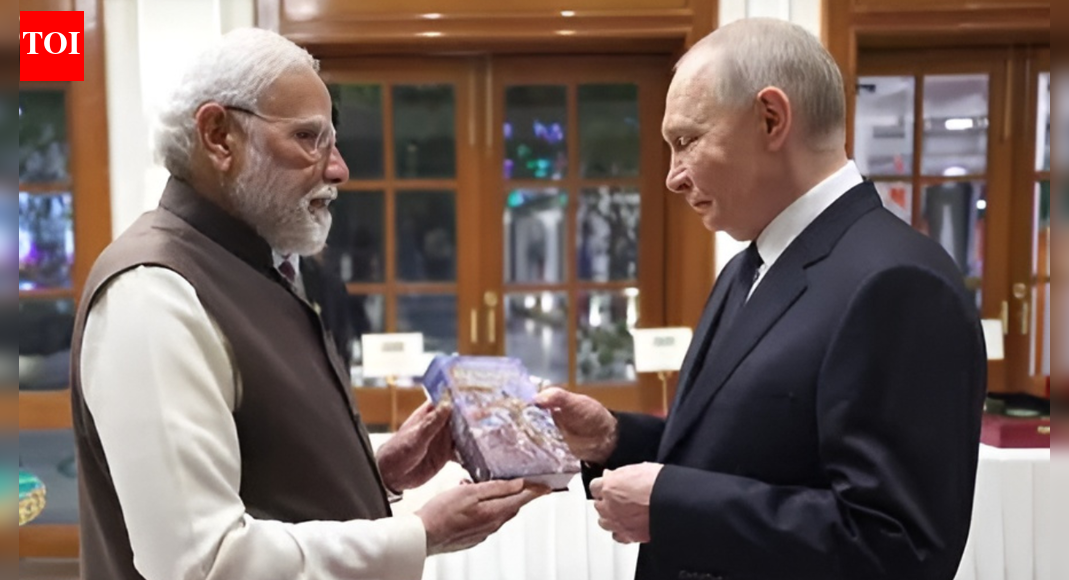
PM Modi presents Srimad Bhagavad Gita to Russian President Vladimir Putin (IANS photo)

NEW DELHI: Prime Minister Narendra Modi presented a set of specially curated gifts to visiting Russian President Vladimir Putin during his two-day trip to India. The gifts showcased India’s culture, craftsmanship, and heritage.They included a Russian edition of the Srimad Bhagavad Gita, GI-tagged fine Assam tea, Kashmiri saffron, and an ornate silver tea set.

PM Modi, Putin Share Another Car Ride, Russian President Says It Was His Idea To Show Friendship

Putin was in India for a special edition of the 23rd India–Russia Annual Summit, a tradition that has continued since 2000. His visit included a joint statement with PM Modi, several trade and business agreements, and other official engagements.

Assam black tea

The finely processed Assam black tea, grown in the Brahmaputra plains, is known for its strong flavour and bright colour. It received the GI tag in 2007 and is valued not only for its taste but also for its cultural significance and health benefits.

Assam black tea

Ornate silver tea set

The Murshidabad silver tea set from West Bengal features detailed hand engravings. It represents India’s rich artisanal tradition and also reflects the shared importance of tea culture in both India and Russia.

Ornate silver tea set

Srimad Bhagavad Gita (Russian edition)

PM Modi gifted President Putin a Russian copy of the Srimad Bhagavad Gita. Part of the Mahabharata, the text contains Lord Krishna’s teachings to Arjuna on duty, the soul, and spiritual wisdom—guidance that continues to inspire people around the world.

Srimad Bhagavad Gita in Russia edition

Kashmiri saffron

Kashmiri saffron, known locally as Kong or Zaffran, is one of the costliest spices in the world. Recognised with GI and ODOP tags, it is valued for its deep colour, aroma, and flavour. Hand-harvested in Kashmir’s highlands, this “red gold” supports local farmers and carries enormous cultural significance.

Kashmiri saffron

Handcrafted silver horse

The Prime Minister also gifted a handcrafted silver horse from Maharashtra, known for its detailed artistry and fine metalwork. In both India and Russia, the horse symbolizes dignity and valour. Its forward-moving stance represents the strong and steadily progressing partnership between the two countries.

Silver horse

Putin’s first India visit since 2021

Russian President Putin concluded his two-day visit on Friday with a special dinner hosted by President Droupadi Murmu at Rashtrapati Bhavan. This was his first visit to India after December 2021 and his first since the Ukraine war began in 2022. During the trip, he attended the 23rd annual India–Russia summit in New Delhi.


[ad_2]

Source link

Want to invest in SpaceX? Elon Musk owned rocket-maker hints at 2026 IPO; chasing a massive $800 billion valuation

[ad_1]

Want to invest in SpaceX? Elon Musk owned rocket-maker hints at 2026 IPO; chasing a massive $800 billion valuation

SpaceX might soon reach a $800 billion valuation as the rocket maker has began a new secondary share sale, according to sources cited by the Wall Street Journal. In case it manages to reach the figure, SpaceX will rush ahead of OpenAI to become the most valuable private company in the US. The new valuation target is double the $400 billion the company received in its most recent secondary sale.However, there is no assurance that the company will achieve the desired $800 billion valuation.

‘US Benefited Immensely From Indians’, Says Tesla CEO Elon Musk, Warns US Against Scrapping H-1B

Executives also said the company is considering an IPO next year, something investors have been waiting on for years.The aerospace giant has become a key partner for the US government, launching satellites and astronauts. Its Starlink broadband service is also used widely around the world, including in remote parts of the US and in the war in Ukraine. Starlink now has more than eight million active customers, which many investors believe is helping push the company’s valuation higher, Wall Street Journal reported. The IPO market has shown signs of improvement this year after a long slowdown. Shares of Circle Internet Group and Figma rose sharply when they went public in 2025. The government shutdown slowed activity, but many bankers and investors think 2026 could see IPO levels return to normal. SpaceX runs its share sale as a tender offer, something it usually does twice a year. This allows employees and early investors to sell some of the shares they already hold. The company is almost 25 years old but hasn’t yet gone public. The Texas-based company continues to fly missions for commercial satellite firms and for US agencies including NASA, the Pentagon and the intelligence community. It also regularly launches its own satellites. There are around 9,000 Starlink satellites in low-Earth orbit providing high-speed internet to homes, businesses and airlines. SpaceX is also building a service to link satellites directly to mobile phones. To support that project, the company has agreed to buy spectrum from EchoStar. It has committed more than $20 billion in cash, stock and debt to secure the spectrum. “We are so pleased to be doing this transaction with @EchoStar and working with operators across the globe to advance our mission to end mobile dead zones everywhere on Earth,” SpaceX President Gwynne Shotwell said in a September post on X. The company is also spending heavily on Starship, the large rocket it is developing for future missions, including NASA’s planned moon landing with astronauts. Tech site The Information earlier reported that SpaceX had been speaking with investors about the timing of a possible IPO.


[ad_2]

Source link
President Murmu’s banquet dinner for Putin: Jhol momo, saffron pulao, bharwan aloo & more; what was on the menu | India News

[ad_1]

President Murmu’s banquet dinner for Putin: Jhol momo, saffron pulao, bharwan aloo & more; what was on the menu
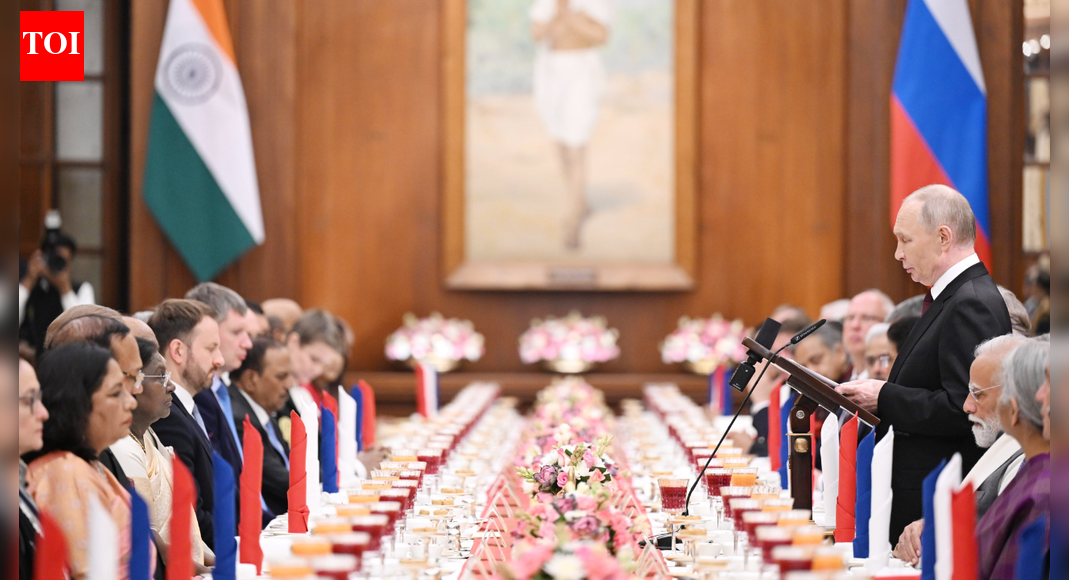
Putin at state banquet (@rashtrapatibhvn)

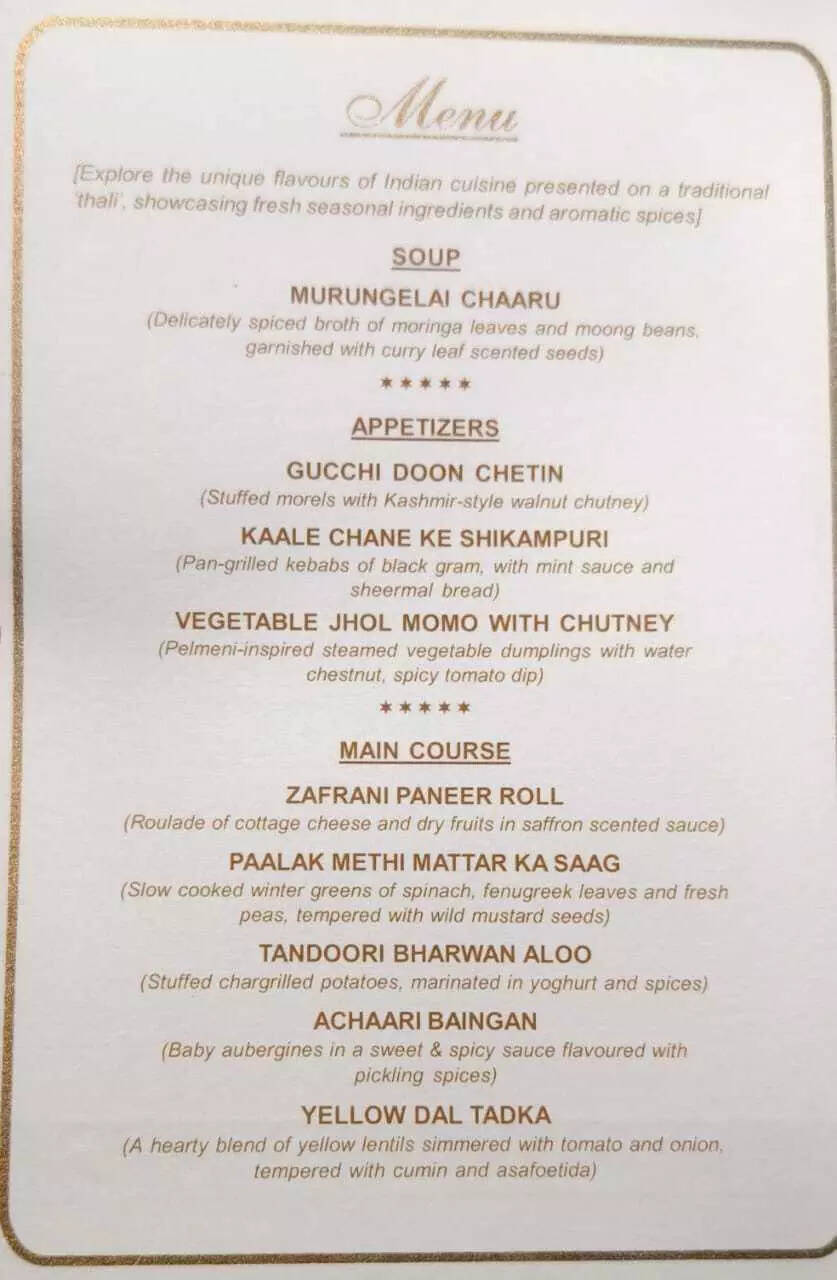
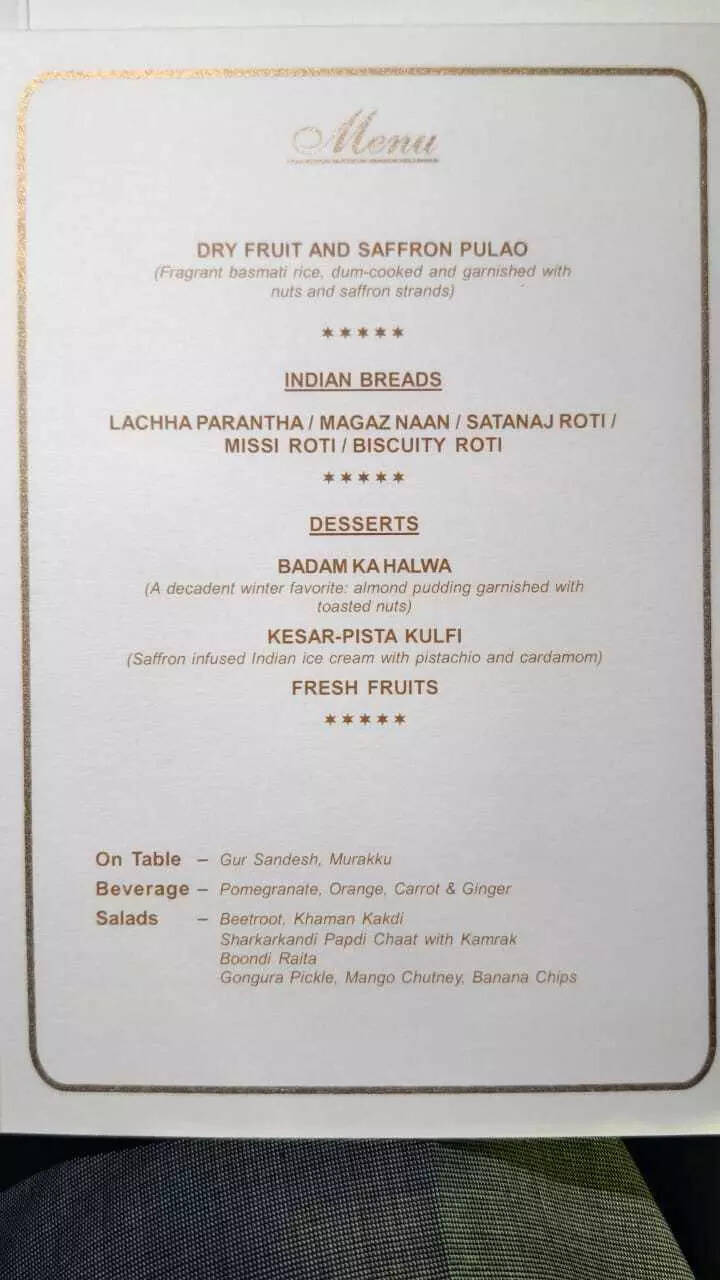
NEW DELHI: President Droupadi Murmu hosted Russian President Vladimir Putin at Rashtrapati Bhawan for a lavish state banquet on the second day of his India visit, featuring an all-vegetarian menu presented as a traditional thali built around fresh ingredients and aromatic spices. The carefully curated spread was designed to highlight India’s regional diversity and culinary heritage while remaining light, elegant and festive.The meal began with murungelai chaaru soup, a light broth of moringa leaves and moong beans garnished with curry leaf-scented seeds, setting a delicate and comforting tone for the evening. This was complemented by gucchi doon chetin (stuffed morels with white walnut chutney), kaale chane ke shikampuri (black gram kebabs) and vegetable jhol momo served with chutney, offering a mix of textures and flavours that moved from earthy to tangy and subtly spiced.

Starters and main course menu

Putin attends lavish banquet at Rashtrapati Bhawan hosted by President Droupadi Murmuu (PTI)

For the main course, guests were served zaafrani paneer roll, palak methi matar ka saag, tandoori bharwan aloo, achaari baingan and dal tadka. Together with the variety of gravies and dry preparations, harmonised the international palate while staying firmly rooted in Indian traditions.

Breads and desserts menu for state banquet

Putin was presented with lavish vegetarian menu during the state banquet

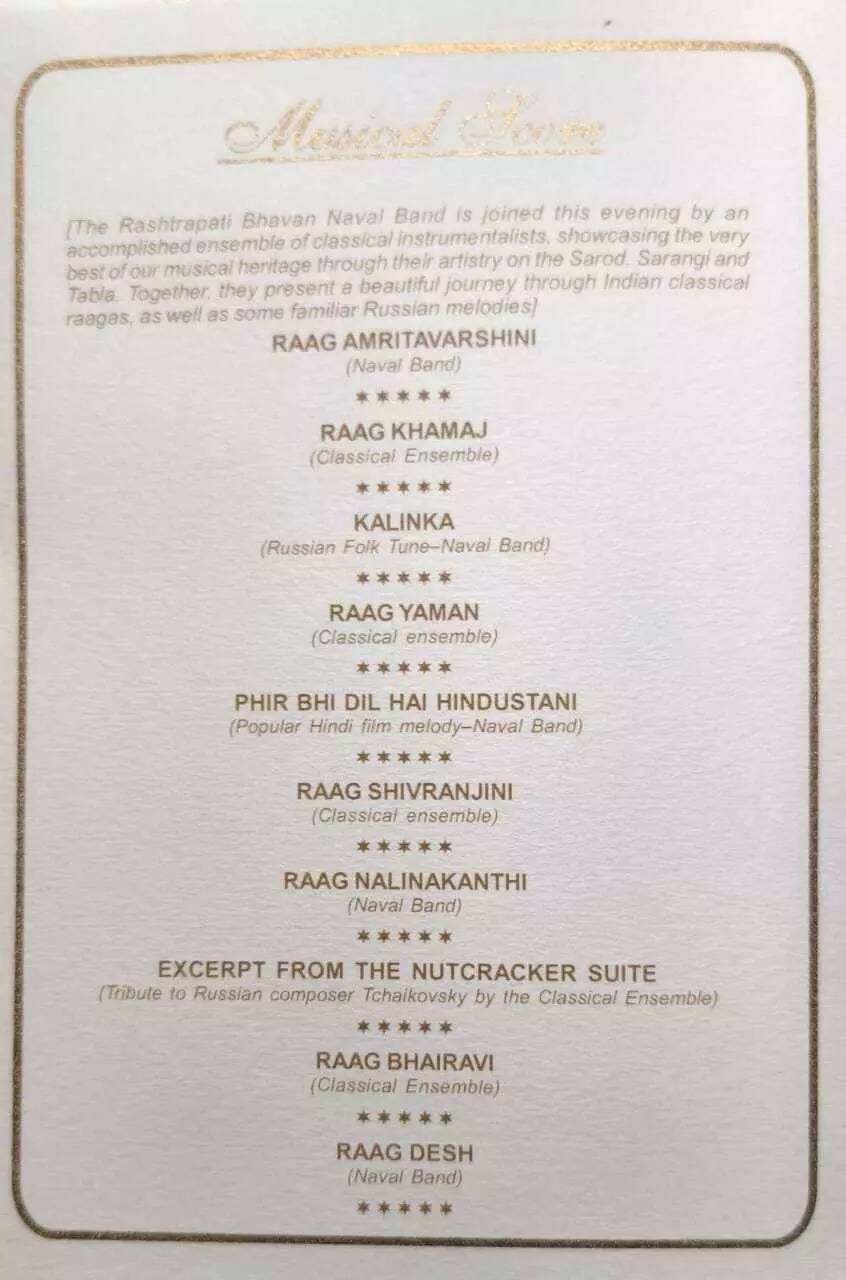
These dishes were paired with dry fruit and saffron pulao and an assortment of Indian breads, including lachha parantha, magaz naan, satanaj roti, missi roti and biscuity roti, ensuring ample options for guests to sample different combinations. Desserts featured badam halwa, kesar pista kulfi and fresh fruits, rounding off the meal with a blend of rich, nut-based sweetness and light, refreshing elements.Alongside this culinary journey, a parallel “raag menu” on the table introduced an ensemble of classical instrumentalists on the sarod, sarangi and tabla, who performed Indian classical ragas accompanied by familiar Russian melodies, turning the dinner into a cultural exchange as much as a gastronomic one.

Music Score

Music score for the lavish banquet at Rashtrapati Bhawan

The melodies included a Bollywood number like “Phir Bhi Dil Hai Hindustani” and Indian classical pieces like raag Shivranjini and raag Yaman, which were harmoniously supplemented by Russian melodies such as an excerpt from “The Nutcracker Suite” as a tribute to Tchaikovsky and “Kalinka”, a Russian folk tune rendered by a naval band. Together, the food and music created a carefully choreographed atmosphere of warmth, respect and soft diplomacy, blending Indian and Russian traditions in a single, memorable evening.Putin underlined the breadth of the India–Russia partnership, saying the joint declaration with PM Modi spans cooperation in politics, security, economy and trade, energy, education and more, and stressed that both countries are working to build a “fairer and just world order,” framing the relationship as one of “go together, grow together.” He later departed Delhi after the banquet, with External Affairs Minister S. Jaishankar seeing him off at the airport.


[ad_2]

Source link
‘Insane’: How Elon Musk reacted to EU’s $140m fine on X & why the platform was penalised

[ad_1]

'Insane': How Elon Musk reacted to EU's $140m fine on X & why the platform was penalised

Elon Musk on Saturday slammed the European Union’s $140 million fine on his social media platform X, calling the penalty “crazy” and “insane” in a post on the site. Taking to the site, he said, “The EU imposed this crazy fine not just on @X, but also on me personally, which is even more insane!”“Therefore, it would seem appropriate to apply our response not just to the EU, but also to the individuals who took this action against me.”

‘US Benefited Immensely From Indians’, Says Tesla CEO Elon Musk, Warns US Against Scrapping H-1B

The penalty comes after a two-year investigation into X under the EU’s Digital Services Act (DSA) and represents the first formal non-compliance ruling since the sweeping framework was introduced. The DSA requires major digital platforms to assume greater responsibility for user safety, curb illegal or harmful content, and maintain full transparency in their advertising and data practices.“Freedom of speech is the bedrock democracy. The only way to know what you are voting for,” he posted earlier on X. Regulators concluded that X violated three different transparency requirements. According to the Commission, the platform’s current blue checkmark system amounted to “deceptive design practices” that can expose users to scams. Prior to Musk’s takeover in 2022, badges on the former Twitter were mostly reserved for prominent public figures, however, after the acquisition, X began issuing the symbols to anyone prepared to pay $8 per month. The Commission argued that this system does not “meaningfully verify who’s behind the account,” making it harder for users to judge authenticity. The EU also faulted X for shortcomings in its digital ad database, which is legally required to disclose who paid for advertisements and the audiences targeted. Officials said the platform’s system is weakened by built-in limitations, delays and access obstacles that make it harder for researchers to identify scams and influence campaigns. Regulators further accused X of placing “unnecessary barriers” in the way of researchers seeking public data relevant to systemic risks. Henna Virkkunen, the EU’s executive vice-president for tech sovereignty, security and democracy, said in a prepared statement, “Deceiving users with blue checkmarks, obscuring information on ads and shutting out researchers have no place online in the EU. The DSA protects users.” The ruling has fuelled criticism from Washington, where senior officials have long accused Brussels of singling out American technology companies. US Secretary of State Marco Rubio posted on X that the punishment was aimed at the United States rather than at one social platform. “The European Commission’s $140 million fine isn’t just an attack on X, it’s an attack on all American tech platforms and the American people by foreign governments,” Rubio wrote. “The days of censoring Americans online are over.” Musk went on to agree with his statement. Vice President JD Vance also pre-empted the decision on X, claiming the Commission sought to fine the platform “for not engaging in censorship.” He added: “The EU should be supporting free speech not attacking American companies over garbage.” Despite the backlash, European officials rejected suggestions that the DSA is designed to suppress major American firms. Commission spokesperson Thomas Regnier told reporters in Brussels, “The Commission is not targeting anyone, not targeting any company, not targeting any jurisdictions based on their color or their country of origin. Absolutely not. This is based on a process, democratic process.” In a separate action taken the same day, EU regulators closed another DSA case involving TikTok, after the video platform committed to making changes to ensure full transparency in its advertising database.


[ad_2]

Source link

‘Treated worse than animals’: 12 labourers from UP reportedly stranded in Kyrgyzstan; families allege fraud by local agents

[ad_1]

‘Treated worse than animals’: 12 labourers from UP reportedly stranded in Kyrgyzstan; families allege fraud by local agents

Twelve labourers from Pilibhit, reportedly stranded and facing harassment in Kyrgyzstan, are at the centre of a detailed report submitted by the district administration to the Uttar Pradesh Home Department, officials said on Friday.District magistrate Gyanendra Singh stated that the report was prepared following a directive from the Home Department, which had asked for factual details and instructed the Superintendent of Police to conduct an inquiry.“Information about all 12 persons stranded in Kyrgyzstan has been compiled and sent to the government so that the due process can be initiated for their safe return,” Singh was quoted as saying by PTI. The families identified the workers as Ravi Kumar, Ajay, Chandrapal, Santram, Rohit, Ramesh, Harswaroop, Shyamcharan, Sanjeev, Prempal, Ramasare, and Harishankar, saying they were sent to Kyrgyzstan nearly three months ago by agents of a local recruitment agency. Each worker reportedly paid around Rs 2.5 lakh and was sent on a 59-day visa under “misleading contracts,” relatives claimed.The families alleged that the men are being forced to work in different cities, denied adequate food, and prevented from returning home. They further claimed the workers were being beaten and treated “worse than animals.” Families of the stranded labourers have alleged that the men are being tortured abroad, and that local agents are demanding up to Rs 2 lakh for their return. The workers have also been sending video messages to their families, pleading for rescue.Relatives have repeatedly approached police and administrative officials for assistance. Earlier this week, several family members met with Singh and superintendent of police Abhishek Yadav to recount the ordeal.Officials stated that all 12 workers want to return to India as soon as possible, and their video appeals have been included in the ongoing investigation. According to the district magistrate, the administration’s report will assist the state government in taking steps to facilitate their repatriation, PTI. SP Abhishek Yadav confirmed that the case has been assigned to CO City Deepak Chaturvedi for investigation. He said the families have submitted written complaints alleging that a local firm operating from a city colony, along with its representatives, played a role in sending the workers abroad on false promises.


[ad_2]

Source link