Breaking News
US stock markets today (March 25, 2026): S&P 500, Nasdaq & Dow rally over 1%; Brent crude slides on renewed hopes of Iran war pause

[ad_1]

US stock markets today (March 25, 2026): S&P 500, Nasdaq & Dow rally over 1%; Brent crude slides on renewed hopes of Iran war pause

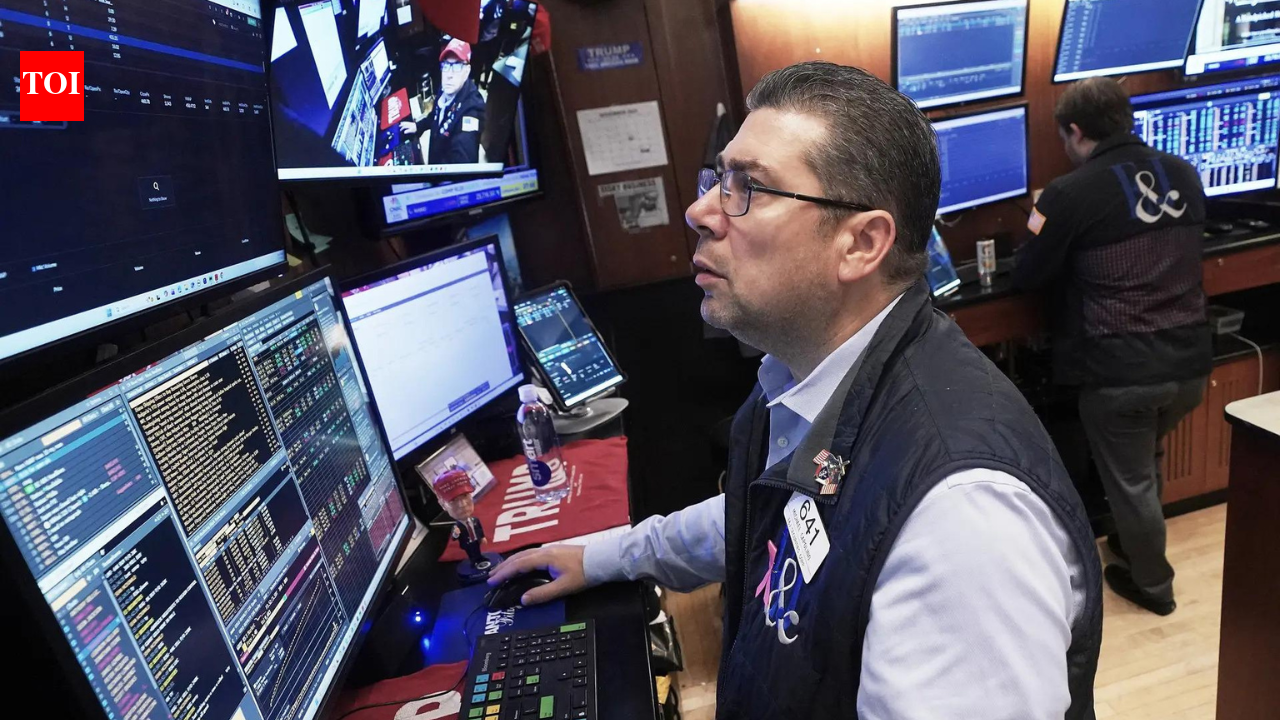
US stock markets jumped on Wednesday while oil prices declined as hopes resurfaced for a possible pause in the war with Iran, lifting investor sentiment across global financial markets.The S&P 500 rose 1.1% in early trading after the United States delivered a proposal to Iran aimed at halting the conflict. The Dow Jones Industrial Average was up 529 points, or 1.1%, at 9:35 a.m. Eastern time, while the Nasdaq Composite gained 1.3%, AP reported.Brent crude, the global oil benchmark, fell 5.4% to $94.78 per barrel amid expectations that easing hostilities could allow smoother flow of oil and natural gas from the Persian Gulf. Oil tanker movement has remained disrupted around the Strait of Hormuz, which had earlier pushed Brent prices close to $120 per barrel.Despite the rally, markets remained volatile as uncertainty persisted over the duration and trajectory of the conflict, which began more than three weeks ago with US and Israeli strikes on Iran. Financial markets have swung sharply in recent weeks, with sentiment shifting rapidly in response to geopolitical developments.Iran did not confirm receiving the US ceasefire proposal and publicly rejected the diplomatic effort, even as fresh attacks were launched on Israel and Gulf Arab countries. Military action also continued against Iran, while the US deployed additional paratroopers and Marines to the region.Optimism, however, was visible across global markets, with stock indices rising more than 1% in several regions, including London, Paris and Shanghai. Japan’s Nikkei 225 surged 2.9%.In the bond market, Treasury yields eased, potentially providing some relief for borrowing costs such as mortgages that had risen since the start of the conflict. The yield on the 10-year US Treasury slipped to 4.33% from 4.39% late Tuesday, though it remained above the 3.97% level seen before the war began.Gold prices also recovered, rising 3.5% to $4,558.10 per ounce. The metal had earlier touched nearly $5,400 this month before retreating as higher Treasury yields reduced its relative appeal.On Wall Street, companies with high fuel expenses rallied on the back of falling oil prices. Norwegian Cruise Line Holdings rose 4.2%, while United Airlines gained 4%.Robinhood Markets jumped 7.1% after its board approved a programme to return up to $1.5 billion to shareholders through stock buybacks.

[ad_2]

Source link

Allahabad HC grants anticipatory bail to Avimukteshwaranand in POCSO case | India News

[ad_1]

Allahabad HC grants anticipatory bail to Avimukteshwaranand in POCSO case

The Allahabad high court granted anticipatory bail to seer Swami Avimukteshwaranand Saraswati and his disciple Mukundanand Brahmachari in a case involving allegations of sexual exploitation of minors under the Protection of Children from Sexual Offences (POCSO) Act.The relief was granted on Wednesday by justice Jitendra Kumar Sinha, who also directed both the complainant and the accused to refrain from making any public statements about the case.The court allowed the anticipatory bail pleas while emphasising that the investigation must proceed without external influence. Alongside granting relief from arrest, the court imposed a gag order on both sides, restraining them from speaking to the media on the matter.The order comes weeks after the court had reserved its judgment following detailed hearings and had earlier extended interim protection from arrest to the accused.

Interim protection and court observations

On February 27, the High Court had stayed the arrest of Avimukteshwaranand, directing that he would not be taken into custody until the final order was pronounced. During the proceedings, the court had also instructed both the state government and the complainant to file their responses and asked the accused to cooperate fully with the investigation.

Allegations and FIR details

The case stems from an FIR registered at Jhunsi police station in Prayagraj, following directions from a POCSO court. The complaint alleges sexual exploitation of several ‘batuks’ (young disciples) associated with the ashram.The complainant, Ashutosh Pandey alias Ashutosh Brahmachari, has claimed that minors were subjected to abuse, expressing hope that “justice would be served after the evidence was submitted in court.”

Defence and prosecution arguments

The defence has strongly denied the allegations, calling them fabricated. It argued that the complainant has a criminal background and claimed that the alleged victims never resided at the seer’s ashram. The seer also questioned the authenticity of medical reports and accused the complainant of attempting to influence the case.In a notable submission, Avimukteshwaranand expressed willingness to undergo a narcoanalysis test to establish his innocence.The state, however, opposed the anticipatory bail plea on procedural grounds, arguing that the accused had approached the high court directly instead of first moving a sessions court.

[ad_2]

Source link

Delay in FSSAI finalising front of pack labelling rules unusual by its own norm

[ad_1]

Delay in FSSAI finalising front of pack labelling rules unusual by its own norm

While the Food Safety and Standards Authority of India (FSSAI) has claimed in the Supreme Court that the framing of front-of-pack labelling (FOPL) regulations would take longer and sought more time, a look at several regulations framed by the authority in the last ten years shows that the average time taken to frame one or make amendments to existing ones has been about two years. In the case of the FOPL, the process has been dragging on for about a decade.After framing guidelines in 2014 which included front-of-pack labelling specifying how much fat, sugar or salt a packaged food contained, when the FSSAI put it in the public domain in 2015, it had stated that the guidelines would be “converted into regulation in due course after following the process of inviting suggestions and comments, suggestions etc. from various stakeholders”. FSSAI put out the draft Food Safety and Standards (Labelling and Display) Regulations, 2018 in public domain in April 2018. However, since then there have been half a dozen stakeholder consultations and more drafts put out, but no regulation in sight yet.In response to a public interest petition in the Supreme Court seeking directions to FSSAI to make FOPL regarding high fat, sugar and salt mandatory for packaged foods, the court has been monitoring the process even as the authority has been seeking repeated extensions. In its latest affidavit in court, the FSSAI laid out a long process before the Supreme Court.It told the court that it is “contemplating” a tabular or pictorial representation to reflect high fat sugar or salt on front of pack labelling. It stated that it is a complex matter “requiring further consultation and examination” and hence stakeholder consultation is proposed before deciding on the modalities of FOPL. The latest stakeholder consultation had over 60 food industry and industry association representatives and just two public health experts representing civil society or public health interest.There remain several steps:1. After stakeholder consultations a draft amendment will be prepared2. Draft amendment will be placed before scientific panel (consist of nine eminent food scientists from different government organizations/institutions). Scientific committee comprising of chairpersons of the 21 scientific panels and six independent members, FSSAI and Health ministry “for due consideration”3. To include amendment in the regulation a draft regulation including the proposed amendment/s is placed before the scientific panel concerned4.Recommendations of the scientific panel will be placed before the scientific committee5. On endorsement of the scientific committee it will be placed before FSSAI for approval and if there are substantial changes in the notified draft regulation, another draft regulation will have to be notified6. Once approved by FSSAI, the draft or final regulation is sent to health ministry7. After ministry approval, if it is a draft regulation, it has to be notified in the gazette for public comments giving 60 days’ time and the entire process spelt out above is repeated before it is finally notified.8. In case what the health ministry approves is the final regulation, it has to be sent to the legislative department of the law ministry for vetting followed by approval of the health ministry. The approved final regulation is published in the Gazette of India for implementation.In short, the FSSAI stated in court that the regulation is far from becoming a reality any time soon. However, the longest time FSSAI has taken for framing any of the existing regulations or amendments has been over three years. The only other regulation that the FSSAI has not framed even after seven years is the Food Safety and Standards (Genetically Modified and Engineered Foods) Regulations which have been in the works since 2019.Average time to bring in various regulations/amendments to regulations

New regulations Draft notified in the gazette Put in public domain for feedback from stakeholders Date of gazette notification Gap between draft and final notification
Food Safety and Standards (Health Supplements, Nutraceuticals, Food for Special Dietary Use, Food for Special Medical Purpose, Functional Food and Novel Food) Regulations, 2016. Jul 30, 2015 Sep 11, 2015 Dec 23, 2016 17 months
Food Safety and Standards (Alcoholic Beverages) Regulations, 2018 Sep 5, 2016 Sep 9, 2016 Mar 19, 2018 18 months
Food Safety and Standards (Fortification of Foods) Regulations, 2018 Dec 23, 2016 Jan 3, 2017 Aug 2, 2018 19 months
Food Safety and Standards (Organic Foods) Regulations, 2017 Jun 19, 2017 Jun 22, 2017 Dec 29, 2017 6 months
Food Safety and Standards (Advertising and Claims) Regulations, 2018 Mar 13, 2018 Mar 23, 2018 Nov 19, 2018 8 months
Food Safety and Standards (Packaging) Regulations, 2018 Mar 19, 2018 Apr 2, 2018 Dec 24, 2018 9 months
Regulation amendments
Food Safety and Standards (Contaminants, toxins and Residues) First Amendment Regulations, 2024 Aug 20, 2020 Aug 26, 2020 Oct 17, 2024 26 months
Food Safety and Standards (Packaging) First Amendment Regulations, 2025. May 17, 2022 May 24, 2022 Mar 28, 2025 34 months
Food Safety and Standards (Food Products Standards and Food Additives) First Amendment Regulations, 2024. May 25, 2022 May 31, 2022 Oct 21, 2024 29 months
Food Safety and Standards (Food Products Standards and Food Additives) First Amendment Regulations, 2025 Oct 31, 2022 Nov 3, 2022 Jul 10, 2025 32 months
Food Safety and Standards (Prohibition and Restrictions on Sales) first Amendment Regulations, 2024 Apr 27, 2023 Apr 28, 2023 Oct 17, 2024 18 months

[ad_2]

Source link

Happy Ram Navami 2026: Top 50 wishes, messages and quotes to share with your family and friends

[ad_1]

Happy Ram Navami 2026: Top 50 wishes, messages and quotes to share with your family and friends

Ram Navami is among the most-awaited and auspicious Hindu festivals celebrated across India. The day celebrates the birth of Lord Ram, who is considered an incarnation of Lord Vishnu. The festival is observed every year on the ninth day (Navami) of Chaitra month in the Hindu calendar. It is a symbol of victory over evil and the importance of truth, virtue, and dharma. In 2026, Ram Navami will be celebrated on 26/27 March with great devotion across the country, with devotees fasting, visiting temples and chanting bhajans.Ram Navami is also a time to connect with loved ones by sharing heartfelt wishes, messages, and quotes that reflect the spirit of the festival. Whether you are sending greetings on WhatsApp, posting on social media, or writing a personal note, here are the top 50 Ram Navami wishes, messages, and quotes to help you spread joy, positivity, and blessings.

Ram Navami Wishes

Wishing you and your family a joyful and blessed Ram Navami 2026. May Lord Ram fill your life with happiness and prosperity.May this Ram Navami bring peace, harmony, and success into your life.Jai Shri Ram! May your heart be filled with devotion and your home with happiness.On this auspicious day, may Lord Ram bless you with strength and courage.Happy Ram Navami! May your life be guided by truth and righteousness.May the divine grace of Lord Ram always protect you and your loved ones.Wishing you a Ram Navami filled with love, light, and spiritual growth.May this festival inspire you to follow the path of dharma.Sending warm wishes on Ram Navami—may your life be as pure as Lord Ram’s ideals.May Lord Ram shower you with blessings and remove all obstacles from your life.

Ram Navami Messages

Let us celebrate the birth of Lord Ram by embracing truth, kindness, and compassion in our lives. Happy Ram Navami!On this sacred day, may your soul be uplifted and your mind be at peace.Ram Navami reminds us that good always triumphs over evil—may you always walk the path of goodness.Celebrate this divine day with devotion and positivity.May the teachings of Lord Ram guide you in every step of your journey.Let us welcome this day with faith and gratitude.Wishing you a life full of values and virtues inspired by Lord Ram.May your home be filled with happiness, your heart with devotion, and your life with success.Ram Navami is a reminder of the power of patience, humility, and righteousness.May this festival bring new hope and endless joy to your life.Short Ram Navami Greetings (Perfect for WhatsApp & SMS)Jai Shri Ram! Happy Ram Navami!Wishing you divine blessings on Ram Navami.May Lord Ram bless you always.Happy Ram Navami to you and your family!Celebrate the spirit of Ram Navami with joy and devotion.Jai Shri Ram! Stay blessed.May peace and happiness surround you this Ram Navami.Ram Navami ki hardik shubhkamnayein!May your life shine with Lord Ram’s blessings.Sending you love and blessings on this holy day.

Inspirational Ram Navami Quotes

“The life of Lord Ram teaches us that truth and righteousness always prevail.”“Follow the path of dharma, just as Lord Ram did.”“In every challenge, remember the courage of Lord Ram.”“Ram Navami is not just a celebration, but a reminder of ideal living.”“Let your actions reflect the values of Lord Ram—honesty, humility, and compassion.”“The story of Ram is a guide to a life of virtue and strength.”“May Lord Ram inspire you to conquer negativity with positivity.”“True devotion lies in living by the principles of Lord Ram.”“Let Ram Navami inspire a new beginning filled with goodness.”“Where there is faith, there is Lord Ram.”Ram Navami Wishes for Family & FriendsDear family, may Lord Ram bless our home with love, unity, and happiness. Happy Ram Navami!To my dear friend, may your life be filled with success and divine blessings this Ram Navami.Wishing my loved ones a festival full of devotion and joy.May our bond grow stronger with the blessings of Lord Ram.Sending warm Ram Navami wishes to you and your family.May Lord Ram protect your family and bring prosperity to your home.To those I cherish, may this day bring you peace and positivity.Celebrating Ram Navami with gratitude for having such wonderful people in my life.May your days be filled with happiness and your nights with peace. Jai Shri Ram!

Wishing you all a blessed and joyful Ram Navami 2026!

Ram Navami

canva

It is important to understand that Ram Navami is more than just a Hindu festival. It is a celebration of legacy and values that define a meaningful life. Lord Ram’s journey teaches us about duty, sacrifice, loyalty, and the power of righteousness. In today’s fast-paced world, these teachings remain deeply relevant, reminding us to stay grounded and compassionate.As you celebrate Ram Navami 2026, take a moment to reflect on these timeless ideals and share positivity with those around you. A simple message or heartfelt wish can brighten someone’s day and strengthen your bond with them.

[ad_2]

Source link

India’s future is in manufacturing, deep tech, and skills building: Himanshu Shah

[ad_1]

India’s future is in manufacturing, deep tech, and skills building: Himanshu Shah

When it comes to India’s economic future, few are as optimistic — and as candid — as Himanshu Shah. For the North Carolina investor, the country’s greatest opportunity lies not in rhetoric, but in execution. Speaking at a panel during the Indiaspora Forum 2026 on the outskirts of Bengaluru on Monday, the founder of Raleigh-based Shah Capital argued that India’s real promise can be seen in the industrial and skills infrastructure taking shape beneath the surface, even if the broader picture remains uneven. Pointing to massive manufacturing clusters and the government’s growing support for new industrial zones, Shah said the deeper story is one of capacity building. “India is full of ideas. It’s the execution of it… that is going to play a bigger role over here,” Shah said. “You also have just amazing improvement going underneath on the skills improvement. Because again, a lot of manufacturing has not been in India.” He linked that manufacturing gap to India’s continued colossal dependence on Chinese imports, even as its entrepreneurial energy and young workforce continue to grow. India, he said, still runs a significant trade deficit of over $100 billion with China despite China’s 5X higher per capita income, a sign of the skill and production advantages China has built over time. At the same time, Shah stressed that India is making progress. There “is an amazing improvement going on that front,” he said, adding that even if “it doesn’t look great on the surface, but underneath, I’m very excited.” The panel, moderated by Indiaspora founder M.R. Rangaswami, also featured Ravneet Mann, Partner at Stride Ventures, and Sridar Iyengar, Founder of 360plus. Speaking about capital allocation and public policy, Shah argued that India’s government should think much more aggressively about seeding future industries through targeted public-private partnerships. “First of all, let’s talk about the fund that was set up by the Indian government in 2016. It was a billion-dollar fund, and that resulted in over 200,000 start-ups in India. Recently, another billion-dollar plus fund was set up for AI and Deep Tech,” Shah said. “Frankly, Indian government should be setting up 10 to 20 of that. Marine technology, space, drones, machine tools, material science, the list goes on and on.” For Shah, such investments are not just about financial returns. They are also a way to create structured collaboration between the state, private capital, and the Indian diaspora.“And bringing that public and private partnership on that, the diaspora can truly contribute, including myself,” he said. He also highlighted what he described as an “industrial renaissance” at the state level, with some Indian states using land incentives and sector-specific support to attract manufacturing projects. Bihar, Uttar Pradesh, Odisha, and Gujarat, he said, are among the states beginning to experiment with such models. To illustrate the scale of the opportunity, Shah pointed to titanium dioxide, a material used in products such as paint and coatings. He gave an example of a potential large company to show how India could replace imports with domestic production if the economics and policy support aligned. Shah noted that “India’s demand for titanium dioxide is 400,000 metric tons. And … the country only produces 70,000-80,000 [tons]. And by the way, it imports the rest from China, if you look at the cost of making that today assuming you have a free land in some of these states that I’ve mentioned, the project becomes very economical and interesting.” That example, he suggested, offers only a small glimpse of what could be possible if India becomes truly more supportive of entrepreneurs and manufacturers. “So, this is just a slip of what is possible in India if the government starts really working for the entrepreneurs instead of being an obstacle,” he said. But Shah’s optimism came with a familiar caveat. He acknowledged that India’s bureaucracy remains a major drag on enterprise, and he did not soften that criticism. “It is still there,” he said. “It is very frustrating. You need ~27 forms to open a bank account in India still today in 2026. Doesn’t make any sense. So, there are a lot of things that this country needs to work on. But I see the signs of it.” In the closing part of the discussion, Shah widened the lens beyond investing and manufacturing to the broader role of the diaspora. Asked what he would want overseas Indians to do in engaging with India, he pointed to remittances, philanthropy, and early-stage investment, but returned most strongly to one theme: skills. He suggested that India should actively draw on the expertise of older, often retired engineers and professionals across the diaspora to help upgrade the country’s industrial base.“I think one area, and philanthropy, actually, on top of that, there’s job skills. And I really want to go back to that,” Shah said. “If there is a public and private partnership, maybe as a 2047 initiative, that you can actually bring those people and give, you know, whether it’s in engineering, in science, in manufacturing.” He added that many Indians who moved abroad built technical careers and now have precisely the experience India needs if it wants to manufacture more sophisticated products at home.“A lot of these people that moved out of India were engineers. And there are a lot of them in their 50s, 60s, and 70s are retired and looking for something to do,” he said. “Because this country needs that skill set to make good quality products.” For Shah, the future of India’s growth story will depend not only on government policy or investor appetite, but also on whether the country can connect capital, skills, and execution. Events that bring together diaspora leaders, investors, and policymakers, he suggested, can help make that happen. “And I think an event like this will play a big role in making something happen on that front,” he said, referring to the Indiaspora Forum 2026.(By arrangement with The American Bazaar, www.americanbazaaronline.com)
[ad_2]

Source link

Cabinet approves UDAN 2.0 at Rs 28,840 crore to expand regional air connectivity

[ad_1]

Cabinet approves UDAN 2.0 at Rs 28,840 crore to expand regional air connectivity

The Union Cabinet has approved a modified UDAN (Ude Desh ka Aam Nagrik) scheme worth Rs 28,840 crore aimed at strengthening regional air connectivity through new airport infrastructure, enhanced financial support for airlines and operational assistance for smaller aerodromes.Under the revamped programme, 100 new airports will be developed in challenge mode, with an estimated average cost of Rs 100 crore per airport. The government has provided budgetary support of Rs 12,159 crore for this component to improve connectivity in remote and underserved regions.The scheme also proposes the development of 200 modern helipads, particularly to improve access in Himalayan, North-Eastern and island regions, as well as aspirational districts. A budgetary allocation of Rs 3,661 crore has been earmarked for helipad construction.In addition, the modified UDAN framework includes support for the acquisition of Made-in-India aircraft, backed by budgetary assistance of Rs 400 crore, with the objective of strengthening domestic aviation manufacturing capabilities.To improve route sustainability, the government will provide Viability Gap Funding (VGF) support ranging from 80 per cent to 90 per cent for airlines operating under the regional connectivity scheme. This assistance will be tapered over a five-year period, with an overall budgetary outlay of Rs 10,043 crore.The Cabinet has also approved operation and maintenance (O&M) support for RCS aerodromes for three years, recognising the higher operating costs faced by aircraft operators and airport developers in low-traffic regions. The scheme provides for an annual ceiling of Rs 3 crore per airport and Rs 90 lakh per heliport, supported by a budgetary allocation of Rs 2,577 crore.Government said the updated UDAN scheme aims to deepen regional connectivity, improve accessibility in difficult terrains and support balanced economic development by integrating smaller towns and remote regions into the national aviation network.

[ad_2]

Source link

‘Talking bulls**t’ about Arjun Tendulkar’: Yuvraj Singh’s father blasts R Ashwin | Cricket News

[ad_1]

'Talking bulls**t' about Arjun Tendulkar': Yuvraj Singh's father blasts R Ashwin
R Ashwin and Arjun Tendulkar

NEW DELHI: A debate has broken out over Arjun Tendulkar’s chances in IPL 2026 after Ravichandran Ashwin said the youngster is unlikely to feature for Lucknow Super Giants (LSG). With a strong pace attack already in place, Ashwin felt Arjun would struggle to break into the playing XI.Speaking about the team combination, Ashwin said, “Arjun Tendulkar khelega hi nahi (Arjun Tendulkar won’t play at all), and let’s not even go there. I think it is very difficult because there are Mayank Yadav, Mohsin Khan, Avesh Khan, and Mohammad Shami in this lineup. There are so many fast bowlers. How will he play? I don’t think he makes any case unless and until there are a lot of injuries.”

Watch

Impact Player Rule: Game-changer or all-rounder killer?

His blunt take did not go down well with former India cricketer Yograj Singh, who strongly criticised Ashwin for his comments.Yograj Singh’s strong responseHitting back in an interview with InsideSport, Yograj, father of superstar cricketer Yuvraj Singh, said, “He is talking bulls**t, this guy, R Ashwin, whoever he is. He should know what to talk about somebody. Somebody’s sitting on the television and talking,’ Oh, he can’t do this, he can’t do that’. Who are you? What are you?”He also shared his own views on Arjun’s abilities, saying, “He is Sachin Tendulkar‘s son, that is a different story. When he was here, I told Yuvi, that all of you are concentrating wrong on Arjun Tendulkar. “He is not a bowler, he had a spine problem, and his hands come down from 45 degree. When he was here, I was talking to him. I told his coach as well when he was with the Goa team.”Backing his confidence, Yograj added, “If you can’t do it. Send him to me, I challenge the whole world that if Arjun Tendulkar spends six months with me, he will surpass all the batters in this world. If not, I will cut off my beard and throw it.”LSG Squad (* denotes Overseas players): Abdul Samad, Aiden Markram*, Akash Singh, Arjun Tendulkar, Arshin Kulkarni, Avesh Khan, Ayush Badoni, Digvesh Rathi, Himmat Singh, Manimaran Siddharth, Matthew Breetzke*, Mayank Yadav, Mohammed Shami, Mitchell Marsh*, Mohsin Khan, Nicholas Pooran*, Prince Yadav, Rishabh Pant, Shahbaz Ahmed, Josh Inglis*, Mukul Choudhary, Akshat Raghuwanshi, Anrich Nortje*, Wanindu Hasaranga*, Naman Tiwari.

[ad_2]

Source link

60 million barrels of Russian crude booked by Indian refiners amid global supply strain

[ad_1]

60 million barrels of Russian crude booked by Indian refiners amid global supply strain

Indian refiners have stepped up purchases of Russian crude as they lock in supplies for the coming month, with around 60 million barrels secured, according to people aware of the developments. The move comes as disruptions linked to the ongoing Middle East conflict continue to affect global oil flows.The cargoes have reportedly been contracted at premiums ranging between $5 and $15 per barrel over Brent, people told Bloomberg, speaking on condition of anonymity. The overall volume is similar to the purchases made for the current month, while majorly surpassing the levels seen in February, based on estimates from data intelligence firm Kpler.The latest buying activity comes after a waiver issued by the US, after which India has turned towards imports of Russian oil, already been loaded onto vessels before March 5. The measure was introduced to help address supply constraints arising from the effective closure of the Strait of Hormuz, and was later broadened to include additional countries, with updates permitting crude already at sea before March 12 to be purchased.India, which depends heavily on imports to meet its energy needs, had emerged as a major destination for discounted Russian crude following the Russia-Ukraine conflict in 2022. However, purchases were scaled back amid pressure from the United States, prompting refiners to source more oil from Saudi Arabia and Iraq. A large portion of those shipments subsequently remained within the Persian Gulf after the escalation of the current conflict.Officials in New Delhi are expecting the US waiver to continue as long as disruptions in the Hormuz route persist, according to the people cited. Refining companies such as Mangalore Refinery & Petrochemicals Ltd. and Hindustan Mittal Energy Ltd, which had stayed away from Russian supplies since December, have now resumed participation in the market.At the same time, Indian refiners are broadening their sourcing strategy to manage uncertainty in global supplies. Imports of Venezuelan crude for April delivery are projected at about 8 million barrels, the highest level since October 2020, according to Kpler. Venezuela is thus playing a larger role in India’s diversification efforts.Russia, meanwhile, is benefiting from the renewed demand and higher pricing environment, with the Kremlin seeing elevated earnings from crude exports, marking its strongest performance since March 2022, shortly after the conflict in Ukraine began.Earlier this month, Reliance Industries Ltd. reportedly purchased 5 million barrels of Iranian crude, following adjustments in sanctions policy that enabled such transactions. This comes after US administration gives a 30-day waiver for Iranian oil already in transit. The exemption covered cargo loaded on or before March 20, including shipments on sanctioned vessels, provided delivery and discharge were completed by April 19.

[ad_2]

Source link

Govt mandates switch to piped gas: Centre orders transition to PNG wherever available; here’s what it says

[ad_1]

Govt mandates switch to piped gas: Centre orders transition to PNG wherever available; here's what it says

Centre stepped up its bid to expand gas networks in the country and reduce dependence on a single fuel source, rolling out a new policy that will halt supplying LPG to households that do not shift to piped natural gas (PNG) in areas where such infrastructure is already available. The move comes at a time when global oil supplies have been disrupted by the ongoing Middle East crisis. As the crisis continues, authorities are promoting PNG as an alternative for both households and commercial users, highlighting its continuous supply through pipelines that removes the need for repeated cylinder refills. The directive has been issued through the Natural Gas and Petroleum Products Distribution (Through Laying, Building, Operation and Expansion of Pipelines and Other Facilities) Order, 2026, notified by the ministry of petroleum and natural gas.

Watch

Centre Urges LPG Users To Shift To PNG While Assuring Uninterrupted Fuel Supply Nationwide

Explaining the intent behind the reform, oil secretary Neeraj Mittal stated in a post on X that “a crisis (has been) turned into an opportunity”, referring to the reforms linked to ease of doing business. The order, issued under the Essential Commodities Act, also lays emphasis on speeding up approvals related to pipeline projects. It introduces time-bound clearances, standardised charges, and simplified procedures to ensure faster execution of infrastructure projects.

Here’s what the order said:

Switching from LPG to PNG: The order focused on accelerating pipeline infrastructure, streamlining approval processes, and encouraging a transition from LPG to PNG in the country to enhance energy security. The policy also aims to optimise the distribution of LPG by reallocating supplies from regions that already have pipeline access to those that do not, while supporting “fuel diversification” amid ongoing global disruptions, including damage to liquefaction facilities in the Gulf and restrictions around the Strait of Hormuz.LPG supply cease: Under the provisions of the order, households located in areas where PNG connectivity is available will be required to make the switch. The order specifies that households notified by authorised entities must apply for and obtain PNG connections where pipelines have been laid. It notes, “The LPG supply to such an address shall cease after three months from the date of the communication.”New rules for authorities: Public authorities are required to grant permissions or right of way within specified timelines, failing which approvals will be treated as automatically granted. Additionally, the order prohibits authorities from levying charges beyond those prescribed under the framework. In residential clusters, entities responsible for managing access must provide permissions within three working days, while last-mile PNG connections are expected to be completed within 48 hours. Applications for pipeline connectivity in such areas are not to be rejected. To resolve disputes related to land access and permissions, the order empowers designated officers with authority similar to that of a civil court to grant right of way where required. New rules for operators: Pipeline operators are also bound by timelines, with a requirement to begin laying pipelines within four months of receiving approval. Failure to comply may attract penalties, including the possibility of losing exclusivity rights. Oversight of the entire implementation has been assigned to the Petroleum and Natural Gas Regulatory Board (PNGRB), which will track approvals, rejections, and compliance across entities involved.Exceptions: At the same time, the order provides flexibility in cases where providing a piped connection is “technically infeasible”, in which case a no-objection certificate (NOC) can allow continued LPG supply. “The supply of LPG to a household shall not cease, if the authorised entity issues a no-objection certificate (NOC) on the ground that it is technically infeasible to provide a piped natural gas connection or gas supply to such household,” the order stated. Authorised entities are required to maintain detailed records explaining the reasons for such infeasibility and must withdraw the NOC once they are able to operationalise piped gas supply to those households.

[ad_2]

Source link

Iran War: Why US supercarrier had to leave Middle East amid Iran war: Many problems of USS Gerald Ford

[ad_1]

Why US supercarrier had to leave Middle East amid Iran war: Many problems of USS Gerald Ford

The USS Gerald R Ford, US Navy’s most expensive aircraft carrier, has come under renewed scrutiny after it was forced to leave its Middle East deployment following a fire onboard, even as longstanding concerns about its operational readiness remain unresolved.The carrier arrived at a port in Crete earlier this week after a fire broke out in its laundry area during deployment linked to operations involving Iran. The incident saw two sailors getting injured and led to more than 200 sailors being treated for smoke inhalation, according to US senator Tim Kaine, who raised the issue in a letter to Navy Secretary John Phelan, reported Bloomberg.

IRGC Warns Trump For Sending 82nd Airborne Division; ‘Remember Gerald Ford & Abraham Lincoln…’

The development has drawn attention to broader questions surrounding the $13.2 billion warship, which was delivered in May 2017 after delays and has since faced persistent technical and testing challenges.

Lack of operational data

A recent assessment by the Pentagon’s testing office noted that “insufficient data are available at this time” to determine the operational effectiveness of the Ford-class carriers, citing incomplete realistic combat testing even years after induction.

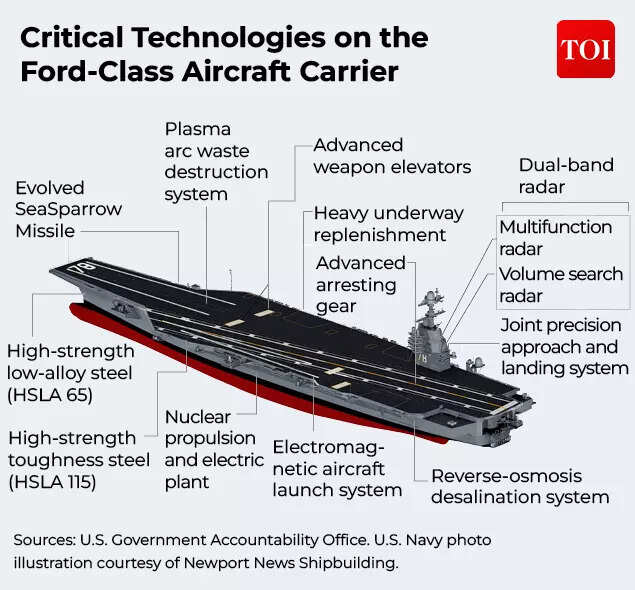
Critical Technologies on the Ford-Class Aircraft Carrier

The report cited by Bloomberg also flagged gaps in assessing “operational suitability,” including the reliability of key systems such as aircraft launch and recovery, radar performance, weapons elevators and the ship’s ability to sustain operations under enemy attack. The lack of sufficient test data means it remains unclear how effectively the carrier can detect, track or intercept threats such as enemy aircraft, anti-ship missiles or small attack craft, particularly under the strain of sustained combat operations involving continuous flight activity.Some previously identified issues also remain unresolved. While the Navy has developed fixes for certain combat system deficiencies highlighted in earlier classified assessments, the Pentagon testing office said “the fixes still remain largely unfunded.”

USS Gerald Ford carrier group

The old sewage issue

The supercarrier has also faced persistent sewage system failures even during active deployment. The carrier introduced a vacuum-based waste system adapted from cruise ships to reduce water usage. However, reports, including those cited by Gulf News, indicate that the system’s narrow pipes have struggled to cope with waste generated by a crew of over 4,600 sailors, leading to frequent clogs and repeated vacuum failures. NPR reported that emails it reviewed documented 205 sewage-related breakdowns within a four-day period, with engineering crews working extended shifts of up to 19 hours to manage leaks and overflows. During its 2025 deployment, the carrier averaged roughly one sewage-related maintenance call per day, according to Navy Times. Earlier reports, including from Forbes in 2022, noted that severe blockages required specialised acid flushing procedures costing around $400,000 each time, reflecting the recurring and costly nature of the issue.

Extended missions and amenity shortage

The report also pointed to logistical and personnel challenges, including a shortage of berthing space. It noted that an additional 159 bunks are required to adequately accommodate the ship’s crew and associated personnel, warning that such shortfalls “will affect quality of life onboard.” The issue could intensify with the addition of newer aircraft and drone systems. Despite these concerns, the Navy has maintained that the carrier continues to demonstrate operational capability. It said its assessments take into account both testing performance and real-world deployments, adding that operations so far have shown the ship’s ability to meet mission requirements while “continuing to improve.”The Ford has been deployed at sea for about nine months, exceeding the typical seven-month deployment cycle, after being involved in operations related to Venezuela before being sent to the Middle East under orders from US president Donald Trump. Senator Kaine said that the extended deployment has required sailors to “improvise with broken equipment and ship support systems,” and warned it could become the longest carrier deployment since the end of the Vietnam War.The Navy has said it will continue testing and make improvements based on ongoing assessments and operational experience, noting that evaluation of complex systems such as the Ford-class carriers continues well beyond initial deployment.(With inputs from agencies)

[ad_2]

Source link