Breaking News
‘Hate-filled agenda’: Cong slams arrest of Nagpur Christian priest; demands action against Bajrang Dal | India News


'Hate-filled agenda': Cong slams arrest of Nagpur Christian priest; demands action against Bajrang Dal

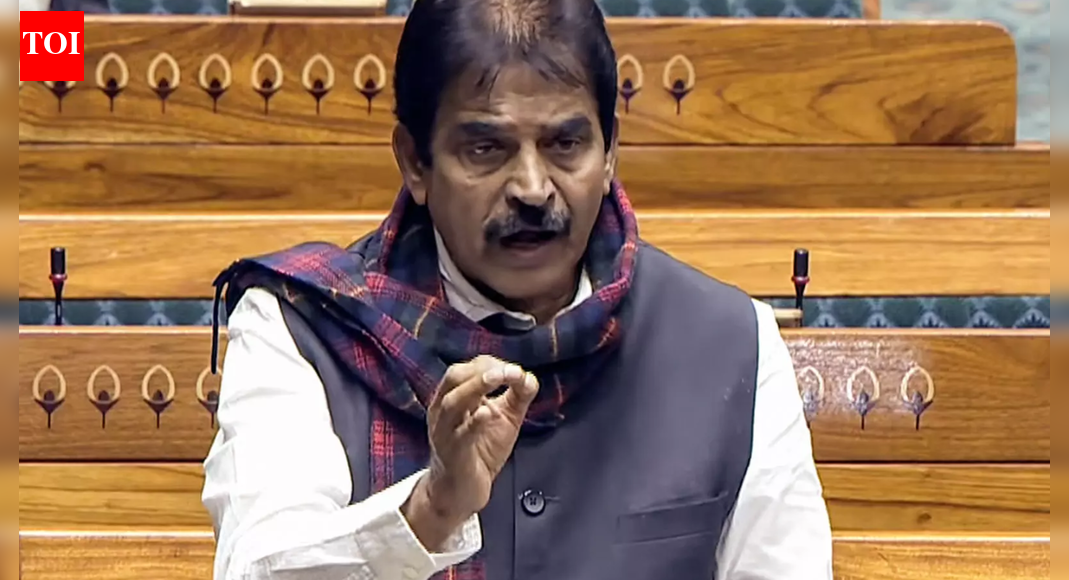
NEW DELHI: Congress on Wednesday strongly criticised the BJP following the arrest of a Christian priest and 11 others in Nagpur, Maharashtra, during a Christmas prayer meeting, accusing the party of pursuing a “hate-filled agenda of religious bigotry.The Maharashtra Police arrested 12 individuals, including Father Sudhir, a Malayali priest of the CSI South Kerala Diocese, Nagpur Mission, and his wife Jasmine, after a complaint allegedly filed by Bajrang Dal activists. The arrests reportedly took place around 8.00 pm during a Christmas prayer meeting in Nagpur. According to the leaders, people who later went to the police station to enquire about the incident were also taken into custody, and cases were registered against them.Congress MP KC Venugopal in an official post on X described the incident as “highly condemnable” and alleged that the arrest showed the BJP “uses the state machinery to harass Christians under the bogus pretense of religious conversions.”Venugopal said growing polarisation had made life “unlivable for all minorities” in BJP-ruled states. He demanded that the FIR against the priest be withdrawn immediately and called for strict action against what he described as “Bajrang Dal goons,” whose alleged “hooliganism” led to what he termed a “frivolous case.” He said, “Those who take law into their own hands and destroy the secular fabric envisioned in our Constitution must be the ones receiving punishment – not innocent citizens.”Kerala Assembly Leader of Opposition VD Satheesan also condemned the arrests and sought urgent intervention from the Centre and the Maharashtra government. In a post on X, he tagged PM Modi and Maharashtra chief minister Devendra Fadnavis, demanding the release of all those arrested.In his letter, Satheesan wrote, “I write this letter to register my strong protest and to seek your urgent intervention regarding the arrest of twelve persons, including a Malayali priest, in Nagpur on allegations of forced religious conversion.” He added that Father Sudhir is a native of Amaravila in Thiruvananthapuram district and has been serving in Maharashtra for the past five years, while the remaining 10 arrested individuals are natives of Maharashtra.Satheesan said all the arrested persons are currently being detained at the Benoda Police Station and are likely to be produced before a court shortly. He noted that CSI representatives attempted to secure bail at the police station but were directed to approach the court. Describing the incident as alarming, he said, “This incident is deeply disturbing and raises serious concerns about the violation of the fundamental rights guaranteed by the Constitution of India, particularly the freedom to profess, practice, and propagate religion. Arresting individuals for conducting a peaceful prayer meeting is unconstitutional and contrary to the spirit of our democratic and secular values.


Source link

Stock market outlook 2026: Why did Sensex, Nifty underperform in 2025 & where are indices headed next year? Top things to know


Stock market outlook 2026: Why did Sensex, Nifty underperform in 2025 & where are indices headed next year? Top things to know

If global markets were running a marathon this year, Indian equities were clearly trailing the pack. While South Korea saw Kospi skyrocketed nearly 76%, Japan’s Nikkei soared over 25%, and Hong Kong’s Hang Seng climbed more than 30%, China’s Shanghai Composite posted gains of over 16%. In the west, Wall Street also bagged doubled digit gains with tech heavy Nasdaq up 21%, S&P 500 rising 17.5%, and the Dow Jones advancing over 14%. Indian benchmark indices, Nifty50 and BSE Sensex, however, struggled to keep pace. Against these strong gains in global markets, India’s benchmarks posted more modest returns, with the Nifty 50 rising over 10% and the Sensex ending the year 8.55% higher. On December 31, the Sensex closed at 85,220.60, up 545.52 points, while the NSE’s Nifty 50 finished in the green at 26,129, gaining 190 points.Despite the Nifty 50 and Sensex recently touching record highs, broader market sentiment remained muted, with nearly half of the NSE’s top 500 stocks still trading below the benchmark. Though the indices ended 2025 in green, the relative underperformance has left investors struggling with two key questions as the calendar turns: Why did Dalal Street remain muted in 2025? And importantly, what’s the outlook for Nifty50 and Sensex in 2026?

So, what dragged Indian benchmarks down?

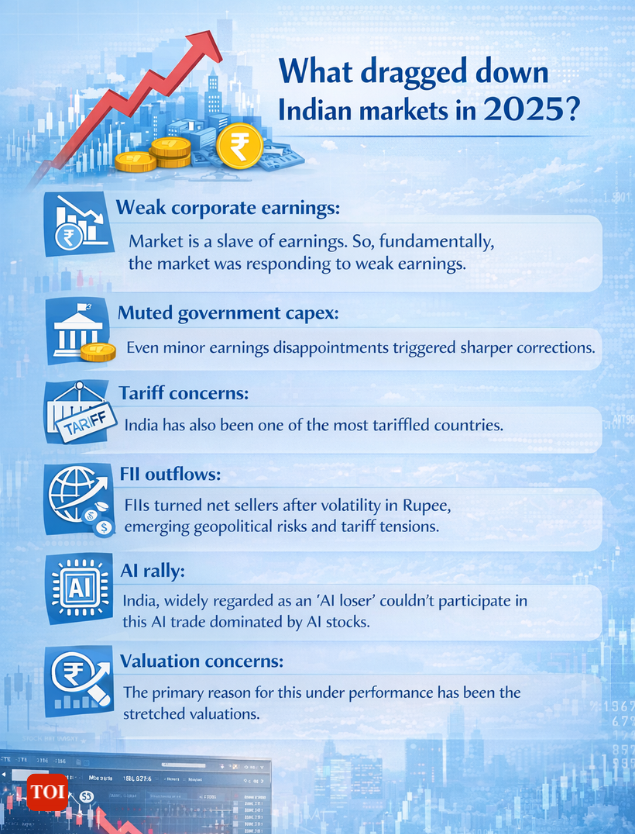
What dragged down Indian markets

According to experts that TOI spoke to, the stock market was dragged down by a combination of factors, both internal and external. Factors like US-India trade deal delay, not participating in the AI race, muted corporate earnings, and FII selling weighed the market down.Earnings slowdownMuted corporate earnings emerged as one of the major reasons behind the stock market’s underperformance. VK Vijayakumar, chief investment strategist at Geojit Investments, told TOI that “during the last six quarters, earnings growth has been in single digits. In the long run, the market is a slave of earnings.” So the drag down was, ultimately, the market’s response to weak earnings.Despite the benchmarks trading near lifetime highs, the overall market appeared weak, weighed down by the deceleration in earnings momentum since the June 2024 quarter, following a robust 18% CAGR during FY20–FY25, said Sunny Agrawal, head of fundamental research at SBI Securities. Sharp divergenceAccording to Ankit Soni, associate vice president – fundamental research at Mirae Asset Sharekhan, market returns over the last one-and-a-half years remained largely single-digit, with a stark gap across segments.“Large-cap indices delivered around single-digit returns, while mid and small caps underperformed by nearly 10%,” he said, highlighting the high variability in returns and sustained weakness in the broader market. Agrawal also noted that “despite benchmark indices trading close to lifetime highs, the broader market continued to trade on weaker footing.”FII sellingMarkets hit new highs towards the end of the year, but failed to hold those levels. Soni pointed out that “there is always a pullback of around 2–4% from the 52-week highs,” largely due to foreign institutional investor (FII) selling. Agrawal added that persistent selling by Foreign Portfolio Investors (FPI), promoters and PE firms, despite strong domestic liquidity enabling smooth exits, weighed heavily on sentiment.According to Nikhil Khandelwal, managing director at Systematix Group, uncertainty around global interest-rate trajectories, currency volatility and geopolitical tensions led to intermittent foreign portfolio outflows.Valuation concerns versus global peersSeveral experts flagged stretched valuations as a key deterrent for foreign investors. Sunny Agrawal said Indian markets looked relatively expensive compared to other emerging markets, prompting capital outflows. Siddarth Bhamre, head of institutional research at Asit C Mehta Investment Intermediates Limited said that while Indian markets delivered higher single-digit returns, the valuation premium made the underperformance stark when compared with global equities and other asset classes.Missing the AI rallyOne of the defining features of global markets in 2025 was the AI-led rally, which India largely missed. Vijayakumar described India as an “AI loser” in a year when “AI winners like the US, China, Taiwan and South Korea gained substantially.” The lack of a pure-play AI story reduced India’s attractiveness for global fund managers, Agrawal pointed out.Currency volatilityRupee instability emerged as another headwind, as the currency is hovering around 90 per US dollar levels. Vijayakumar explained that FII selling weakened the rupee, which in turn triggered further FPI outflows, creating a negative feedback loop. This year the currency has fallen over 5%, depreciating past the 91 per US dollar mark, before recovering to 89. Tariff tensions and geopolitical risksFears linked to geopolitical tensions combined with US President Donald Trump’s imposition of trade tariffs worsened the sentiment and disrupted global business dynamics.India’s export competitiveness also came under strain. Khandelwal pointed out that India became “one of the most tariffed countries by the US under the new tariff regime,” impacting export-oriented industries. Ankit Soni further cited the non-closure of key trade deals as one of the factors preventing markets from sustaining rallies.The United States imposed a total of 50% tariffs on India – with a 25% tariff on Indian imports for purchases of Russian oil. Muted domestic capex and policy-related concernsDomestically, muted government capital expenditure added to the pressure, particularly in sectors dependent on public spending, according to Nikhil Khandelwal. Policy changes such as an increase in capital gains tax also dented investor sentiment during the year, Agrawal flagged.“Valuations have turned comfortable for Nifty50, which is trading at a 1-year forward P/E multiple of 19-20x vs 22x-23x during the last peak in Sept’24. During the last 14 months, there has been notable compression in the valuation premium of Nifty50 over MSCI EM index from 80% in September 2024 to 47% in December 2025, which is below the 10 year average of 57%. Barring few pockets, valuations have turned comfortable across mid and small caps,” Agrawal told TOI.Now that we know why Dalal Street’s performance was muted in 2025, it is time to dive into how the stock market is likely to perform in 2026. The answer depends on many factors including FII performance, earnings, balance sheets and much more!

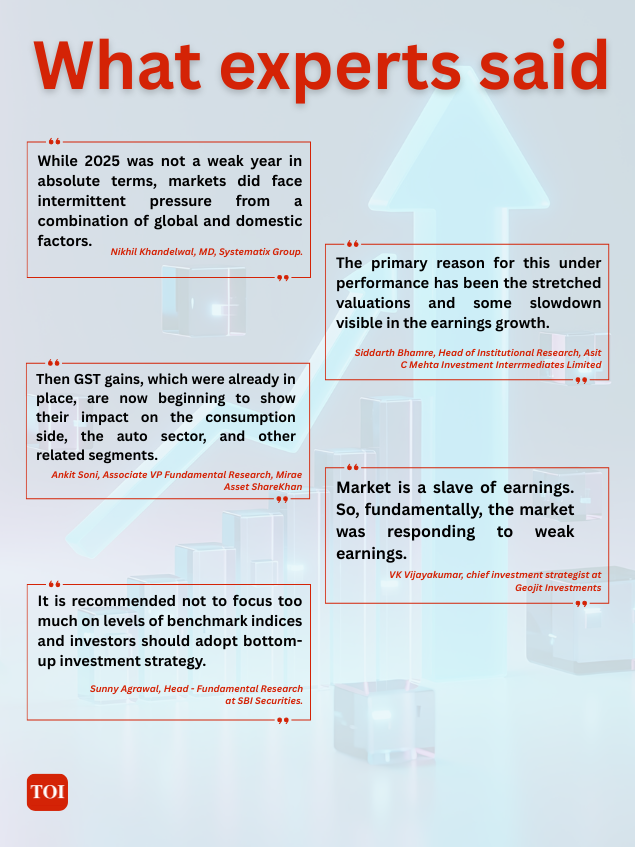
What experts said

What about next year — Will Dalal Street stand stronger in 2026?

A short answer to if the Indian stock market is expected to perform better than their global peers in 2026 would be, Yes. Here’s why:Just a consolidation phaseSoni told TOI that the stock markets gave a strong rally from 2022 to 2025 and hence this subdued momentum was just a pause.“A good set of rallies we have seen, so there is always a gap of one year or two with respect to your continuation of the rally, and this we feel is good for the market to consolidate for some time and then give us a good set of rallies,” he added.”India has structural growth driversAs compared to other markets, India remains “relatively well placed” supported by key growth drivers such as strong domestic demand and improving balance sheets. “While global markets will continue to influence sentiment, India’s long-term fundamentals remain supportive,” Nikhil told TOI.Reversal of fundsAgrawal also placed India among emerging markets like Brazil and China, supported by reversal of funds from “safe haven US Bonds towards riskier assets like EMs and commodities.”Meanwhile, Vijayakumar said that while India is expected to perform better than it did in 2025, it would be tough to say if it will be able to outperform its global peers.

Will FIIs come back?

In 2025, FIIs turned net sellers, withdrawing Rs 1,04,050 crore from India throughout the year. Funds from FIIs are expected to return in 2026, reversing their current position as net sellers. These inflows will however, depend on many factors. According to Bhamre, declining Rupee against US dollar has fueled the possibility that FIIs will be returning in the upcoming year, as “not an expensive market and depreciated currency is an ideal setup for foreigners.”The expert further added that besides the case of heavy buying, “they won’t be bigger sellers in 2026 of Indian equities.” Soni believes that a strong monsoon and a favourable kharif season, along with other positive factors, could encourage FIIs to return to the country.“FIIs won’t be able to neglect the Indian market for long,“ he said, adding that they will be back given RBI initiatives with respect to the open market operations, a better Kharif season and a good earnings report. He further added that FII inflows are expected after the H2 earnings report. “We could get stabilized FII inflows maybe in financial year 2027”Meanwhile, Nikhil told TOI that FII flows are expected to remain volatile and largely data-driven, shaped by global interest rate movements and currency trends. However, he said consistent domestic inflows through SIPs, along with long-term investments from global private equity and strategic investors, should act as a strong cushion, lowering India’s dependence on FPI flows compared with previous cycles.

Stock market in 2026 — What will support Dalal Street?

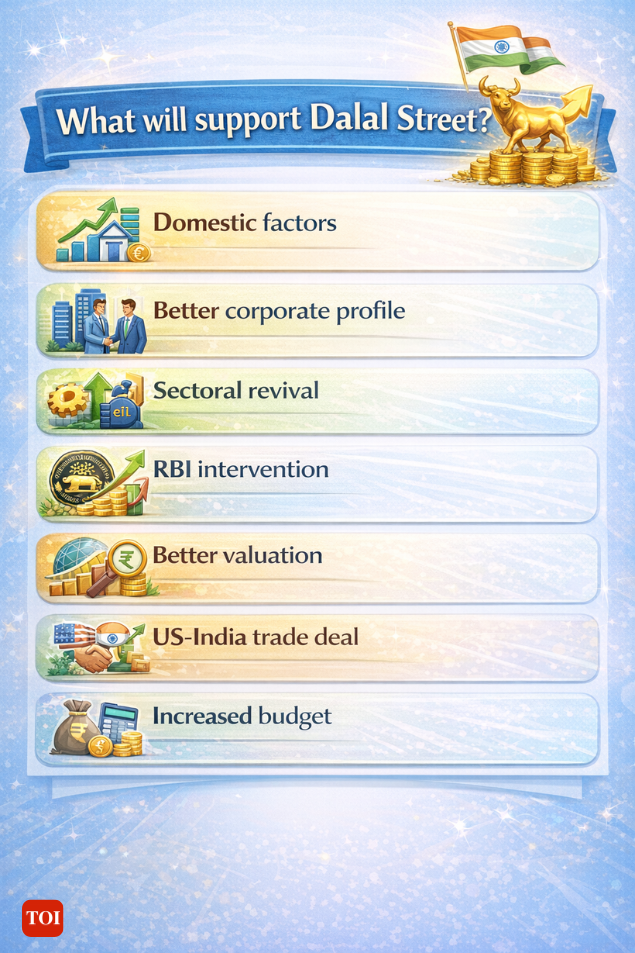
What will support Dalal Street?

Domestic factors2025 was a year of policy changes with GST reforms, income tax changes, interest rate reduction by 125 bps and more. The effect, however, will be visible in the upcoming year, 2026, Bhamre said. On the internal side, “consumption trends and credit growth will be closely watched,” Khandelwal said, adding “While global developments will continue to shape short-term sentiment, domestic fundamentals are likely to play a larger role in determining market direction.”Better corporate profileOne of the major internal factors to push stock markets higher is the growth in corporate earnings. “Indian corporates in the long term are likely to deliver earnings growth in line with the nominal GDP growth of 10-11% and the same should get reflected in the performance of benchmark indices,” Agrawal said. Simultaneously, “sustained improvement in profitability, margins, and cash flows will drive confidence,” Nikhil told TOI.Vijaykumar added that the rally might be further helped by weakening artificial intelligence trade.Sectoral revivalAutos, especially commercial and passenger vehicles, along with IT are emerging as critical growth engines. After underperforming for nearly two to three years, the auto sector is now gaining traction and is expected to contribute meaningfully to earnings in 2026, Soni adds. The agriculture sector is also expected to remain upbeat, thanks to a good kharif season and an overall favourable weather.According to Khandelwal, “returns are likely to be in the 10 -12% range, with outperformance coming from more sector specific, asset class specific and company specific investments.”RBI interventionInitiatives by the Reserve Bank of India with respect to the open market operations, controlling inflation and other aspects.Better valuationComfortable valuation for NSE benchmark Nift50, is expected to lift investor sentiments in 2026. Nifty “is trading at 1-year forward P/E multiple of 19-20x vs 22x-23x during the last peak in September 2024, significant compression in valuation premium over MSCI EM index from 80% in Sep’24 to 47% in Dec’25, which is below 10 year average of 57%,” Agrawal noted.US-India trade dealFactors such as delays in concluding the India-US trade deal are also expected to play a major role in deciding the momentum of Dalal Street next year as markets are more favourable towards early closure of the deal.Increased budgetAnother major driver that could boost growth and create a platform for other factors to contribute is government capital expenditure. Announcements of significant capital spending, whether in the upcoming budget or through other channels, could set the momentum for Indian equities, Bhamre said.

Nifty and Sensex targets in 2026

So, where are Nifty and Sensex headed in the coming year and what are the targets. According to experts, Nifty is expected to touch anywhere between 28,500 to 29,800. Sensex, meanwhile, might reach 98,000 levels. Nifty50 began 2025 at 23637.65 while the BSE benchmark began at 77,500. In the bull case scenario, NSE benchmark Nifty is expected to reach 29,800 by the end of 2026 while BSE Sensex is expected at 98,000, Vijaykumar predicted.According to Soni, the NSE benchmark is expected to touch 28,000 in financial year 2027, “and then 28,500 would be a good range of approach going forward”, Soni told TOI. provided the FIIs come back. “Nifty 50 FY27E EPS is likely to be Rs 1280-1300. At upper PE band of 22-23x – Nifty can touch 28,500-30,000 levels and accordingly Sensex should also deliver inline returns,” Agrawal said, adding that from an investor’s perspective, focus will be on the broader market which has been underperforming since the past 12-14 months.“The indices are trading at approx 22-23x PE basis the FY26 estimated EPS of Nifty, which is at the lower end of the past 10 year Nifty multiple of 22-28x,” Systematix executive told TOI.Agrawal suggested traders to not “focus too much on levels of benchmark indices and investors should adopt bottom-up investment strategy.”

Which sectors & stocks to watch in 2026

Large caps remain the preferred safety play:Market experts see large caps as relatively better placed in 2026 due to reasonable valuations, stronger balance sheets and clearer earnings visibility. Vijayakumar told TOI that large caps are fairly valued and remain his preferred segment, while Nikhil noted that companies with balance-sheet strength offer comfort in a volatile environment. According to Bhamre, FIIs are more likely to return to large-cap stocks where valuations remain attractive.Mid caps need selectivity, not blanket exposure:Experts told TOI that mid caps still offer opportunities, but only through careful stock selection. Soni believes cherry-picking in mid caps can deliver returns, while Khandelwal points out that select mid-cap companies with scalable business models and disciplined capital allocation could outperform. However, the consensus remains that 2026 will reward bottom-up investing, not broad-based bets.Divergent views on small-cap valuations:Views on small caps remain mixed. Agrawal said that small-cap valuations have turned more comfortable and could outperform in 2026. In contrast, Vijayakumar and Bhamre remain cautious, flagging continued overvaluation in parts of the segment, especially amid heavy retail inflows through mutual funds, which could amplify downside risks if liquidity tightens.Retail-driven liquidity a key risk factor:The surge in retail money into mid- and small-cap stocks has led to valuation excesses, warns Bhamre, who says any reversal in liquidity could cause sharp corrections. This risk underpins the broader market view that stability will be concentrated in large caps, while volatility remains higher in smaller stocks.Portfolio strategyReflecting the cautious optimism for 2026, Bhamre suggested a large-cap dominated portfolio with “with some room for high growth not richly valued mid and small cap” proposing an allocation of around 70% large caps, 20% mid caps and 10% small caps.

Sectors likely to stand out in 2026

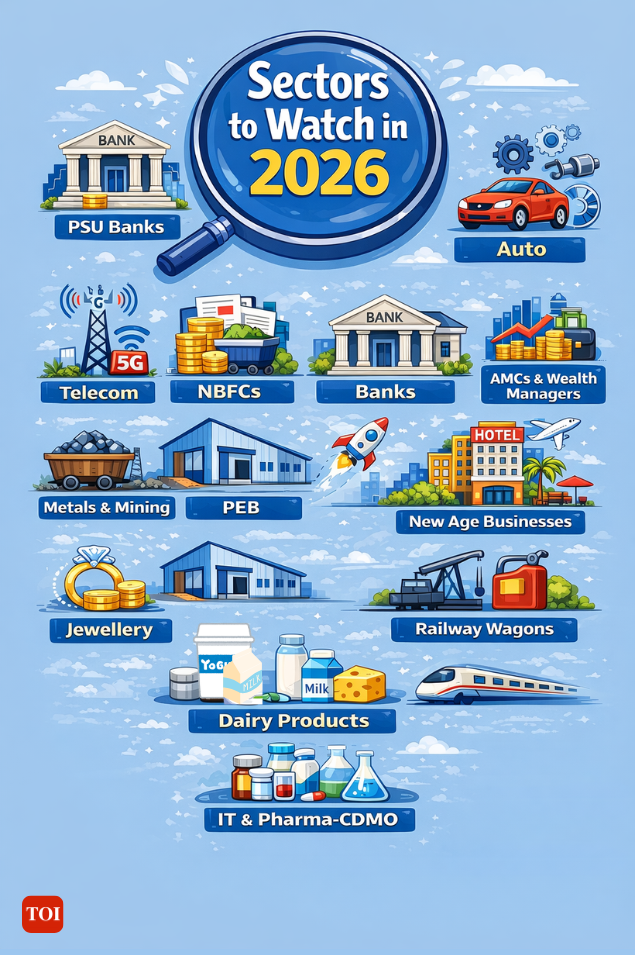
Sectors to watch in 2026

Metals: The metal sector is expected to deliver healthy returns, as valuations remain favourable when viewed over a longer horizon. While the sector is currently trading above its five-year average valuation, it is still well below the 10-year average. “So, we see a good set of values in the metal sectors out there,” Soni told TOI.PSU Banks: Public sector banks also continue to offer value, supported by relatively attractive valuations and improved balance sheets. “There is also good value in PSU Banks this year, as valuations remain at around 8–9x multiples…The last five years’ valuation is around 5%–10%, 11%–12%, which is currently at 8%–9%. So, we see a good value buying opportunity in PSU Banks.” IT: Soni said the IT sector is trading close to its long-term averages, creating a potential entry point for investors. “The IT sector itself is currently trading at a five-year average multiple of around 28, which is a five-year average multiple of 30X. So this could just provide you a good opportunity to invest into the IT sector; that sector is basically considered to be cheaper in relation to your stabilizing global macro environment,” he told TOI.Other industries like auto, auto ancillary, telecom, NBFCs, banks, AMCs, wealth managers, metals & mining, PEB, new age businesses, hotels, jewellery, liquor, dairy products, railway wagons, OMC, IT and Pharma-CDMO are also expected to outperform in 2026.

Risks for Dalal Street — factors that could hamper performance

Small caps at riskAn escalation in stress across the retail and MSME segments could lead to higher delinquencies, triggering market corrections, particularly in mid- and small-cap stocks, warned Bhamre, adding that a worst-case scenario would be rising NPAs in the NBFC space, which could dent consumption and create spillover risks across sectors.AI bubble shockA potential burst of the AI-driven tech bubble in the US is one of the biggest known risks for 2026, said Vijayakumar. While healthy corrections are desirable, a bubble burst could trigger sharp global market sell-offs. Vijayakumar also flags risks from a slowdown in India’s growth momentum and prolonged delays in a US–India trade deal.External macro risks could weigh on sentimentGlobal headwinds such as a sharper-than-expected slowdown in growth, renewed inflationary pressures and prolonged currency volatility could impact risk appetite, according to Khandelwal. Domestic factorsOn the domestic front, he cautioned that muted government capital expenditure and earnings disappointment in high-valuation pockets, such as the recent sell-off in EMS stocks, remain key concerns.Weak corporate profileMarkets are becoming increasingly unforgiving of weak execution, especially in over-owned themes where expectations are already stretched, Khandelwal noted. Companies that fail to deliver on earnings quality or governance could continue to underperform, reinforcing the need for disciplined stock selection.The absence of earnings upgrades could trigger meaningful market downside.Liquidity, crude oil and trade deficit risks loomA reduction in domestic liquidity support, a spike in crude oil prices due to geopolitical tensions, and a widening trade deficit could all act as pressure points for markets next year, said Agrawal.As the new year 2026 is knocking on the door, stakes are high for the stock market as investors look to bag bigger returns as compared to 2025. Traders need to watch out for internal and external components before making any investment decisions.(Disclaimer: Recommendations and views on the stock market, other asset classes or personal finance management tips given by experts are their own. These opinions do not represent the views of The Times of India)


Source link

Rishabh Pant fails ahead of NZ ODI series selection; Odisha hand Delhi first defeat in Vijay Hazare Trophy | Cricket News


Rishabh Pant fails ahead of NZ ODI series selection; Odisha hand Delhi first defeat in Vijay Hazare Trophy

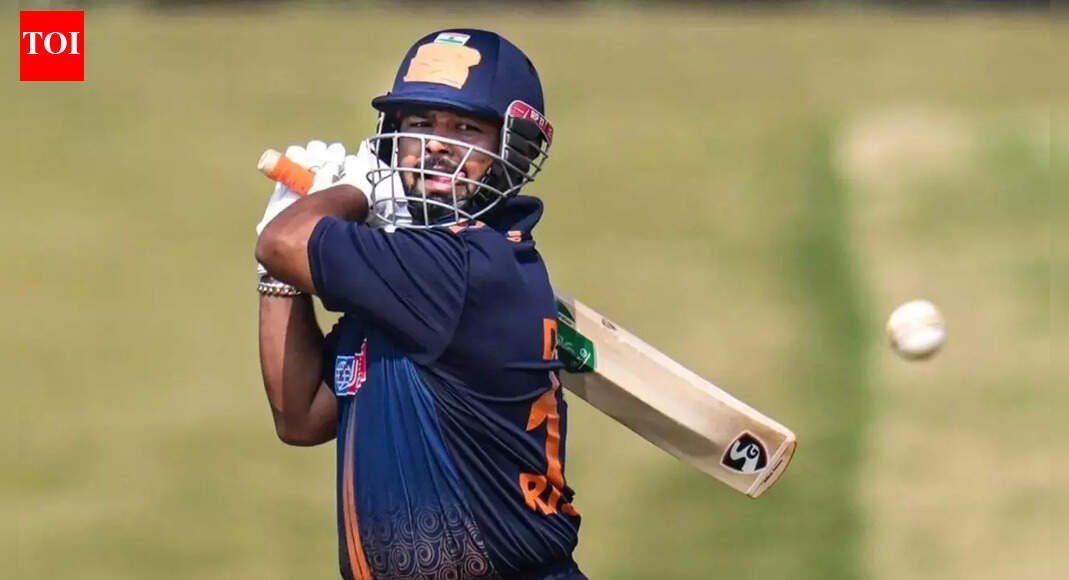
India wicketkeeper Rishabh Pant’s poor run with the bat, along with failures from Delhi’s senior batters, brought an end to the team’s unbeaten streak as Odisha registered a 79-run win in a fourth-round Group D match of the Vijay Hazare Trophy on Wednesday.With national selectors set to name the squad for the five-match ODI series against New Zealand in the first week of January, attention was firmly on Delhi captain Pant. However, the India batter managed only 24 as Delhi’s much-talked-about batting line-up collapsed, folding for 193 in 43.3 overs while chasing Odisha’s 272 for 8, a target that looked within reach.Delhi’s campaign this season has largely depended on one strong batting effort in each game. The absence of such a performance on Wednesday not only cost them the match but also their position at the top of the points table, a setback that could affect them later in the tournament.Odisha moved to the top of the table with 12 points and a strong net run rate. Delhi also have 12 points but slipped to fourth place, with Railways and Haryana moving above them on net run rate.This was the first time this season that Delhi failed to cross the 200-run mark. Earlier, the target had looked routine when Virat Kohli scored a century against Andhra in the opening match, and opener Priyansh Arya struck 78 against Saurashtra in the previous game.Pant, who had scores of 5, 70 and 22 earlier in the tournament, could add only 24 from 28 balls before being dismissed by pacer Debabrata Pradhan, who finished with figures of 3 for 28. Pradhan, along with young right-arm pacer Sambit Baral (3/34), played a key role in triggering Delhi’s collapse.Odisha’s total was anchored by captain Biplab Samantray, who scored 72 off 74 balls after the team lost three wickets before crossing 100. Contributions from the lower order added useful runs and tested the Delhi bowlers, including India players Navdeep Saini and Nitish Rana. Off-spinner Hrithik Shokeen was the pick of the Delhi bowlers with figures of 4 for 27 from his 10 overs.Delhi’s chase got off to a poor start as openers Priyansh Arya and Sarthak Ranjan were dismissed for single-digit scores, leaving the side at 6 for 2. Pant’s wicket reduced Delhi to 50 for 3 in the 11th over, and the situation soon worsened to 55 for 5.From there, a comeback was unlikely, though Harsh Tyagi (43) and Hrithik Shokeen (32) showed resistance and delayed the end with some determined batting.


Source link

‘Reunification of our motherland unstoppable’: Xi Jinping’s message as Taiwan drills end; region on edge


‘Reunification of our motherland unstoppable’: Xi Jinping’s message as Taiwan drills end; region on edge

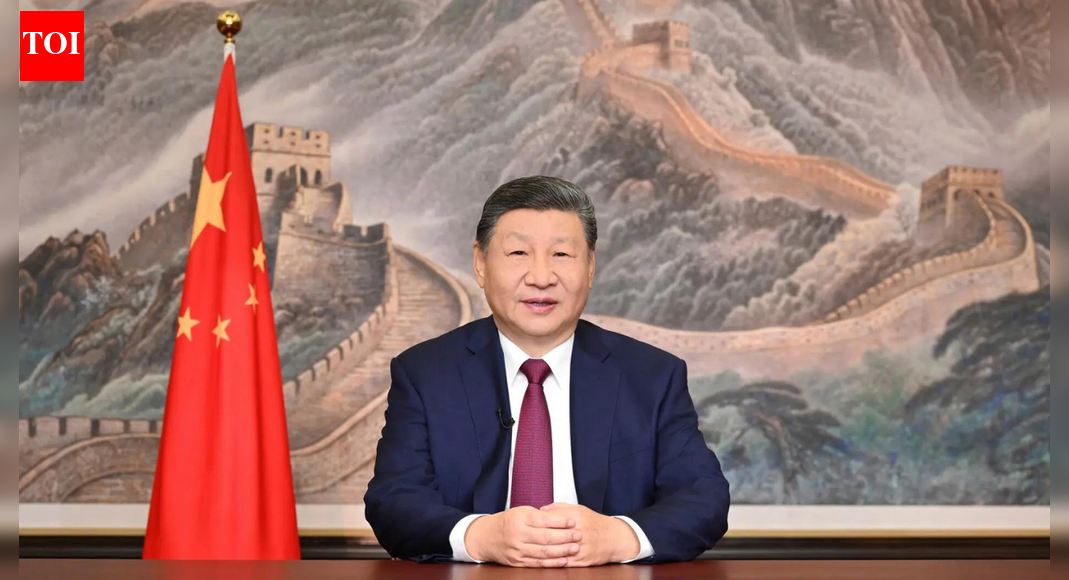
China’s President Xi Jinping said that the “reunification of our motherland, a trend of the times, is unstoppable” in his 2026 New Year message, delivered just hours after Beijing announced the conclusion of large-scale live-fire military drills around Taiwan. Xi’s remarks came as China’s military said it had “successfully completed” exercises designed to simulate a blockade of the self-ruled island and strikes on maritime targets. While Xi did not mention Taiwan directly in his address, his language echoed long-standing claims over the island, which Beijing considers part of its territory despite never having ruled it.

Xi STUNNED As Taiwan Declares ‘No Return To China’; Japan ‘SCHOOLS’ Beijing | Big War Looms?

Xi also used the speech to frame 2025 as a landmark year, marking the completion of China’s 14th Five-Year Plan and the 80th anniversary of the victory in the Chinese People’s War of Resistance Against Japanese Aggression and the World Anti-Fascist War. He said China’s economic strength, technological capabilities, defence capacity and overall national power had all reached “new heights”, adding that these developments were “rallying a mighty force for the great rejuvenation of our nation”.

Military pressure and Taiwan’s response

The drills, code-named “Justice Mission 2025”, involved missiles, fighter jets, bombers, navy ships and coastguard vessels operating around Taiwan over two days. China’s People’s Liberation Army said the exercises tested sea-air coordination, integrated blockade capabilities and joint strike operations, including live-fire training in waters north and south of the island.Taiwan condemned the manoeuvres as “highly provocative and reckless”. Its defence ministry said some Chinese live rounds landed closer to the island than in previous exercises, with several rockets falling within Taiwan’s 24-nautical-mile zone. President Lai Ching-te warned that the drills were “not an isolated incident” and posed “significant risks” to regional stability, global shipping and trade.Taipei said Chinese warships and coastguard vessels began withdrawing on Wednesday, though Taiwan’s coastguard maintained deployments at sea, citing the need to remain vigilant. Taiwanese authorities also reported major disruption to civil aviation, with hundreds of flights delayed or cancelled due to temporary danger zones declared during the drills.China accused Taiwan’s ruling Democratic Progressive Party of pursuing separatism and relying on foreign support, particularly arms sales from the United States. Beijing has vowed to seize the island by force if necessary and continues to send aircraft and naval vessels towards Taiwan on a near-daily basis.

International criticism and Beijing’s rebuttal

The exercises drew sharp criticism from several countries. Japan said the drills increased tensions across the Taiwan Strait, while Australia described them as “destabilising”. The Philippines said it was deeply concerned about actions that could undermine regional peace and stability.Beijing dismissed the criticism as “irresponsible”. Foreign ministry spokesman Lin Jian accused other countries of ignoring what he called separatist attempts in Taiwan while condemning China’s “necessary and just actions” to defend its sovereignty. He said such criticism distorted facts and was “utterly hypocritical”.


Source link

CEO Scott Tannen asks this question to catch unprepared candidates: 7 cues that quietly tell employers you walked in casually


CEO Scott Tannen asks this question to catch unprepared candidates: 7 cues that quietly tell employers you walked in casually

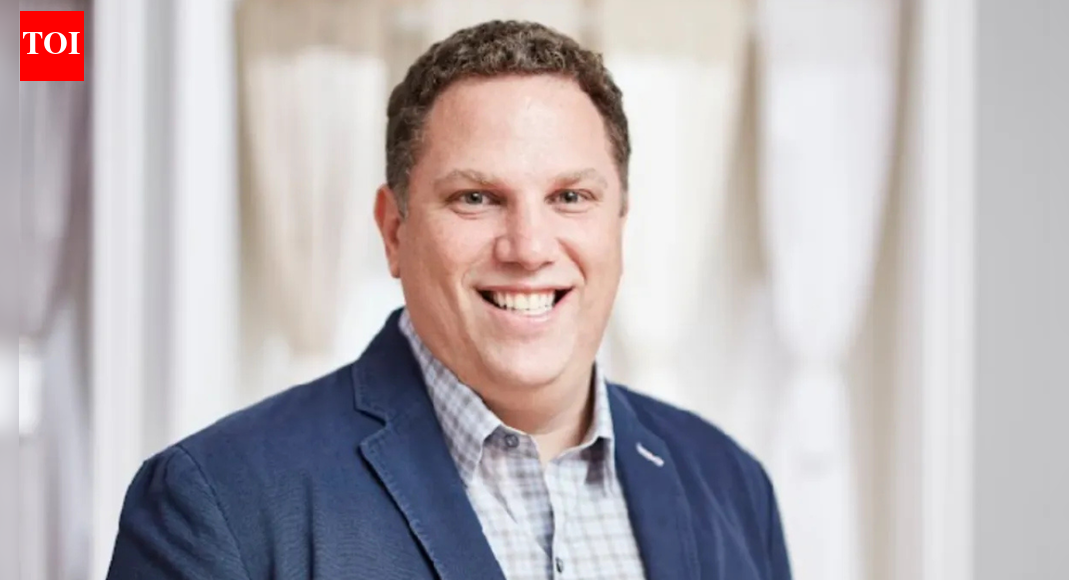
In a hiring market crowded with polished résumés and rehearsed answers, effort has become the real differentiator.That is the blunt message from Scott Tannen, founder and CEO of Boll & Branch, who has personally interviewed and hired hundreds across roles ranging from interns to C-suite executives. Speaking to CNBC, Tannen says he always begins interviews with the same, deceptively simple question: What do you know about Boll & Branch?It is not a warm-up. It is a filter. “I think when people have not done their homework, that is the biggest red flag,” Tannen has been quoted saying in the CNBC interview. “You don’t have to know every answer, but you have to have done your homework,” he added. Tannen does not expect encyclopaedic recall, but he does expect signs of effort — time spent reading, understanding the business, and thinking about how the company works. “If they can’t at least give me back what’s on our Wikipedia page, we probably are not starting off on the best foot,” he shared. What Tannen is really diagnosing here is not ignorance, but indifference. In an era when candidates have unlimited access to information, failing to learn even the basics about a prospective employer signals something deeper: A casual attitude towards opportunity. The question works because it collapses pretence. Confidence, charm and fluency cannot compensate for the absence of preparation. Within minutes, the employer knows whether a candidate has shown up curious, or merely hopeful.And this is where most interview advice quietly falls apart. Candidates obsess over answers — how to explain weaknesses, how to negotiate salary, how to sound passionate — but neglect the far more consequential mistake: Walking into a conversation without context. Employers are not testing memory; they are testing intent. Here are 7 ways you are inadvertently telling employers that you’re not serious.

You describe the company in vague, catch-all language

Saying a company is “into tech,” “does consulting,” or “makes products” is not neutrality, it is a tell. It signals that the candidate has skimmed, not studied. When you cannot articulate what a company actually builds, sells, or stands for—even in broad strokes—you are telling the interviewer that this organisation could have been swapped with ten others. Employers hear that as a lack of intent, not a lack of information.

Your enthusiasm is generic

“I’m excited to learn.” “I’m looking for growth.” “I want to challenge myself.”These lines are not wrong. They are just empty.Tannen’s emphasis on preparation exposes how quickly employers now discount generic enthusiasm. Passion that is not anchored to the specific business, product, or role sounds rehearsed, not sincere. It tells the interviewer you prepared for interviews, not for this interview.Curiosity only counts when it has a direction.

You cannot explain why this role exists

Many candidates can describe what they want to do. Fewer can explain why the role they are applying for exists inside the company.When asked about responsibilities, candidates often repeat the job description or talk about skills they hope to gain. What employers listen for instead is whether the candidate understands the problem the role is meant to solve. A failure to do so quietly signals surface-level preparation.Walking in without that understanding suggests you have not thought seriously about what you are signing up for.

You have no questions, or only safe ones

Lack of questions is not politeness. It is passivity.Equally revealing are questions that sound interchangeable: “What does success look like?” or “What is the culture like?” These are acceptable starting points, but when they are the only questions asked, they reveal a candidate who has not engaged deeply enough to go further.In the CNBC interview, Tannen adds that preparation is not limited to reading up about the company. It also means walking into the interview with questions of your own, along with confidence, enthusiasm for the role and a clear sense of what you hope to achieve by taking it.Tannen’s insistence on questions underscores a shift: Employers now read questions as evidence of preparation. No questions—or default ones—signal that the candidate is waiting to be impressed rather than choosing deliberately.

You talk only about what you want, not what you can offer

Candidates often frame interviews as extraction exercises: What they will learn, how they will grow, where this role might take them. When candidates speak only in terms of personal gain, they appear casual about contribution. Employers are not allergic to ambition. They are wary of asymmetry.Preparation shows up when a candidate has thought about reciprocity.

You rely on confidence to compensate for context

Confidence without context is increasingly easy to spot.Candidates who speak fluently but inaccurately, or confidently but vaguely, trigger the very red flag Tannen describes. In an age of polished communication, confidence alone is no longer proof of readiness. Employers are looking for grounded assurance and confidence that rests on understanding. Charm cannot compensate for not knowing where you are.

You treat the interview like a performance, not a conversation

Perhaps the clearest cue of casualness is when an interview feels scripted. Candidates move mechanically from one answer to the next, rarely responding to the room, the interviewer, or the company’s specifics.In his CNBC interview, Tanne shared the example of an intern who spoke about building her own brand. It stood out precisely because it was conversational, contextual and rooted in curiosity. She was not performing an interview; she was engaging with a business. That difference is immediately apparent to employers.


Source link

Turkey nationwide sweep: Istanbul arrests 125 IS suspects; coordinated raids across 25 provinces


Turkey nationwide sweep: Istanbul arrests 125 IS suspects; coordinated raids across 25 provinces
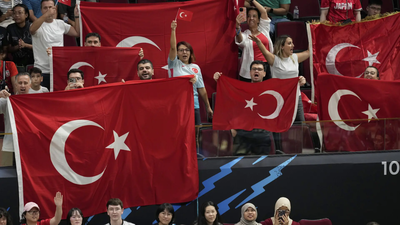
Turkey flag representative image

Turkey detained dozens of people suspected of links to the Islamic State (IS) group during nationwide raids on Wednesday, iInterior minister Ali Yerlikaya said.The raids were carried out in Istanbul and 24 other provinces, including Ankara and Yalova. Yerlikaya shared a video showing security forces raiding suspects’ homes, with some detainees seen with their hands cuffed behind their backs.“We captured 125 Daesh suspects in simultaneous operations carried out in 25 provinces this morning,” Yerlikaya wrote on X, using the Arabic acronym for IS.

Netanyahu ‘GOES RED’ As Trump Calls Erdogan ‘Good Friend’, Then Drops ‘RESPECT’ Bombshell | Watch

The latest operations follow a series of security actions against the extremist group. On Monday, three police officers were killed during an operation targeting IS in Yalova, in northwestern Turkey. The hours-long clash left six IS members dead, all of them Turkish nationals.The security forces arrested 357 people during another operation, a day later, aimed at IS suspects.Commenting on the crackdown, Yerlikaya said, “Those who seek to harm our brotherhood, our unity, our togetherness … will only face the might of our state and the unity of our nation,” as quoted by news agency AFP.


Source link

Nimesulide painkiller ban: Centre bars oral formulations over 100 mg, cites health risks | India News


Nimesulide painkiller ban: Centre bars oral formulations over 100 mg, cites health risks

NEW DELHI: The central government has banned the manufacture, sale, and distribution of all oral formulations of painkiller Nimesulide containing more than 100 mg in immediate-release form, saying such doses posed risk to human health.In a notification issued on Monday, the ministry of health and family welfare said it was “satisfied that the use of all oral formulations containing Nimesulide above 100 mg in immediate release dosage form are likely to involve risk to human beings”. The government also noted that safer alternatives to the said drug were available.The ban has been imposed with immediate effect under Section 26A of the Drugs and Cosmetics Act, 1940, after consultation with the Drugs Technical Advisory Board.On the same day, the ministry issued a separate notification proposing amendments to the Drugs Rules, 1945. The draft rules propose omitting the word “syrup” from a specific entry in Schedule K, which pertains to drugs exempt from certain regulatory provisions.The government said the draft amendments are being published for information of all persons likely to be affected and that objections or suggestions received within 30 days will be considered.In January, the Centre banned the manufacture, sale, and distribution of all formulations of Nimesulide, widely used as a painkiller for animals, after studies conducted by scientists at the Indian Veterinary Research Institute (IVRI) at Izatnagar, Bareilly, confirmed its toxicity to vultures.


Source link

New Year alert in Rajasthan: 150kg explosives, batteries and wires seized from car; 2 arrested | Jaipur News


New Year alert in Rajasthan: 150kg explosives, batteries and wires seized from car; 2 arrested
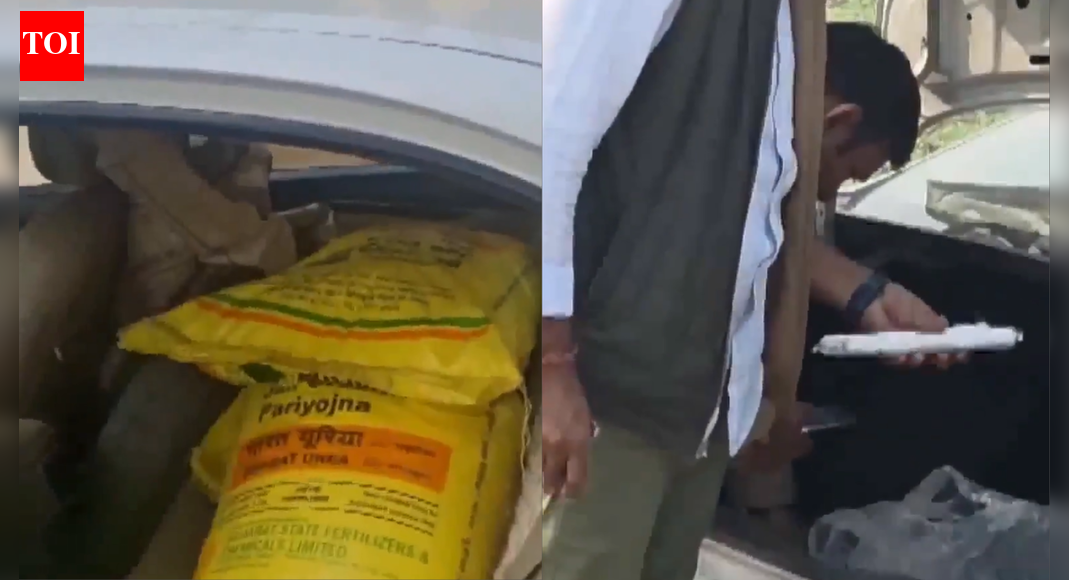
As per reports, the car was reportedly heading toward Bundi when it was intercepted.

TONK: Police on Wednesday seized around 150kg of ammonium nitrate from a car on the Tonk–Jaipur highway during a special vehicle-checking drive held on New Year’s Eve. Two men travelling in the vehicle were detained for questioning.The police also seized 200 explosive batteries and 1,100 metre electric wire.The seizure was made under Baroni police station limits. “Explosives were seized from a Maruti Ciaz car. 150kg of ammonium nitrate hidden in sacks of urea seized. In addition, police recovered 200 explosive batteries and 1,100 meters of wire. Two accused have been arrested. One is Surendra and the other is Surendra Mochi,” ANI quoted DSP Mrityunjay Mishra as saying. As per reports, the car was reportedly heading toward Bundi when it was intercepted.Multiple bags containing ammonium nitrate were found inside the vehicle news agency ANI reported.The detained men are being quizzed about the source of the chemical and its intended destination. The intelligence agencies have been alerted and the police are are tracing the supply chain to determine who procured the material and for what purpose.The recovery assumes significance in light of the recent suicide bombing in Delhi on November 10, which killed 15 people. The blast occurred a day after two major consignments of explosives — weighing 358kg and 2,563kg, respectively — were recovered from two separate houses in Faridabad during raids conducted between November 8 and 10. Indicating that the bombs had not yet been assembled, the explosives were found packed in suitcases and bags, with no metal pieces — typically used as shrapnel to maximize injuries — detected.(With agency inputs)


Source link

How to get access to Google’s Gemini Pro, OpenAI’s ChatGPT Go and Perplexity for free: All offers and more


How to get access to Google’s Gemini Pro, OpenAI’s ChatGPT Go and Perplexity for free: All offers and more
AI-generated image for representation purpose

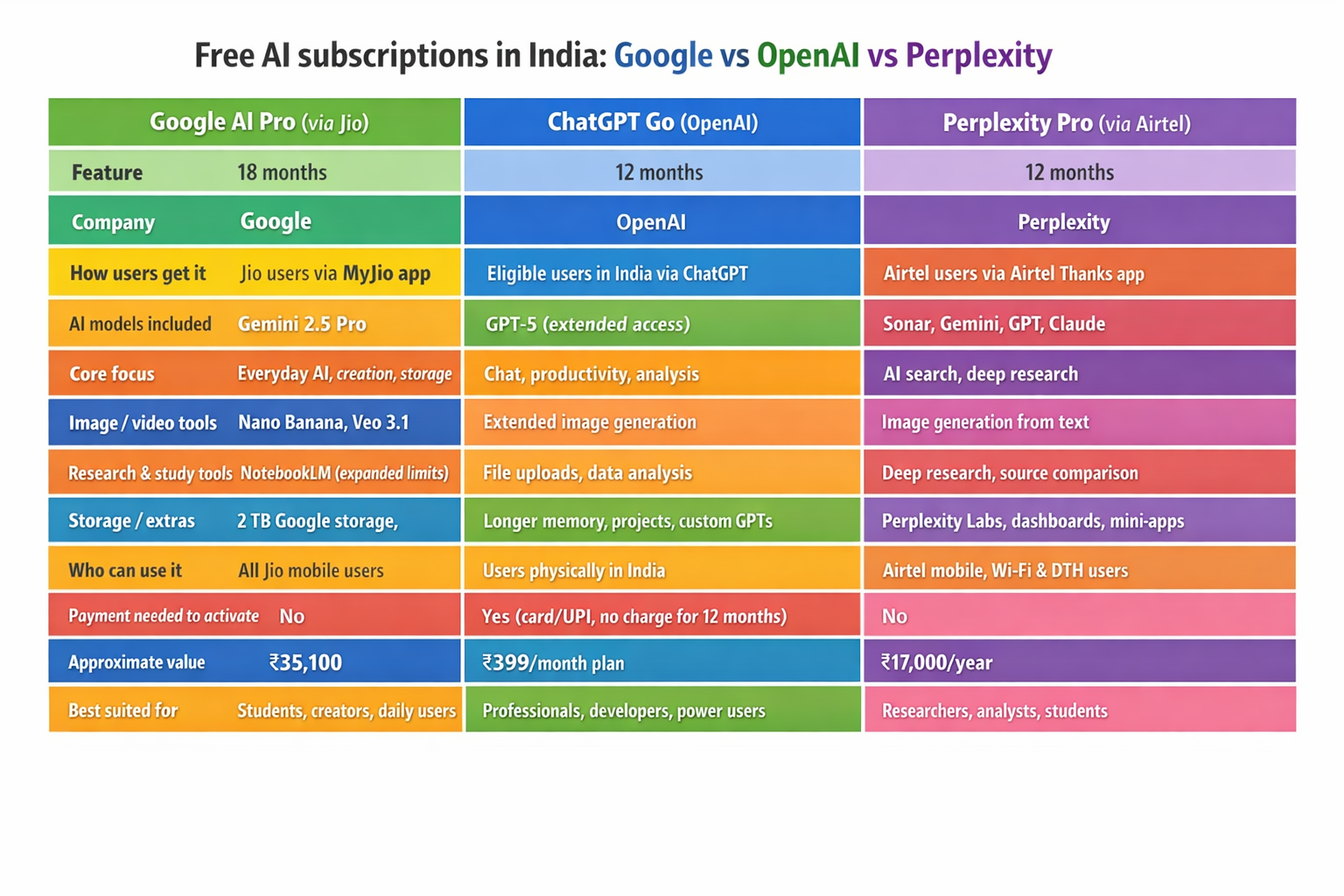
Artificial intelligence (AI) is no longer limited to tech labs. OpenAI launched ChaGPT in 2022. Since then AI chatbots have become mainstream with big tech companies not only developing their own AI tools but also fostering partnerships to make them accessible to more users. As access expands and costs come down, AI tools are moving beyond early adopters and becoming part of routine digital life. In 2025, we saw Google, Perplexity and OpenAI announce free access to their premium AI services in India. Google partnered with Jio to offer Gemini Pro at no extra cost for 18 months. Similarly, Perplexity partnered with Airtel to offer 12-month Perplexity Pro subscription free of cost to all its 360 million customers. OpenAI also made ChatGPT Go available at no cost for 12 months for eligible users in India. In this story, we look at what these offers include and who benefits the most.

Google partners with Reliance to bring Google AI worth Rs 35,100 for free

In October 2025, Google announced a strategic partnership with Reliance Intelligence to offer Google’s AI Pro plan, and with it the latest version of Google Gemini, to Jio Unlimited 5G plan users at no extra cost for 18 months. Announcing the partnership, the US-based tech giant said “We are excited to expand access to our most powerful AI models to more people across India, and can’t wait to see how our world-class tools deliver powerful benefits in people’s everyday lives.”“Through a new strategic partnership with Reliance Intelligence, we’re bringing together our most capable AI models and powerful tools, giving millions of their users access to the Google AI Pro plan at no extra cost for 18 months,” it added.

What is Google AI Pro

With a Google AI Pro membership, one gets expanded access to certain AI features built by Google. It includes 2 TB of expanded storage and additional benefits to optimize Google usage. Users also get access to AI credits with the Google AI Pro membership that can be used across Whisk and Flow. Google AI Pro members get 1,000 monthly AI credits.

Who are eligible for free Google AI Pro

Google’s free AI offer was initially available to Jio users between 18 to 25 years of age. It was eventually expanded to every Jio user nationwide. The offer can be activated via MyJio app.

Benefits under Jio-Google free AI offer

As announced by the company, eligible Jio customers gain access to Google’s most capable Gemini 2.5 Pro model in the Gemini app. Jio users also get higher limits to generate stunning images and videos with the company’s state-of-the-art Nano Banana and Veo 3.1 models, expanded access to NotebookLM for study and research, 2 TB of cloud storage across Google Photos, Gmail, Drive and for backing up WhatsApp (on Android) and more. In a press release, the company stated that the offer has a combined value of approximately Rs 35,100.“Today’s announcement will put Google’s cutting-edge AI tools in the hands of consumers, businesses, and India’s vibrant developer community,” Sundar Pichai, CEO of Google and Alphabet, said in an official statement then.“Through our collaboration with strategic and long-term partners like Google, we aim to make India not just AI-enabled but AI-empowered — where every citizen and enterprise can harness intelligent tools to create, innovate, and grow,” Reliance chairman Mukesh Ambani said.Notably, Google offered Indian students a free one-year subscription to its AI Pro plan earlier this year.

Free AI subscriptions in India: Google vs OpenAI vs Perplexity

Airtel partners with Perplexity to offer benefits worth Rs 17,000 for free

Airtel announced its partnership with Perplexity in July 2025. “Bharti Airtel has partnered with Perplexity, to offer 12-month Perplexity Pro subscription free of cost to all its 360mn customers,” the telecom operator said in a press release then. Under the partnership, Airtel users get free access to Perplexity Pro worth Rs 17,000. Commenting on the partnership, Gopal Vittal, Vice Chairman & Managing Director, Bharti Airtel said, “We’re thrilled to announce a game-changing partnership with Perplexity, bringing their cutting-edge AI capabilities exclusively for Airtel customers. This collaboration will bring the powerful and real-time knowledge tool for millions of users at their fingertips, at no extra cost. This first of its kind Gen-AI partnership in India is focused on helping our customers navigate the emerging trends in the digital world with confidence and ease.Aravind Srinivas – Cofounder, CEO – Perplexity said “This partnership is an exciting way to make accurate, trustworthy, and professional-grade AI accessible to more people in India—whether a student, working professional, or managing a household. With Perplexity Pro, users get a smarter, easier way to find information, learn, and get more done.”

What is Perplexity Pro

Perplexity Pro is the advanced version of the Perplexity tool. It is claimed to be a smarter, faster way to search, research, and boost your productivity. Key capabilities include:

  • Leverages leading AI models such as GPT, Claude, and Gemini for richer responses.
  • Answers queries in natural, conversational language using verified sources.
  • Allows up to 300 advanced searches per day, making it ideal for in-depth research.
  • Enables document and file uploads with expert-level analysis and summarisation.
  • Transforms text prompts into images within seconds.

Exclusive features of Perplexity Pro are:

  • Enhanced AI search: Up to 300 in-depth AI searches per day.
  • Multiple AI models: Choose from Sonar (in-house model), Google Gemini, GPT, Anthropic Claude, and more.
  • File assistance: Upload and analyse PDF, DOCX, CSV, and other file types quickly.
  • Image generation: Create images directly from text prompts.
  • Perplexity Labs: Build mini-apps, automate data analysis, and generate dashboards.
  • Deep research: Summarise large documents, compare sources, and extract key insights.

Ideal use cases of Perplexity Pro

For students: Working on a 100-page dissertation has never been easier. Students can upload their PDFs, summarise key points, compare credible sources, and even turn raw data into charts—all in minutes, not weeks.For Professionals: No more sifting through endless reports. With Perplexity Pro, professionals can boost productivity by pulling competitive insights, summarising industry papers, and turning spreadsheets into interactive dashboards in seconds.“Perplexity has a free offering, which offers powerful search functions, while the Pro version provides enhanced capabilities for professionals and heavy users. Perplexity Pro includes more daily Pro searches per user, access to advanced AI models (e.g., GPT 4.1, Claude) and the ability to select specific models, deep research, image generation, file uploads and analysis, as well as Perplexity Labs, a unique tool that brings ideas to life. Perplexity Pro is priced globally at *INR 17000 for a year,” Airtel said in a press statement.

How to avail Perplexity Pro at no cost with Airtel

Those interested can follow the steps below:

  • Step 1: Open the Airtel Thanks app on your device.
  • Step 2: Tap the “Rewards and OTTs” section from the home menu.
  • Step 3: Locate the “Perplexity Pro” offer banner and select it.
  • Step 4: Click “Claim Now” and proceed with sign-in (Gmail/Apple ID recommended).
  • Step 5: Enjoy instant access to the Perplexity Pro tool and its complete feature set.

Who can access the offer

As announced by the telecom company, eligible users include:

  • All Airtel prepaid and postpaid mobile customers.
  • All Airtel Wi-Fi
  • All Airtel DTH subscribers.

OpenAI offers ChatGPT Go for free in India

Starting November 4, 2025, Sam Altman-led OpenAI is giving ChatGPT GO subscription for free to all users in India. The move is aimed to counter rival Google and Perplexity which as mentioned above has partnered with leading telecom operators Jio and Airtel to offer access to their respective AI models for free.

What is ChatGPT Go

ChatGPT Go is a low-cost subscription plan that provides expanded access to ChatGPT’s most popular features at an affordable price. The price costs Rs 399 per month in India. As listed on OpenAI help page, ChatGPT Go offers everything included in the Free plan, along with:

  • Extended access to GPT-5: Enjoy more usage of our flagship model.
  • Extended access to image generation: Create more images for work or play.
  • Extended access to file uploads: Analyze and work with more documents, spreadsheets, and other files.
  • Extended access to advanced data analysis: Use tools like Python for data exploration and problem-solving more often.
  • Longer memory for more personalized responses: Keep conversations flowing with a larger context window.
  • Access to projects, tasks, and custom GPTs: Organize your work, track progress, and create / edit custom GPTs to build AI tools tailored to your needs.

Who are eligible

As stated by OpenAI on its help page, eligibility and terms to get free access to ChatGPT Go for 12 months are as follows:

  • One must be physically located in India to be eligible for the promotion, and must be new to ChatGPT, a current free user, or an existing ChatGPT Go subscriber with your account in good standing.
  • If one intends to subscribe on Android through the Google Play store, he/she must both be physically located in India and have your Play store account location set to India.
  • A user must provide a method of payment (Credit Card or UPI) to enroll into the promotion. He/she will not be charged a subscription fee till the 12-month period ends (see special note on UPI payments, below). Also, there is no need to enter a promo code to redeem the promotion. At the end of the 12-month period, OpenAI will automatically charge the payment method the current monthly ChatGPT Go fee unless one cancels in advance.
  • Additionally, one can redeem the promotion one time per account during the promotion redemption period. If a user cancels their subscription after redemption, it will no longer be available for him/her to redeem.

Note on UPI payments: OpenAI clarifies that if one uses UPI for redeeming the promotion, he/she may temporarily see a charge of INR (₹) 1 on their account every billing basis. The charge is required for purposes of using UPI as a payment method, and will be refunded.

How to get ChatGPT Go for free

OpenAI has listed steps to access ChatGPT Go for free. These includeStep 1: Sign up for ChatGPT, if you’re new, or login to your account if you already have one.Step 2: Click on Try ChatGPT Go or go to Settings → Account → Try ChatGPT GoStep 3: During checkout, add a payment method – you will not be charged (see special note on UPI).Step 4: Upon completion of checkout, your promotional subscription will be active, and renew automatically on a monthly basis for 12 months.Step 5: You can review terms from Settings → Account anytime.If you have already subscribed to ChatGPT Go from ChatGPT Web, or Google Play store, OpenAI will automatically move your next billing date back by 12 months. No action is required on your part. However, if you have subscribed to ChatGPT Go from the Apple app store, you must cancel your current subscription, wait for the end of your final billing period and then redeem from the Apple app store.


Source link

‘Weakened our negotiating position’: Congress demands clarity on China’s role in Operation Sindoor; calls relationship ‘lopsided’ | India News


'Weakened our negotiating position': Congress demands clarity on China's role in Operation Sindoor; calls relationship 'lopsided'
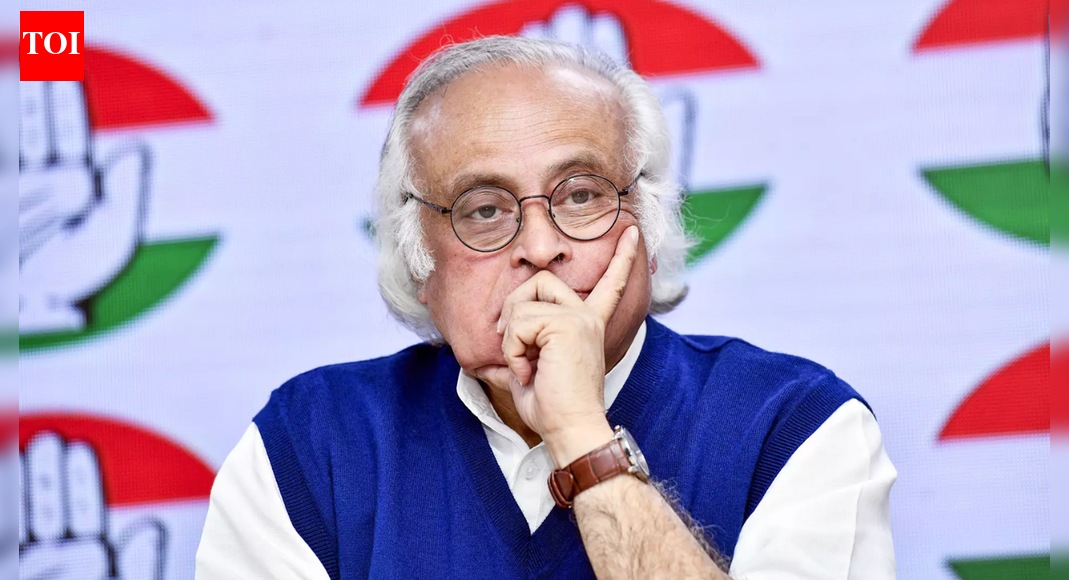
Congress leader Jairam Ramesh

NEW DELHI: Congress on Wednesday launched a broadside against the Centre and sought a clarification on China’s role after Beijing claimed credit for mediation between India and Pakistan after tensions flared up between the two countries in May.Congress leader Jairam Ramesh, in a social media post on X, said that China’s claim are concerning as it seems to “make a joke of India’s national security”.

Donald Trump Tells Netanyahu He Stopped India-Pakistan War The 70th Time Since Op Sindoor Paused

“President Trump has long claimed that he personally intervened to halt Operation Sindoor on May 10, 2025. He has done so on 65 different occasions in various forums in at least seven different countries. The Prime Minister has never broken his silence on these claims made by his so-called good friend,” the Congress leader said.“Now the Chinese foreign minister makes a similar claim and says China also mediated. On July 4, 2025, the Deputy Chief of Army Staff Lt. Gen Rahul Singh had publicly stated that during Operation Sindoor, India was actually confronting and combating China. Given that China was decisively aligned with Pakistan, Chinese claims of having mediated between India and Pakistan are concerning – not just because they directly contradict what the people of our country have been led to believe, but because they seem to make a joke of our national security itself,” he added.Jairam Ramesh further said that the statement must be understood in the context of India’s relationship with China. The Congress leader claimed that New Delhi’s re-engagement with Beijing has been on Chinese terms.“This claim must also be understood in the context of our relationship with China. We have begun re-engagement with them – but unfortunately it has been on Chinese terms. The Prime Minister’s clean chit to China on June 19, 2020, has considerably weakened India’s negotiating position,” the Congress leader said.“Our trade deficit is at record highs and much of our exports are dependent on imports from China. Provocative actions by China in relation to Arunachal Pradesh continue unabated. Amidst such a lopsided and hostile relationship, the people of India need clarity on what role China played in the abrupt halt to Operation Sindoor,” he added.This comes after Chinese foreign minister Wang Yi, at the Symposium on the International Situation and China’s Foreign Relations, said Beijing had played a mediating role in several global conflicts, including the one between India and Pakistan.“To build peace that lasts, we have taken an objective and just stance, and focused on addressing both symptoms and root causes. Following this Chinese approach to settling hotspot issues, we mediated in northern Myanmar, the Iranian nuclear issue, the tensions between Pakistan and India, the issues between Palestine and Israel, and the recent conflict between Cambodia and Thailand,” Wang said.Wang’s remarks come months after India and Pakistan were locked in a brief but intense military confrontation in May, triggered by a terror attack in the Pahalgam valley of Jammu and Kashmir on April 22, which took 26 innocent lives.India responded with Operation Sindoor, targeting terror infrastructure in Pakistan and Pakistan-occupied Kashmir.India has consistently dismissed claims of any third-party mediation, maintaining that the four-day confrontation was resolved through direct military-to-military communication.New Delhi has maintained that, inflicted by this heavy damage, Pakistan’s Director General of Military Operations (DGMO) called the Indian DGMO and both sides agreed to stop all firing and military action on land and in the air and sea with effect from May 10.


Source link