Breaking News
‘Hurt Hindu sentiments’: Bajrang Dal stages protest outside Bareilly church; video goes viral | India News


'Hurt Hindu sentiments': Bajrang Dal stages protest outside Bareilly church; video goes viral

NEW DELHI: Members of the right wing outfit Bajrang Dal and Vishwa Hindu Parishad a staged protest outside a Bareilly church during Christmas eve, alleging that the Hindu religion had been portrayed in objectionable manner.A video of right wing group members reciting ‘Hanuman Chalisa’ in protest outside the church in the presence of police surfaced on social media. Protesters gathered near the main gate of the church on Wednesday in the Cantt police station area, raising slogans including “Jai Shri Ram” and “Har Har Mahadev.” They alleged that the Christmas celebrations had hurt Hindu sentiments and also raised objectionable slogans during the demonstration. Police arrived at the spot after being alerted about the protest.

‘Every Indian Is Assaulted When…’: Shashi Tharoor Slams Attacks On Christmas Celebrations In India

The demonstration, which continued for under 30 minutes, ended after Bajrang Dal members submitted a memorandum to city circle officer (City) Ashutosh Shivam, calling for an impartial investigation and stringent action against those responsible for any wrongdoing.As stated in the memorandum, the Bajrang Dal claimed that a Christmas programme held at the church on Tuesday featured audio-visual skits by various schools that allegedly portrayed issues related to religious conversion, Hindu temples and Hindu society in a misleading manner.“An investigation will be carried out and necessary action will be taken on the basis of facts,” PTI quoted city circle officer saying.Later, the right wing group members protested outside the Kotwali police station in Bareilly, demanding the suspension of the circle officer Shivam for allegedly failing to register an FIR against a pastor accused of making defamatory remarks against Hindu deities.


Source link

‘Can’t bear the pain’: Indian-origin man made to wait for hours at Canada hospital, dies after cardiac arrest


‘Can’t bear the pain’: Indian-origin man made to wait for hours at Canada hospital, dies after cardiac arrest
Prashant Sreekumar (Image/X@yegwave)

Prashant Sreekumar, a 44-year-old Indian-origin man died after waiting for hours in the emergency room of Edmont Hospital.He began experiencing intense chest pain while at work. A client drove him to Grey Nuns Hospital in southeast Edmonton, where he was registered at triage and asked to wait in the emergency room. His father, Kumar Sreekumar, arrived at the hospital shortly afterwards. “My son told me, ‘Papa, I cannot bear the pain,” Kumar recalled, as reported by Canadian news channel Global News.

Canada Rejects 74% Indian Student Visas In August, Citing Fraud, As Ties With India Hit New Low

According to the family, Prashant described his pain as “15 out of 10” and informed hospital staff about the severity of his condition.An electrocardiogram (ECG) was conducted to assess his heart, but the family said he was told that nothing serious was detected and that he would need to continue waiting. He was also offered Tylenol to manage the pain.As the hours passed, Kumar said nurses periodically checked his son’s blood pressure, which kept rising. “It went up, up, and up. To me, it was through the roof,” he said.More than eight hours later, Prashant was finally called into the treatment area. Kumar said his son had been seated for only a few seconds when he suddenly stood up, clutched his chest and collapsed.“Nurses called for help, but it was too late,” Kumar said. Prashant died of an apparent cardiac arrest.Prashant is survived by his wife and three children, aged 3, 10 and 14. Family members said he was deeply devoted to his children and known for his cheerful, playful nature. The family often travelled together and shared a close bond.“He lived for his family and his kids,” his father said. “Anyone who knew him would say they had never met someone as kind as him.”Friends and relatives are now seeking answers, questioning how someone reporting severe chest pain could remain untreated for so long in an emergency room.Family friend Varinder Bhullar, who had also used Prashant’s accounting services, said the death has deeply shaken the local Indian-origin community in Edmonton.“This is a huge loss,” Bhullar said. “We expect better from the hospital and from the health-care system.”Grey Nuns Hospital is operated by Covenant Health. In a statement, the organization said that the case has been referred to the Office of the Chief Medical Examiner.“We offer our sympathy to the patient’s family and friends. There is nothing more important than the safety and care of our patients and staff,” the hospital said in a statement.As the family mourns Prashant’s death, they say they are struggling to come to terms with how he died and without being seen by a doctor. “They took my baby for nothing,” his father said.


Source link

Indian IT’s biggest trade body NASSCOM to US on changes in US H-1B visa programme: This would work against …


Indian IT's biggest trade body NASSCOM to US on changes in US H-1B visa programme: This would work against ...

Nasscom, Indian IT’s biggest trade body, has said that the proposed shift in the H-1B visa selection process from a lottery system to one weighted by salary levels will harm innovation and weaken competitiveness by disadvantaging small businesses, research institutions and early-career international graduates. In a statement on the proposed rule, Nasscom highlighted that maintaining a strong pipeline of Indian talent is vital for US leadership in artificial intelligence (AI). It also noted that Indians constitute about 71% of H-1B holders and attracting more such will reinforce the Indo-US partnership.

Read Nasscom’s full statement on proposed changes in H1-B visa process

Nasscom statement on the proposed Rule: Weighted Selection Process for Registrants and Petitioners Seeking to File Cap-Subject H-1B PetitionsThe recent changes with regards to the wage-weighted selection mechanism for H-1B visas proposed by the Department of Homeland Security represents a significant departure from the long-standing, neutral lottery system and raises important legal, economic, and operational concerns. While the intent behind the proposed changes, to promote high-skill employment, curb misuse, and protect U.S. wages, is well understood, a transparent, trusted visa framework is essential to maintaining the strength of the U.S. technology ecosystem.By assigning multiple selection entries based on Occupational and Employment Wage Statistics levels, the framework risks moving beyond the statutory focus on “specialty occupation” and toward wage ranking, potentially introducing regional and occupational distortions. Wage levels vary significantly by geography and role, and a weighted model could inadvertently disadvantage small and mid-sized enterprises, startups, research institutions, and university-linked employers that operate with moderate but market-appropriate wage structures.While H-1B professionals constitute a small share of the overall U.S. workforce supported by Nasscom member companies, they play a major role in driving innovation, productivity, and job creation across the digital economy.H-1B petitions at Level I and Level II wage bands frequently represent entry-level roles for graduates of U.S. universities in science, engineering, and computing disciplines. These positions form a vital part of the STEM talent pipeline, enabling early-career professionals to gain industry experience and progress into mid- and senior-level innovation roles over time. Under a wage-weighted system, restricting opportunities at the entry level could weaken the future talent base and discourage international students from pursuing advanced education in the United States. This would work against the country’s goals of strengthening competitiveness, driving innovation, and supporting higher education.Further, a sudden shift to a wage-weighted model would introduce uncertainty, increase compliance complexity, and disrupt long-established workforce planning, particularly for smaller and mid-sized firms that align recruitment with academic calendars, client delivery schedules, and product release cycles.Nasscom member companies collectively support more than 1.6 million skilled jobs across the United States, contributing $198 billion to the U.S. GDP—an impact larger than that of over 20 state economies. With over 264,500 employees directly in the U.S. and a presence in more than 25 major American communities, Nasscom companies help strengthen both established and emerging technology hubs. Notably, more than two-thirds of these jobs are located outside Silicon Valley and New York, fostering inclusive growth in regions such as Texas, North Carolina, Ohio, and Illinois.Any structural reform must preserve predictability, equity, and alignment with statutory intent. Should a wage-weighted approach be pursued, a phased implementation with sufficient lead time would be essential. Delaying implementation until the FY 2028 lottery cycle would provide employers the necessary runway to adapt processes, ensure compliance, and maintain confidence in the stability of the U.S. talent and investment environment.The joint US congressional letter issued on 30th October 2025 addressed to the President also highlights that Indian nationals, who make up the largest share of H-1B recipients, are central to U.S. leadership in information technology and artificial intelligence. America must continue attracting the world’s best talent to maintain our innovation ecosystem, strengthen the defence industrial base, and preserve our long-term competitive edge.In the case of India, the country of origin for 71 percent of H-1B holders last year, attracting this talent also reinforces our strategic partnership with a key democratic partner in the Indo-Pacific.A balanced, consultative approach will be critical to ensuring that reforms strengthen rather than inadvertently weaken the innovation advantage and global competitiveness of the United States. The H-1B program is not simply about addressing labour needs; it is about securing U.S. leadership in the industries that will define global power in the 21st century.


Source link

Chess | ‘R Praggnanandhaa is third favourite’: World No. 1 Magnus Carlsen rates Candidates 2026 line-up | Chess News


Chess | 'R Praggnanandhaa is third favourite': World No. 1 Magnus Carlsen rates Candidates 2026 line-up
Magnus Carlsen and R Praggnanandhaa

World No. 1 and five-time World Chess Champion Magnus Carlsen has shared his thoughts on the players competing in the 2026 Candidates Tournament. According to the former world champion, Indian Grandmaster R Praggnanandhaa is the third strongest contender to win the event.

Inside the Life of Belarus’s Top Chess Player Amid Russia-Ukraine Turmoil | Denis Lazavik Exclusive

Carlsen believes that Praggnanandhaa has a good chance, but still ranks him behind two American players. The Candidates Tournament is very important in chess. The winner earns the right to challenge the current World Champion. This time, the champion is India’s D Gukesh. Eight top players will take part in the tournament, and Praggnanandhaa is the only Indian among them.The 2026 Candidates Tournament will begin on March 28 in Cyprus. Carlsen feels that Americans Hikaru Nakamura and Fabiano Caruana are the top favourites. After them, he places Praggnanandhaa. He also said that there is a clear gap between these three and the rest of the field. “Just like last time, probably the Americans are the favourites. Then we got Pragg as the third favorite, and then probably a pretty big drop off after that. Wei Yi is really good, but I don’t think he’s capable of winning enough games to win the Candidates. So it will be interesting to see,” Carlsen told Chess.com in an interview. Apart from Nakamura, Caruana, and Praggnanandhaa, the tournament will include Anish Giri from the Netherlands, Matthias Bluebaum from Germany, Javokhir Sindarov from Uzbekistan, Wei Yi from China, and Andrey Esipenko from Russia. Carlsen also spoke about players who missed out on qualifying. He feels that some strong names deserved a place in the Candidates. “I would have loved to see some more big names in the field, but then again, if you didn’t qualify, you didn’t qualify. Maybe this system should kind of account for somebody like Vincent Keymer, who was really close to qualifying a lot of times and has the highest rating of anybody who’s not there. He certainly deserved to be there, but I guess he and Arjun and a few others will have to await their returns. It’s always interesting to follow,” Carlsen added.


Source link

A hidden Arctic world: Methane mounds and life found 3.6 km below the Greenland Sea |


A hidden Arctic world: Methane mounds and life found 3.6 km below the Greenland Sea

Deep down, beneath the icy edges of the Greenland Sea, a remarkable and previously undiscovered geological and biological complex has been found by scientists. The existence of this topographic anomaly deep down in the sea, where light, high pressure, and low temperature are prevalent factors, extends our understanding of what is known about the oceanography of the Arctic. The findings are especially pertinent in light of recent increased scientific interest in the Earth’s poles in relation to increased understanding of global climate processes. The observation of a level of biological and geological interaction in one of the most remote ocean regions on Earth contributes important information on what is known about the physical characteristics of the Arctic.

Why methane hydrate mounds forming deep beneath the Arctic Ocean

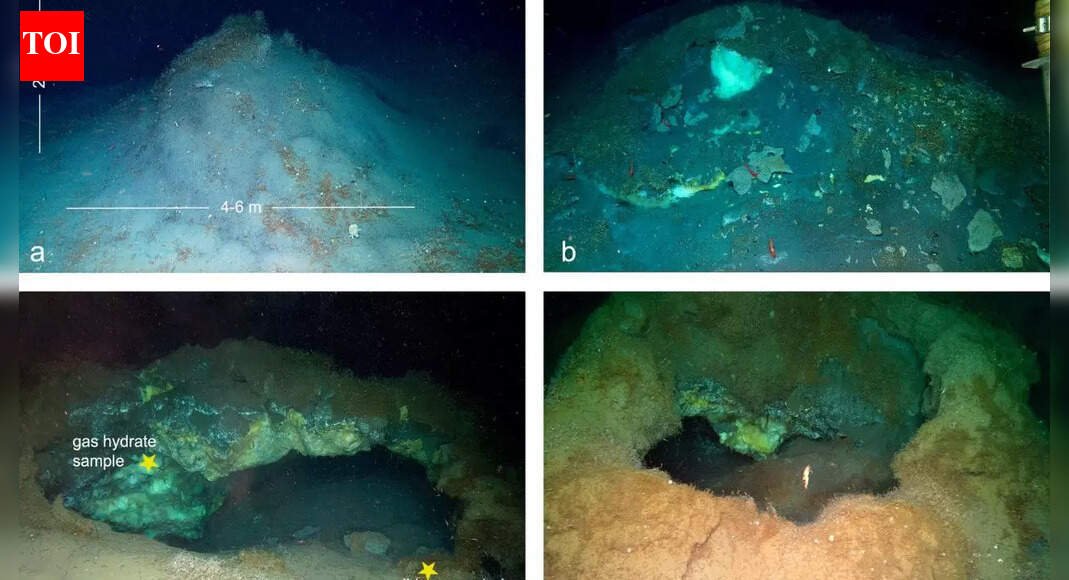
The most notable aspect of the discovery is that it consists of a number of gas hydrate mounds along the Molloy Ridge, a tectonic boundary that lies deep beneath the Greenland Sea. A gas hydrate is a molecule that consists of a large amount of trapped methane, all held together with crystalline ice. The existence of these hydrates at a depth of some 3,640 meters is one of the deepest known hydrate formation sites that have been discovered so far. According to the research paper that was published in Nature Communications, high-resolution images that included the extent of these hydrate mounds along the ridge have been discovered with the help of a remotely operated robotic vehicle. Gas hydrates have until now been thought to be largely associated with continental slopes and the shallower margins of the Arctic.

How life survives without sunlight on the Arctic sea floor

The ecologists surrounding the hydrate mountains recorded the existence of a dense population of chemosynthetic organisms. Such organisms receive energy from chemicals instead of sunlight. Based on the fact that the area is lightless, the organisms receive energy from the methane seeping from beneath the seafloor. The organisms form the base of the food chain, in turn supporting other life forms. Scientists recorded tube worms, crustaceans, as well as a dense mat of microbes aggregated in areas surrounding the seeps. The organisms exhibit specific adaptations in order to withstand high pressures as well as near-freezing temperatures. The organisms’ metabolism is specifically attuned in order to take advantage of the methane as well as sulphide compounds seeping from the sediments. The finding shows the existence of life in the deepest parts of the Arctic Ocean utilizing available energy in the area.

What role does the Molloy Ridge play in deep Arctic sea floor processes?

The Molloy Ridge is recognised as one of the deepest mid-ocean ridges in the world and is characterised by tectonic plates that are gradually drifting apart. The tectonic activities in this process result in the creation of cracks and channels in the Earth’s crust that facilitate methane gas to flow from deeper to upper layers. When methane gas reaches lower temperatures close to the ocean floor, it either gets trapped in its hydrate form or seeps out gradually. The process that is observed in this tectonic interaction is directly related to biological activities occurring on the ocean floor. The mid-ocean ridge functions both as a channel and as a supporting structure that determines hydrate and biologically active zones. The process of interaction in this study is very helpful in gaining an understanding of deep-sea ecosystems’ maintenance at a deeper level for extended periods.

What this discovery means for Arctic methane stability

Methane has a crucial role within the carbon cycle, and what happens to methane under the ocean floor is closely tracked because methane can affect the climate. The methane hydrate mounds under the Greenland Sea support a long-term trap that holds methane under stable conditions. At present, the conditions on the Molloy Ridge support a stable environment to retain methane, hindering massive amounts of methane from entering the water body. Still, recognising such systems is critical to predict their reaction to potential warming within the ocean currents or temperatures. The findings provide scientists a chance to observe and measure methane within a system that has been underrepresented within climate models to predict climatic changes. The findings confirm the essence of the deep basins within the Arctic to control carbon beneath the Earth and within the ocean.

Why the deep Arctic Ocean is becoming a focus of scientific research

The discovery of hydrate mounds and their ecosystems in the Greenland Sea is one such finding that showcases the effect that advances in technology are having on deep oceanography. The use of remotely operated vehicles with sophisticated sensors and imaging systems is enabling scientists to explore regions that were hitherto unexplored. With every new expedition, new layers of complexity are being found under the Arctic Ocean, from unexpected topographical features to new ecosystems. The Molloy Ridge finding indicates that perhaps such regions are to be found elsewhere on deep tectonic margins, waiting to be located and studied.Also Read | A step toward time travel? Physicists reverse waves in time


Source link

India to miss $1 trillion exports target? Exports struggle despite the FTA push — Here’s what’s happening


India to miss $1 trillion exports target? Exports struggle despite the FTA push — Here’s what’s happening

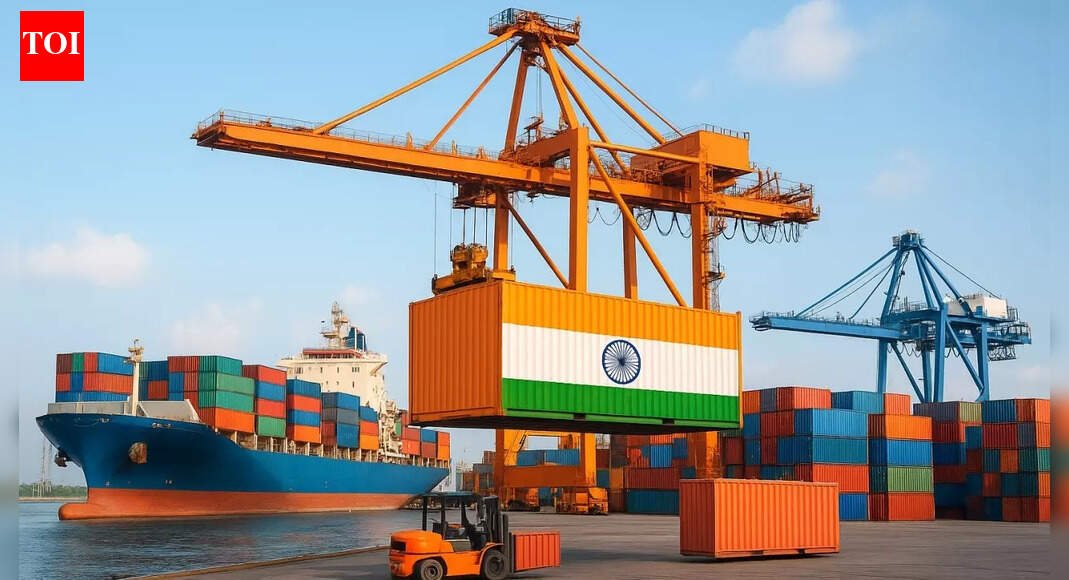
India’s ambition of exporting goods and services worth $1 trillion by the end of FY26 is likely to remain out of reach, Global Trade Research Initiative (GTRI) predicted in its latest report on Thursday, pointing to weak merchandise shipments due to weak global demand and increasing protectionist trends.Ajay Shrivastava, founder of the economic think tank, said that India is expected to record flat increase in exports this year with goods outflows showing almost no growth. Total exports in FY26 are expected to rise only to almost $850 billion, missing the $1 trillion number by $150 billion. The think tank predicted that services exports might be able to cross $400 billion, providing “the only meaningful growth cushion for India’s trade,” as the overall growth struggles with weak global demand. Meanwhile, Shrivastava highlighted that the target may be achieved if India succeeds in sealing major trade deals. “That I think we may achieve once our trade deal with the US and EU comes. That is maybe next year, not this year,” he said.While exports face sustained pressure, Shrivastava said that domestic economic conditions remain stable. “The domestic economy is working fine,” he said, adding, “The GDP numbers are telling; low inflation numbers are telling. The only pressure on the GDP will be the pressure on the export side.”

India’s trade with US and EU — a different picture

Despite the overall slowdown, recent trade figures suggest that India has begun to diversify its export destinations. Shrivastava pointed out that exports to the United States declined sharply between May and November, even as shipments to other regions rose.Exports to the US dipped almost 21% amid President Donald Trump’s 50% tariffs imposition on Indian shipments.“We have seen that between May and November, our exports to the US are down by 20.7%” he said. The report added that unless Washington rolls back the extra 25% duties on India or locks in a trade deal, “exports to India’s largest market risk further erosion.”For India’s trade with the European Union, the think tank highlighted a difference with exports dropping even before duties came into play with the bloc’s compliance and reporting requirements dragging down the country’s steep shipments by almost 24%.EU will “activate its Carbon Border Adjustment Mechanism (CBAM) on January 1, 2026, effectively imposing a carbon tax on imports.” From the next year, 2026, EU importers will lable Indian goods inclusive of the CBAM costs, “with payments settled through certificate surrender in 2027.”

India is diversying its export destinations

Shrivastava said, “During this time, our exports to the rest of the world increased by 5.5%. That means diversification already started happening in a small way.”However, he cautioned that geographical diversification must be accompanied by changes in the composition of India’s exports. “For more diversification, for more exports to these countries, we have to focus on diversifying our export basket also,” Shrivastava said. “Right now, our export basket needs inclusion of more medium to high-tech products.” The think tank said that while the country has already signed 18 FTAs and more possible in 2026, India’s priority must change, going from signing agreements to “making FTAs deliver real export gains, especially in electronics, engineering and textiles.”

What should be India’s strategy for 2026?

  • For the next year, India’s export strategy needs to focus inward, as there is limited influence over global geopolitics.
  • Export growth will depend on improving product quality, improving the value chain and bringing production costs down.
  • Electronics, engineering and textiles will emerge as the strongest opportunities, as higher value addition can sustain exports when the global trade environment is hostile.
  • Using trade agreements effectively.
  • Execution of policies and schemes should be in focus, with emphasis on operationalising the Export Promotion Mission, simplifying regulations and improving ease of doing business.

The think tank cautioned that tariffs, climate-related taxes and geopolitical uncertainty will continue to weigh on global trade conditions. Export survival and growth will depend on competitiveness at home, including better products, deeper manufacturing capabilities and lower costs.Back in FY25, India’s overall exports stood at $825 billion, including $438 billion in merchandise outflows and $387 billion in services.


Source link

‘National Total War’: America’s Growing Vulnerability Amid China’s Military Ascent | World News


'National total war': How China's military buildup up is making US more vulnerable
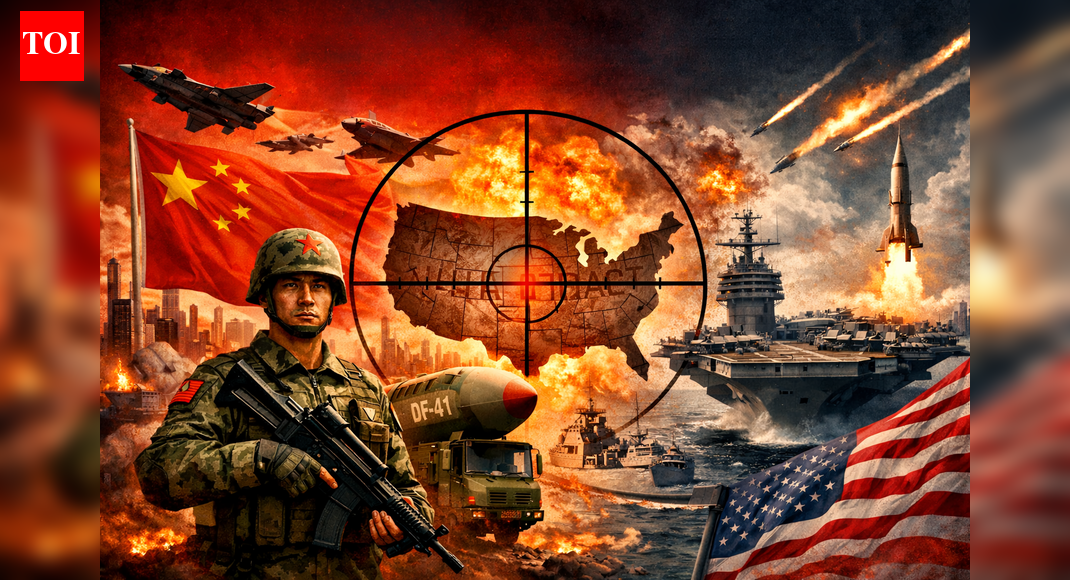
A new Pentagon report reveals China’s military buildup increasingly threatens the US homeland. Beijing is developing capabilities for direct attacks on critical infrastructure, cyber systems, and space assets, aiming to disrupt American decision-making during a Taiwan crisis. This signifies a shift from regional deterrence to direct homeland vulnerability, fundamentally altering US defense calculations.

For the first time, a Pentagon report says plainly what had long been implied. China’s “historic military buildup” has made the US homeland “increasingly vulnerable.” The phrase appears early in the Defense Department’s 2025 annual assessment of China’s military power, and it is not rhetorical flourish. It marks a shift in how the US government wants Americans to understand the problem Beijing poses. This is no longer only about aircraft carriers in the Pacific or missile ranges around Taiwan. It is about the United States itself as a target.The report, formally titled Military and Security Developments Involving the People’s Republic of China, describes a Chinese military that is no longer content with regional deterrence. The People’s Liberation Army is now measuring its capabilities against what it calls the “strong enemy,” an unmistakable reference to the United States. In doing so, it is building ways to pressure American decision-making directly, including through cyber access to critical infrastructure, long-range conventional and nuclear strikes, and attacks on the space systems that underpin US military power.The effect, the report argues, is a new vulnerability equation. Washington must now think not only about whether it can intervene in a conflict near Taiwan, but whether it can do so while absorbing disruption at home.Why it matters

  • The Pentagon’s core point isn’t just that China is getting stronger. It’s that Beijing is building multiple ways to shape US decision-making in a crisis-by threatening the homeland directly while also complicating US military intervention in the Indo-Pacific.
  • That shift widens the problem from “Can the US win near Taiwan?” to “Can the US sustain domestic stability, critical infrastructure, and space-enabled warfighting while intervening?” The report’s framing of vulnerability is deliberately multi-domain. The latest benchmark: 2027
  • The report says the PLA is making “steady progress” toward its 2027 goals, including achieving “strategic decisive victory” over Taiwan and building “strategic counterbalance” against the US in nuclear and other strategic domains. Then it translates the implication plainly: “China expects to be able to fight and win a war on Taiwan by the end of 2027.”
  • To get there, the report says the PLA is refining options to force unification, including “most dangerously” an amphibious invasion, “firepower strike,” and possibly a maritime blockade-testing “essential components” through 2024 exercises, including striking sea/land targets and striking US forces in the Pacific.

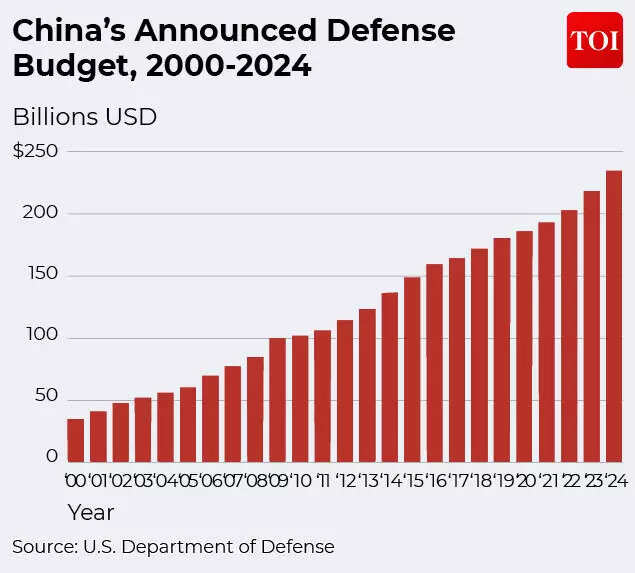
‘National total war’The most striking doctrinal shift described in the report is Beijing’s embrace of what Chinese military writings call “national total war.” The idea treats future conflict not as a discrete military contest but as a clash between entire national systems. Political authority, economic resilience, civilian infrastructure, information control, and military power are all part of the same battlefield.The Pentagon links this thinking directly to China’s long-term political goal of “national rejuvenation” by 2049 and to its nearer-term military benchmarks. Defense spending has nearly doubled since Xi Jinping took power. Civil-military integration reforms are designed to ensure that commercial sectors and local governments can be rapidly mobilized in wartime. Chinese planners, the report notes, have studied the war in Ukraine closely, drawing lessons about industrial capacity, sanctions resistance, and the risks of a prolonged fight.

China defence budget over the years

This is not abstract theory. The report repeatedly emphasizes integration. China’s “core operational concept,” known as Multi-Domain Precision Warfare, is built around fusing data from space, cyber, air, sea, and land sensors into a single targeting system. The aim is to identify weak points in an adversary’s operational system and strike them quickly, at scale, and in coordination.

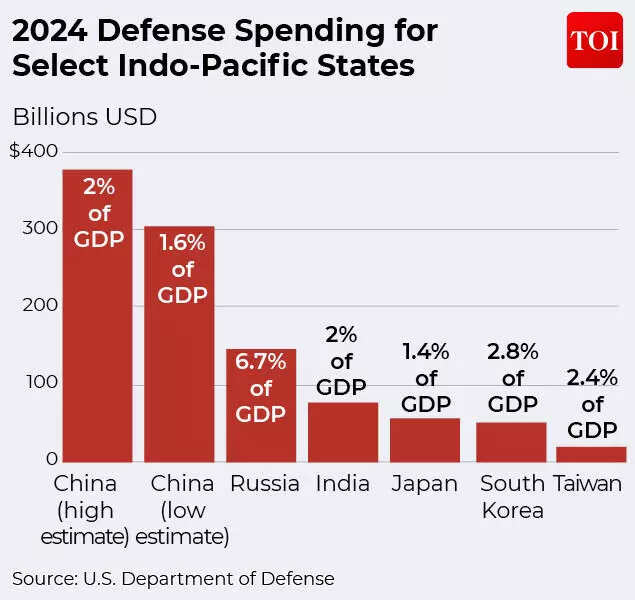
Defence budget: China and other Asian powers

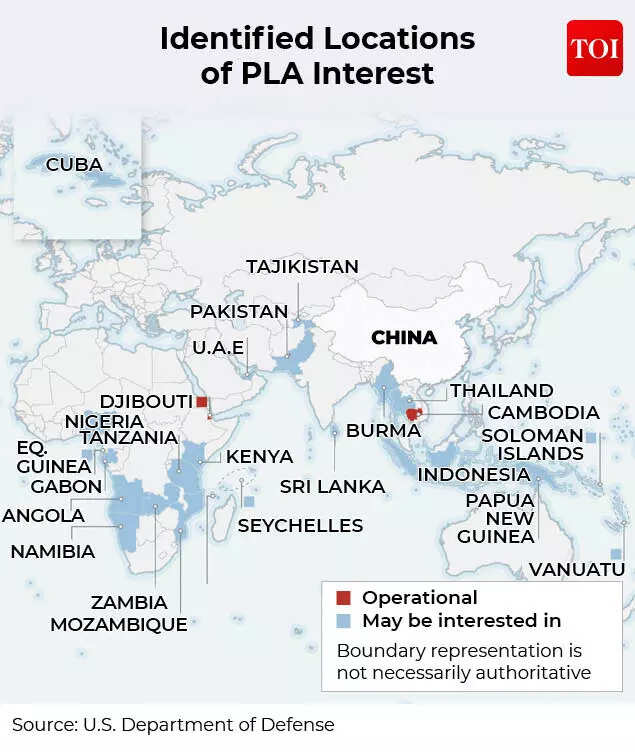
Taiwan as the pacing scenarioEverything in the report ultimately bends back toward Taiwan. The Pentagon reiterates that the PLA is making “steady progress” toward its 2027 goals, which are explicitly tied to the ability to force unification with the island. The assessment translates the implication without hedging: China expects to be able to “fight and win” a war over Taiwan by the end of 2027.To get there, Beijing is refining multiple military options. A maritime blockade. A joint firepower strike campaign. A full-scale amphibious invasion. In 2024, the PLA’s “JOINT SWORD” exercises rehearsed the encirclement of the island, simulated strikes on sea and land targets, and practiced blocking key ports. These were not symbolic displays. They were stress tests of command-and-control, logistics, and coordination under realistic conditions.Crucially, Taiwan planning is inseparable from counter-intervention. The PLA’s growing missile forces can now range 1,500 to 2,000 nautical miles from China’s shores. In sufficient volume, the report warns, those strikes could seriously disrupt US operations across the western Pacific. Chinese units train against professional “blue forces” that replicate US equipment and tactics. The point is explicit preparation for a fight with American forces, not a generic regional contingency.Cyber as a homeland leverIf Taiwan is the likely trigger, cyber operations are the lever that reaches home. The report calls China the most persistent cyber threat to US government, military, and civilian networks in 2024. What distinguishes the current assessment is its emphasis on pre-positioning.Chinese cyber actors associated with campaigns such as “Volt Typhoon” have “burrowed into US critical infrastructure,” the report says. These intrusions go beyond espionage. They demonstrate the ability to disrupt systems during a crisis, including those needed to mobilize and deploy US forces. Likely targets include military command networks and civilian infrastructure with political or economic significance.The Pentagon’s language is careful but unsettling. Disruptions might be localized and temporary, lasting days or weeks. But the strategic effect could be outsized. Interruptions to pipelines, power, or telecommunications during a Taiwan crisis could slow military response and generate public pressure at home. Another campaign, known as “Salt Typhoon,” targeted US telecommunications providers in 2024, highlighting vulnerabilities in the backbone of American communications.Taken together, cyber operations are portrayed as a way to impose costs below the nuclear threshold while shaping the domestic environment in which US leaders make decisions.The ‘kill chain’The report is equally blunt about space. China sees space superiority as decisive. Its intelligence, surveillance, and reconnaissance satellite fleet has more than tripled since 2018, reaching over 359 systems by early 2024. That constellation dramatically improves China’s ability to track US aircraft carriers and expeditionary forces across the Pacific.These satellites are not passive observers. They are integral to closing what the military calls the kill chain: finding targets, tracking them, and delivering long-range precision strikes. Without space-based sensors and communications, that chain breaks.China is therefore building multiple ways to sever its adversary’s access to space. The report describes kinetic antisatellite missiles capable of destroying satellites in low Earth orbit, with ambitions to reach higher orbits. It highlights “dual-use” satellites equipped with robotic arms, such as Shijian-21, that can grapple and reposition other satellites. Ground-based lasers can disrupt or damage sensors. Jammers target military satellite communications across frequency bands.Cyber plays a role here too. Chinese actors have been implicated in attacks on foreign satellite networks, particularly those of the United States. The goal is not necessarily to destroy everything, but to degrade enough systems to slow decision-making and blunt operational advantage at the outset of a conflict.Nuclear growth and signalingOverlaying all of this is a rapidly expanding nuclear force. China’s warhead stockpile remained in the low 600s through 2024, the report says, but it is on track to exceed 1,000 by 2030. New silo fields in western China, a growing fleet of mobile intercontinental ballistic missiles, and advances in early warning systems point to a shift toward higher readiness.The report also notes Chinese interest in lower-yield nuclear weapons, suggesting a strategy that contemplates limited nuclear use rather than only massive retaliation.The effect is to thicken the strategic layer. Nuclear expansion does not replace cyber or conventional pressure. It sits alongside them, complicating escalation dynamics and shortening decision timelines.Ships, reach, and presenceNaval power provides the endurance behind this posture. China’s third aircraft carrier, Fujian, completed its first sea trials in 2024. The navy aims to field six carriers by 2035, for a total of nine. In October, China’s two operational carriers conducted their first dual-carrier operations, a milestone in integrated combat capability.The relevance to homeland vulnerability is indirect but real. Maritime power supports blockade options around Taiwan and sustained airpower projection. It also helps keep US forces at distance while other tools apply pressure elsewhere.China’s ambitions are not confined to the Indo-Pacific. The report details a growing global logistics network, from Djibouti to Cambodia’s Ream Naval Base, with potential future sites in Africa and the Pacific islands. Access to the Atlantic, the Pentagon warns, would pose new challenges for US planners.

PLA is continuously expanding its interest areas

Russia and the outer perimeterChina’s partnership with Russia adds another layer. Combined bomber patrols near Alaska, joint coast guard operations in the Bering Sea, and expanded exercises signal a shared interest in countering the United States. These activities are not decisive on their own, but they stretch attention and resources, reinforcing the report’s central theme of multi-directional pressure.What the warning really meansThe Pentagon’s core message is not simply that China is stronger. It is that Beijing is building an integrated system designed to shape US choices in a crisis. The question is no longer only whether the United States can prevail militarily near Taiwan. It is whether it can do so while managing cyber disruption at home, threats to space systems, and a more complex nuclear backdrop.China is not betting on a single knockout blow. It is constructing multiple pressure points, many of them far from the Taiwan Strait, to raise the cost and uncertainty of American intervention.The report does not offer easy solutions. It does, however, make clear that the era in which the US homeland could be treated as a sanctuary in great-power conflict is ending. The competition, as Beijing’s own doctrine suggests, is becoming a contest between entire systems. And in that contest, distance alone is no longer protection.




Source link

Hymns, carols, morning prayers: How PM Modi celebrated Christmas — see pics, watch video | India News


Hymns, carols, morning prayers:  How PM Modi celebrated Christmas — see pics, watch video

NEW DELHI: Prime Minister Narendra Modi on Thursday extended Christmas greetings to people across the country, wishing for the festival to be filled with “peace, compassion and hope.” He also called for the strengthening and harmony in our society.The PM also attended the Christmas morning service at The Cathedral Church of the Redemption in Delhi along with a large congregation of Christians of Delhi and North India.

PM Modi attends Morning prayer

The service included prayers, carols, hymns and a special prayer for the Prime Minister by Rt Rev Paul Swarup, the Bishop of Delhi.PM’s message entailed the enduring values of love, service and brotherhood associated with the teachings of Jesus Christ, and their relevance in fostering social harmony and mutual respect. In a post on X, the PM said, “Wishing everyone a joyous Christmas filled with peace, compassion and hope. May the teachings of Jesus Christ strengthen harmony in our society.” Referring to the service he attended, he added, “Attended the Christmas morning service at The Cathedral Church of the Redemption in Delhi. The service reflected the timeless message of love, peace and compassion. May the spirit of Christmas inspire harmony and goodwill in our society.”Over the last few years, PM Modi has been regularly attending programmes that have connected with the Christian community.

.

During Easter 2023, PM Modi attended an Easter programme at the Sacred Heart Cathedral in Delhi. Later that year, he hosted a Christmas programme at his official residence at 7, Lok Kalyan Marg.In 2024, the PM attended a Christmas dinner at the residence of minister of state George Kurian and also participated in a programme organised by the Catholic Bishops’ Conference of India (CBCI).(WIth inputs from agency)


Source link

Navi Mumbai Airport opens today! Stunning pictures, flights, destinations & more — All that you need to know


Navi Mumbai Airport opens today! Stunning pictures, flights, destinations & more — All that you need to know

The Navi Mumbai International Airport (NMIA) begins commercial flight operations on Thursday, opening a second aviation gateway for the Mumbai Metropolitan Region after years of missed deadlines. The new facility is expected to emerge as one of the busiest and a significant aviation hub in the country.On its opening day, the airport is expected to handle over 4,000 passengers, according to people familiar with the matter.Here is all that you need to know about the Navi Mumbai International Airport — Flights, schedule, routes, pictures & more!

Airlines operating from the Navi Mumbai International Airport

Commercial operations will see four airlines operating domestic services from NMIA. These include IndiGo, Air India Express, Akasa Air and Star Air, an NMIA spokesperson said.People familiar with the matter said IndiGo will be the dominant operator across most routes, while Akasa Air will operate services to Ahmedabad, Goa, Kochi and Delhi. Air India Express will operate flights to Bengaluru and Delhi, and Star Air will operate flights to Goa.

Navi Mumbai International Airport – Destinations and routes

NMIA will be connected to nine domestic destinations, including Hyderabad, Goa and Bengaluru. Routes to Delhi will see the highest activity, with a total of three daily flights operated by IndiGo, Air India Express and Akasa Air, the people said.In the initial phase, the airport is expected to operate up to 24 scheduled daily departures to 13 destinations, with the capability to manage up to 10 aircraft movements per hour, according to an NMIA statement.

Today’s flight schedule at the Navi Mumbai International Airport

Thursday’s launch will see around 30 domestic flights, split equally between arrivals and departures.

Time
Airline
Flight Number
Destination
18:50 IndiGo 6E 2055 Mopa (GOX)
17:45 IndiGo 6E 866 Mangalore (IXE)
17:35 IndiGo 6E 818 Nagpur (NAG)
17:00 Akasa Air QP 1928 Mopa (GOX)
16:15 Star Air S5 707 Mopa (GOX)
13:30 Star Air S5 703 Ahmedabad (AMD)
13:25 Air India Express IX 2152 New Delhi (DEL)
13:00 IndiGo 6E 836 Ahmedabad (AMD)
12:05 IndiGo 6E 884 Hyderabad (HYD)
10:00 IndiGo 6E 907 Kochi (COK)
8:45 IndiGo 6E 6346 New Delhi (DEL)
8:15 IndiGo 6E 829 Lucknow (LKO)
8:10 Akasa Air QP 1831 New Delhi (DEL)
8:10 Air India Express IX 2914 Bangalore (BLR)
8:00 IndiGo 6E 460 Bangalore (BLR)

The terminal building opened to departure passengers around 6.40 am, the NMIA spokesperson said. Gautam Adani, chairman of the Adani Group, Jeet Adani, director (airports), and other officials will be present at the airport to welcome passengers arriving on the first flight and to hand over boarding passes to departing travellers.

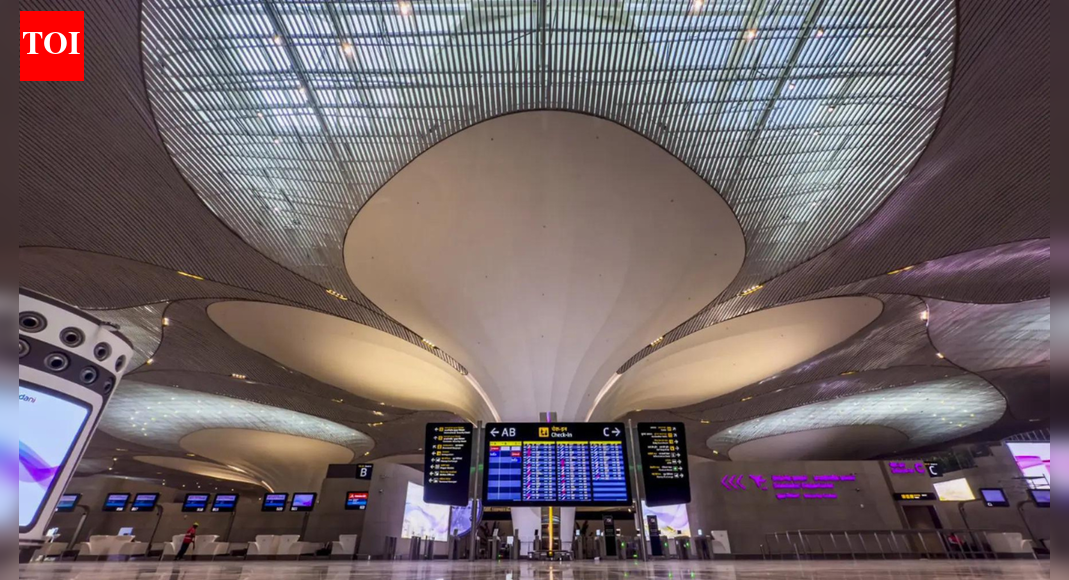
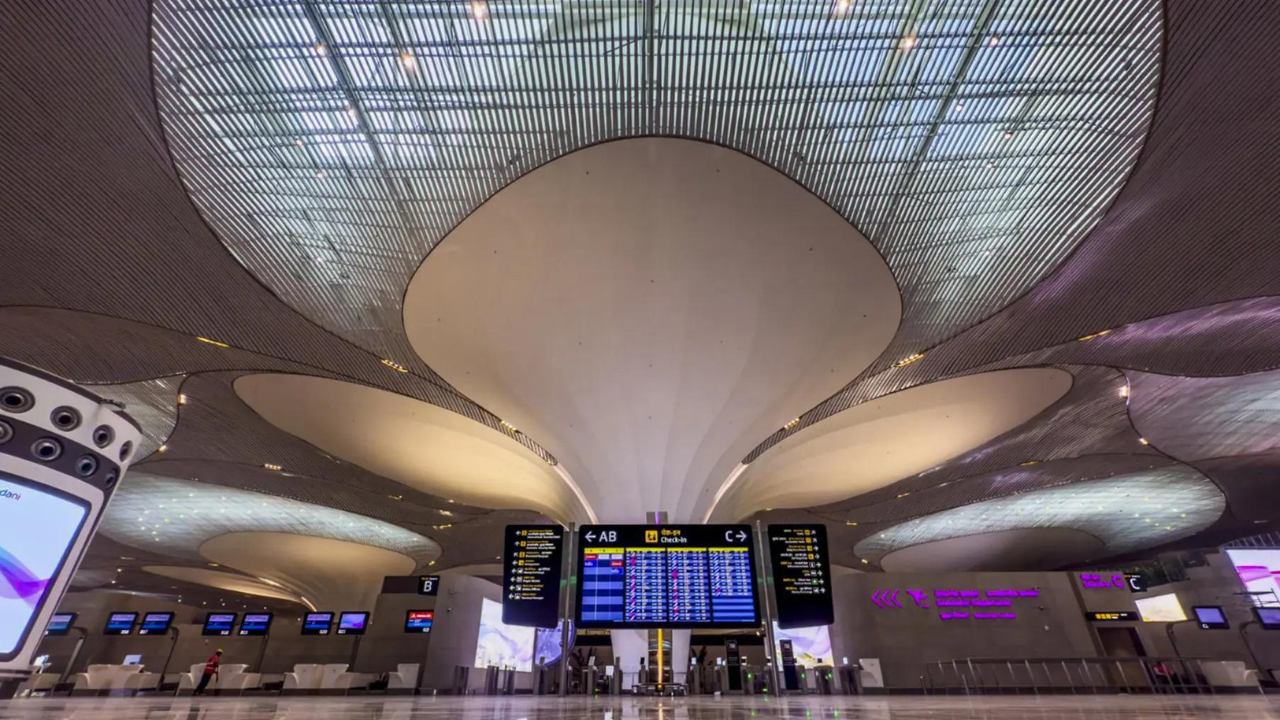
Stunning images of the Navi Mumbai International Airport

Navi Mumbai International Airport
Navi Mumbai airport opens today with 30 domestic flights
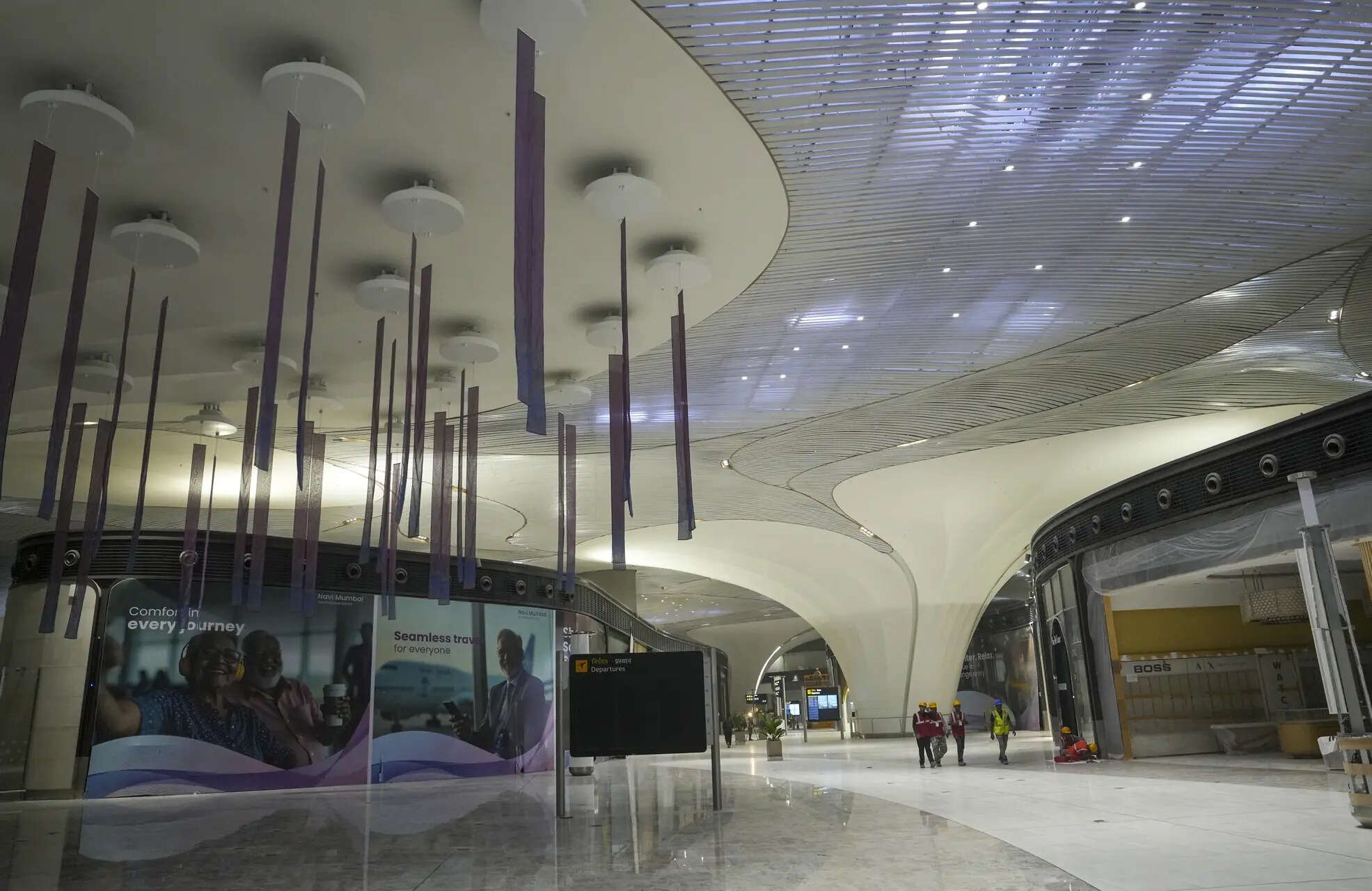
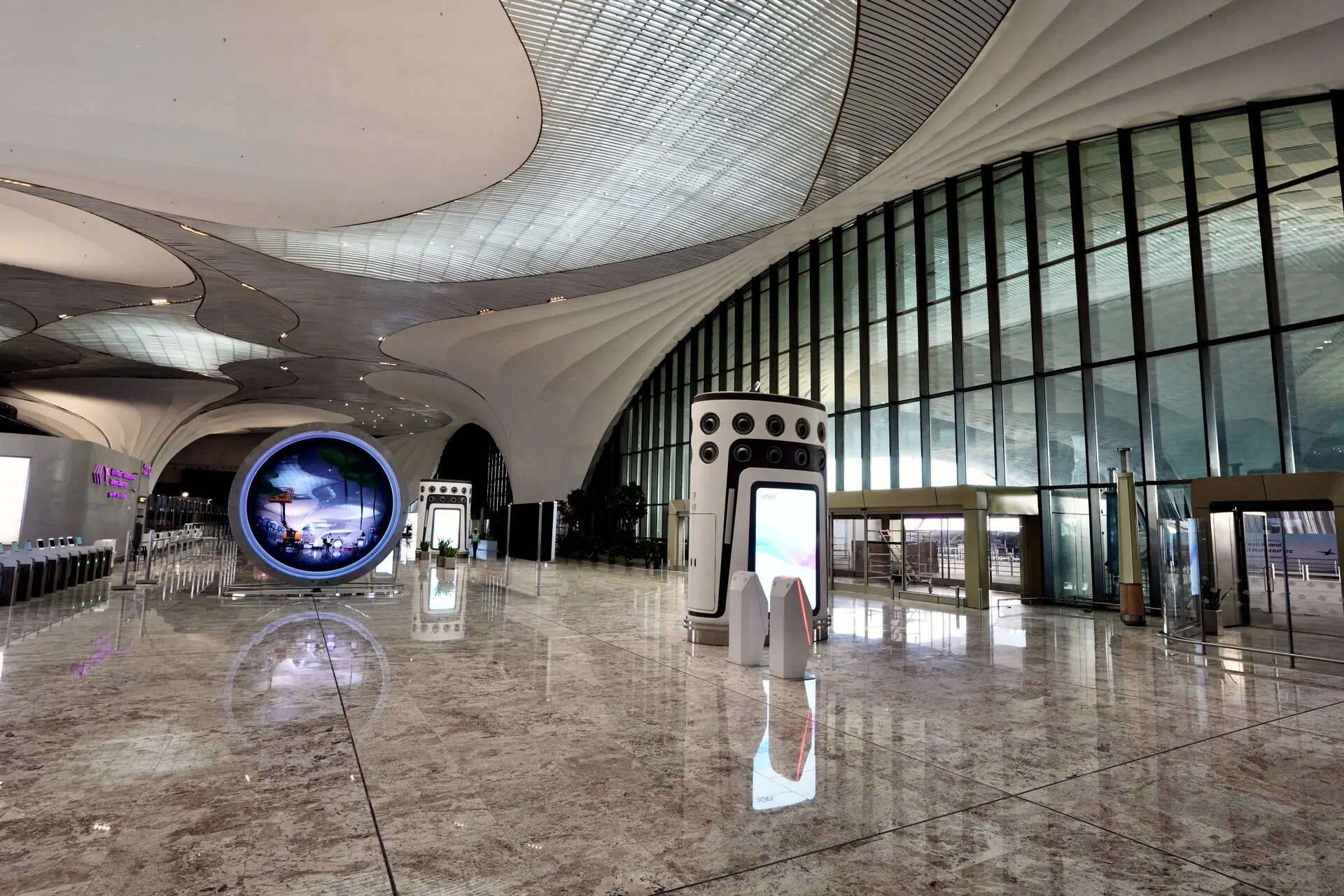
Interiors of the newly-constructed Navi Mumbai International Airport
The airport will eventually feature two parallel runways, terminal buildings and advanced cargo facilities.
Passenger services from day one will include Digi Yatra-enabled contactless processing at designated touchpoints.

Also see: Exclusive first glimpse of Navi Mumbai international airport

How to get to the Navi Mumbai International Airport?

Getting to the NMAI from Pune or Lonavala:For those travelling from Alibag, Pen, or rest of the Konkan:Getting to NMAI from Navi Mumbai and PanvelFrom Kalyan, Dombivli, or BhiwandiGoing from Eastern Suburbs to Navi Mumbai International AirportThane, Airoli, or Ghansoli to NMAIWestern Suburbs to NMAIGoing to NMAI from Central Mumbai Planning your journey from South Mumbai to NMAI

Passenger services at the Navi Mumbai International Airport

“During the initial phase, NMIA will operate between 8 am and 8 pm, with up to 24 scheduled daily departures to 13 destinations and the capability to manage up to 10 aircraft movements per hour. From Feb 2026, operations are planned to progressively scale up to round-the-clock services,” the NMIA spokesperson said.Passenger services from day one will include Digi Yatra-enabled contactless processing at designated touchpoints. “Passenger services from day one will be supported by Digi Yatra-enabled contactless processing at designated touchpoints, along with trained terminal staff across kerbside, check-in, security and boarding areas,” the spokesperson said. Conventional check-in counters will also be available for passengers not opting for Digi Yatra.Retail and food and beverage offerings have been curated with a focus on affordability and local preferences, the airport said.

Airport size and future capacity

Built as a greenfield airport by Navi Mumbai International Airport Ltd (NMIAL) under a public-private partnership, the project is owned 74% by Adani Airports Holdings, with the remaining 26% held by the City and Industrial Development Corporation of Maharashtra (CIDCO).Spanning over 1,160 hectares (2,866 acres), NMIA is designed to handle 90 million passengers per annum on completion. The airport will eventually feature two parallel runways, terminal buildings and advanced cargo facilities.In the initial phase, NMIA opens with Terminal 1 and one operational runway, with the capacity to handle 20 million passengers per annum and 0.5 million metric tonnes of cargo annually. The terminal is expected to reach its declared passenger capacity before mid-2026 and can accommodate an additional 2–3 million passengers beyond that level.The airport is located around 45–50 km from North Mumbai, 35–40 km from South Mumbai, and 35–45 km from the eastern suburbs.


Source link

Ravi Shastri the next England coach? Monty Panesar explains why he fits the bill | Cricket News


Ravi Shastri the next England coach? Monty Panesar explains why he fits the bill

NEW DELHI: England head coach Brendon McCullum is under mounting scrutiny after another humbling Ashes tour Down Under, and former spinner Monty Panesar has floated a bold alternative: Ravi Shastri. With England losing the Ashes inside 11 days and trailing 0-3 with two Tests remaining, Panesar believes a rethink at the top may be inevitable — and that Shastri is uniquely qualified for the job.Go Beyond The Boundary with our YouTube channel. SUBSCRIBE NOW!Speaking to journalist Ravi Bisht on his YouTube channel, Panesar argued that England need a coach who understands how to beat Australia in their own conditions, both tactically and mentally. “You have to think: who exactly knows how to beat Australia?” Panesar said. “How do you take advantage of Australia’s weaknesses, mentally, physically, and tactically? I think Ravi Shastri should become England’s next head coach.

Franchise boom vs Test cricket: Tom Moody’s honest take

Panesar’s case rests squarely on Shastri’s record. Under his stewardship, India won back-to-back Border-Gavaskar Trophy series in Australia — first in 2018/19, India’s maiden series triumph there, and again in 2020/21. The latter victory was particularly remarkable, coming after India were bowled out for 36 in Adelaide and despite a squad ravaged by injuries.McCullum, appointed after England’s 4-0 Ashes defeat, initially transformed the Test side alongside captain Ben Stokes. England won 10 of their first 11 matches, but that momentum has stalled. Since then, England have lost 16 of their next 33 Tests and failed to win marquee five-match series against Australia or India.

Poll

Is Brendon McCullum the right coach for England despite recent failures?

Despite the noise, McCullum has reiterated his desire to continue, though he acknowledged his future may not be in his hands. Contracted until the 2027 ODI World Cup, he remains motivated even amid criticism.Panesar’s intervention, however, reframes the debate. For him, the question is simple: who knows how to win in Australia? His answer — Ravi Shastr i— adds a compelling twist to England’s coaching conversation.


Source link