Breaking News
‘Warship can be sent to sea floor’: Khamenei’s blunt warning to Trump, US


US-Iran War Outcome Decided? Trump Deploys 'Radar-Blinding' Growler In Middle East

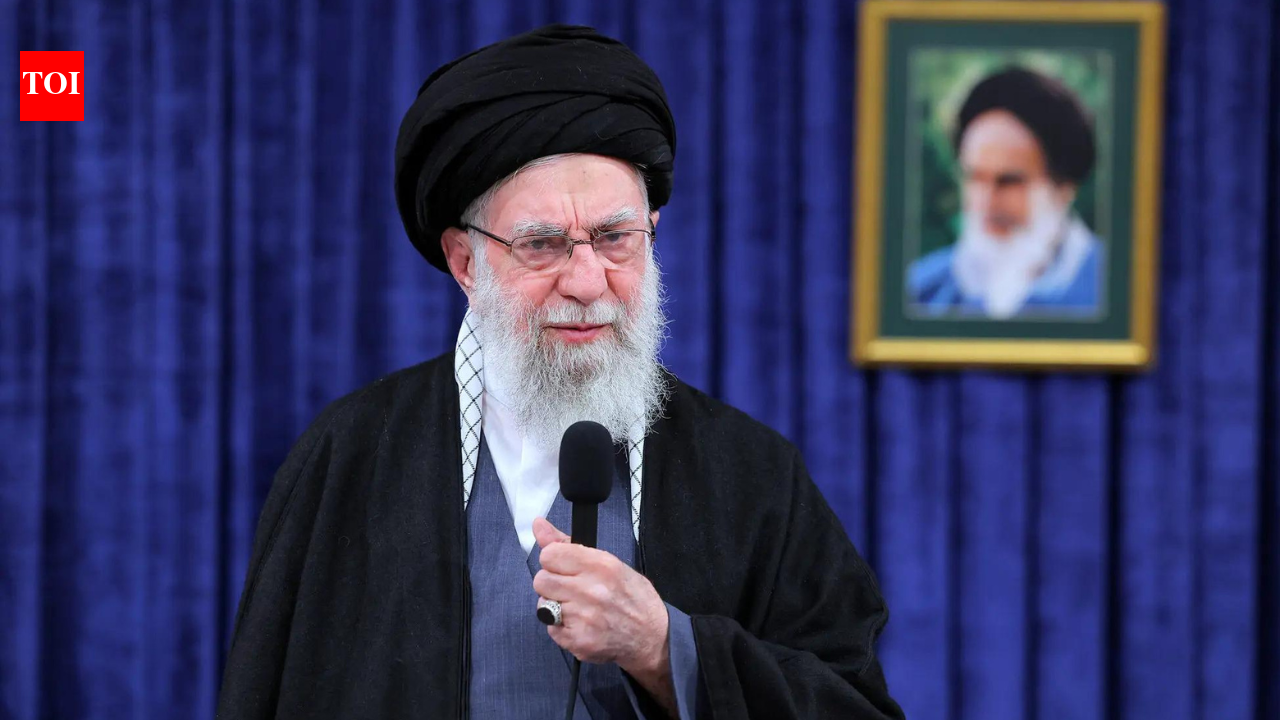
Iran Supreme Leader Ayatollah Ali Khamenei (AP file photo)

Iran Supreme Leader Ayatollah Ali Khamenei on Tuesday issued a series of direct threats against President Donald Trump and the United States, saying that even the “strongest military force in the world may at times be struck so hard that it cannot get up again,” amid ongoing tensions between Tehran and Washington.Taking to X, Khamenei targeted the Trump administration and warned Washington over its efforts to keep Tehran’s political regime and nuclear programme under close surveillance. He said, “The US President keeps saying that they have the strongest military force in the world. The strongest military force in the world may at times be struck so hard that it cannot get up again.”

US-Iran War Outcome Decided? Trump Deploys ‘Radar-Blinding’ Growler In Middle East

The Supreme Leader also referred to America’s deployment of US warships near Iran. In an apparent escalation, he warned that Iran has the capability to strike them, saying, “The Americans constantly say that they’ve sent a warship toward Iran. Of course, a warship is a dangerous piece of military hardware. However, more dangerous than that warship is the weapon that can send that warship to the bottom of the sea.”He added, “The US President has said that for 47 years, the United States hasn’t been able to eliminate the Islamic Republic. That is a good confession. I say, ‘You, too, will not be able to do this.’”Relations between Tehran and Washington have remained strained for years, with Trump repeatedly threatening Iran’s leadership and warning of possible military action to curb its nuclear ambitions.The United States has also deployed warships near Iran to monitor its activities and keep check on it. Last year, Washington launched “Operation Midnight Hammer” aimed at countering Iran’s nuclear programme, and Trump has continued to warn of potential military action against the Iranian regime.


Source link

Auto wholesale growth to normalise at 3–6% in FY27 after strong H2 recovery: Report


Auto wholesale growth to normalise at 3–6% in FY27 after strong H2 recovery: Report

Domestic passenger vehicle (PV) volumes are estimated to grow 4–6 per cent year-on-year in 2026–27, supported by sustained demand momentum.Srikumar Krishnamurthy, senior vice president & co-group head – corporate ratings at ICRA, said, “The current fiscal has unfolded as a tale of two halves for the Indian automotive industry, with the first half witnessing subdued demand while the second half is seeing a strong recovery on the back of policy support and healthy rural demand.“Industry sales volumes have been robust over the past few months, aided by the GST rate cut, pent-up demand, supportive rural output, and conducive financing environment. Although demand sentiment remains optimistic, volumes are reaching levels that would weigh on the potential for outsized growth in 2026-27,” he added, as quoted by news agency ANI.ICRA expects PV wholesale volumes to grow 5–7 per cent in 2025–26 before moderating to 4–6 per cent in 2026–27, due to a higher base and elevated system-level inventory.Utility vehicles continue to outperform other categories, supported by shifting consumer preferences and new model launches. The share of alternative powertrains — including CNG, hybrids and electric vehicles, is rising steadily amid regulatory pushes and evolving customer preferences.

Two-wheelers: Growth to ease after recovery

The two-wheeler (2W) industry is currently witnessing a gradual recovery, with growth estimated at 6–9 per cent in 2025–26, aided by healthy agricultural output and improved financing availability.However, growth is expected to normalise to 3–5 per cent in 2026–27.ICRA noted that premiumisation is shaping demand trends in the segment. While entry-level motorcycle demand remains under pressure due to affordability constraints, premium motorcycles and scooters have recorded a sharp recovery.

Commercial vehicles: Bus segment to lead

Commercial vehicle (CV) wholesale volumes are projected to expand 7–9 per cent in 2025–26, led by the light commercial vehicle and bus segments.Replacement demand and infrastructure activity remain supportive, though regulation-led price hikes may limit stronger growth for trucks.For 2026–27, the CV segment is estimated to grow 4–6 per cent overall, with bus volumes expected to outperform at 7–9 per cent growth, driven by replacement demand from State Road Transport Undertakings.

Electrification: A key structural theme

Highlighting broader industry trends, Krishnamurthy said, “The Indian automotive industry is currently at crossroads amid changing consumer preferences, technological advancements, and focus on sustainability.” “ICRA expects the growth trajectory to continue in 2026-27, even as growth is likely to remain modest across segments. Over the medium term, vehicle electrification is expected to be a key structural theme, with EV penetration rising steadily across segments”, Krishnamurthy added.Overall, while growth is set to continue into 2026–27, it is expected to remain moderate as the industry adjusts to a higher base and evolving demand dynamics.


Source link

Gold price today: Yellow metal slips; check 24K, 22K city-wise rates in Delhi, Mumbai, Kolkata and more


Gold price today: Yellow metal slips; check 24K, 22K city-wise rates in Delhi, Mumbai, Kolkata and more

Gold prices declined more than 1 per cent in the futures trade on Tuesday amid easing safe-haven demand, improving geopolitical sentiment and a firm US dollar.On the Multi Commodity Exchange (MCX), gold for April delivery fell by Rs 2,228, or 1.44 per cent, to Rs 1,52,532 per 10 grams in a business turnover of 7,553 lots.“Gold traded on a softer note on Tuesday, consolidating after recent volatility as investors booked profits and reacted to a firmer US dollar and shifting interest-rate expectations from the Federal Reserve,” Gaurav Garg, research analyst at Lemonn Markets Desk, said, as quoted by news agency PTI.He added that safe-haven demand due to weakness in global equities and continued central bank buying helped limit the downside.Garg noted that in 2026, precious metals are witnessing a volatile corrective phase following last year’s strong rally, although the broader multi-year bullish trend remains intact. MCX gold is currently consolidating in the Rs 1.55–1.58 lakh per 10 grams range, below earlier peaks.“The current weakness is largely seen as consolidation rather than a trend reversal. Investors may consider holding and rebalancing on dips, while fresh allocations should be staggered amid choppy market conditions,” he said.In the global markets, Comex gold futures for April delivery dropped $119.6, or 2.37 per cent, to $4,926.7 per ounce.“Gold slipped below $4,970 per ounce amid thin trading volumes as several Asian markets, including China, remained closed for the Lunar New Year following a US market holiday,” Jigar Trivedi, senior research analyst at IndusInd Securities, said.Renisha Chainani, head – research at Augmont, said safe-haven demand eased as geopolitical tensions moderated and the US dollar strengthened.She noted that comments from President Donald Trump indicating indirect US involvement in upcoming nuclear discussions with Iran raised hopes of diplomatic progress. Fresh Ukraine-Russia talks also reduced immediate geopolitical tensions, improving overall risk appetite.“As risk sentiment improved, some investors reduced defensive positions in precious metals,” Chainani said, adding that market focus has now shifted to the Federal Reserve’s January meeting minutes for guidance on the interest-rate outlook.

City-wise gold rates today

Gold rate in Bengaluru today:

Bengaluru’s 24K gold price stands at Rs 15,491 per gram, while 22K gold costs Rs 14,200 and 18K gold is priced at Rs 11,618 per gram. Compared to yesterday, 24K gold declined by Rs 153, 22K fell by Rs 140, and 18K dropped by Rs 115.

Gold rate in Delhi today:

Delhi’s 24K gold price is Rs 15,506 per gram, with 22K at Rs 14,215 and 18K at Rs 11,633 per gram. Since yesterday, 24K gold decreased by Rs 153, 22K fell by Rs 140, and 18K declined by Rs 115.

Gold rate in Mumbai today:

Mumbai’s 24K gold price stands at Rs 15,491 per gram, while 22K gold is Rs 14,200 and 18K gold is priced at Rs 11,618 per gram. Compared to yesterday, 24K fell by Rs 153, 22K declined by Rs 140, and 18K dropped by Rs 115.

Gold rate in Chennai today:

Chennai’s 24K gold is trading at Rs 15,622 per gram, with 22K at Rs 14,320 and 18K at Rs 12,250 per gram. Since yesterday, 24K gold decreased by Rs 131, 22K fell by Rs 120, and 18K declined by Rs 100.

Gold rate in Kolkata today:

Kolkata’s 24K gold price is Rs 15,491 per gram, while 22K gold stands at Rs 14,200 and 18K gold at Rs 11,618 per gram. Compared to yesterday, 24K declined by Rs 153, 22K fell by Rs 140, and 18K dropped by Rs 115.

Gold rate in Hyderabad today:

Hyderabad’s 24K gold rate stands at Rs 15,491 per gram, with 22K at Rs 14,200 and 18K at Rs 11,618 per gram. Since yesterday, 24K fell by Rs 153, 22K declined by Rs 140, and 18K dropped by Rs 115.

Gold rate in Ahmedabad today:

Ahmedabad’s 24K gold price stands at Rs 15,496 per gram, while 22K is priced at Rs 14,205 and 18K at Rs 11,623 per gram. Compared to yesterday, 24K decreased by Rs 153, 22K fell by Rs 140, and 18K declined by Rs 115.
Gold rate in Jaipur today:

Jaipur’s 24K gold price is Rs 15,506 per gram, with 22K at Rs 14,215 and 18K gold at Rs 11,633 per gram. Since yesterday, 24K declined by Rs 153, 22K fell by Rs 140, and 18K dropped by Rs 115.

Gold rate in Bhubaneswar today:

Bhubaneswar’s 24K gold is priced at Rs 15,491 per gram, with 22K at Rs 14,200 and 18K at Rs 11,618 per gram. Compared to yesterday, 24K decreased by Rs 153, 22K fell by Rs 140, and 18K declined by Rs 115.

Gold rate in Pune today:

Pune’s 24K gold rate stands at Rs 15,491 per gram, while 22K is Rs 14,200 and 18K is Rs 11,618 per gram. Since yesterday, 24K declined by Rs 153, 22K fell by Rs 140, and 18K dropped by Rs 115.

Gold rate in Kanpur today:

Kanpur’s 24K gold price stands at Rs 15,506 per gram, with 22K at Rs 14,215 and 18K gold at Rs 11,633 per gram. Compared to yesterday, 24K decreased by Rs 153, 22K fell by Rs 140, and 18K declined by Rs 115.



Source link

Jeff Bezos wife MacKenzie Scott gave away more than anyone else on Earth in 2025, here’s the list of all organisations she donated to including the one under FBI investigation


Jeff Bezos wife MacKenzie Scott gave away more than anyone else on Earth in 2025, here's the list of all organisations she donated to including the one under FBI investigation

Amazon founder Jeff Bezos divorced MacKenzie Scott in 2019 after 25 years of marriage. After the divorce, Scott received roughly a 4% stake in Amazon, amounting to about 139 million shares at the time. We are in 2026 and Scott has given away more than 75% of her Amazon shares, donating around $26 billion giving sprint in seven years. Last year alone, she donated a record $7.2 billion, making her the third-biggest philanthropist of all-time, Forbes report says. It’s also the most donated in a single year since Forbes started tracking top givers in 2012, the report says.With the donations made in 2025, Scott has given more than world’s richest billionaires– Elon Musk, Larry Page, Larry Ellison and her ex-husband Bezos have in their lifetimes combined.

Mackenzie Scott becomes 3rd biggest philanthropist in US

Forbes recently published its list of America’s Top 25 Philanthropists. According to the list, Warren Buffett topped the list with a lifetime giving of $68.3 billion, followed by Bill Gates and Melinda French Gates who have a lifetime giving of $52.6 billion. Mackenzie Scott came in third with a total lifetime giving of $26.4 billion, donating 46% of her net worth. Meta CEO Mark Zuckerberg and wife Priscilia Chan also appeared in the list who have donTED $6.1 billion so far. Here’s the complete list

America’s Top 25 Philanthropists (Forbes)

1. Warren BuffettLifetime giving: $68.3 billionGiving focus: Health, poverty alleviationGiving as % of net worth: 32%Net worth: $146 billion2. Bill Gates and Melinda French GatesLifetime giving: $52.6 billionGiving focus: Health, poverty alleviationGiving as % of net worth: 28%Net worth: $134 billion3. MacKenzie ScottLifetime giving: $26.4 billionGiving focus: Education, economic equityGiving as % of net worth: 46%Net worth: $30.9 billion4. Michael BloombergLifetime giving: $25.4 billionGiving focus: Climate change, health, educationGiving as % of net worth: 19%Net worth: $109 billion5. George SorosLifetime giving: $24.0 billionGiving focus: Democracy, human rightsGiving as % of net worth: 76%Net worth: $7.5 billion6. Marilyn Simons and familyLifetime giving: $10.3 billionGiving focus: Science, mathGiving as % of net worth: 24%Net worth: $32.6 billion7. Steve and Connie BallmerLifetime giving: $6.5 billionGiving focus: Economic mobilityGiving as % of net worth: 4%Net worth: $141 billion8. Mark Zuckerberg and Priscilla ChanLifetime giving: $6.1 billionGiving focus: AI-powered biologyGiving as % of net worth: 3%Net worth: $213 billion9. Sergey BrinLifetime giving: $5.1 billionGiving focus: Parkinson’s, climate changeGiving as % of net worth: 2%Net worth: $249 billion10. Jeff Bezos and Lauren Sánchez BezosLifetime giving: $4.7 billionGiving focus: Climate, homelessnessGiving as % of net worth: 2%Net worth: $250 billion11. Phil and Penny KnightLifetime giving: $4.5 billionGiving focus: Education, medical researchGiving as % of net worth: 12%Net worth: $31.8 billion12. Dustin Moskovitz and Cari TunaLifetime giving: $4.3 billionGiving focus: Global health, AI safetyGiving as % of net worth: 29%Net worth: $10.5 billion13. Barbara PicowerLifetime giving: $4.1 billionGiving focus: Democracy, medical researchGiving as % of net worth: Not availableNet worth: < $1 billion14. Lynn and Stacy SchustermanLifetime giving: $4.0 billionGiving focus: Education, Jewish communityGiving as % of net worth: 47%Net worth: $4.4 billion15. Edythe Broad and familyLifetime giving: $3.6 billionGiving focus: Education, artsGiving as % of net worth: 34%Net worth: $7 billion16. Michael and Susan DellLifetime giving: $3.3 billionGiving focus: Education, economic stabilityGiving as % of net worth: 2%Net worth: $139 billion17. Pierre and Pam OmidyarLifetime giving: $3.1 billionGiving focus: Poverty alleviation, human rights, educationGiving as % of net worth: 20%Net worth: $12.1 billion18. Eric and Wendy SchmidtLifetime giving: $2.9 billionGiving focus: Education, scientific researchGiving as % of net worth: 7%Net worth: $37.2 billion19. Billi Marcus and familyLifetime giving: $2.7 billionGiving focus: Medical research, Jewish causesGiving as % of net worth: Not availableNet worth: < $1 billion20. Ken GriffinLifetime giving: $2.5 billionGiving focus: Medical research, educationGiving as % of net worth: 5%Net worth: $51.8 billion21. George KaiserLifetime giving: $2.5 billionGiving focus: Education, healthGiving as % of net worth: 14%Net worth: $15.7 billion22. John and Laura ArnoldLifetime giving: $2.3 billionGiving focus: Education, criminal justice reformGiving as % of net worth: 44%Net worth: $2.9 billion23. Reed Hastings and Patty QuillinLifetime giving: $2.2 billionGiving focus: EducationGiving as % of net worth: 31%Net worth: $4.9 billion24. Donald BrenLifetime giving: $2.1 billionGiving focus: Education, conservationGiving as % of net worth: 10%Net worth: $19.2 billion25. Charles KochLifetime giving: $2.0 billionGiving focus: Education, poverty alleviationGiving as % of net worth: 3%Net worth: $73.8 billion

List of organisations Mackenzie Scott donated to

Scott has donated to hundreds of organisations in 2025. Among many of her 2025 donations went to causes focused on DEI, disaster recovery, and higher education, one has sparked debate. In a December 9 blog post written, Scott said her philanthropic organization Yield Giving donated to Solidaire Network, which says it “nurtures relationships between social movements and members to create regenerative systems rooted in love and justice.” “This means in practice that the network has funded organizations including Students for Justice in Palestine (SJP), American Muslims for Palestine (AMP), the US Palestinian Community Network, and the Palestinian Youth Movement (PYM), according to tax filings and press releases from the Solidaire Network,” the report said. It is also facing investigations in both the House and Senate for allegedly coordinating with terror group Hamas to start anti-Israel protests in the U.S, Forbes reported.List of organisations:


Source link

‘Much lower than Japan, China’: Fares of Vande Bharat chair car Rs 2.19 per kilometre; global range at Rs 7-20


‘Much lower than Japan, China’: Fares of Vande Bharat chair car Rs 2.19 per kilometre; global range at Rs 7-20

Vande Bharat chair car is an all air-conditioned service that was first introduced in 2019.

How do the fares of Vande Bharat chair car trains compare to similar trains around the world? According to Railway Minister Ashwini Vaishnaw, the ticket prices for the Vande Bharat chair car are much lower than such trains operating in countries such France, China, and Japan.Vande Bharat chair car is an all air-conditioned service that was first introduced in 2019 and has since then expanded across the Indian Railways network. The self-propelled train set is said to be a world-class offering by the national transporter, allowing for better passenger amenities and faster train travel.

Vande Bharat Chair Car Fares

Recently, Ashwini Vaishnaw informed the Lok Sabha that the fare for the Vande Bharat AC chair car for journeys covering around 300 to 400 kilometres is approximately Rs 2.19 per kilometre. This, he said, is significantly lower than comparable services in countries such as China, Japan and France. “The fare of Vande Bharat AC chair car over a journey between 300 and 400 kilometres is around Rs 2.19 per kilometre, which is much lower than the fares of similar segments of services in countries like China, Japan and France, where it ranges from Rs 7 to Rs 20 per kilometre,” Vaishnaw said.Also Read | How seven new high-speed rail corridors can transform train travel in IndiaIn his written reply, Vaishnaw said the Ministry of Railways determines passenger fares after considering multiple factors, including operational costs, the value and quality of services provided, the nature of facilities offered, affordability for passengers, competition from alternative modes of transport, and broader socio-economic considerations.Vande Bharat train services currently operate across 82 routes, running a total of 164 services. According to the minister, these trains function as a separate category within passenger services, featuring a different fare structure along with amenities such as improved suspension systems, quicker acceleration through semi-high-speed operations, automatic plug doors, ergonomic seating, mini pantry facilities, CCTV surveillance and the KAVACH safety system.Vaishnaw added that passenger affordability has remained a key consideration, and as a result, ticket prices for these trains have been maintained below the actual cost of providing the service.He further said, “The rationalised fare structure has facilitated the wider expansion of these services across the country, reflecting strong passenger demand for these services. Vande Bharat services have high occupancy level on all major routes with occupancy of Vande Bharat near 100 per cent, demonstrating a change in passenger preferences.”Commenting on fares in the ordinary class of other trains, Vaishnaw said these remain among the lowest when compared internationally. Drawing a comparison with neighbouring countries, he noted that the per-kilometre fare in India stands at about 20 paise, while the corresponding fares are 54 paise in Pakistan, 37 paise in Bangladesh and 51 paise in Sri Lanka.Recently a sleeper version of the Vande Bharat Express train has also been launched, and hundreds of such trains are planned for overnight train travel in the coming years.


Source link

Amazon wants 80% of its developers to use AI for coding at least once a week, but there’s one condition


Amazon wants 80% of its developers to use AI for coding at least once a week, but there's one condition

Amazon is pushing hard to make AI-assisted coding an everyday habit across the company. The target is clear—80 per cent of developers should be using AI for coding tasks at least once a week, according to the Financial Times. But the company isn’t leaving the choice of tool up to its engineers. It wants them on Kiro, its in-house AI coding assistant that launched in July 2025, and it’s actively discouraging everything else.An internal memo viewed by Reuters last November laid it out plainly: “We do not plan to support additional third-party AI development tools.” The memo, signed by two senior VPs—Peter DeSantis of AWS utility computing and Dave Treadwell of eCommerce Foundation—named Kiro as Amazon’s “recommended AI-native development tool.” OpenAI‘s Codex was flagged as “Do Not Use” after a six-month review. Anthropic’s Claude Code briefly got the same tag before the designation was reversed.A spokesperson told Business Insider that about 70 per cent of Amazon’s software engineers used Kiro at least once in January. The company wants to push that number higher—and fast.

Engineers aren’t thrilled—1,500 of them backed Claude Code instead

Not everyone is on board. Around 1,500 Amazon employees endorsed the formal adoption of Claude Code in an internal forum discussion, Business Insider reported. Many argued it was simply the better tool. “A tool that can’t keep pace with rivals offers no real innovation,” one employee wrote, adding that Kiro’s “only survival mechanism becomes forced adoption rather than genuine value.”The frustration is sharpest among AWS sales engineers who are tasked with selling Claude Code to customers through Amazon’s Bedrock platform—while being barred from using it for their own production work. “Customers will ask why they should trust or use a tool that we did not approve for internal use,” one of them wrote. Amazon maintains there’s no outright ban on Claude Code but says it applies “stricter requirements” for production tools.What makes this especially complicated is that Amazon has invested $8 billion in Anthropic, the company behind Claude Code, and signed a $38 billion cloud computing deal with OpenAI, whose Codex tool it also restricts internally.

Jassy’s bigger play: $200 billion in AI spending, 30,000 fewer jobs

The Kiro push is one piece of a much larger AI transformation under CEO Andy Jassy. He has told staff that AI-driven efficiency gains will shrink Amazon’s corporate workforce over time, and the numbers back that up. The company has cut 30,000 corporate roles since October 2025—the biggest reduction in its history—while committing a record $200 billion in capital expenditure this year, most of it directed at AI infrastructure and data centres, the Financial Times reported.Even as Amazon bets everything on its own AI tools, some of its own engineers aren’t convinced. Several told the Financial Times they preferred Anthropic’s Claude over Amazon’s Nova models for coding. One AWS engineer put it bluntly to FT: “I didn’t even know we had a model.”


Source link

Indian man accused of sexually assaulting minor held in New Jersey; ICE takes custody


Indian man accused of sexually assaulting minor held in New Jersey; ICE takes custody
(Image credits: X @ICEgov)

An Indian-origin man accused of multiple offences, including the sexual assault of a minor, has been detained by the US Immigration and Customs Enforcement (ICE). Vodela Yashaswi Kottapalli faces charges in New Jersey for the sexual assault of a child under 13 years of age, shoplifting and public disorderIn a post on X, ICE said, “Vodela Yashaswi Kottapalli, a criminal illegal alien from India, has pending charges for sexual assault and larceny in New Jersey. We’ll keep him in custody pending removal proceedings.The agency said he remains in custody pending removal proceedings.The enforcement action comes as ICE has intensified action against undocumented migrants during the second term of Donald Trump, with the agency publicly sharing details of arrests and detentions involving foreign nationals accused of crimes.In December, ICE had also released details of another case involving an Indian truck driver linked to a fatal motorway crash in Oregon that killed two people. Authorities said the driver entered the United States illegally through Arizona in November 2022 and later received work authorisation and a commercial driving licence from California state authorities.That case followed several similar crashes involving Indian nationals driving heavy goods vehicles in the US. In recent months, US authorities have highlighted at least three other fatal accidents in Florida and California involving undocumented Indian lorry drivers.


Source link

Safety-first approach, brittle batting: Why Pakistan froze before India’s ingenuity | Cricket News


Safety-first approach, brittle batting: Why Pakistan froze before India’s ingenuity
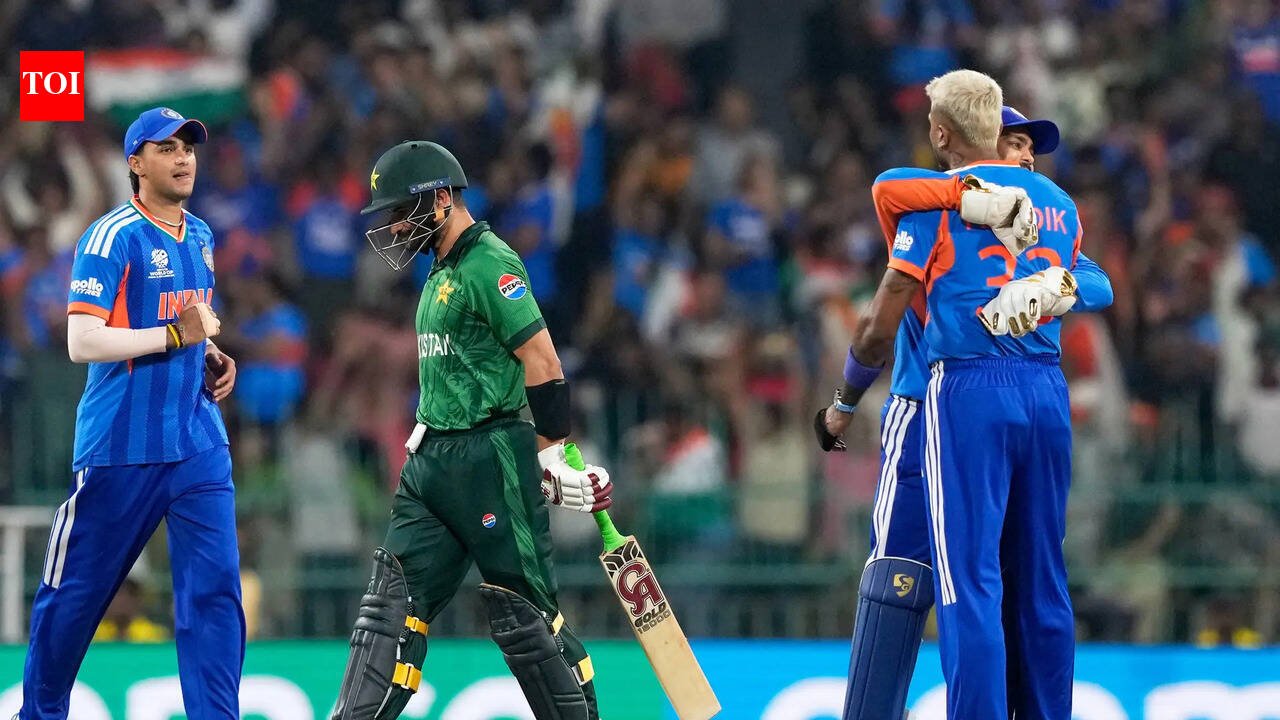
Hardik Pandya, right, celebrates with teammate Ishan Kishan the wicket of Pakistan’s Sahibzada Farhan. (AP Photo)

COLOMBO: All those who don’t mind a sense of competition in an India-Pakistan game were left scratching their heads by late Sunday at the Premadasa.Go Beyond The Boundary with our YouTube channel. SUBSCRIBE NOW!Pakistan have been in Sri Lanka since the start of this World Cup, and have the spinners to make use of the slow pitch conditions here. There is an X-factor bowler in Usman Tariq, who may not be Varun Chakravarthy but has taken wickets in 24 consecutive T20 games and bowls at an economy rate of 5.93 in T20Is.

Mike Hesson press conference: ‘Ishan took the game away from us’ after India beat Pakistan

Still, when it came to the high-pressure India game, it was a meek surrender. It seemed that the Pakistan team had learnt nothing from their hat-trick of Asia Cup defeats and went down even before the game could take the shape of a contest.Before going into any analysis, let’s accept one thing. India are a superior side than Pakistan and for the neighbours to turn the tables, it will need an upset. But the passionate Pakistan fans are well within their rights to demand that upset once in a blue moon. Like the Indian teams from the mid-80s to the early 2000s — they won the World Cup games, the Independence Cup in Bangladesh and one Sahara Cup in Toronto even as Pakistan dominated the subcontinental rivalry.

Poll

What was the main reason for Pakistan’s loss against India?

On Sunday, for Pakistan it was a case of being timid to start with. The pitch gets slower and it would have been much easier for Pakistan to set a target and pressurize India with their spinners.But they got it wrong by choosing to field first and bringing all the pressure on their batting line-up, which is average at best. They should have understood that if it took them a humongous struggle to chase 147 against the Netherlands, they are not good enough to cross the line chasing against India, a side that would not give you a sub-160 target even on their worst batting day.“I was surprised to see Pakistan choose to field after winning the toss. That’s where they lost half the game,” spin legend R Ashwin said on his youtube show. Pakistan coach Mike Hesson, though, defended his skipper Salman Agha’s decision and felt it was Ishan Kishan’s brilliance that took the game away from them. “The pitch didn’t slow down and it spun less in the second innings. So you have to look at the facts rather than be emotional. It was the quality of the bowling in the first six overs and the way Ishan played that took the game away from us,” Hesson said.Also, hurting Pakistan cricket is the poor form of paceman Shaheen Afridi. He has been below-par with each successive game, but there’s some reason better known to the team management that he can’t be dropped. On Sunday, he bowled two crucial overs and gave away 31 which, in a low-scoring game, was huge. For India, Jasprit Bumrah and Hardik Pandya, the two pacers, bowled five overs conceding 33 and took four wickets. “Afridi cannot bowl the hard length consistently on a pitch like this. And if he was bowling to Ishan, he should have tried something different,” Ashwin said.The third aspect, is of course the Pakistan batting approach. It’s true that 175 on a slow pitch was akin to a 225 on any Indian track. Still keeping wickets towards the end would have given Pakistan a fighting chance at the back end.Former Pakistan captain Ramiz Raja, on his show said that he finds it hard to fathom the approach of the Pakistani team. “They learnt nothing from their Asia Cup losses. They keep trying the slam bang approach, which cannot work for them against a team as skilled as this India. But no player is ready to take the game deep,” Rameez pointed out.But for the negatives, Pakistan can still qualify for the Super-8s with a win against Namibia on Wednesday. They will continue to play in Colombo if they go that far and the fans will hope against hope that the opposition teams will not be as lethal as India.


Source link

‘In the lap of the gods’: How Australia can still reach Super 8s in the T20 World Cup despite Sri Lanka heartbreak | Cricket News


‘In the lap of the gods’: How Australia can still reach Super 8s in the T20 World Cup despite Sri Lanka heartbreak
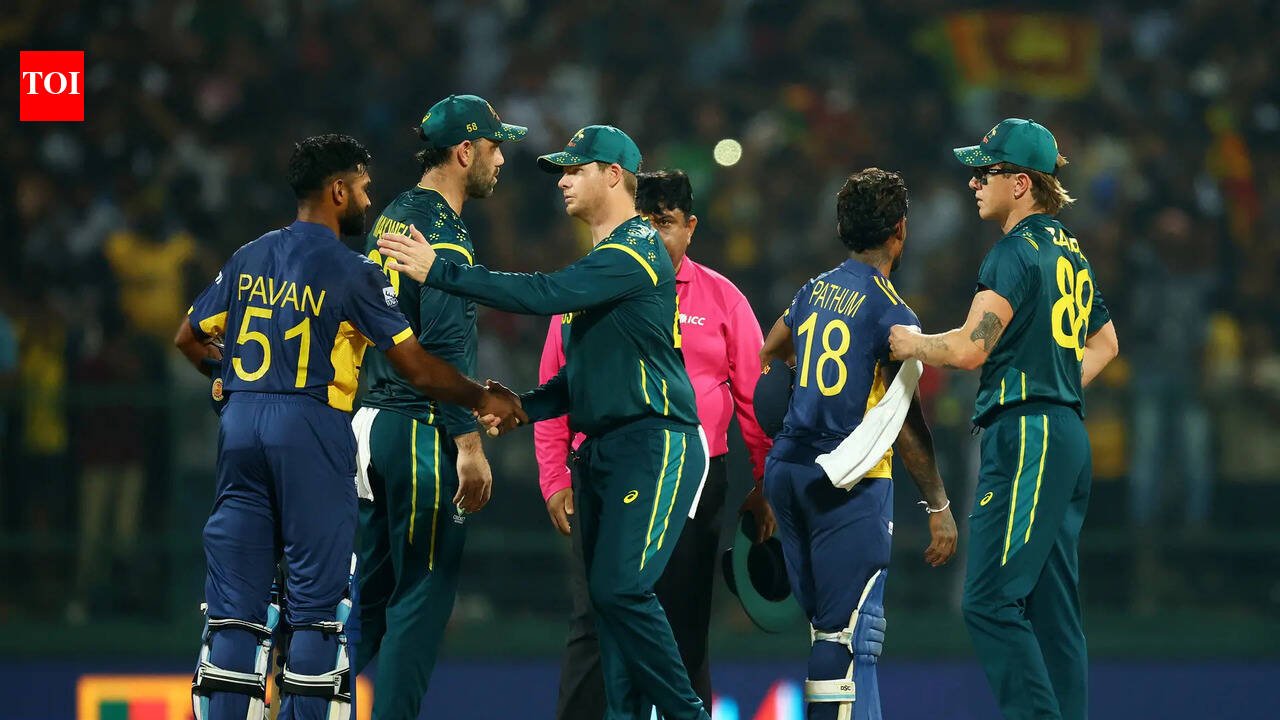
Steve Smith of Australia shakes hands with Pavan Rathnayake of Sri Lanka after the match. (Getty Images)

NEW DELHI: A shattered Mitchell Marsh did not hide his emotions after Australia crashed to a crushing eight-wicket defeat against Sri Lanka in a must-win clash at the Pallekele International Cricket Stadium on Monday, conceding his side’s fate in the tournament is now out of their hands.Go Beyond The Boundary with our YouTube channel. SUBSCRIBE NOW!Australia posted 181 after a blazing start but were blown away by a sensational chase led by Pathum Nissanka, whose unbeaten century sealed Sri Lanka’s place in the Super 8s and left the former champions staring at an early exit.“It is a devastated group. We’re in the lap of the gods now, I think, with the way it’s shaped up,” Marsh said in a brutally honest assessment. “There’s a lot of emotion in the rooms right now. We haven’t been at our best… we’re a disappointed bunch at the moment.”

T20 World Cup: India humiliate Pakistan again

Blazing start, bitter finishAt the halfway stage of their innings, Australia looked firmly in control. Marsh (54) and Travis Head (56) powered their side to a commanding 110/2, setting the platform for a massive total. But what followed was a dramatic collapse in momentum, as Sri Lanka’s bowlers tightened the screws.“Well, I thought it was a competitive total at the halfway mark. There’s no doubt we probably left ourselves a few short after the start that we had. So that’s disappointing,” Marsh admitted. “We know that at our best we can make big scores. And we just lost our way a little bit there towards the back-end. Couldn’t get a partnership going and Sri Lanka bowled really well.”He added with resignation: “Coming off, we knew we were a few short… not much else to say other than Sri Lanka outplayed us tonight.”Sri Lanka made Australia pay dearly. Nissanka’s breathtaking 100 not out off just 52 balls turned the chase into a statement, as Australia’s bowlers had no answers on a night when everything seemed to slip away.Qualification hopes hang by a threadThe defeat marked Australia’s second consecutive loss and left them in a precarious position in Group B. With just one win from three matches, their Super 8 hopes now hinge on other results — particularly the crucial clash between Zimbabwe and Ireland.Marsh admitted the team could only watch and hope.“We watch the Zimbabwe-Ireland game and we hope… but yeah, we’re a disappointed bunch at the moment,” he said.

Australia T20 World Cup

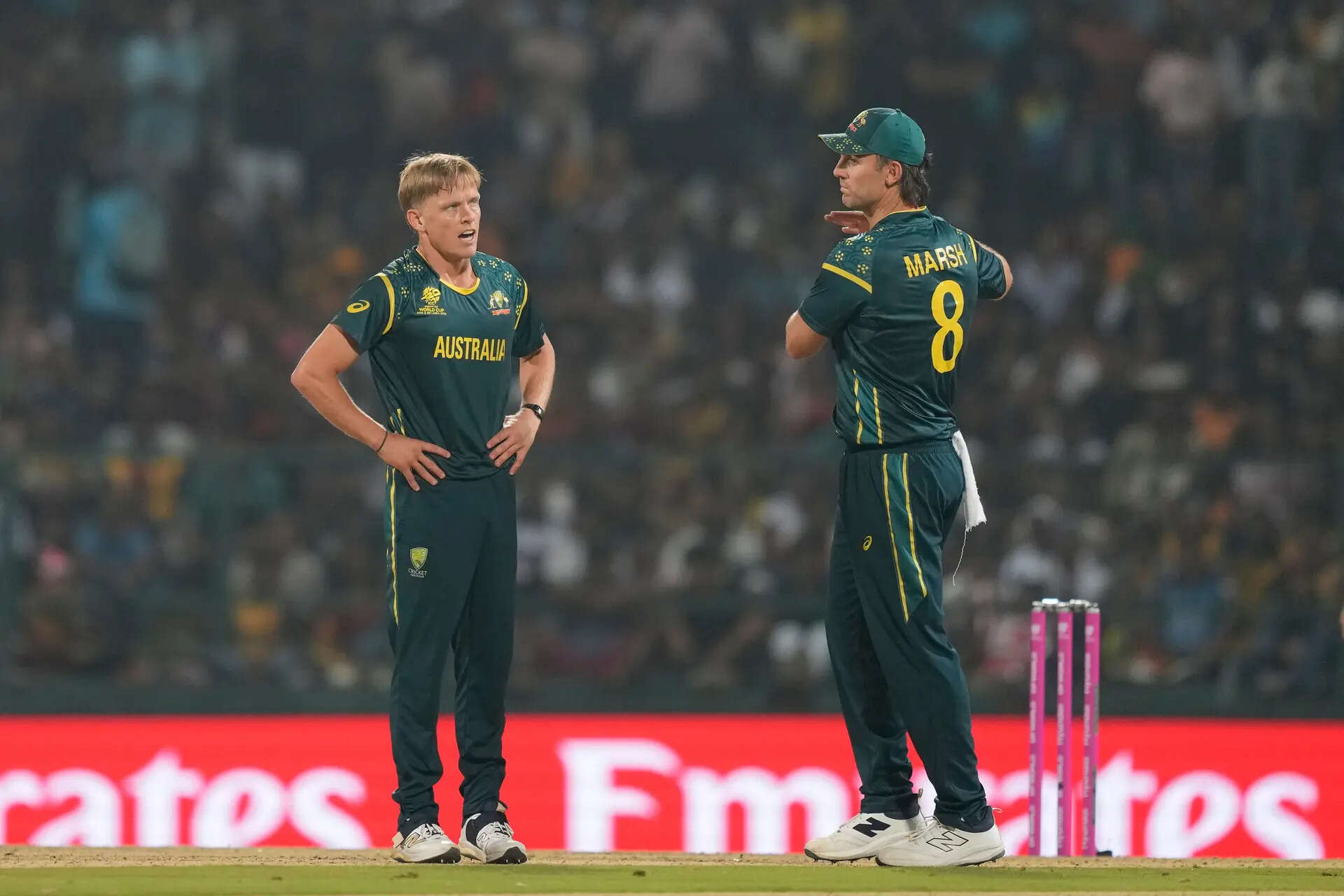
Australia’s captain Mitchell Marsh, right, with Nathan Ellis. (AP Photo)

T20 World Cup: How Australia can still qualify for Super 8s

The qualification equation is tense and unforgiving.If Zimbabwe beat Ireland on Tuesday, Australia will be eliminated from the tournament. However, an Ireland victory will keep Australia’s hopes alive and open up a three-way fight for the remaining Super 8 spot.In that scenario, Zimbabwe’s final group match against Sri Lanka on February 19 will become decisive. A Zimbabwe win over the co-hosts will take them through to the Super 8s alongside Sri Lanka, ending Australia’s chances regardless of other results.But if Zimbabwe lose to Sri Lanka — and Ireland have already beaten Zimbabwe — then Zimbabwe and Ireland will both finish on four points, bringing net run rate into play to determine the second qualifier from the group.Australia, who face Oman on February 20 in their final match, will then enter the contest with a clear net run rate equation. They will need a convincing win and a favourable swing in numbers to stay alive and secure a dramatic late qualification.


Source link

Yunus mentions ‘Northeast’ in speech as he bows out


Yunus mentions 'Northeast' in speech as he bows out
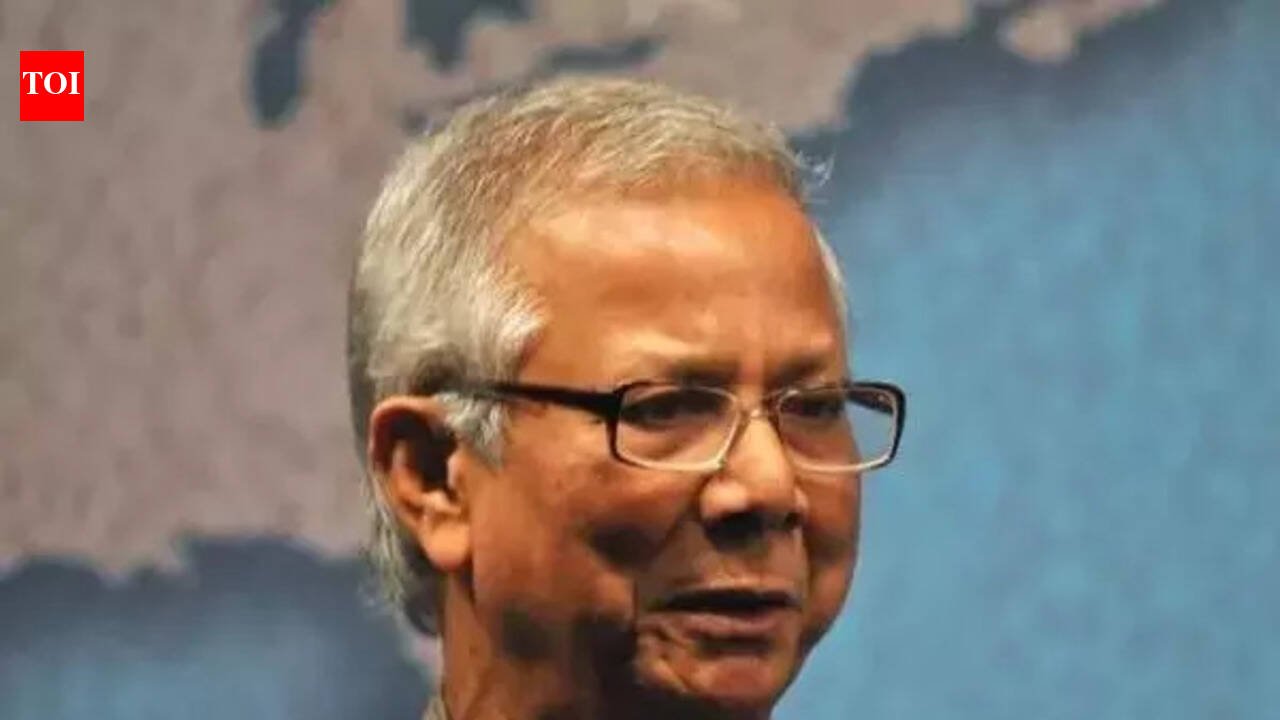
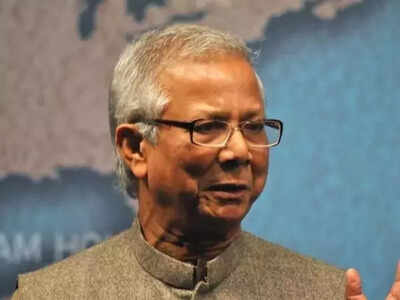
Muhammad Yunus (File photo)

On his last day as Bangladesh chief adviser, Muhammad Yunus on Monday claimed that the interim govt led by him has been able to firmly restore the country’s sovereignty, national interests and dignity in foreign policy – an allusion to former PM Sheikh Hasina’s proximity to India. “Bangladesh is no longer a country with submissive foreign policy or dependent on the instructions and advice of other countries, today’s Bangladesh is confident, active, and responsible in protecting its independent interests,” said Yunus in a televised address to the nation, a day ahead of the interim govt handing over power to the new govt led by BNP’s Tarique Rahman.Tarique, the son former premier Khaleda Zia, will take oath of office as Bangladesh’s PM along with his cabinet members on Tuesday.In his around 25-minute speech, Yunus – who took charge of Bangladesh on Aug 8, 2024, as chief adviser – did not miss out on mentioning the “Northeast region”. Bangladesh can provide huge potential for economic prosperity for the Northeast region, including India’s “seven sister states, Nepal and Bhutan”.“Through economic zones, trade agreements, and access to duty-free markets, a strong foundation will be established for this region to become a global manufacturing hub,” he said. “Our open sea is not just a geographical boundary, it is an open door for Bangladesh to connect with the global economy,” Yunus saidHis comments last year that India’s “landlocked Northeast faced the prospect of becoming an extension of Chinese economy” had led to further straining of New Delhi-Dhaka ties, which had hit a low after Hasina’s ouster as PM.Before his address, Yunus on Monday participated in a brief farewell ceremony at his office, drawing the curtains on a tenure marked by anti-India posturing, rise of extremism, unabated attacks on minorities, particularly Hindus, and instability. Yunus had little to say in his speech to officials, except for thanking then for their support.


Source link