Breaking News
3-hr takedown, AI labels: Govt cracks down on deepfakes | India News


3-hr takedown, AI labels: Govt cracks down on deepfakes

NEW DELHI: Cracking down on deepfakes, the Centre has tightened India’s digital rules by mandating compulsory labelling, traceability and user declarations for AI-generated content. It has also sharply cut timelines to take down unlawful content to as little as three hours from 36 hours and placed direct compliance responsibility on social media platforms and their senior officers.For the first time, AI-generated material, including deepfake videos, synthetic audio and manipulated visuals, has been brought under a formal regulatory framework through amendments to the IT intermediary rules. The Information Technology (Intermediary Guidelines and Digital Media Ethics Code) Amendment Rules, 2026 will come into force from Feb 20. The amended rules introduce a statutory definition of “synthetically generated information” (SGI).AI-made, edited posts must carry clear disclosureThe new rules impose mandatory obligations on intermediaries to identify, label and trace AI content. All AI-generated or AI-altered material must carry a clear and prominent disclosure visible to users. Platforms must also embed persistent metadata and unique identifiers to enable traceability of the content’s origin and the tools used to create it. Once applied, these disclosures cannot be altered, hidden or removed.The rules exclude routine edits such as colour correction, noise reduction, compression or translation, as long as they do not change the meaning. Clearly hypothetical or illustrative drafts are exempt.Large social media platforms face stricter compliance requirements. Before any content goes live, platforms must ensure users declare if it is AI-generated. Intermediaries must deploy automated tools to verify these declarations by analysing the content’s format, source and characteristics. If content is identified as synthetic, visible labelling becomes mandatory. Platforms that knowingly allow unlabelled AI-generated content to remain online will be treated as having failed their due-diligence obligations.The rules also compress response timelines. Certain lawful takedown orders must now be complied with within three hours, compared to 36 hours earlier. Other deadlines have been tightened, with a 15-day window reduced to 7 days and a 24-hour window cut to 12 hours. Platforms must acknowledge user grievances within two hours and resolve them within seven days.Oversight and enforcement will rest with the ministry of electronics and information technology, while users can appeal platform decisions to the grievance appellate committee.Misuse of SGI linked to child sexual abuse material, obscene content, false electronic records, impersonation using a real person’s identity or voice, or explosives-related material will attract action under multiple criminal laws.Platforms must also warn users at least once every three months about penalties for misuse of AI-generated content.


Source link

US trade deal will bite into Kashmiri apples: J&K CM Omar Abdullah | India News


US trade deal will bite into Kashmiri apples: J&K CM Omar Abdullah

JAMMU: J&K legislators voiced concern on Tuesday over the US trade deal’s potential impact on Kashmiri apples, with many describing it as a “death blow”.“They (Centre) have told America it can send as much fruits and apples as it wants at zero duty and we will buy it here. Where has their sympathy for Jammu and Kashmir gone?” CM Omar Abdullah asked in the assembly.Omar questioned claims by some BJP legislators that the trade deal would benefit the region. “I am still trying to understand where this good thing is for J&K,” Omar said. He claimed apples and walnuts have been placed under zero-duty imports as part of the agreement.CPM legislator MY Tarigami flagged similar worries, claiming the Centre had signed another deal with New Zealand. “These agreements are posing serious challenges to Kashmir’s apple industry, the backbone of our economy,” Tarigami said.PDP MLA Waheed Parra demanded minimum support prices (MSP) for the region’s horticultural produce.


Source link

‘Could be part of conspiracy’: Rohit Pawar raises doubts over Ajit Pawar plane crash | India News


'Could be part of conspiracy': Rohit Pawar raises doubts over Ajit Pawar plane crash

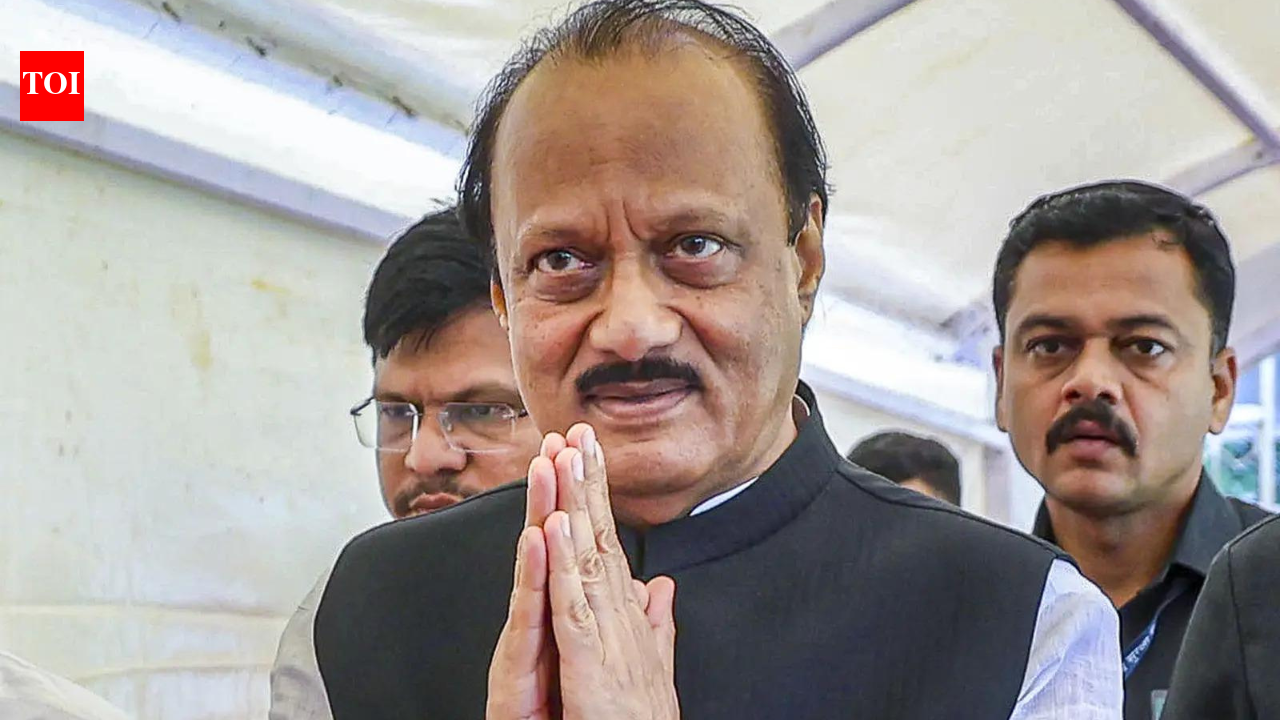
NEW DELHI: NCP (SP) leader Rohit Pawar on Tuesday suggested that the death of Maharashtra deputy chief minister Ajit Pawar in a plane crash could have been part of a larger conspiracy, as several questions surrounding the incident remain unanswered.Rohit Pawar made the remarks during a presentation in Mumbai on the air crash that killed Ajit Pawar and four others last month. While briefing on the incident, he said that the circumstances leading up to the crash warranted closer scrutiny.“Ajit Dada’s plane crash could be a part of a conspiracy. We also investigated certain aspects of the accident. A book mentions that if someone wants to kill a person, the easiest way is to target the driver. The day before the accident, Dada was supposed to travel from Mumbai to Pune by car, and the convoy had also started. But why did he not leave by car? Ajit Dada was also scheduled to meet a senior leader,” Rohit Pawar said.He alleged that there were serious doubts about the aircraft, the pilot and the handling company. Rohit said that the crash warranted scrutiny beyond routine procedures.He questioned the credentials of the pilot who flew the aircraft on the day of the crash. The NCP (SP) leader referred to Capt Sumit Kapoor, who was piloting the Learjet and cited his past suspension.“Capt Sumit Kapoor had earlier been suspended for three years for alcohol consumption. This raises serious questions,” he said, while adding that the pilot’s role needed thorough examination.Rohit Pawar also raised concerns over the investigation process, arguing that existing agencies may not be sufficient to clear all doubts.“The AAIB functions under the DGCA. There is a need for an independent and comprehensive probe by multiple expert agencies, including international bodies,” he said, naming agencies such as the National Transportation Safety Board, the UK-based Air Accidents Investigation Branch, along with Indian authorities.He further alleged that VSR Company, which owned the Learjet aircraft, wielded influence over aviation regulators.“The final probe report of the 2023 crash involving a VSR company aircraft has already been submitted. Even now, VSR company planes continue to be used by high-ranking political leaders. Why was the company’s licence never cancelled?” Rohit Pawar asked.Stating that the tragedy could not be dismissed as an accident, he added, “We do not believe this was a mere accident. There is room to suspect sabotage.”“Entire Maharashtra is questioning whether Ajit Dada’s plane crash was an accident or a conspiracy? I am sharing with you all what I feel. Some people are still expecting dada to come from somewhere, some say 6 people were in aircraft, it was not Ajit dada’s dead body, it still feels like a nightmare,” Rohit said. Rohit Pawar also flagged multiple technical and operational issues, including whether the aircraft’s transponder was switched off, why a difficult runway was chosen despite poor visibility, and why the aircraft attempted landing under such conditions.“Why did the pilot demand Runway 11? Why did he attempt to land despite visibility issues? Why did he remain silent when the aircraft tilted?” he asked.He further said that Ajit Pawar was scheduled to travel to Pune by road on the evening of January 27 after a cabinet meeting and that his convoy had already been readied.“However, a leader from East Vidarbha arrived with a file related to scrapping a political consultant’s contract, which delayed the meeting. The aircraft booking was done late at night. Ajitdada was scheduled to take off at 7 am, yet the plane departed only at 8.10 am,” Rohit Pawar said.Ajit Pawar was killed on January 28 when a chartered Learjet aircraft crashed while attempting to land at the table-top airstrip in Baramati, Pune district. Four others, including his personal security officer, the pilot, co-pilot and a flight attendant, also lost their lives in the crash. The Zilla Parishad and Panchayat Samiti elections in Maharashtra were postponed following the incident.Notably, NCP (SP) chief Sharad Pawar has earlier ruled out any conspiracy and described the incident as an accident.West Bengal chief minister Mamata Banerjee earlier alleged that Ajit Pawar’s death could be linked to a political conspiracy and demanded a Supreme Court-monitored investigation, citing reports that he was considering rejoining the NCP (SP) led by Sharad Pawar.Meanwhile, the Union government has said that a technical investigation is under way. Minister of state for civil aviation Murlidhar Mohol said that the Aircraft Accident Investigation Bureau (AAIB) and the Directorate General of Civil Aviation (DGCA) were examining the crash.“The black box has been recovered and is being analysed. The data will be downloaded, followed by a detailed inquiry. A preliminary report will be released after that,” Mohol said, urging caution against drawing premature conclusions.Authorities have said the investigation is being conducted under the AAIB Rules, 2025 and will determine the exact sequence of events, including the role of weather and visibility conditions during the aircraft’s attempted landing.The Maharashtra Crime Investigation Department (CID) has also initiated a parallel investigation, while Pune Rural Police have registered a case of accidental death and transferred it to the CID.


Source link

‘This is the status of the book’: Ex-army chief MM Naravane reacts to row over memoir; shares publisher’s statement | India News


'This is the status of the book': Ex-army chief MM Naravane reacts to row over memoir; shares publisher's statement
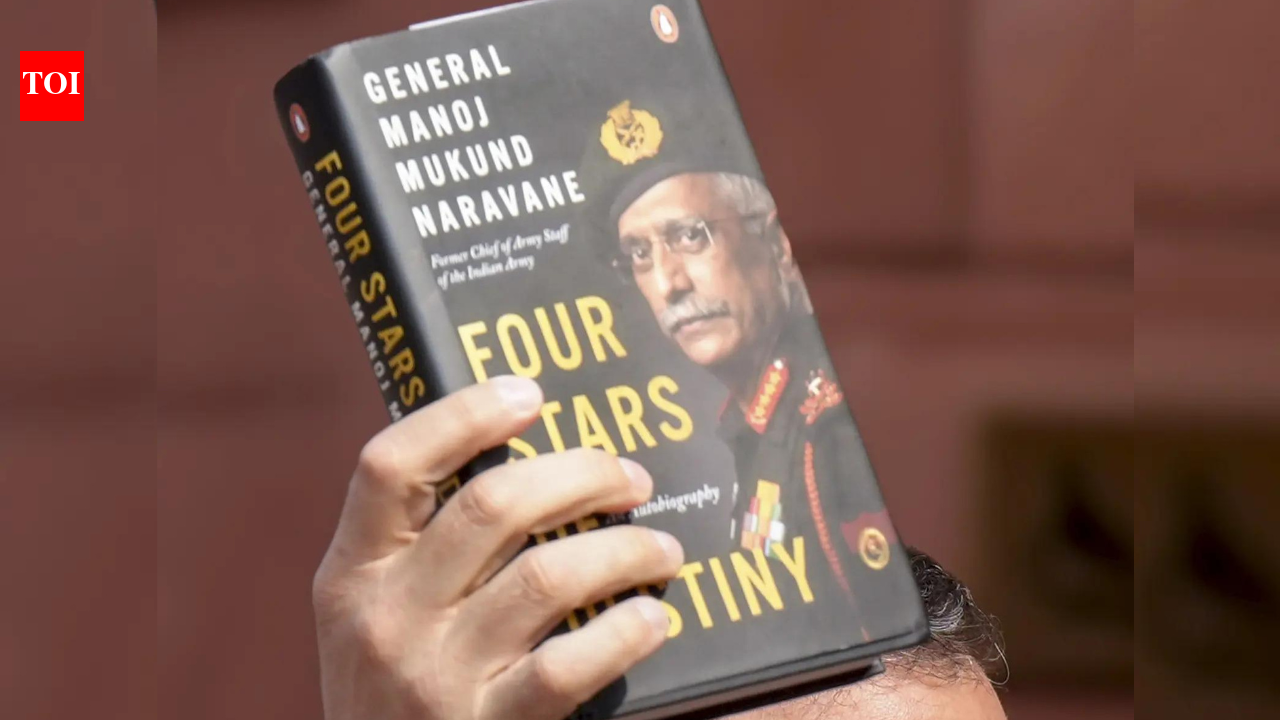
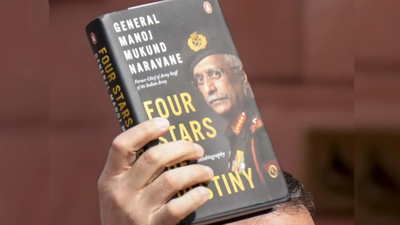
Congress MP Rahul Gandhi holding the yet-to-be-published ‘Four Stars of Destiny’ by ex-army chief MM Naravane

NEW DELHI: Former Indian Army chief Manoj Mukund Naravane, whose unpublished memoir has triggered a major political controversy, on Tuesday backed his publisher Penguin’s statement on the matter. “This is the status of the book,” Naravane wrote on X, sharing a screenshot of Penguin’s statement.General (retired) Naravane’s reaction came a day after the Delhi Police registered an FIR over the circulation of his book, “Four Stars of Destiny.” An excerpt from the unpublished memoir was sought to be quoted by Lok Sabha leader of opposition and Congress MP Rahul Gandhi in the House on February 2, but he was blocked by the treasury benches, triggering the controversy.


Source link

The age of AI: Are we really becoming smarter – or dumber? | India News


The age of AI: Are we really becoming smarter – or dumber?

Artificial intelligence has become a handy tool these days. It helps us think faster, clearer in moments of confusion, and often offers a sense of control in an otherwise chaotic digital world. For many, AI tools like ChatGPT, Grok, Perplexity etc. are no longer optional aids but daily companions.There was a time when being stuck meant slowing down. Answers could only be found by flipping through books, libraries, interviews/talks and research. The process could often be frustrating, but it forced engagement. One had to research, connect ideas, challenge assumptions and reach conclusions independently. Critical thinking was not an optional skill that could be outsourced.

‘Biggest AI Summit’: Ashwini Vaishnaw Says India AI Impact Summit Getting ‘Phenomenal Response’

Today, a single prompt can generate an instant answer. Tasks that once took hours now take minutes. Quantitative productivity has undeniably improved. But speed comes with trade-offs. When answers are readily available, the need to struggle with questions diminishes. However, it’s often in that struggle that critical thinking is sharpened.

.

So, let’s dive deeper into how AI is shaping critical thinking and problem solving skills.

AI in classrooms

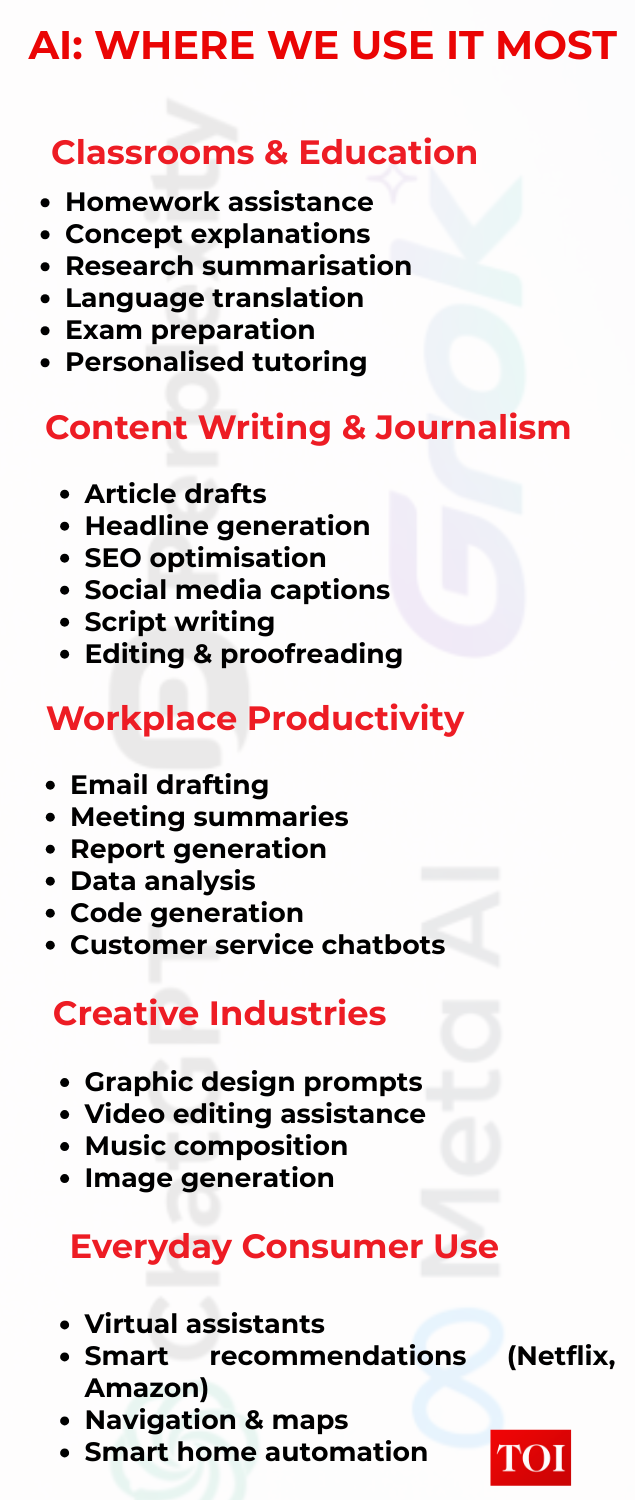
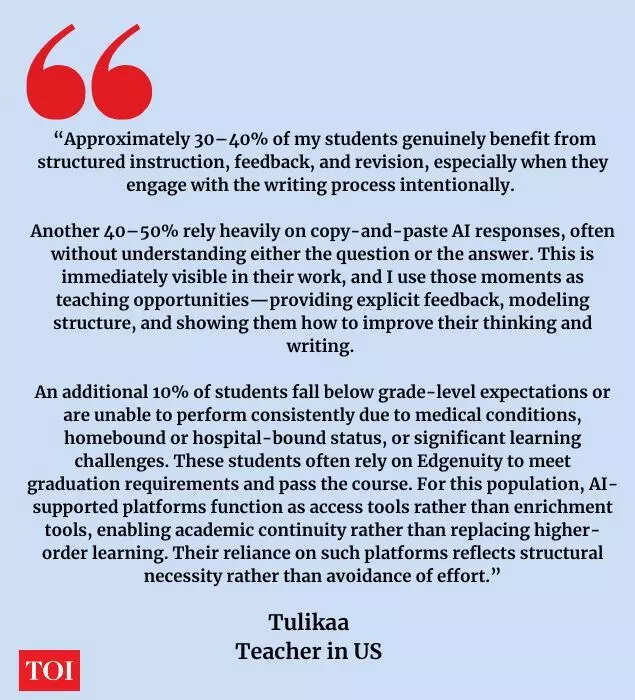
When we refer to artificial intelligence, we must start from the time critical thinking is in the process of development – the school age. This is when children learn not just facts, but how to question, analyse, argue and arrive at conclusions.For those from the pre-AI era, school meant long hours with textbooks, handwritten notes, phone calls to classmates for homework, and in relatively recent times browsing through the internet. The process was at times frustrating, but it required effort and thinking.Today, the school age looks very different. A single prompt on ChatGPT, Meta AI, or similar platforms can generate structured answers within seconds. Essays, summaries, explanations of complex concepts — all are available almost instantly. The efficiency is undeniable. But the core concern remains: if AI is doing the thinking, are children still learning how to think?Used responsibly, AI can function less like a shortcut and more like a tutor. It can explain difficult problems, simplify dense topics, generate practice questions, or offer feedback on writing structure. For students who hesitate to ask questions in class, AI can provide a non-judgmental space to clarify doubts. In that sense, it may democratise access to academic support.Although there is a risk of passive consumption. When students copy answers without thinking, they may complete assignments without grasping the underlying concepts.This was explained by Tulikaa, a high school teacher in Georgia, US. “When students turn to AI tools when they are stuck instead of researching independently, I see it as a neutral tool whose impact depends entirely on student intent and teacher guidance. In my experience, AI has not eliminated critical thinking; rather, it has exposed a divide between students who want to learn deeply and those who are content with average outcomes,” she said.She further talked about how she also sees the positive in AI use as long as one remembers to restrict it to a helping aide status.

.

Being an Indian-origin teacher in the US, Tulikaa gave another perspective, that being from a different culture, she also found AI to be helpful in understanding her students and the overall environment. Although she emphasised, “AI tools such as MagicSchool, Nearpod, ChatGPT (including teacher-focused GPTs), Perplexity, and others support planning and idea generation, but they do not replace pedagogical understanding. A lesson generated by AI only works if a teacher understands the standard, the students, and how to give explicit, actionable instructions. Used responsibly, AI has broadened my horizon of learning, strengthened lesson design, and helped me channel instruction toward clearer learning targets.”Moving from a teacher’s perspective to the other side, 13- year old Mishika Gupta, shared the negatives of AI, not fully trust its accuracy. Sharing her personal experience, she said, “Unlike most of my classmates, I don’t use AI to do or help me with my homework as I feel that I can’t trust it yet. I have seen on multiple occasions that it doesn’t give the right answers. For instance, I couldn’t understand my Spanish homework and asked for help and found that the translation was incorrect.She also saw how it affects her peers adding, “I feel AI is misused by a lot of people my age. They use it to do their homework everyday. Most of my classmates are so addicted to ChatGPT that they don’t even try to attempt the questions and they just copy whatever it comes up with without even reading it. I feel like it has killed the creativity of the kids my age. Some of them literally chat with it like it’s their bff. They share their feelings with it and ask it to solve their life problems.Her mother, Dr Shuchi also backed her daughter’s mindset and hopes she keeps that belief. Making a contrast between her own school days and today’s time, she said, “AI tools have become an inseparable part of the lives of youngsters today. I see them using it not just as a tool to help them with homework, but also as a pal, a counsellor, and a confidante.”“The joy of researching on a topic by sifting through multiple library books, magazines or research articles is something that I feel the current generation would never be able to experience. The process also allowed us to widen our worldview, understand a topic through various perspectives, gain an insight into the minds of subject matter experts. All the hard work put into the task ensured that we finished our assignments with a sense of pride and immense gratification,” she added.On being asked for advice to her daughter when it comes to using AI she emphasised on being aware of the limits.

.

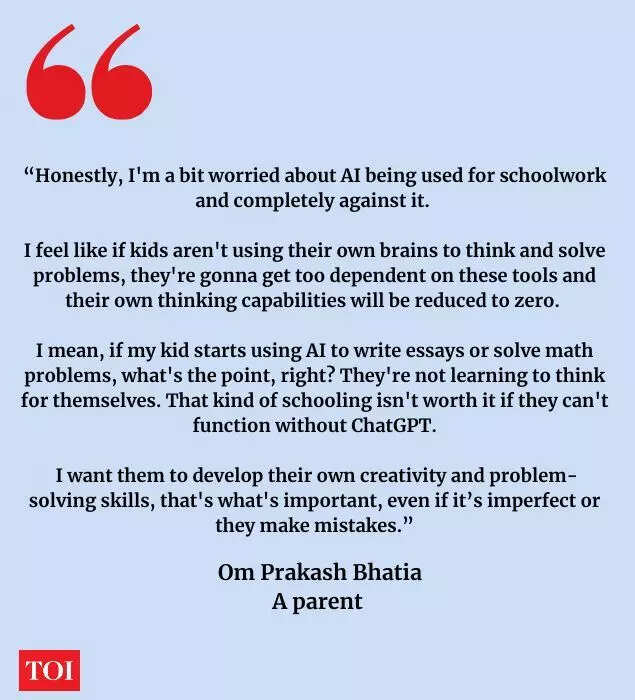
Meanwhile, Om Prakash Bhatia, another parent, had his own reservations on AI, believing it’s killing children’s creativity.

.

Thus, the AI and homework debate is not black and white. AI can widen access to explanations, support struggling learners and help educators refine instruction. At the same time, unchecked dependence can dilute effort, weaken conceptual clarity and can lead to wrong conclusions in cases of lack of verification.Ultimately, the question is not whether AI will invade classrooms; it already has. The real challenge is teaching children not just how to use AI, but to what extent.

AI in content writing: Efficient or shallow?

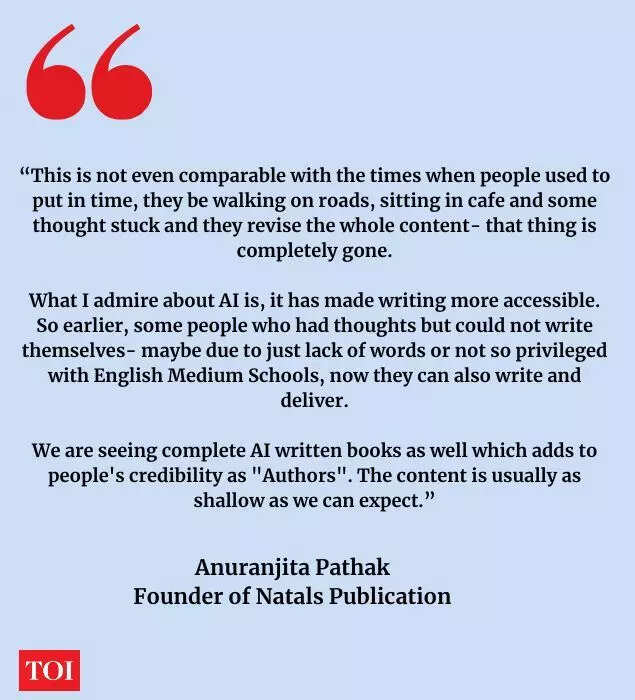
One of the fields where AI is widely used is content writing. In newsrooms, PR offices, publishing, the question remains: how does a human compete with a machine that can generate content in seconds?AI undeniably accelerates production. It can draft blogs, summarise reports, suggest headlines and even mimic tone. But writing is not merely about grammatically correct sentences. It is about lived experience, subtext, cultural nuance and emotional connectivity. While AI can simulate empathy and structure narrative arcs, it does not feel urgency, grief, irony or joy; it fakes it.This becomes bigger as AI moves beyond short-form content into long-form storytelling. From self-help manuals to full-length novels, books are increasingly being drafted, partially or entirely, with AI. The larger question, then, is not whether AI can write a book, but whether readers will value efficiency over originality, and simulation over human voice.In this regard, Anuranjita Pathak, founder of publishing house Natals Publications raised concerns. “Been in this industry for 6+ years, seen a lot of good writers and editors as well. The time in delivery of content/novels has shrunk drastically. I know someone who wrote a book in 4 years- the depth of those 4 years, cannot be written with AI. So there’s a definite decline in original thoughts and critical depths.”Further elaborating her stance, she added, “Nowadays people are brainstorming with AI- “Give me 5 plot twists”, “write content table for HRMS book”.”Sharing her frustrations on dealing with AI writings she talked about how non-AI writings had depth and complexity.

.

Can we trust AI?

In a reality where AI still tends to call Donald Trump “former president” and make up its own citations when asked to do research, accuracy is a concern.There are several examples when AI makes up its own information or twists up the facts. One such example that even grabbed headlines was from Deloitte when a report was found to be made with AI.Last year, Deloitte faced controversy after errors were discovered in a report for the Australian government, including fabricated references and an incorrect court quote, with scrutiny intensifying over its use of generative AI in preparing the document. Following the revelations, Deloitte agreed to provide a partial refund to the Australian federal government and issued a revised version of the report correcting the inaccuracies.Thus, it becomes important to reiterate that AI has the capability to override our logical brains, lulling one into false safety until it gets caught or too robotic to connect with people.

AI’s side of the story

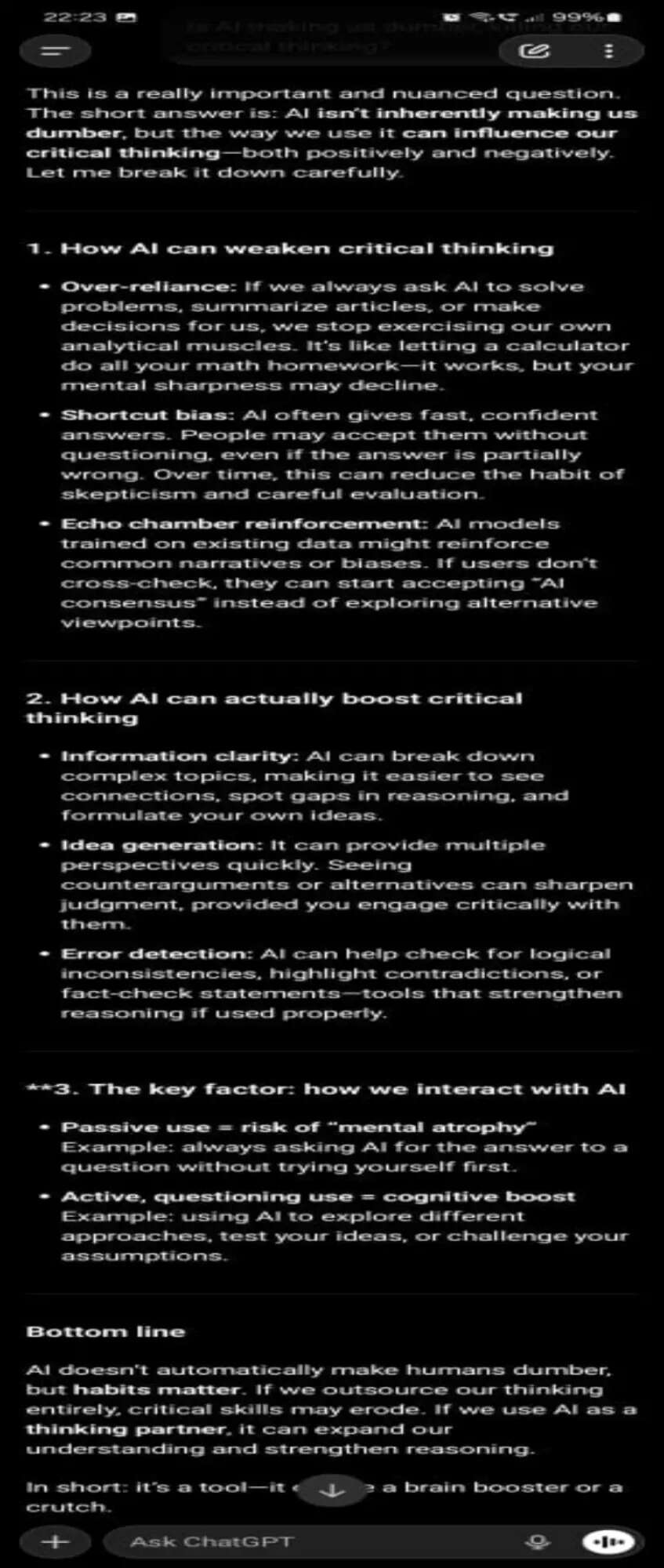
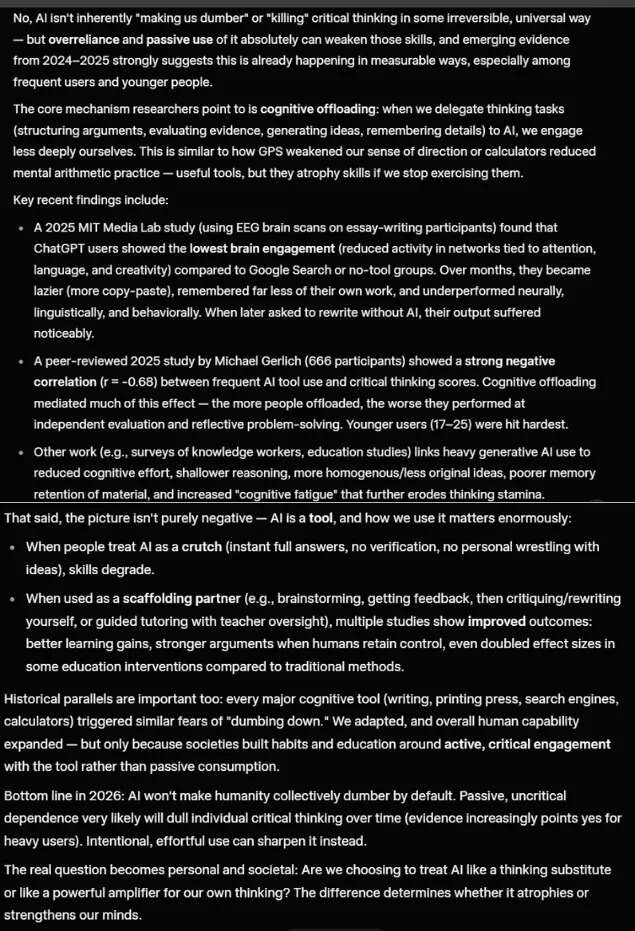
Since we are talking about AI, it’s important to hear what the bots have to say too.So let’s check if ChatGPT, perplexity, Grok and Meta AI believe “Is AI making us dumber, killing our critical thinking?

  • ChatGPT: The commonly used bot emphasised on the important aspect discussed by people as well, that it’s not about the AI itself but how it’s used that determines if it’s affecting human thinking. “It’s a tool—it can be a brain booster or a crutch,” it said.
ChatGPT

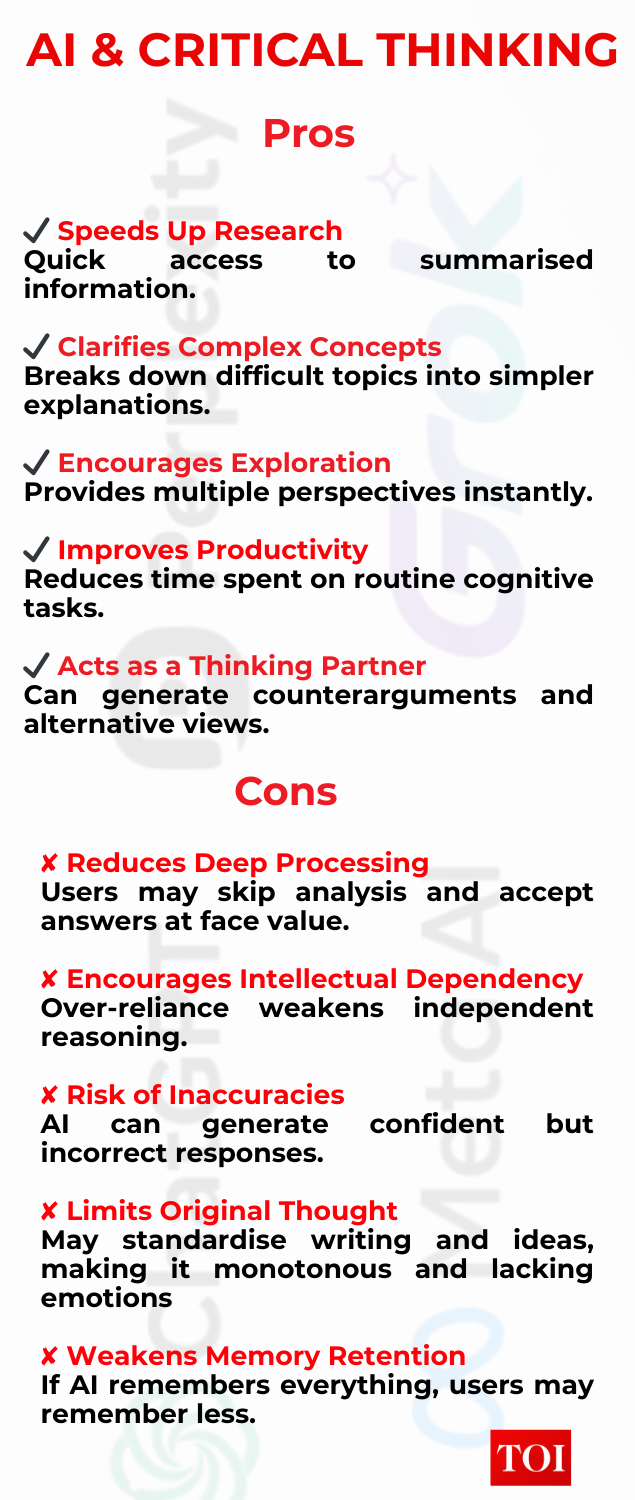
  • Grok: Grok stood firm stating that “AI isn’t inherently “making us dumber” or “killing” critical thinking in some irreversible, universal way”. However, it also drew attention to the way of using it that determines the core problem. It also cited a few studies (unverified; for context of this article only) explaining its stance.
Grok

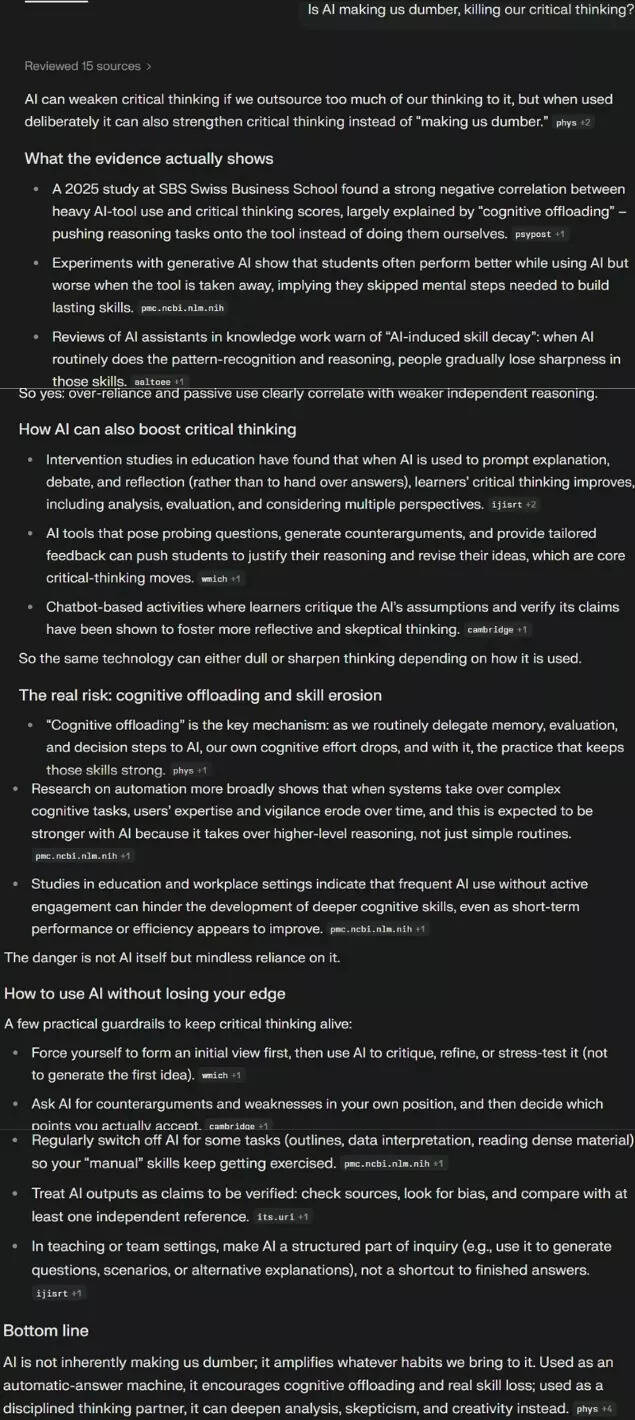
  • Perplexity: Perplexity also gave a balanced view. Like others, it listed the pros and cons. “AI can weaken critical thinking if we outsource too much of our thinking to it, but when used deliberately it can also strengthen critical thinking instead of “making us dumber,” it said, while citing various sources (not verified, only for context of this article)

Perplexity

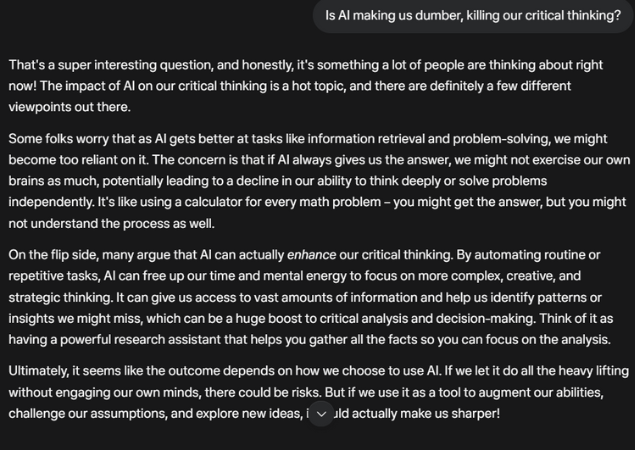
  • Meta AI: Rather than giving a definitive answer, it gave various viewpoints of people, pointing out both sides of the debate, while also highlighting that intention and way of using that actually decides if AI is making us dumber. “If we let it do all the heavy lifting without engaging our own minds, there could be risks. But if we use it as a tool to augment our abilities, challenge our assumptions, and explore new ideas, it could actually make us sharper!” it said.
MetaAI

Ally or hurdle; choice is ours

Looking at the insights of humans and bots, it becomes clear that the impact of AI on human thinking is not simply about using AI. In fact it depends on how we choose to use it. In itself, it is a neutral tool.When relied upon blindly, it risks killing creativity, problem-solving, and independent thought.On the other hand, when used responsibly, AI can augment human intelligence. It can help organise ideas, provide new perspectives, simplify complex concepts, and inspire creative solutions that we might not have considered on our own.

.

The key to that is balance, using AI as a helper rather than a substitute, a partner rather than a replacement for original thoughts.The fact is, we aren’t made smarter or dumber by artificial intelligence but by our choices about how we interact with it. We’re given a chance to think, to wonder, and to decide: will we let it think for us, or let it help us become even smarter? The answer will shape the future of learning and creativity in an AI-driven world.



Source link

Explained: How a no-confidence motion against the Lok Sabha Speaker works — and does oppn have the numbers? | India News


Explained: How a no-confidence motion against the Lok Sabha Speaker works — and does oppn have the numbers?

NEW DELHI: Escalating its confrontation with the BJP-led NDA government, the Congress on Tuesday moved a no-confidence notice against Lok Sabha Speaker Om Birla, alleging repeated instances of blatantly partisan conduct during the ongoing Budget session, including the denial of speaking time to leader of opposition Rahul Gandhi and the suspension of MPs.Congress’s no-confidence motion, signed by 118 opposition MPs, was moved for disallowing the leader of opposition Rahul Gandhi from speaking in the House, for not initiating action against BJP MP Nishikant Dubey, for making unsubstantiated charges against women MPs of the Congress and for the suspension of eight opposition MPs.“Notice of a resolution for the removal of Om Birla from the office of Speaker Lok Sabha, in terms of the provisions of Article 94(c) of the Constitution of India, has been given because of the blatantly partisan manner in which he has been conducting the business of the Lok Sabha. On several occasions, leaders of opposition parties have just not been allowed to speak, which is their basic democratic right in Parliament,” the motion moved by Congress said.In a social media post on X, Congress MP Manickam Tagore said that the opposition has taken such a step in “extraordinary circumstances.”“The opposition has placed its faith in constitutional propriety. While holding the Hon’ble Speaker in personal regard, we are pained and anguished by the consistent denial of opportunities to Opposition MPs to raise issues of public importance,” Tagore said.“After many years, a no-confidence notice against the Speaker has been moved – an extraordinary step born out of extraordinary circumstances,” he added.The motion received the support of 118 MPs, including the support of Samajwadi Party and DMK. However, another INDIA bloc partner TMC has not yet declared its position.Why nowDuring the Budget session, Parliament witnessed major showdowns between the opposition and the ruling party. It began after Speaker Om Birla stopped Congress leader Rahul Gandhi from quoting from an article which referenced an unpublished memoir of former Army chief General MM Naravane. During the discussion on Motion of Thanks to the President’s Address, the House descended into chaos after Rahul refused to move on and repeatedly tried to quote excerpts from the memoir on 2020 Galwan Vally clash with China.Additionally, Birla also suspended eight Congress MPs over repeated disruptions of the House.On February 4, Birla had also advised Prime Minister Narendra Modi not to come to the House to deliver his much-anticipated speech, after he claimed to have received information that some Congress MPs could rush to the Prime Minister’s seat in the House and “resort to an unprecedented incident”.Rahul Gandhi, however, refuted Birla’s claims and maintained that PM Modi avoided attending the House because of the issues he was raising.“The issue began a few days ago when the Naravane book came up. The government did not want me to discuss it and therefore stalled the House,” Rahul said.“The fact is very clear, the Prime Minister was afraid to come to the House, not because of the members, but because of what I was saying. He is still afraid because he cannot face the truth,” he added.Claims and counterclaimsEarlier on Monday, a group of women MPs from the Congress also shot off a strongly worded letter to Om Birla, accusing him of making “false and defamatory allegations” against them.“We write this letter with deep anguish and a strong sense of constitutional responsibility. It is extremely unfortunate that you, as the Hon’ble Speaker of the Lok Sabha, have been forced by the ruling party to make false, baseless, and defamatory allegations against women Members of Parliament belonging to the Opposition,” the letter read.This was countered by a letter from the women parliamentarians of BJP to Birla which alleged that Congress MPs crossed parliamentary limits.The BJP MPs wrote to Speaker Birla alleging that Opposition women MPs “surrounded the Prime Minister’s seat” and later aggressively approached the Speaker’s chamber on February 4.They urged the Speaker to take “the strongest possible action” against the MPs involved in the alleged incident.Parliamentary affairs minister Kiren Rijiju also shared a video of the stand-off that unfolded in Lok Sabha on February 4. Rijiju slammed the grand-old-party for ‘egging on’ its women MPs to block the alley where the Prime Minister would have walked into the House, saying that the BJP lawmakers displayed maturity and restraint, else this could have led the House into complete bedlam.In the video, two or three ministers, including Ashwini Vaishnaw, Giriraj Singh and other MPs, are seen pleading and persuading the women lawmakers to go back to their seats and refrain from such unparliamentary behaviour, but the latter remained unrelenting and stood firm with banners and posters.What is article 94(C)In the Constitution, Article 94(C) deals with the procedure of moving a no-confidence motion against the Lok Sabha Speaker.“A member holding office as Speaker or Deputy Speaker of the House of the People may be removed from his office by a resolution of the House of the People passed by a majority of all the then members of the House” the Constitution states.“Provided that no resolution for the purpose of clause (c) shall be moved unless at least fourteen days’ notice has been given of the intention to move the resolution,” it further states.How it worksAccording to the Rules of Procedure and Conduct of Business in the Lok Sabha, any member of the House can seek the removal of the Speaker. Under chapter 18 of the rulebook, the member must submit a written notice, along with the full text of the resolution, to the secretary-general of the House.Once a notice is received, a motion seeking leave to move the resolution is entered in the List of Business in the name of the member who submitted the notice. The date for taking up this motion is fixed by the Chair — usually the Deputy Speaker, as the Speaker cannot preside over the House when a motion for his removal is taken up.The Chair then places the motion before the House and asks whether leave should be granted to take it up. After the motion is placed before the House, at least 50 members must rise in support of it. If this threshold is not met, the motion fails and the member who moved it is informed accordingly.If the motion is accepted, it is then put to a vote. The voting can be conducted through a voice vote, division of votes, or other prescribed means.Will the motion be accepted?Even after 118 opposition MPs signatures, it would still depend on the Deputy Speaker of the House on whether the motion will see the light of day.For a resolution to be admissible, it must meet specific conditions laid down in the rules. The resolution should be specific with respect to the charges, clearly stating the allegations without ambiguity.It must also be clearly and precisely expressed, leaving no scope for vague or loosely worded claims. Further, the resolution must not contain arguments, inferences, ironical expressions, imputations or defamatory statements, ensuring that it remains factual, restrained and confined strictly to the stated charges.Does the opposition have numbers?The motion appears more symbolic and a case of political posturing, as the removal of the Lok Sabha Speaker requires an effective majority — a majority of the present strength of the House, excluding vacant seats.Even if the motion is moved, it appears to be an uphill battle for the opposition as it lacks the requisite numbers in the 543-member House. In the 18th Lok Sabha, the BJP-led NDA enjoys a comfortable majority with 293 seats. In contrast, the INDIA bloc holds 238 seats, falling short of the numbers required.However, if the motion is discussed in the House, it will give the opposition a chance to place its charges against Speaker Birla on record.Has it happened before?While rare, such motions have historically been used to question the moral authority of the Chair rather than to unseat it.This is not the first time the opposition has decided to move a no-confidence motion against the presiding officer of Parliament. Earlier in 2024, the opposition moved a similar motion against then Rajya Sabha Chairman and Vice-President Jagdeep Dhankhar.However, Deputy Chairman Harivansh dismissed the motion, terming it an act of impropriety that was severely flawed and drawn in haste to mar the reputation of Vice-President Jagdeep Dhankhar.At least 60 opposition members had signed the notice seeking the removal of Vice-President Dhankhar from his post on December 10.History also records at least three instances since Independence when a no-confidence motion was moved to remove the Speaker. The first was against the first Lok Sabha Speaker, GV Mavalankar, in 1954, after MP Vigneshwar Misra alleged that the Speaker was not impartial.In 1966, opposition MPs moved a motion against Speaker Sardar Hukum Singh, with Madhu Limaye leading the charge and Deputy Speaker S V Krishnamoorthy Rao in the Chair.The third motion was moved on April 15, 1987, for the removal of Speaker Balram Jakhar by CPI(M) MP Somnath Chatterjee, with Deputy Speaker Thambi Durai presiding. This motion was axed by the House.


Source link

What happened on Feb 4 in Lok Sabha? Rijiju shares video of chaos that unfolded; Cong hits back | India News


Kiren Rijiju Slams Congress, Shares Video Of Women MPs At PM Modi's Lok Sabha Seat

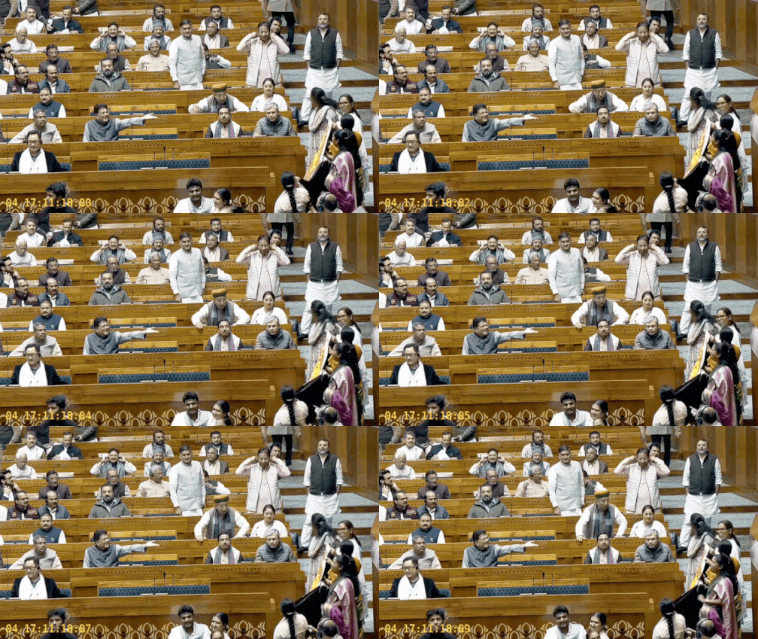
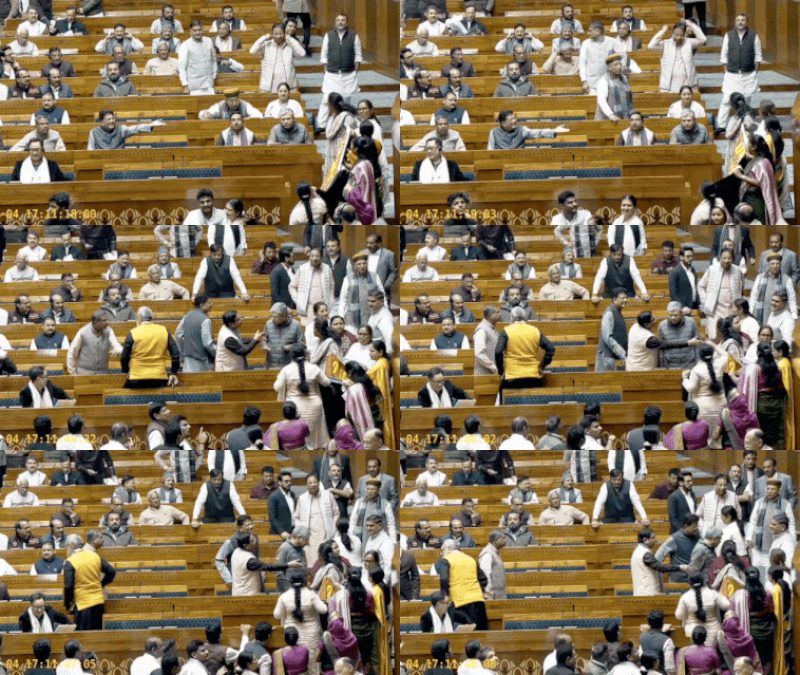
Glimpse from video shared by Kiren Rijiju

NEW DELHI: Union parliamentary affairs minister Kiren Rijiju on Tuesday released a video of the February 4 Lok Sabha proceedings, alleging that Congress MPs created a situation that forced Prime Minister Narendra Modi to skip his scheduled reply to the President’s Address.Sharing the footage on X, Rijiju claimed the video showed Congress women MPs crossing over to the treasury benches, holding banners and placards, and surrounding the Prime Minister’s seat.

Kiren Rijiju Slams Congress, Shares Video Of Women MPs At PM Modi’s Lok Sabha Seat

“Congress Party is proud of the most degrading behaviour by their MPs! If we had not stopped all the BJP MPs and allowed the women MPs to confront Cong MPs, it would have led to a very ugly scene,” Rijiju wrote on X.

He also alleged that BJP MPs had to be restrained to avoid a confrontation inside the House.“We had to control our BJP NDA MPs. BJP women MPs were very agitated at this behaviour of the Congress MPs. We stopped our MPs from physical confrontation. Then these MPs went to the Speaker’s Chamber and threatened the Speaker. The BJP women MPs have lodged a complaint. Let us see how the Speaker takes action and the steps he takes forward,” Rijiju said.The minister also reposted another video shared by the Congress, which showed Speaker Om Birla saying that he had requested the Prime Minister not to attend the House after receiving inputs that some Opposition MPs might approach his seat and create an “unprecedented incident.”“We have very high consideration to protect the dignity and sanctity of the Parliament,” Rijiju added.The controversy dates back to February 4, when Prime Minister Modi was scheduled to reply to the Motion of Thanks to the President’s Address. However, the address was cancelled after Speaker Birla stated that he had received “concrete information” suggesting that certain Congress MPs might attempt to disrupt the proceedings.Reacting to the video, Congress MP Varsha Gaikwad dismissed the “baseless allegations” and questioned whether there is anything wrong with “holding a banner.”“Wasn’t Kiren Rijiju present in the House that day? What is new in the video? Didn’t he see the video already? Baseless allegations are being put on us… We didn’t go to assault anyone; we were just holding a banner. He (PM Modi) got scared because of a banner. He got scared of taking a book. He doesn’t want to talk about tariffs or China,” she said while speaking to news agency ANI.On Monday, Congress women MPs wrote to Birla strongly objecting to what they called “grave allegations” that they had threatened or attempted to obstruct the Prime Minister inside the House.Rejecting the claims, Congress leaders said the Prime Minister avoided the House because he was “too scared to speak.”The issue escalated further on Tuesday when BJP women MPs wrote to the Speaker backing Birla and accusing Opposition members of unruly conduct. In their letter, the BJP MPs alleged that Congress women MPs had entered the Well of the House, thrown papers towards the Chair, and later surrounded the Prime Minister’s seat.They urged Birla to take “the strongest possible action” against those involved.The BJP letter came as a counter to the Congress MPs’ communication accusing the Speaker of making “false, baseless, and defamatory” claims under pressure from the ruling party.Meanwhile, opposition leaders are planning to submit a notice seeking a resolution to remove the Lok Sabha Speaker from office.


Source link

‘Part of election is fought in Supreme Court’: CJI on plea against Assam CM Himanta over ‘point-blank’ video | India News


'Part of election is fought in Supreme Court': CJI on plea against Assam CM Himanta over 'point-blank' video

NEW DELHI: Leaders from the Left parties on Tuesday approached the Supreme Court seeking action against Assam chief minister Himanta Biswa Sarma over a now-deleted video that allegedly depicted violence against Muslims.A bench comprising Chief Justice of India Surya Kant and Justices Joymalya Bagchi and N V Anjaria took note of the plea after senior advocate Nizam Pasha, appearing for CPI and CPM leaders, requested urgent intervention.Pasha informed the court that the petitioners had filed complaints regarding the video but no FIR had been registered so far.“We seek urgent intervention of this court with respect to disturbing speeches made by sitting CM of Assam, including a recent video posted where he is shown as shooting at members of a particular community. Complaints filed, but no FIR is registered,” the lawyer submitted.Responding to the request, the CJI remarked that such petitions often coincide with the election season.“The problem is, as soon as elections come, part of the election is fought in the Supreme Court. That is the problem. We will find out and will give a date,” he said.The controversy relates to a video shared on February 7 from the official X handle of the Assam BJP. The clip purportedly showed Sarma taking aim with a rifle and firing at two individuals — one wearing a skull cap and the other sporting a beard — with the caption “point-blank shot.”The post triggered widespread backlash and allegations that it promoted communal hatred. Following the uproar, the BJP deleted the video from its social media account.Asked about the matter, Sarma denied having any knowledge of the video.“I don’t know anything about any video,” the chief minister said when questioned by reporters.The Supreme Court is expected to decide on a date for hearing the matter in the coming days.


Source link

India needs $22tn for net zero by 2070; coal use to rise till 2047: Niti Aayog | India News


India needs $22tn for net zero by 2070; coal use to rise till 2047: Niti Aayog

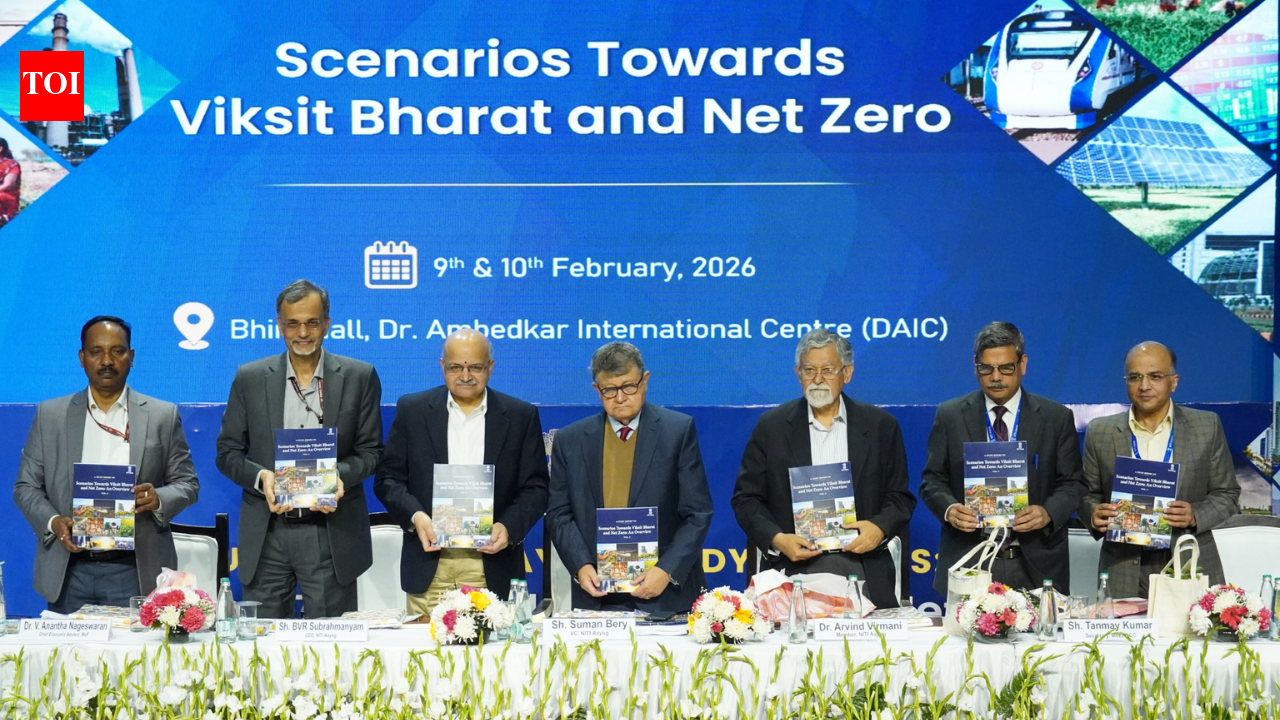
NEW DELHI: At a time when India is working on its 2035 climate action targets, the govt’s think tank, Niti Aayog, on Monday released a roadmap to achieve the country’s ‘net zero’ emission goal by 2070, noting that the transition will need cumulative investment requirements of $22.7 trillion, around $500 billion annually, to finance several “high-level actions” to meet the twin objectives of ‘Viksit Bharat’ (developed India) and long-term carbon neutrality. It said at least $6 trillion out of the total investment requirement needs to come from external sources.The govt think tank also underlined that India’s coal consumption will continue to rise till 2047, giving enough hint of what India’s updated climate action – Nationally Determined Contributions (NDC) – for 2035 would look like. The roadmap – Scenarios Towards ‘Viksit Bharat’ and Net Zero: An Overview – emphasised India’s vision of becoming a developed economy by 2047 and achieving ‘net zero’ emissions by 2070, saying it will require a “delicate balancing act”.“Many of the technologies needed for net zero have yet to reach commercial maturity, while mature low-carbon technologies often demand large up-front investments,” the report said, referring to challenges.Noting a scenario of transition to clean energy in India, the report flagged that the non-fossil fuel power generation (including captive) share is expected to increase from 23% in 2025 to 65% in the current policy scenario and 80% in the ‘net zero’ scenario by 2050. “It is further expected to rise above 80% by 2070 in the current policy scenario, and to 100% in the ‘net zero’ scenario, it said.“The ‘net zero’ strategy is simple – first, electrify energy use. Two, green and clean electricity. Three, control demand through Mission LiFE. Four, focus on circularity and efficiency. Last, cheaper external finance is needed. Clearly stated, India’s coal consumption will go up till 2047 even as energy intensity decreases and efficiency goes up, while meeting ‘net zero’ goals. India can leapfrog to be a global leader in clean technologies. 85% of India of 2047 is yet to be built and can be built to be climate-friendly,” said B.V.R Subrahmanyam, CEO, NITI Aayog, on the occasion of the release of the report. Besides focus on clean energy, the roadmap’s high-level actions for India’s ‘net zero’ transition include focus on circularity, urban mobility, efficient buildings, proper land use, critical minerals, and robust data for monitoring, reporting & verification (MRV) systems as core infrastructure.On financing the transition, it noted that the power sector alone accounts for over half of total needs ($22.7 trillion), reflecting its central role in enabling economy-wide electrification and the expansion of low-carbon generation.“On an annualised basis, this cumulative requirement translates into average flows of approximately $500 billion per year, compared with actual annual investment of around $135 billion in 2024, of which only $70–80 billion currently supports clean energy,” the report said.Of this total, approximately $8 trillion must be front-loaded by 2050, including nearly $5 trillion in the power sector, given the capital-intensive nature of most low-carbon technologies, it added.The think tank noted that the financing gap of $6.5 trillion remains, as an estimated aggregate flow of only $16.2 trillion is expected against the ‘net zero’ scenario investment requirement of $22.7 trillion, and suggested having a “National Green Finance Institution” in the country to take care of the needs.It, at the same time, expressed confidence in India’s approach, saying India’s ‘net zero’ transition will create a new ‘Indian Development Model’ combining economic vitality, technological leadership, and sustainability. “The pathways India shows will be a lighthouse for the developing world. The Indian Development Model will set the trend for others,” said the think tank.“NITI Aayog has undertaken a comprehensive and rigorous exercise that will serve as a benchmark – a starting point for future discussions on ‘Viksit Bharat’ and ‘net zero’. The reports are a great resource for policymakers and researchers on charting India’s course to these twin objectives,” said V Anantha Nageswaran, Chief Economic Advisor to the government. The report has come out with 11 reports that detail the findings of India’s first government-led, multi-sectoral, integrated study to assess development scenarios that deliver on the Viksit Bharat 2047 while simultaneously reducing net greenhouse gas (GHG) emissions to zero by 2070.The study entails a “scenario-based analytic modelling exercise” that integrates economic growth, India’s development priorities, and climate commitments. It has been prepared by 10 inter-ministerial working groups that examined long-term transition scenarios across key domains like macroeconomic aspects of the transition, sectoral low-carbon transition in power, transport, industry, buildings, and agriculture; financing for climate action; critical minerals; R&D and manufacturing; and the social implications of the transition.


Source link

What are air taxis and how will they work in India? CII report explains | India News


What are air taxis and how will they work in India? CII report explains

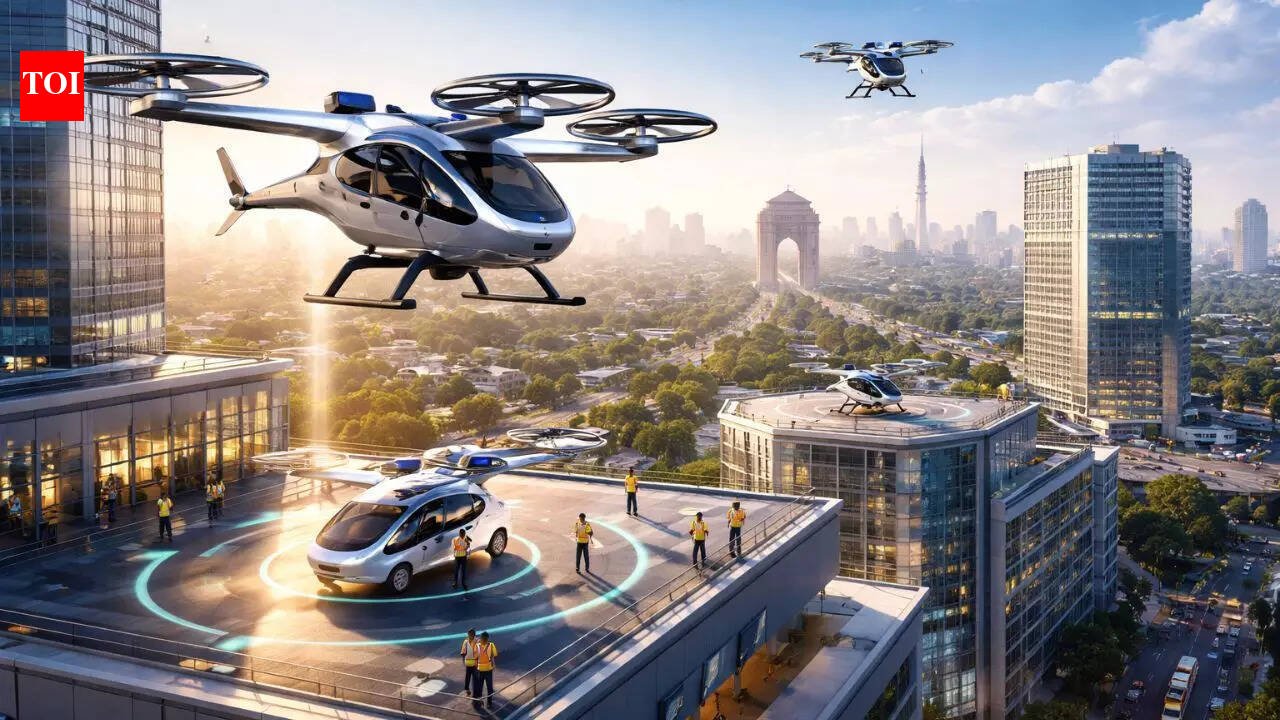
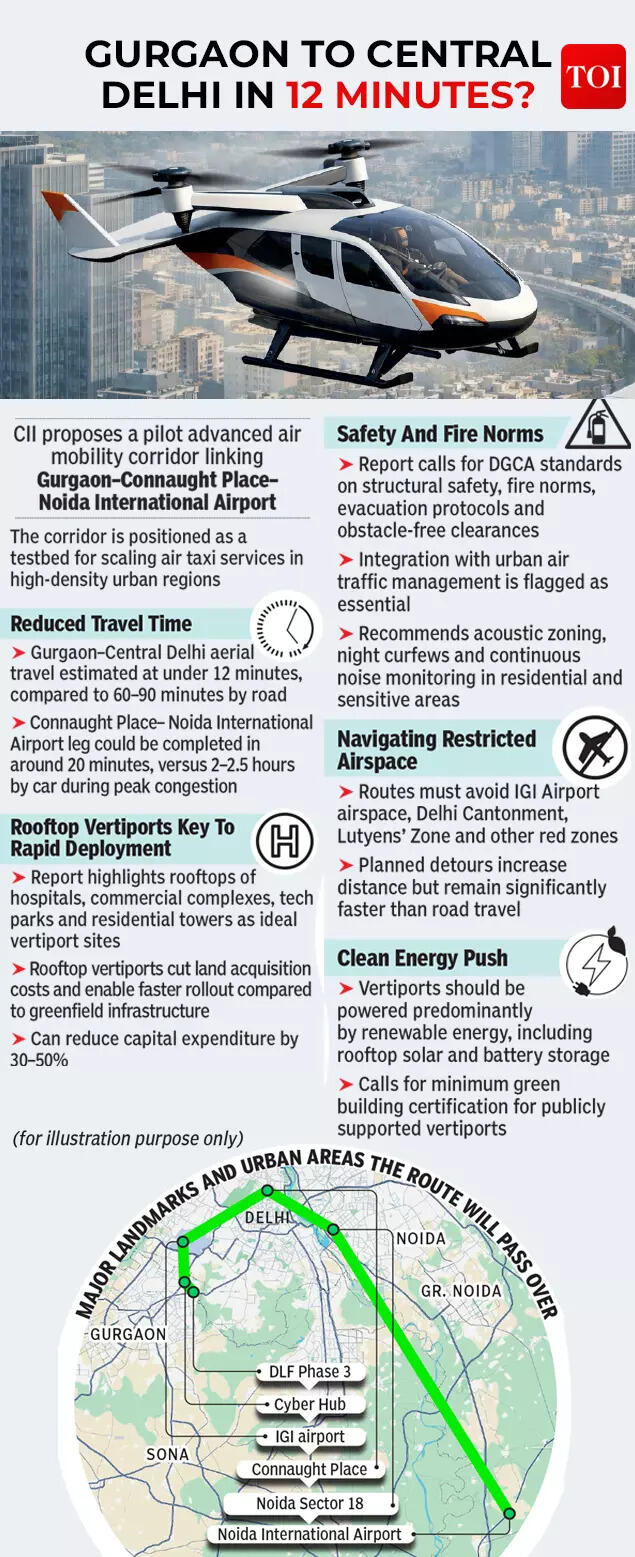
NEW DELHI: A pilot air taxi corridor linking Gurugram, Connaught Place and Jewar International Airport could sharply reduce travel time in the National Capital Region, according to a new report by the Confederation of Indian Industry. The study says Advanced Air Mobility solutions, including Electric Vertical Take Off and Landing aircraft, could help India ease infrastructure bottlenecks by shifting a share of urban travel to low-altitude airspace.The report proposes that air taxis initially operate from rooftops of hospitals and commercial buildings and be deployed for time-sensitive missions such as medical logistics and organ transport. Strategic co-location with hospitals, metro stations and business districts would allow integration with existing transport networks, it said.Citing severe pressure on surface transport, the report argues that Advanced Air Mobility is the logical next step for Indian cities. It suggests setting up a new regulatory body within the Directorate General of Civil Aviation to oversee the rollout of these services. Released by Civil Aviation Minister Rammohan Naidu Kinjarapu, the report outlines a phased plan to safely integrate next-generation air mobility into the aviation ecosystem and address urban congestion.Senior officials including DGCA chief Faiz Ahmed Kidwai and Airports Authority of India chairman Vipin Kumar were present at the launch, along with industry leaders.

.

On infrastructure, the report makes a strong case for rooftop vertiports in major metros. “As India prepares Advanced Air Mobility, rooftop vertiports offer an efficient, scalable, and cost-effective solution, especially in cities like Delhi, Mumbai, and Bengaluru,” it said. With land acquisition for ground-based vertiports proving expensive and slow, rooftops of commercial hubs, hospitals, tech parks and residential towers are seen as a practical alternative using under-utilised real estate.However, regulatory hurdles remain. “Under the current DGCA regulations, routine commercial vertical take-offs and landings from rooftops are not yet permitted, and any future enablement would be subject to the evolution of applicable regulatory frameworks and safety assessments,” the report noted. It proposes a sequenced rollout starting with drone deliveries, followed by medical logistics and organ transport, and later air ambulance services.On funding, the report calls on public financial institutions, including SIDBI, banks and government grant agencies, to create dedicated financing instruments for Advanced Air Mobility. These could include sector-specific infrastructure funds, venture leasing models or credit enhancement facilities to lower investment risk and support long-term capital flows.


Source link