Breaking News
SIR draft electoral rolls in UP pushed back to Jan 6 | India News


SIR draft electoral rolls in UP pushed back to Jan 6

LUCKNOW: The draft electoral rolls for special intensive revision (SIR) in Uttar Pradesh will be published on Jan 6, 2026 instead of the earlier scheduled date of Dec 31, UP chief electoral officer Navdeep Rinwa announced on Tuesday. From the same day, voters will be able to file claims and objections, with the window remaining open until Feb 6. During this period, citizens can request corrections, additions, or deletions to ensure that their voter information is accurate. Election commission will begin issuing notices, examining SIR forms, and resolving all claims and objections from Jan 6 to Feb 27. This phase is crucial for verifying voter details and addressing discrepancies to ensure transparency and accuracy in the electoral process. Once all revisions are completed, the final updated electoral roll for the state will be published on March 6. The revised schedule aims to provide sufficient time for citizens to verify their details and for authorities to conduct a thorough review, an official said.


Source link

‘Was radicalising youths’: Assam Police busts terror cell linked to Bangladesh; 11 arrested | India News


'Was radicalising youths': Assam Police busts terror cell linked to Bangladesh; 11 arrested
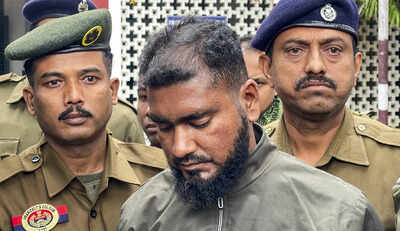
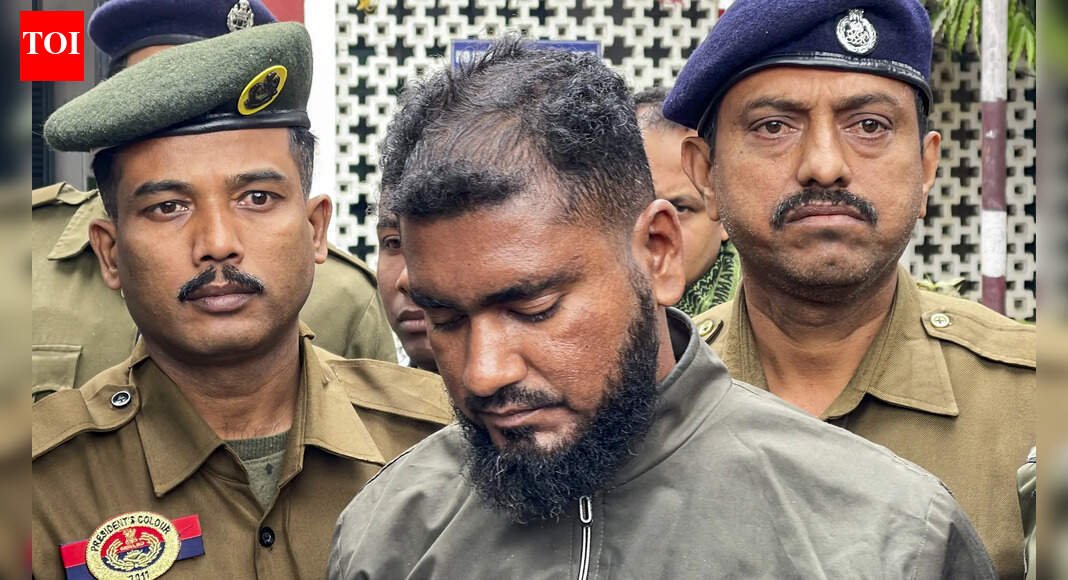
Agartala: Tripura Police, in a joint operation with Assam Police STF and central agencies, arrest suspected JMB offshoot member Jagir Miah from a border village, in Agartala. (PTI Photo)

GUWAHATI: Assam police busted a module of Imam Mahmuder Kafila (IMK) with the arrest of 11 alleged operatives of the Bangladesh-based Jamaat-ul-Mujahideen Bangladesh (JMB) offshoot formed in 2018. Investigators said IMK expanded its base in the state after Bangladesh’s Aug 2024 regime change that led to the exit of former Prime Minister Sheikh Hasina. Of the 11 people held by Assam police’s Special Task Force (STF), 10 were picked up from Assam and one from Tripura in operations since late Monday night. CM Himanta Biswa Sarma acknowledged the threat from such modules. “Fundamentalists are definitely active in Assam. The issue will remain for long as Bangladesh is Assam’s neighbouring country,” Sarma said. STF chief and Guwahati police commissioner Partha Sarathi Mahanta said IMK used encrypted social media groups to radicalise and recruit youths in Assam and nearby states, spread propaganda, raise funds through hawala and UPI channels, and facilitate cross-border travel for training. “Probe revealed that following the regime change in Bangladesh in Aug 2024, top leaders of JMB, Ansarullah Bangla Team (ABT) and al-Qaida in the Indian Subcontinent (AQIS) issued directions to IMK leadership to activate and expand its Indian modules. Bangladeshi nationals Umar and Khalid were assigned to coordinate Assam-based activities. The head of the Assam cell is one Nasim Uddin alias Tamim of Barpeta Road in Barpeta district in Assam,” Mahanta said. Nasim Uddin was among those 11 arrested. Multiple charges under BNS, 2023 and Unlawful Activities (Prevention) Act (UAPA), 1967 were slapped on the suspects. Mahanta said IMK, banned in India, was formed by Jewel Mahmud alias Imam Mahmud Habibullah alias Sohail, described as a former JMB member who claims to be the amir (leader) of IMK and propagates the ideology of “Ghazwatul Hind (Battle against India)”. Mahanta said IMK propagated an ideology aligned with proscribed transnational jihadi organisations and operated through secure social media platforms. “One such social media group is ‘Purva Akash’, which functions as a principal communication and recruitment platform. People from Assam, Bengal and Tripura were being radicalised, recruited, financially mobilised. IMK disseminates extremist propaganda advocating violent jihad and the armed conquest of India. Investigators found that some Assam-based IMK operatives had travelled to Bangladesh earlier this year on valid passports and visas for training and coordination, Mahanta further said.


Source link

‘2025 will be remembered for India’s focus on reforms’: PM Modi | India News


'2025 will be remembered for India's focus on reforms': PM Modi

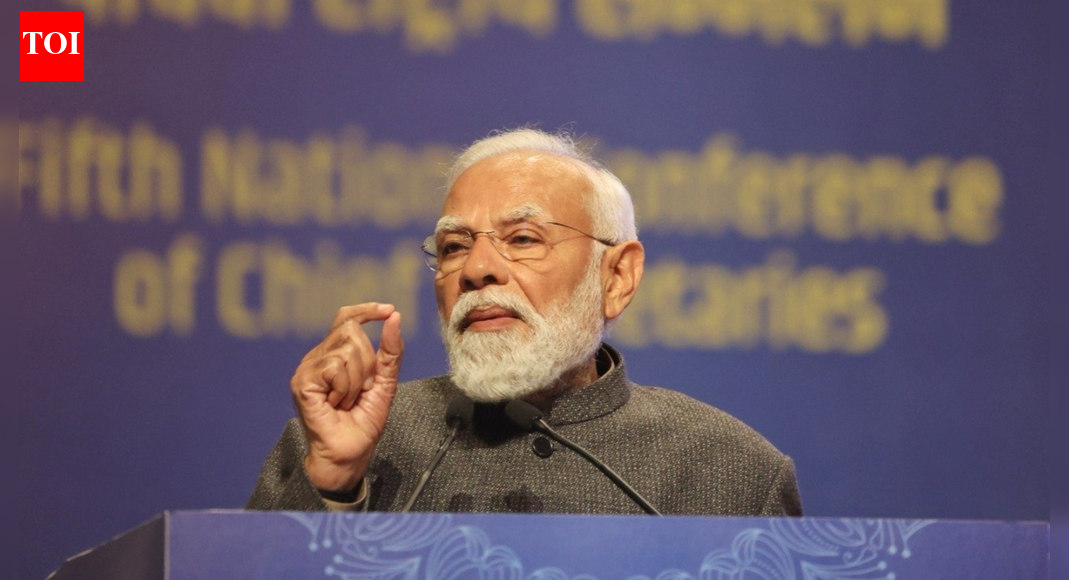
NEW DELHI: The outgoing year (2025) will be remembered for India’s focus on reforms as a continuous national mission, PM Narendra Modi said on Tuesday, asserting that his govt prioritised collaboration over control and facilitation over regulation in the true spirit of a modern democracy. “What makes the reforms of 2025 significant is not only their dimension but also their underlying philosophy. We modernised institutions, simplified governance, and strengthened the foundations for long-term inclusive growth,” he said, citing a host of measures. Asking investors to keep trusting India and investing in its people, he said in a post on LinkedIn, that the country’s youthful demography is the prime engine of “Reform Express”, a term he first used earlier this month during Parliament’s winter session to underscore his govt’s commitment to fast-paced reforms across sectors. These reforms, which included opening up of nuclear sector to private players, higher education, 100% FDI in insurance sector, and introduction of four labour codes to cover a complex web of 29 laws, were designed with empathy, recognising the realities of small businesses, young professionals, farmers, workers and the middle class. “They were shaped by consultation, guided by data and anchored in India’s constitutional values. They add momentum to our decade-long efforts to move away from a control-based economy to one that operates within a framework of trust, keeping the citizen at its core. These reforms are aimed towards building a prosperous and self-reliant India,” he said. He emphasised that his govt will continue pursuing the reform agenda in the coming years. Amid opposition’s determined protest against his govt’s decision to bring G RAM G Act in replace UPA-era MGNREGA, he said provisions of the new law raise employment guarantee from 100 to 125 days, resulting in increased spending towards strengthening village infrastructure and livelihoods. In Parliament’s monsoon session, he said five landmark maritime legislations were passed to simplify documentation, make dispute resolution easier and reduce logistics costs, replacing outdated Acts. Modi said GST slab rationalisation will ensure dispute reduction and better compliance and has boosted consumer sentiment and demand, while tax break for individuals earning upto Rs 12 lakh is an “unparalleled relief for the middle class”. These reforms mark India’s move towards a transparent, technology-driven tax administration, he said. Modi said that trade deals with New Zealand, Oman and Britain will add to investments, job creation and encourage local entrepreneurs. He said a bill introduced in Parliament will lead to establishment of a single, unified higher education regulator in ‘Viksit Bharat Shiksha Adhishthan’ to replace overlapping bodies (UGC, AICTE and NCTE, etc). “Institutional autonomy will be strengthened, with innovation and research boosted,” he said. In a boost to small and medium businesses, the definition of “small companies” has been expanded to include firms with turnovers up to Rs 100 crore, reducing compliance burdens and associated costs for thousands of firms. Another bill will enhance governance norms in Sebi and investor protection.


Source link

Border bonds: Jalpaiguri mourns its daughter Khaleda Zia; Bangladesh’s first woman PM was born in West Bengal town | India News


Border bonds: Jalpaiguri mourns its daughter Khaleda Zia; Bangladesh's first woman PM was born in West Bengal town

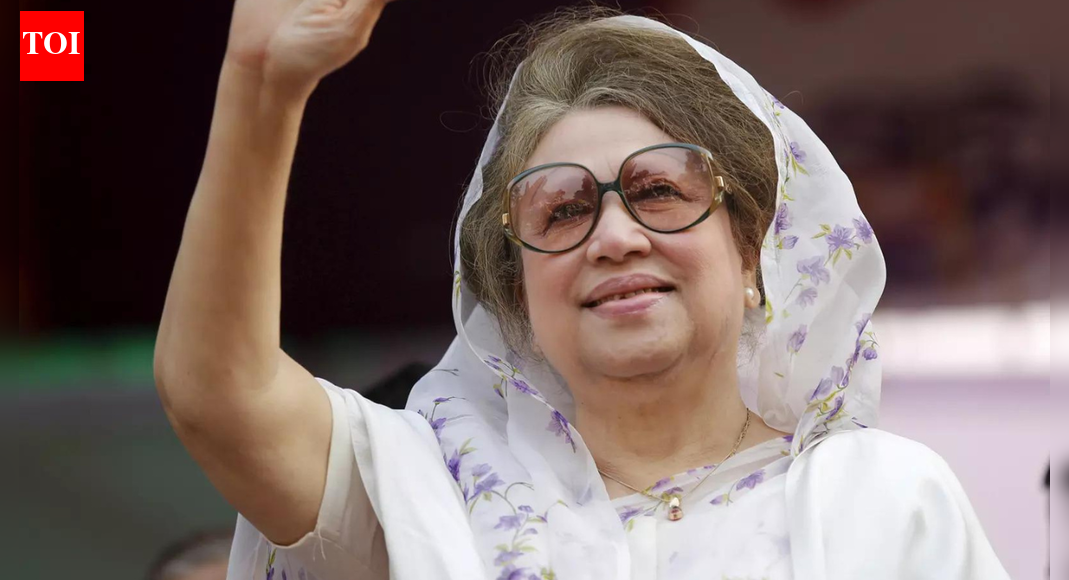
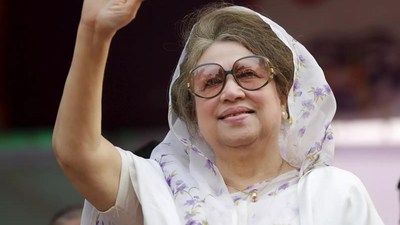
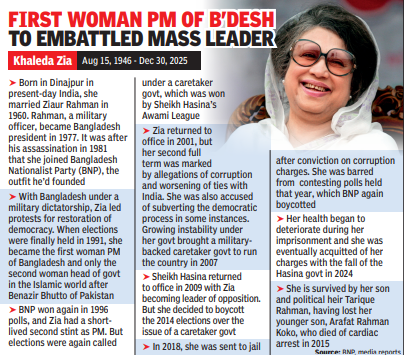
JALPAIGURI: Grief over former Bangladesh PM Khaleda Zia’s death on Tuesday travelled well beyond Dhaka, reaching Jalpaiguri, a north Bengal town nearly 434 km away, where memories of her early life still lingered. For the people here, it was a loss of one of their own.Khaleda Zia was born in Jalpaiguri in 1946 and spent her early life in the town, attending two primary schools before her family eventually moved to what was then East Pakistan, now Bangladesh.“Zia’s father, Mohammad Iskandar, used to work as an agent at my father’s tea trading firm, Das & Co. Khaleda Zia was born at their Nayabasti house in the town. Even after Partition, her family continued to reside in Jalpaiguri, and family moved to erstwhile East Pakistan only in the 1950s,” recounted Jalpaiguri resident and businessman Nilanjan Dasgupta.

Bangladesh's ​first woman PM to embattled mass leader

Bangladesh’s first woman PM to embattled mass leader

According to Jalpaiguri-based historian Umesh Sharma, Zia’s early education began in the town. “Zia was sent to Jogmaya Primary School in Nayabasti, where she studied up to Class III, and was then admitted to Sunitibala Sadar Girls’ School in Samaj Para,” he said. “By then most of their relatives moved to East Pakistan, and Zia’s father migrated there,” Sharma added.Sharma said the family’s departure followed a formal exchange of property. “Iskandar went for a property exchange with one Amarendranath Chakraborty and moved to East Pakistan. Chakraborty’s family still lives in the house at Nayabasti,” he said.Those who remember her family recall the emotional ties that endured long after her departure. “Siyon Mandal, who became a teacher at Sishu Niketan Prathamik Bidyalaya, was her best friend during primary school days. I remember how Siyondi was elated when Zia came to office in Bangladesh. The news of her demise has left people who knew her sorry,” said Dasgupta, a former proprietor of now-defunct Das & Co.Neighbours, too, spoke of a bond that survived borders and decades. “Zia’s niece came only a couple of months ago to see Zia’s birthplace. We talked about how good it would have been if the country was never partitioned. Her loss is mourned by people in Bangladesh as well as here,” said Suhrid Mandal, Zia’s Jalpaiguri neighbour.


Source link

Spirit without the spirits: The coolest New Year party is now hangover-free | India News


Spirit without the spirits: The coolest New Year party is now hangover-free
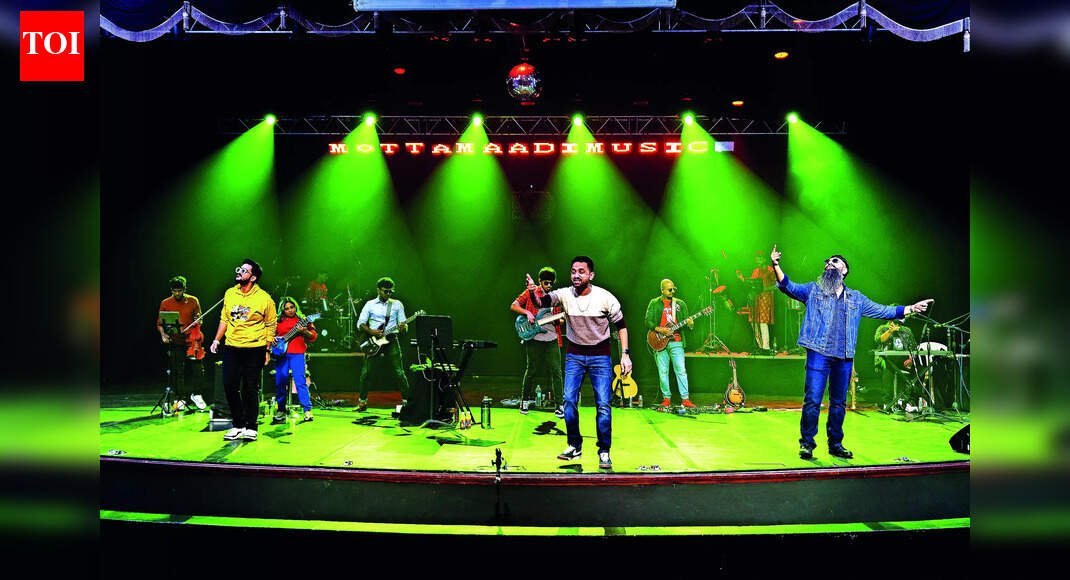
Motta Maadi Music Sober Party, started by Chennai-based musician Badhri Narayanan Seshadri, is a New Year’s concert for teetotaller

For years, New Year’s Eve came with a familiar script: you drink, you party, you recover (or regret it) later. But a growing number of Indians are now opting for a ‘sober’ start to 2026. “There was a time I drank to drown my sorrows,” says 45-year-old Mumbai-based entrepreneur Madhu Gupta. This New Year’s Eve, though, her plans look very different: an early dinner at a hotel, followed by a ‘Stranger Things’ marathon with her teenage daughter. Alcohol doesn’t figure anywhere. Even her 30-year-old niece in Bengaluru is skipping the usual party scene. Gupta and her niece are part of a growing global sober curious movement – people who are reshaping their relationship with alcohol. For some, it means giving it up entirely and for others, it might mean a shift to low-alcohol options. Health reasons and the desire to have more meaningful interactions/experiences without being wasted are driving the shift.‘Wanted to show how one can have fun without booze’For this crowd, the perfect Dec 31 is about music, community, and being home before the streets get wild. That’s the spirit behind the Motta Maadi Music Sober Party, started by Chennai-based musician Badhri Narayanan Seshadri as a mischievous jab at New Year’s excesses. Seshadri is quick to clarify that it wasn’t planned as an anti-alcohol event. “The entire team is largely teetotallers, so this is how we celebrate. Otherwise, where do teetotallers go on Dec 31? Watch television?” he laughs. This year, their Dec 31 show will be held at Sir Mutha Venkatasubba Rao Concert Hall, with two performances at 3pm and 7pm, both featuring Tamil film music. The evening ends not with a countdown. “We finish with ‘Ilamai Idho Idho’, a popular New Year song by Ilaiyaraaja,” says Seshadri. The shift is also showing up in how venues are programming the night. In Hyderabad, rooftop cafe Ce La Vie is advertising a ‘sober and sensational’ New Year’s party complete with a DJ, a midnight countdown and an elaborate mocktail menu. In Indore, Kaner Baag is hosting a sober New Year’s Eve built around a familiar party template – a DJ night, live dhol, unlimited buffet, zero-proof cocktails and a midnight countdown with fireworks – just without the booze. The event is aimed at “families, couples and groups looking for a safe, elegant, and premium alternative to crowded club parties”. For 21-year-old Raj Dashore, a partner at Kaner Baag and one of the organisers, the idea is a pushback against how celebrations in the city have changed over generations. “In our parents’ generation, drinking became the centre of every celebration in Indore. Every month, there’s a new pub launching,” he says. “At Kaner Baag, we wanted to show that you can be surrounded by nature, have fun and feel calm without alcohol. Dry doesn’t mean dull. Across the country, mixologists are leaning into technique-driven creations – think beetroot negronis and kiwi collins – designed to deliver flavour, not buzz. Hyderabad-based Meera Girija Tadimeti, an architect-turned-chef who specialises in homestyle Telugu food, says this New Year’s Eve she will simply sip sparkling water or soda. “There is more research now that shows no amount of alcohol is safe, so I made a conscious decision to say no to alcohol,” says Tadimeti, who was a social drinker earlier. “I don’t succumb to social pressure and respect my body’s limitations,” she adds. Others are stepping away from the pressure to “do something big” altogether. Instead of hosting traditional New Year’s Eve events, Kolkata’s The Barge Company is planning a ‘River Reset’ weekend on Jan 3, 4 and 11 aboard its heritage vessels, Riviera and the restored Bengal Paddle. “The first weekend of Jan should be a sober weekend. We wanted to do that by channelling the tranquillity of the river with activities like sound bath, yoga flow and iceberg mind mastery on the cruise,” say Rishika Das Roy, marketing director at The Barge Company. “As for drinks, we will have tea-tasting and mushroom coffee,” she says.

Source link

If infiltrators in West Bengal, who attacked Delhi, Pahalgam, asks Didi | India News


If infiltrators in West Bengal, who attacked Delhi, Pahalgam, asks Didi
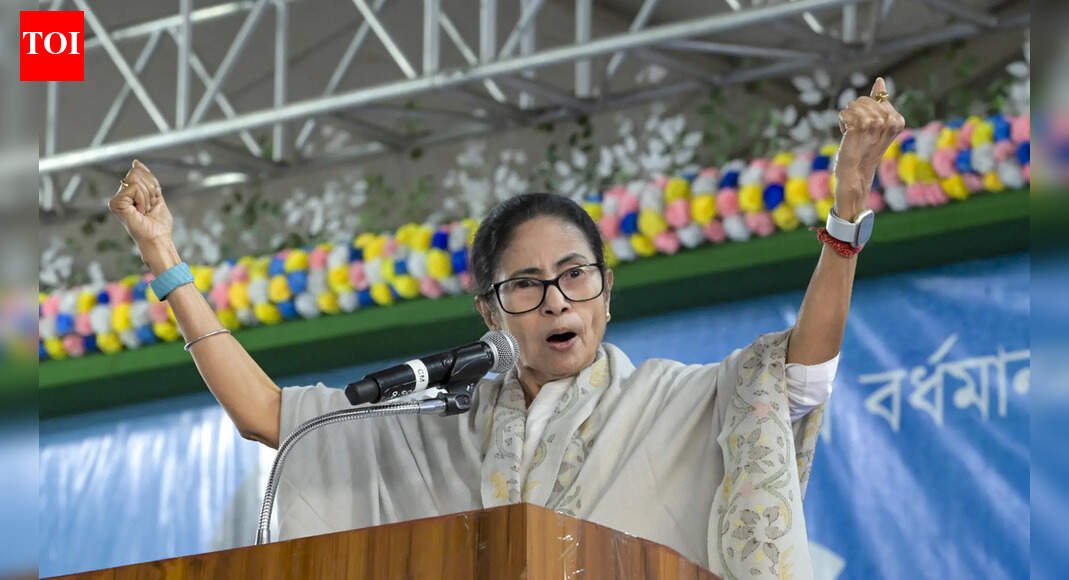
Mamata Banerjee, chief minister of West Bengal

KOLKATA/BANKURA: West Bengal CM Mamata Banerjee Tuesday mounted a counterattack on home minister Amit Shah, questioning his handling of national security and demanding his resignation minutes after he accused Trinamool Congress govt of encouraging infiltration for “vote bank” politics. “If infiltrators exist only in Bengal and nowhere else, then who carried out the Pahalgam attack? Who was responsible for the blast in Delhi?” Banerjee asked at a public rally in Barjora, a town in Bankura district of western Bengal. “Are infiltrators present nowhere except Bengal? Or was it you who did it?” Banerjee repeatedly referred to Shah as “Dushasan”, invoking the Mahabharata figure symbolising misrule. “A person representing misrule has arrived in WB. You are the home minister of the country. You must resign,” she said. “Till my last breath, I will fight these Dushasans.” Shah had earlier alleged the Trinamool govt was allowing cross-border infiltration. Banerjee responded with a point-by-point rebuttal, saying border management falls under Union home ministry. “Which ministry is responsible for infiltration? I gave land wherever required. First do your job there,” she said, accusing BSF units of intimidating villagers after expanding jurisdiction into border areas. Banerjee attacked EC’s SIR of electoral rolls, calling it a “huge scam”. She alleged a BJP IT cell member was “sitting inside Delhi’s EC office” and deleting names while posing as an electoral officer. Responding to corruption charges, Banerjee said her govt acted against wrongdoing and asked whether those arrested were kept in jail.


Source link

Will restore Bengal’s lost glory in 2026: Amit Shah | India News


Will restore Bengal's lost glory in 2026: Amit Shah

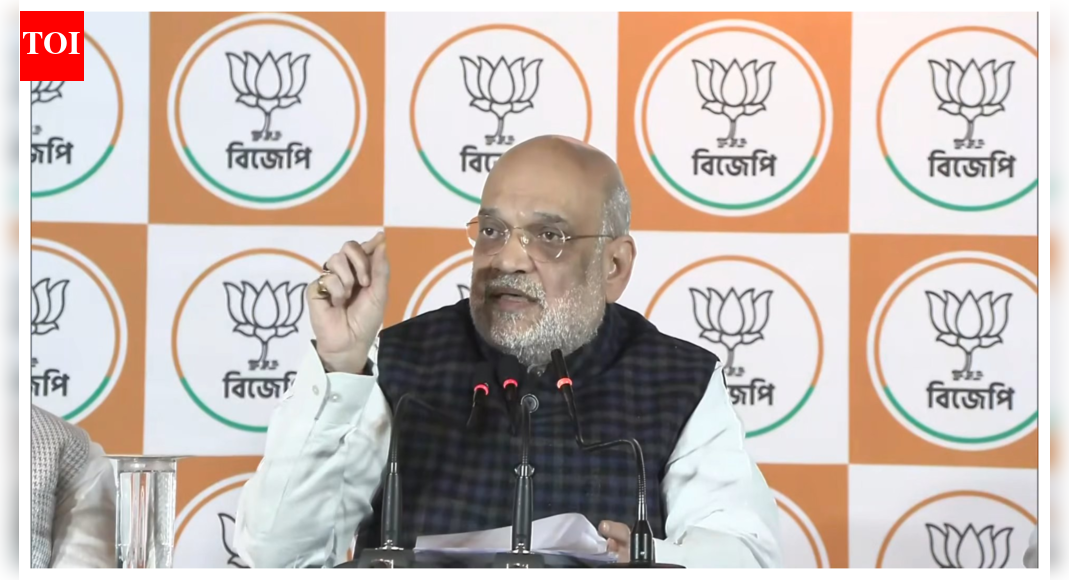
NEW DELHI: Union home minister Amit Shah predicted Tuesday a BJP govt in Bengal with a two-thirds majority in the 2026 assembly polls, while promising to end infiltration and seeking to calm fears among the Matua community over EC’s special intensive revision of electoral rolls and the Citizenship Amendment Act.“BJP has resolved that when it forms govt after April 2026, it will restore Bengal’s lost glory,” Shah said during a 40-minute interaction with reporters. “Development has come to a halt. Fear and corruption have become the identity of the state… We will uproot Trinamool Congress.”

‘Will Rid Bengal Of Infiltrators’: Amit Shah Slams Mamata Banerjee’s 14-Year Rule, Sounds Poll Bugle

Shah traced BJP’s rise in Bengal from two Lok Sabha seats and 17% vote share a decade ago to 18 seats in 2019 and 77 assembly seats in 2021, asserting Congress and CPM had been reduced to zero. “We had 36% vote share in 2021 and we will win 2026 with a two-thirds majority,” he said, adding the election would be fought on “stopping infiltration and driving infiltrators out”.Addressing Matua concerns, Shah said he spoke Monday with Bongaon MP and junior Union minister Shantanu Thakur, assuring that no Matua would lose voting rights or citizenship. “Matuas have no reason to be afraid. Refugees who came to Bengal are citizens of India and nobody can harm them – not even Mamata Banerjee,” he said. BJP functionaries said that of nearly 1.5 crore Matuas in Bengal, about 70,000 have applied for citizenship under CAA.Shah accused the TMC-led govt of blocking border fencing by not allotting land to BSF. “I have sent seven letters… there was no response,” he said. “Infiltration is happening on Mamata Banerjee’s watch. Forged documents are being prepared. Demography is changing to strengthen her vote bank.”Shah also targeted TMC over alleged corruption, naming Partha Chatterjee, Jyotipriya Mallick and Anubrata Mandal, and referring to allegations against Firhad Hakim and Sovan Chattopadhyay. “Yet Didi says there is no corruption,” Shah said.He claimed women’s safety was at risk and people were told not to step out after 7pm. Urging voters to give BJP a chance, Shah said politics over mandir and masjid was a distraction. “Core issues are women’s safety, corruption, jobs for youth and flight of industries,” he said.


Source link

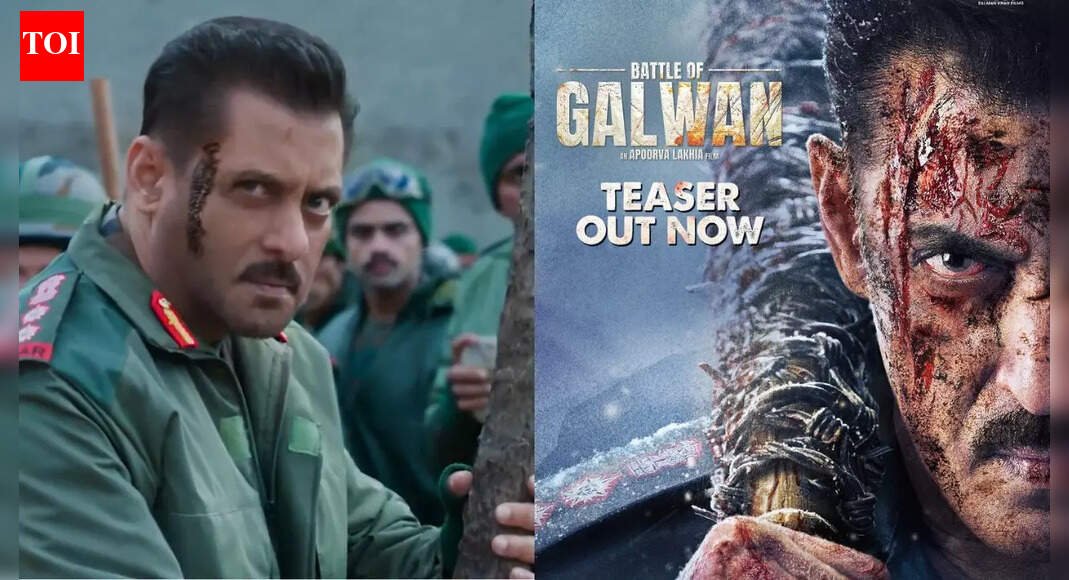
Galwan film teaser draws sharp reaction from China | India News


Galwan film teaser draws sharp reaction from China
Salman Khan in ‘Battle of Galwan’

NEW DELHI: A teaser of Salman Khan-starrer Battle of Galwan, based on the clash between Indian and Chinese soldiers in Galwan Valley in 2020, has been racking up viewership in millions and has drawn critical commentary from Global Times, a Chinese Communist Party mouthpiece aimed largely at an international audience.The film, directed by Apoorva Lakhia, has Salman playing the role of Col Bikkumalla Santosh Babu, who laid down his life along with 19 other Indian soldiers while defending Indian territory in eastern Ladakh. The clash also left an unspecified number of Chinese soldiers dead. Col Babu was posthumously awarded India’s second-highest wartime gallantry honour, the Maha Vir Chakra.

Salman first look from ‘Battle of Galwan’ goes viral as filming starts in Ladakh’s icy terrain

Global Times claimed the movie has sparked controversy for “distorting facts”. Referring to the 1.12-minute teaser, which has crossed over 20 million views in three days, it quoted a Chinese expert as saying Bollywood films offer an entertainment-driven, emotionally charged portrayal. It added that no amount of cinematic exaggeration could rewrite history or shake People’s Liberation Army’s determination to defend China’s sovereign territory.The teaser opens with a voice-over by Salman’s character saying, “Soldiers, remember, if you get wounded, treat it like a medal, and if you see death, salute it,” and shows Indian soldiers bracing for combat as Chinese troops run towards them. According to Army sources, Indian soldiers led by Col Babu regrouped quickly and launched a ferocious response during the high-altitude standoff there.


Source link

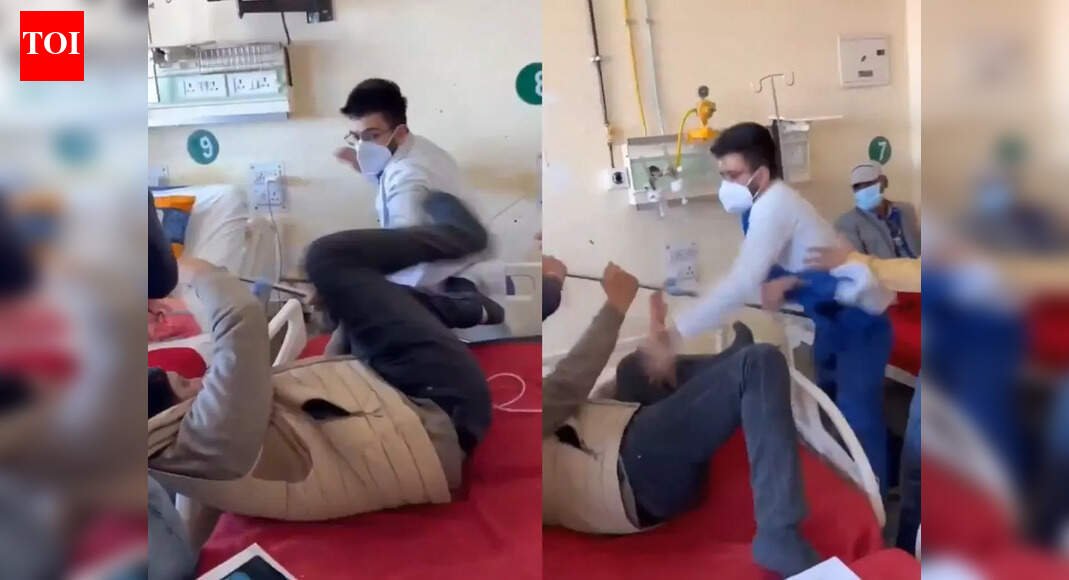
Assault row: Sacked Himachal doctor, patient patch up with a hug | India News


Assault row: Sacked Himachal doctor, patient patch up with a hug

A handshake and an embrace on Tuesday marked an end to the Dec 22 assault case at Shimla’s Indira Gandhi Medical College (IGMC) involving sacked senior resident Dr Raghav Narula and patient Arjun Panwar. Narula and Panwar, in the office of CM’s principal media adviser Naresh Chauhan, apologised to each other and to the people of Himachal Pradesh for the inconvenience caused due to their scuffle, which resulted in a doctors’ strike across the state. Chauhan termed the episode unfortunate, adding that dialogue had helped resolve the issue. In a public gesture of reconciliation, the doctor and the patient shook hands and embraced, stating that the scuffle unfolded suddenly and without prior intent. Narula’s mother emphasised unity, saying both the doctor and the patient were like her children. Panwar thanked Himachal govt and the public for their support and expressed regret for the disruption caused. He also light-heartedly mentioned attending Narula’s upcoming wedding, if invited. Panwar’s father credited CM Sukhu for ensuring justice and welcomed the peaceful resolution.


Source link

In a historic first, Constitution of India translated in Kashmiri | India News


In a historic first, Constitution of India translated in Kashmiri
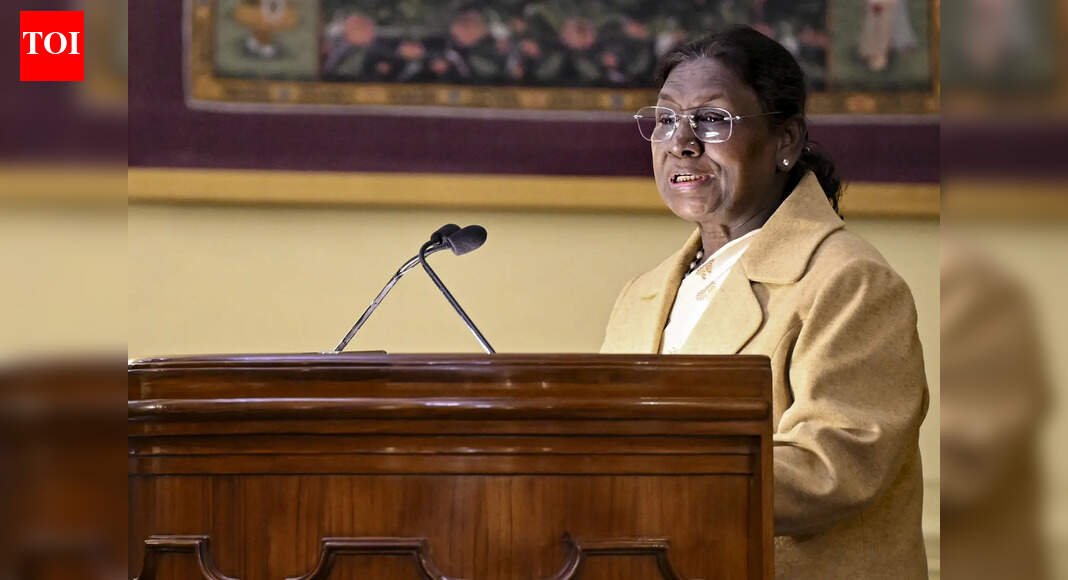
President Droupadi Murmu (File photo)

SRINAGAR: For decades, scholars had tried to translate the Constitution of India into Kashmiri. That wait has now ended. The translation is now available on the Union law ministry’s website.President Droupadi Murmu released the volume in a red-bound edition decorated with Chinar leaves and traditional Kashmiri decorative art. Prof. Aejaz Mohammad Sheikh of University of Kashmir, who led a 11-member translation panel that worked on the project for over two years, described the work as a “watershed moment” for Kashmiri language.“You now have the Bible of law in Kashmiri. This is not just a transfer of knowledge. It enriches the language itself. It gives Kashmiri the legal and intellectual vocabulary needed to translate science, law and modern knowledge,” Sheikh said.Many experts believe that while Kashmiri language possesses a rich body of translated works, including classics from world literature, the translation of a foundational legal document like the Constitution marks a historic first.“A common Kashmiri can now read the Constitution in their own language. When students see that Kashmiri language can carry the language of law, not just poetry, it changes how they see their mother tongue. It proves that Kashmiri language has the grammar, lexicon and strength to express the most complex ideas. This translation has the ability to move Kashmiri language out of a confined literary circle, allowing it to reach the common masses,” said Sheikh, who is dean of School of Arts, Languages and Literature at the university.A govt official echoed the view. “By incorporating constitutional, legal and administrative terminology, the translation strengthens Kashmiri’s capacity to function as a language of governance and law.” Linguistic experts believe the text should be introduced in schools and made available through voice-based software so it can reach the wider public.Basher Bashir, another member of the translation panel, said the exactness and authenticity had been maintained in the legal text of the Constitution.The project began in Aug 2023 when National Translation Mission (NTM) of Central Institute of Indian Languages, Mysuru, approached Sheikh. Fluent in Kashmiri, Urdu and Hindi, and proficient in Sanskrit, the professor agreed to do it. He put together a multidisciplinary team of linguists, academics and legal experts from his university, Satish Vimal of All India Radio (Srinagar), and education department officials.Team members first worked individually, then met to compare and refine their drafts. This was followed by a series of intensive seven-day workshops. The first was held in Mysuru, where legal experts read the Constitution in English while linguists compared it with their Kashmiri translation.. Every term was debated, every phrase tested. Where differences arose, they were discussed until a consensus was reached before moving forward.After the fifth workshop, Sheikh carried out a final, detailed review and submitted the draft. The manuscript was placed online for public feedback for three months by the Union law ministry before the President formally released the final version on Nov 27. The translation uses the standard Kashmiri Perso-Arabic script, adopting a simpler, more accessible style.On Sept 2, 2020, the Union Cabinet had approved Jammu and Kashmir Languages Bill, 2020, recognising five official languages in the UT — Urdu, Hindi, Kashmiri, Dogri and English. Before the revocation of Article 370, Urdu was the sole official language of the erstwhile J&K state.


Source link