Breaking News
Margaret Hamilton: The woman whose handwritten Apollo code is driving Artemis II and taking humans back to the Moon |

[ad_1]

Margaret Hamilton: The woman whose handwritten Apollo code is driving Artemis II and taking humans back to the Moon

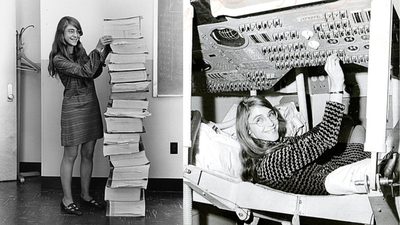
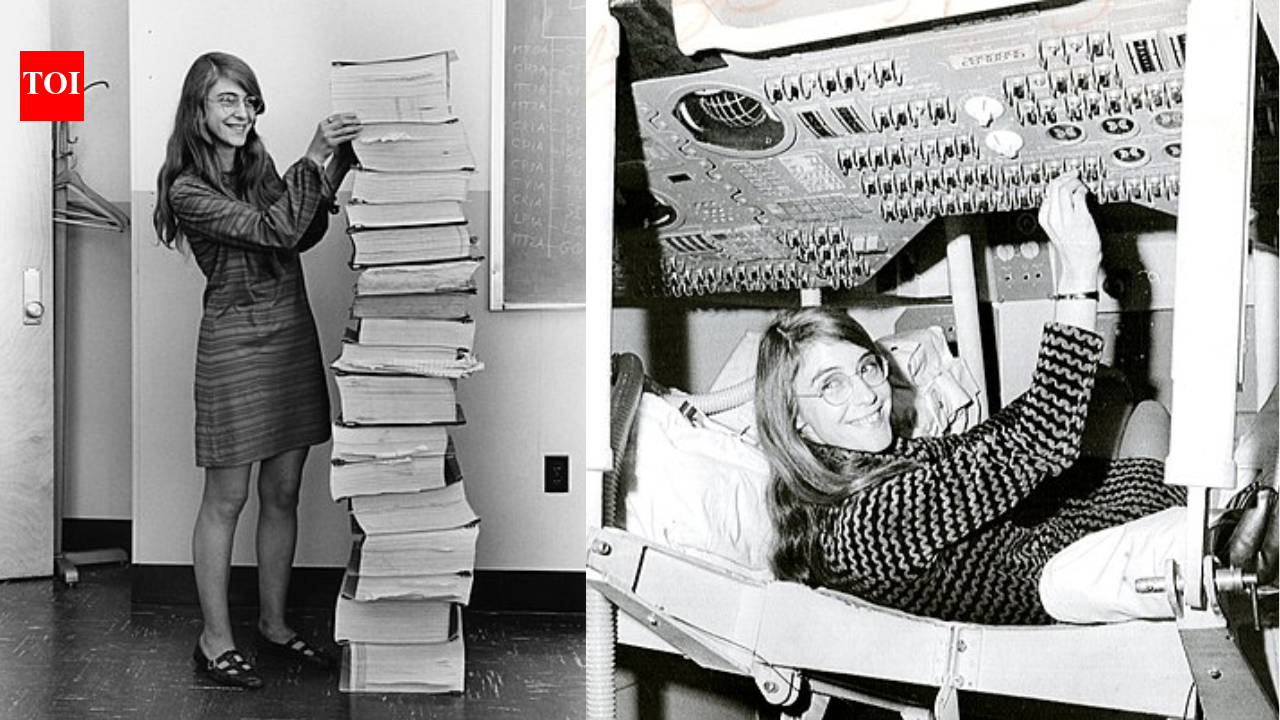
Margaret Hamilton, standing tall with her back to the camera and proudly facing the mountain of Apollo code she had developed, is not only a historic picture, but it is also a representation of the human spirit, precision, and ingenuity. Indeed, the code developed by Margaret Hamilton played a very important role in 1969 in the safe landing of the astronauts on the moon, which is one of the biggest milestones in the history of human achievement. Today, as NASA is gearing up to send humans farther than ever before in nearly 50 years with its historic Artemis II mission, Margaret Hamilton’s work is alive. The move from code to software is a testament not only to technological progress but also to a belief in software as a tool in space exploration.

How Margaret Hamilton’s Apollo code made the Moon landing possible

Margaret Hamilton supervised a division at MIT called the Software Engineering Division, which designed flight software used in NASA’s Apollo missions. As NASA describes, “Margaret’s work in flight software was revolutionary not only because it enabled humans to land on the moon, but because it launched the term ‘software engineering’ itself.”The well-known photograph of Margaret Hamilton was taken in 1969 and depicts her standing beside printouts of the code written by her team for both the Command Module and the Lunar Module. This code wasn’t simply written; rather, it was written in a way that enabled it to process errors that might occur during a mission. During the descent of Apollo 11, when the computer went into overload, the code enabled the mission to continue by prioritising tasks.Speaking about her work on the mission, Margaret Hamilton said, “There was no second chance. We knew that.”

Apollo to Artemis II: A new era of lunar exploration

Fast forward to the year 2026, and NASA is set to send its Artemis II mission to the Moon with four astronauts on board. The mission is expected to take ten days. It is the first mission to fly by the Moon with humans on board since the Apollo 17 mission.One major difference between the Artemis II mission and the Apollo missions is the technology used. Unlike the Apollo missions, theArtemis II mission utilises the much more advanced computing technology. Nevertheless, the main aim of the mission is remarkably similar to the Apollo missions. It is meant to test the technology to take humans further into space.Additionally, the mission is historic because it is the first mission to send the first woman and the first person of colour farther than low Earth orbit. Space travel is not only technologically evolving but also socially.

Software engineering legacy in Artemis missions

While Artemis II uses far more advanced software than Apollo’s 72 kilobytes of memory, the basic premise is still the same. Hamilton’s approach to developing systems that can identify, prioritise, and overcome errors still influences NASA’s approach to engineering.Hamilton’s work demonstrated that software was not merely an auxiliary system, but a mission-critical system. She once said to TIME magazine after Apollo 11, “It worked.” These three simple words illustrate the heart of trust in software, a trust that still exists in Artemis II today.While today’s spacecraft possess a range of advanced technologies such as diagnostic systems, real-time communication systems, and navigation systems, they still follow the same basic premise: software has to be reliable, even in extreme conditions.

From handwritten code to the future of space exploration

The evolution from Margaret Hamilton’s handwritten listings to the sophisticated technology used in Artemis II is one such story. It is the story of human ingenuity evolving over the course of several decades. It is the story of innovation building on innovation.As Artemis II is about to make its way around the Moon, it is not only conducting a test of the latest technology but also a celebration of the pioneers who made it all possible. Margaret Hamilton’s work is a testament to the fact that behind every successful mission, it is not the technology but the lines of code written with foresight and courage.Artemis II is not only making its way back to the Moon but is also a continuation of a woman standing next to her code listings and showing the world that even in the vastness of space, it is the ingenuity of humans that remains the driving force.

[ad_2]

Source link

ITR filing AY 2026-27: Income Tax Return forms ITR-1 to ITR-7 notified; key changes, eligibility explained

[ad_1]

ITR filing AY 2026-27: Income Tax Return forms ITR-1 to ITR-7 notified; key changes, eligibility explained

The government on March 30, 2026 notified Income Tax Return (ITR) forms ITR-1 to ITR-7 for the assessment year 2026-27, marking the start of the ITR filing season. Individuals, pensioners, professionals and other taxpayers can now file their returns using the applicable forms by July 31, 2026.A key change this year relates to ITR-1 (Sahaj), which now allows reporting of income from up to two house properties, easing compliance for a wider set of taxpayers.“One of the welcome change in ITR 1 is that Now ITR 1 can also be filed for income from “two house properties”. Earlier ITR 1 allowed reporting income from one house property only. So if you had two House property, you were required to file ITR 2 or ITR 3 which are more detailed form. With this change, taxpayers can find it easy to file ITR 1 and report their income from two houses,” said Chartered Accountant Ashish Niraj, Partner, A S N & Company, as quoted by ET.

Who can file ITR-1 (Sahaj)

ITR-1 can be used by individuals with relatively simple income profiles. However, it cannot be used if the taxpayer has:

  • Profits and gains from business or profession
  • Short-term capital gains
  • Long-term capital gains under Section 112A exceeding Rs 1.25 lakh
  • Income from more than one house property (earlier restriction, now relaxed to two houses)
  • Income under “other sources” such as lottery winnings or racehorse activity
  • Income taxable under special provisions like Sections 115BBDA or 115BBE
  • Income to be apportioned under Section 5A

Also Read: Your income tax changes from April 1, 2026! Top 10 things salaried taxpayers should know about new rules & tax regime choice

Who should file ITR-2

ITR-2 is applicable for individuals or Hindu Undivided Families (HUFs) who:

  • Are not eligible to file ITR-1
  • Do not have income from business or profession
  • Do not earn income such as interest, salary, bonus or commission from a partnership firm
  • Have income of spouse or minor child that needs to be clubbed

Who cannot file ITR-2

ITR-2 cannot be used by individuals or HUFs who have income from business or profession, including income received from a partnership firm in the form of interest, salary, bonus, commission or remuneration.With forms now notified, taxpayers can begin preparations for filing returns, with the deadline for most individual filers set for July 31, 2026.

[ad_2]

Source link

US-Iran war-linked disruptions hit UAE jobs, consumption; remittance risks for India

[ad_1]

US-Iran war-linked disruptions hit UAE jobs, consumption; remittance risks for India

A month into the Gulf conflict, early economic strain is surfacing in the United Arab Emirates, with companies in hospitality, travel, events and food & beverage beginning to cut costs through layoffs, pay reductions and unpaid leave, according to an ET report.People tracking hiring trends said the adjustment has already started at the firm level and could broaden if hostilities continue. The conflict, which began on February 28, has disrupted travel flows and business activity across the region.“Job losses and salary reduction are already happening in some companies in the UAE since last week,” said Sarah Brooks, managing director, Fikrah HR. “It’s across many companies and industries unfortunately, some are hospitality, retail, and food & beverage.”

Watch

‘DON’T STOP WAR’: Gulf Shocked After Trump Plans To ‘Exit’ Iran War, Makes Big Appeal

For India, the shift carries a second-order impact: weaker employment conditions in the UAE could dent remittance inflows, a key support for the current account. The Gulf nation contributes roughly a fifth of India’s global remittances.Companies appear to be reverting to playbooks used during Covid-19—cutting variable costs while trying to retain staff. “They are providing unpaid and annual leaves, air tickets to facilitate team members travelling home. Fewer are being laid off, they are working to preserve employment knowing that business will return and the team would be needed in time,” Brooks said.

Pressure concentrated in hospitality, events

The initial shock has been most visible in customer-facing sectors. “About 60% of the impact is on the hospitality industry and the events segment, while the remaining 40% is spread across other sectors,” said Amruta Heblikar, founder, Virtual Key.“Salary reductions are already happening. In many companies, pay cuts range from about 20% to even 50%. The situation is getting worse by the day.”Several F&B operators are holding decisions on deeper cuts until mid-April, when they expect clearer visibility on demand.Even with a cessation of hostilities, recovery may lag. “Right now, businesses are not thinking about achieving revenue targets or budgets. It is more about survival,” Heblikar said, adding that a return to normalcy could take another quarter after the war ends.Company-level actions point to stress building beneath the surface: a five-star hotel in Dubai Marina recently let go of 300 employees; a cloud kitchen operator cut around 100 roles; a restaurant in Downtown Dubai reportedly reduced headcount; and another F&B chain halved salaries, asking staff to accept revised pay or exit.

Spending slows, tourism takes the biggest hit

Transaction data suggests a broad-based cooling in demand. Biz2X estimates overall consumption has fallen 25–30% since the conflict began.“The steepest decline has been in tourism, travel, hotels and high-end restaurants, where transactions have fallen by as much as 60%,” said Rohit Arora, CEO and co-founder, Biz2X and Biz2Credit.Redseer Middle East said discretionary consumption has also weakened. “There is no domestic offset for a $59 billion inbound tourist economy. Physical F&B is caught in the middle,” said managing director Sandeep Ganediwalla. “About 20% of residents have cut spending on dining, while tourist-driven footfall in premium restaurant clusters has also declined.”He added that categories such as electronics, furniture and apparel have seen a 35–38% drop, signalling stress in non-essential retail.

Investment-linked sectors begin to feel the pinch

The slowdown is spilling into real estate and business services that depend on new company formation. “Another major area being hit is real estate and business setup companies,” said an HR executive. “I work closely with two large corporate service providers in Dubai, each employing around 300–400 people. They have started laying off staff or sending employees on reduced pay.”With fresh investor inflows drying up, commissions have stalled and, in some cases, salaries have been cut by about 50%, the person said.Industry executives said events have largely been put on hold for the next three to four months, removing a key source of demand for hospitality and ancillary services.As uncertainty persists, firms across sectors are shifting from growth plans to cash preservation, with labour adjustments emerging as the first visible sign of a broader economic slowdown.

[ad_2]

Source link

IndiGo appoints former British Airways chief William Walsh as new CEO

[ad_1]

IndiGo appoints former British Airways chief William Walsh as new CEO
William Walsh (File photo)

NEW DELHI: IndiGo airlines on Tuesday announced the appointment of former British Airways chief William Walsh as new CEO. This comes after Pieter Elbers resigned earlier this month after major operational crisis faced by the aviation operator in December last year.“The Board of IndiGo announces the appointment of William Walsh as Chief Executive Officers National 31′ March, 2026: The Board of InterGlobe Aviation Limited (IndiGo) today appointed Mr. William Walsh as the Chief Executive Officer, subject to Regulatory approvals. Mr. Walsh’s tenure at IATA comes to a close on the 31″ of July, 2026, and he is expected to join no later than on the 3′ of August, 2026,” said IndiGo in an official statement.Adding to the announcement, Rahul Sheila, Managing Director of IndiGo said, “As we enter a new phase of transformation and growth, I am delighted to welcome Willie to IndiGo. He is an iconic and accomplished aviation leader and brings a rare combination of global perspective, operational expertise of having built strong customer-focused airlines, deep industry experience and a values driven leadership, making him exceptionally suited to lead IndiGo at this pivotal cusp of growth.

[ad_2]

Source link

Your income tax changes from April 1, 2026! Top 10 things salaried taxpayers should know about new rules & tax regime choice

[ad_1]

Your income tax changes from April 1, 2026! Top 10 things salaried taxpayers should know about new rules & tax regime choice
Revamp of the Income Tax Rules, 2026 is likely to have a meaningful impact on taxpayers. (AI image)

April 1, 2026 not just signals the start of the new financial year 2026-27, but this time also brings with it a new set of income tax rules. The New Income Tax Rules 2026, based on the Income Tax Act 2025, have several changes that salaried taxpayers should be aware of. Your exemption limits are changing – hence the math behind the choice of the new and old income tax regime is also changing.Beyond that, the language of the Income Tax Act has been simplified and several common sections and forms have been renamed, which is important to know when filing tax returns.According to Kuldip Kumar, Partner, Mainstay Tax Advisors, the use of simpler language and the rearrangement of sections are expected to make the law more streamlined and less complicated for taxpayers. “Taxpayers will now need to familiarise themselves with renumbered sections such as 80C, 80D, etc., which they have long remembered by heart. Greater linkage of information in return forms, along with changes in various reporting requirements, is also set to tighten compliance,” Kuldip Kumar told TOI. The amendments introduced through the Finance Bill 2026, along with the revamp of the Income Tax Rules, 2026—where the limits for several exemptions and deductions have been enhanced—are likely to have a meaningful impact on taxpayers, depending on their individual circumstances, he added.He notes that several changes—such as the enhancement of the free meal limit and the extension of this benefit to those under the new regime, as well and the increase in reimbursement limits for car running and maintenance expenses for employees using their own cars for both official and personal purposes—are expected to reduce the tax burden for the salaried class in general.We take a look at top 10 things salaried taxpayers should know going into the new financial year 2026-27:1. Tax Slabs Remain the SameThe income tax slabs and income tax rates under both the new and old income tax regime remain the same. The old tax regime continues to offer several deductions and exemptions but with higher tax rates at lower income levels, and the new tax regime has almost negligible exemptions but much lower income tax rates at higher income levels.

Income Tax Slab Income Tax Rate
0-2.5 lakh Nil
2.5-5 lakh 5%
5-10 lakh 20%
Above 10 lakh 30%

Old Tax Regime Slabs For Individuals Up To 60 Years of AgeBut while the tax slabs remain the same, several changes in the exemption limits under the old income tax regime may change your decision on which regime to opt for. In certain cases, with higher exemption limits under the new income tax rules, the old regime again becomes lucrative.

Income Tax Slab Income Tax Rate
0-4 lakh Nil
4-8 lakh 5%
8-12 lakh 10%
12-16 lakh 15%
16-20 lakh 20%
20-24 lakh 25%
Above 24 lakh 30%

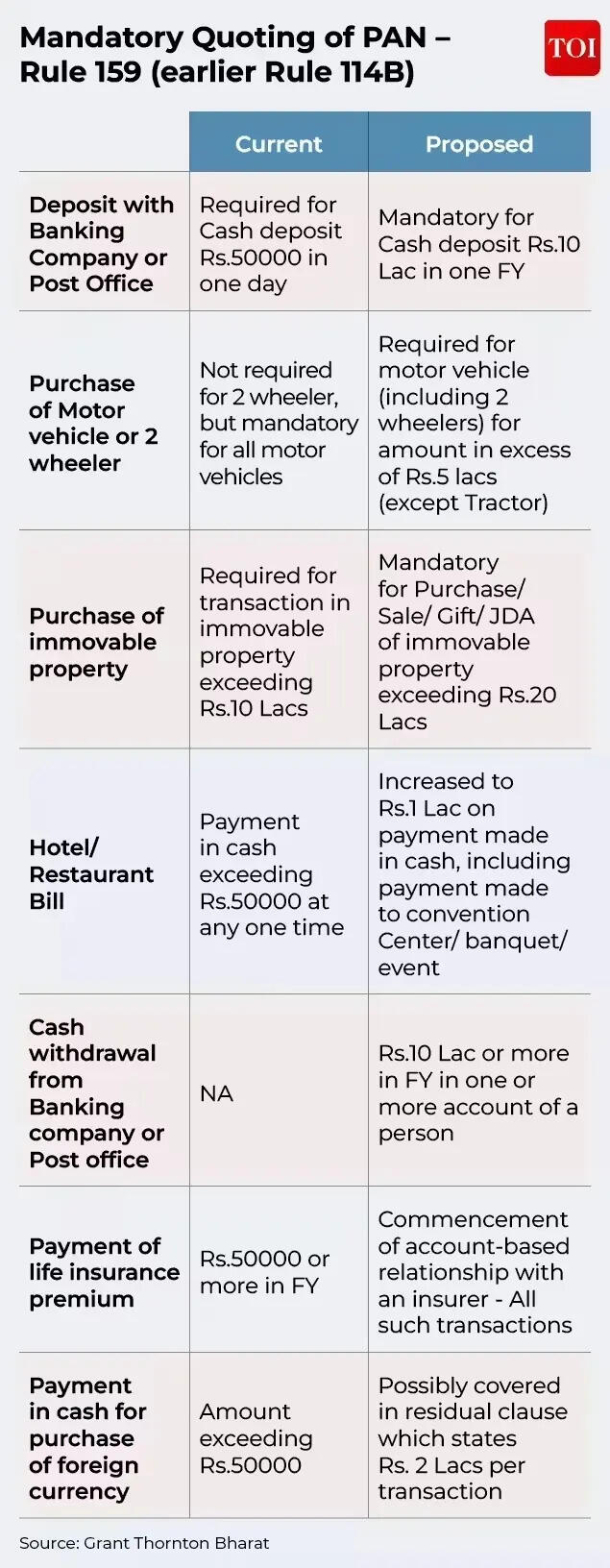
New Tax Regime SlabsWe explain that in detail at the end of this article, but first we take a look at the top changes2. Expansion of 50% HRA benefits to more citiesHouse Rent Allowance or HRA is a common exemption availed by taxpayers under the old income tax regime. How is HRA calculated? It’s the least of the three amounts; actual HRA received, rent paid minus 10% of salary, and 50%/40% of salary.So, what has changed under the new income tax rules? The list of metro cities that are allowed for the 50% of salary calculation has been expanded. Earlier, only those living in Delhi, Mumbai, Kolkata, and Chennai could avail the 50% limit. Now, the list includes Bengaluru, Hyderabad, Pune, and Ahmedabad.Parizad Sirwalla, Partner and Head – Global Mobility Services, Tax, KPMG in India calls the move a welcome step, particularly given the rise in housing costs across emerging urban cities. “By bringing cities such as Bengaluru, Hyderabad, Pune and Ahmedabad at par with traditional metros for HRA computation, the proposal provides meaningful tax relief to salaried individuals residing in these locations,” she tells TOI.The tax expert points out that the exemption will continue to be subject to existing conditions such as actual rent paid and salary structure. Taxpayers should therefore review their compensation structure and HRA claims to benefit from the revised provisions, proposed to take effect from 1 April 2026, she advises.Amarpal Chadha, Tax Partner, EY India tells TOI, “The revision in HRA exemption limits is a welcome move to keep pace with inflation. Extending the higher 50% HRA exemption to cities like Bengaluru, Pune, Hyderabad and Ahmedabad from the earlier 40% will meaningfully benefit salaried taxpayers opting for the old tax regime, where housing remains a significant expense.”3. Big Hike In Education, Hostel AllowanceThis one is a relief for parents – both in terms of an increase in education and hostel allowance. Effective FY 2026-27, the exemption limit for children education allowance has been increased from Rs 100 per month per child to Rs 3,000 per month per child.At the same time, for hostel expenditure, the exemption limit has been hiked from Rs 300 per month per child to Rs 9,000 per month per child. These two exemptions can be availed for up to two children.It’s important to note that these exemptions continue to be available only under the old income tax regime.4. PAN Card Quoting RequirementsUnder the new income tax rules, the requirement of quoting your PAN Card has undergone several changes. Below is a list of the changes that you should be aware of:Fundamentally, the changes to PAN usage and application signal a continued push by the government towards ease of compliance, targeted information collection and strengthening the digital tax ecosystem, says Parizad Sirwalla.

Mandatory quoting of PAN

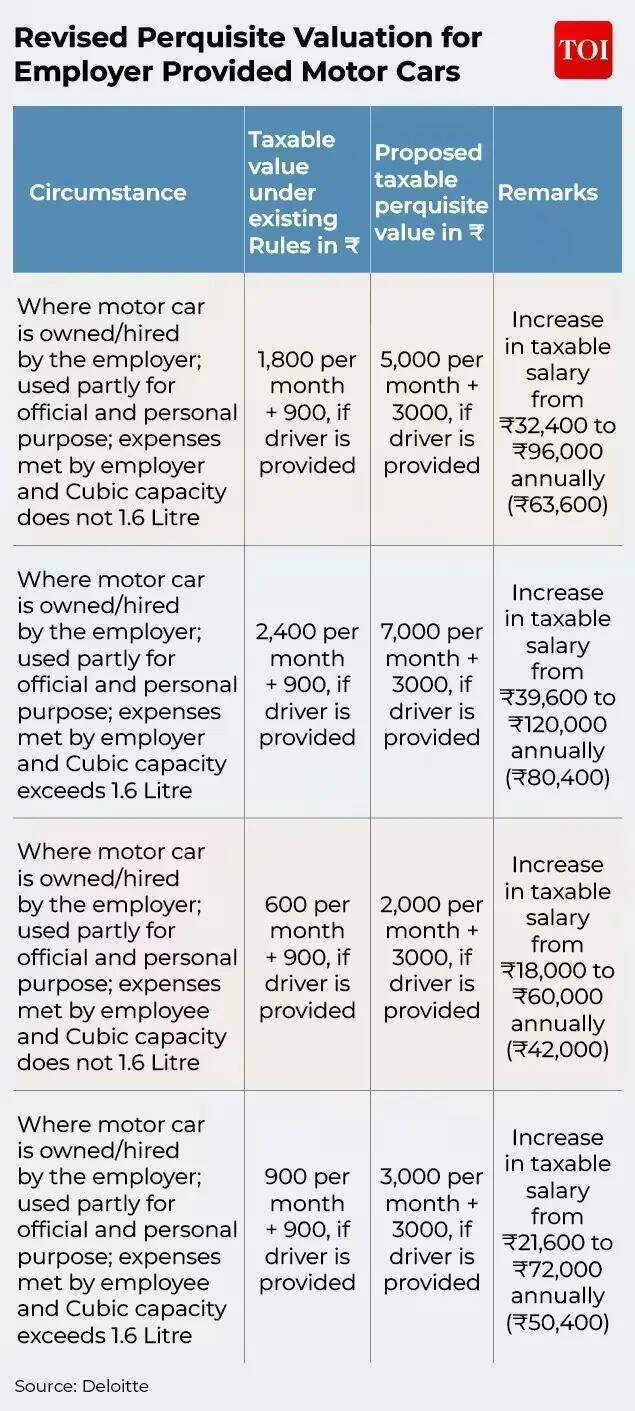
By enhancing transaction limits and curtailing the scope of compulsory PAN quoting requirement, such as moving from daily to annual transaction thresholds (e.g. cash deposit/ withdrawal etc.) and increasing the limits for mandatory quoting in specified transactions (such as hospitality/event expenditures, purchase of motor vehicle/ property etc.), the aim is to ease compliance for routine transactions while enabling closer monitoring of high-value activities, she says.“Even the PAN application process has been streamlined e.g. Aadhaar- PAN name mismatch issue potentially addressed by allowing use of initials where name as per Aadhaar has initials etc. Overall changes have been made to collect targeted information in a simplified manner,” she adds.5. Employer Provided Cars: New Perquisite ValuationIn this case, there is a chance of the tax liability for salaried taxpayers increasing. The valuation of perquisites for employer provided cars has undergone a revision. According to KPMG, the monthly taxable value ranges from Rs 2,000 to Rs 7,000 per month, and an additional Rs 3,000 per month is considered in case of a chauffeur being provided. The hiked slabs replace valuations ranging from Rs 600 to Rs 2,400, plus Rs 900 for chauffeur. Hence it would possibly increase the tax liability for employees who avail such benefits.

Perquisite Valuation For Employer Provided Cars

6. Concept of Tax Year As Against Assessment YearThis is a prominent change, especially when you are filing your tax return. The concept of financial year and assessment year has always caused confusion among taxpayers. That has now been unified to reflect a ‘Tax Year’ which is the year in which you have earned the income that is being taxed. Let’s understand this better with an example:

  • Under the earlier rules, if you were filing income tax returns for FY 2024-25, you selected Assessment Year 2025-26 at the time of filing.
  • Now, you will only select the tax year – which means that when you file returns for FY 2026-27, the tax year would be 2026-27 and no assessment year (2027-28) would be required.

7. Meal Voucher LimitsIf as a salaried employee, you get meal vouchers then the per meal limit has been a four fold increase. The tax free limit for meals provided by employees has been raised to Rs 200 from Rs 50 per meal. 8. Expanded scope of perquisites and exemptions

  • There are enhanced transport allowances for differently abled employees
  • Increased limits for tax-exempt gifts and vouchers provided by employers
  • The threshold for tax-free employer loans increases from Rs 20,000 to Rs 2 lakh.
  • For foreign tax credit claims, Form 67 will be replaced by Form 44. There is mandatory accountant verification for claims of Rs 1 lakh or more.

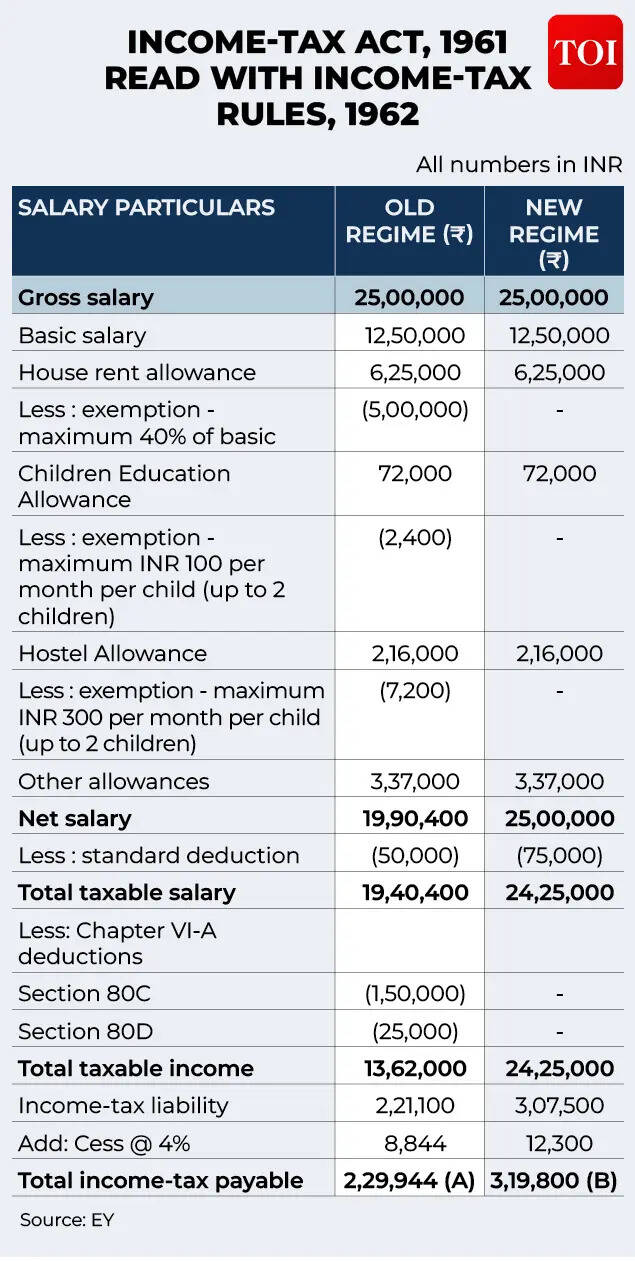
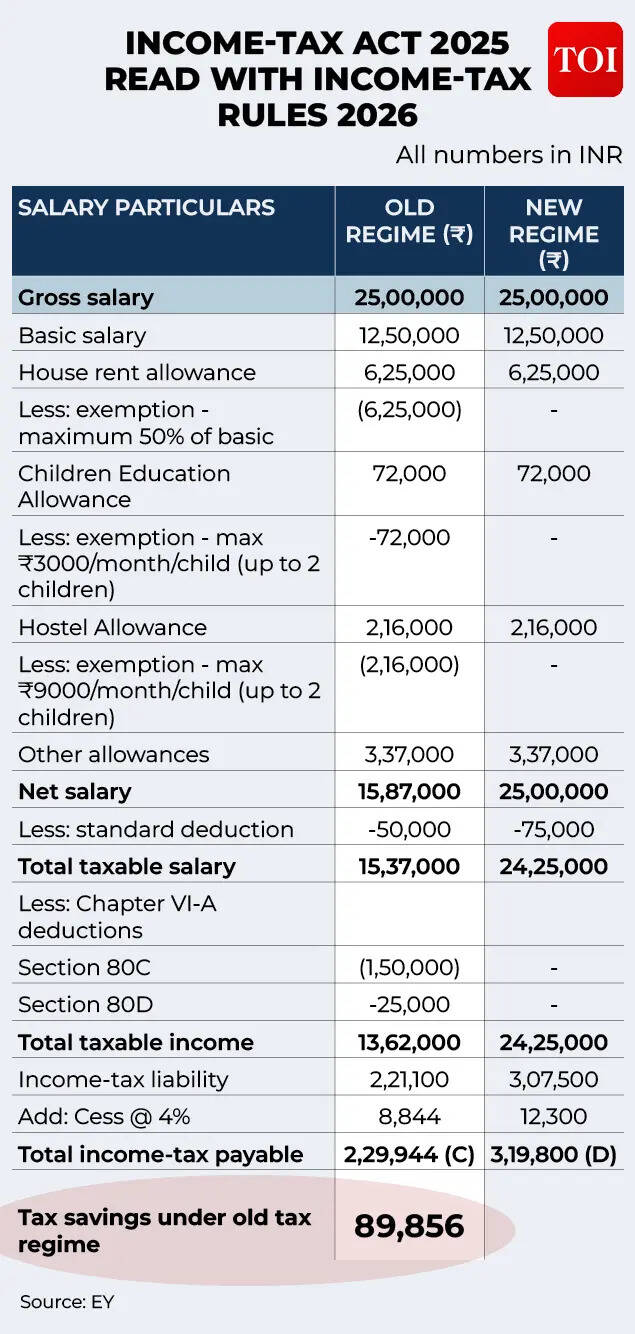
Several existing forms have been replaced or consolidated to simplify compliance. For example, Form 130 has replaced Form 16, commonly used as the salary certificate, while Form 124 has substituted Form 12BB, which was used for employee declarations. 9. Filing Revised Tax Return? New Extended Time Lines In PlaceYet another relief for salaried taxpayers is that the deadline to file revised tax returns is proposed to be extended. From the current December 31 of the tax filing year to March 31 of the subsequent year with the payment of a nominal fee. This measure was first announced by FM Nirmala Sitharaman in her Budget speech this year.10. New Vs Old Tax regime Math changes!Finally, the most important takeaway for salaried taxpayers is that with all the revisions in exemption limits under the old income tax regime, you will now have to do fresh calculations to understand which regime reduces your tax outgo – new or old?To understand this better, Amarpal Chadha of EY India shares two sets of calculations with certain assumptions. First is a comparison of tax liability under the old versus new tax regime as per the 1962 Income Tax Act rules. The second is a comparison between the old and new regime with the revised exemption limits as per the new income tax rules.

New vs Old Tax Regime: Based on 1961 Income Tax Act

Assumptions for Table 1:1. The employee is a resident of Bengaluru, Karnataka (with 40% HRA exemption rule) with a cost to the company of Rs 25,00,000 per annum.2. The above calculation is based on Income-tax Act, 1961 read with Income-tax Rules, 19623. Exemption for Children Education Allowance has been availed at Rs 200 per month per child for a maximum of 2 children4. Exemption for Hostel Allowance has been availed at Rs 300 per month per child for a maximum of 2 children

New vs old Tax regime: Based on New Income Tax Rules 2026

Assumptions for Table 2:1. The employee is a resident of Bengaluru, Karnataka (with the new 50% HRA exemption rule) with a cost to company of Rs 25,00,000 per annum. 2. The above calculation is based on Income-tax Act, 2025 read with Income-tax Rules, 20263. Exemption for Children Education Allowance has been availed at Rs 3,000 per month per child for a maximum of 2 children4. Exemption for Hostel Allowance has been availed at Rs 9,000 per month per child for a maximum of 2 childrenBased on the calculations presented above, a taxpayer is likely to see higher tax savings under the old income tax regime (Income Tax Rules 2026) compared to the Income Tax Rules, 1962 and the New Tax Regime, primarily due to the increase in exemption limits for Children Education Allowance, Hostel Allowance, and HRA. However, the tax outcome may vary depending on the nature and composition of the taxpayer’s salary structure, particularly in light of the higher perquisite valuation for benefits such as car Lease and the enhanced exemption limit for food coupons. Hence, it is wise to make your calculations before deciding on which tax regime to opt for in the new financial year 2026-27.
[ad_2]

Source link

Palmer Luckey: The story behind Palmer Luckey’s ‘firing’ from Facebook, the company he sold his startup for $2 billion |

[ad_1]

The story behind Palmer Luckey’s ‘firing’ from Facebook, the company he sold his startup for $2 billion

Palmer Luckey was only 21 when Meta acquired his virtual reality startup, Oculus VR in March 2014. The company was acquired for a whopping $2 billion, making it one of biggest tech deals of the decade. With the acquisition, Palmer Luckey became one of the youngest self-made billionaires then. “Mobile is the platform of today, and now we’re also getting ready for the platforms of tomorrow. Oculus has the chance to create the most social platform ever, and change the way we work, play and communicate,” Meta CEO Mark Zuckerberg then said. But what happened next was not what many had expected. Just three years after the billion dollar deal, Luckey was ‘fired’ from Meta.

Donation that got Palmer Luckey ‘fired’ from Facebook

In March 2017, Palmer Luckey left Facebook amid controversy surrounding his political contributions and financial support of far-right groups and internet trolls. In a later interview with CNBC, Luckey admitted hat he was fired from the social networking giant a few years ago, saying it was for “no reason at all.”“I gave $10,000 to a pro-Trump group, and I think that’s something to do with it,” he said, adding “it wasn’t my choice to leave” but selling Oculus to Facebook was “the best thing that ever happened to the VR industry even if it wasn’t super great for me.”Since leaving Facebook, Luckey has openly supported Donald Trump.

Palmer Luckey founded defence-tech startup Anduril

Following his exit from Facebook, Luckey founded the security and defense-tech startup Anduril Industries in 2017. The company has secured major contracts from US defence agencies. In a recent interview, Luckey admitted that moving from VR headsets to defense was a shift. “With VR, the only thing stopping us from launching a new headset was whether it was finished and ready to launch. You can’t do that with the military. You’re moving at someone else’s pace.”Cost-plus contracting has perverse incentives: people make more money when programs are slow, more money when things are more expensive, more money when things break all the time. If I relied on the government to give me money to start development, I’d have to wait years just to even start,” he said.

Meta CEO Mark Zuckerberg praises Palmer Luckey

In a taste statement about Luckey, Mark Zuckerberg told Tablet that he had “a huge amount of respect” for Palmer and hoped the two could “find ways to work together in the future.”“He’s an impressive free-thinker and fun to work with,” he said in the statement. “I was sad when his time at Meta came to an end, but the silver lining is that his work at Anduril is going to be extremely important for our national security. I’m glad an entrepreneur of his caliber is working on these problems.”

When Palmer Luckey commented on Meta layoffs

Earlier this year, Palmer Luckey shared an X post expressing sympathy for laid off Meta employees as the company cut 1,500 jobs at its Reality Labs division. Here’s what he said: I have an opinion on the Meta layoffs that is contrary with most of the VR industry and much of the media, but strongly held.This is not a disaster.They still employ the largest team working on VR by about an order of magnitude.Nobody else is even close.The “Meta is abandoning VR” narrative is obviously false, 10% layoffs is basically six months of normal churn concentrated into 60 days, strictly numbers wise.The majority of the 1,500 jobs cut in Reality Labs (out of 15,000) were roles working on first-party content, internally developed games that competed directly with third party developers.I think this is a good decision, and I thought the same back when I was still at Oculus.Change always sucks because people lose their jobs in the process, but in a world of limited resources, Meta heavily subsidizing their own (with money, marketing, placement, etc) at the expense of core technical progress and platform stability doesn’t make sense. Crowding out the rest of the entire ecosystem, even less so. Every developer big and small, even the hyper-efficient ones, have had an extremely hard time competing with games developed by Meta-owned teams with budgets and teams that spend vastly in excess of earning potential.People will point out that these teams did an awesome job and got awesome reviews from critics and customers alike – yes, and fucked up though it is, that makes the problem even worse!Some people will say “they should have just funded those developers as external studios rather than acquiring them, then!”.Yes, I agree, but hindsight is 20/20.Do you think Oculus expected to only sell 700 copies of Rock Band VR after spending eight figures to make sure it was ready and awesome for Rift CV1 launch, to the point of bundling the guitar adapter with every single headset?Of course not, but sometimes you learn what the world actually wants from you the hard way.TL;DR, I feel really bad for the people impacted, but this is a good thing for the long-term health of the industry, especially the ongoing incentives.

[ad_2]

Source link

Could oil hit $200 a barrel? Experts warn of risks if Iran war drags on

[ad_1]

Could oil hit $200 a barrel? Experts warn of risks if Iran war drags on

As the Middle East crisis escalates, crude oil prices could surge to $150 or $200 a barrel if the near-closure of the Strait of Hormuz continues over the next six to eight weeks. The disruption is a result of the ongoing war involving the US, Israel, and Iran, which has already prompted Persian Gulf producers to cut millions of barrels of daily supply.According to energy-market consultancy FGE NexantECA, the impact on the global oil market could be enormous. “Every week, 100 million barrels of oil is not going through, and every month, 400 million barrels are not going through,” Chairman Emeritus Fereidun Fesharaki told Bloomberg on Tuesday. “So, within a period of time, these losses to the market will be astronomical,” he said. Fesharaki highlighted that the physical reality of supply disruptions would determine oil prices, rather than political statements.“The market will choke, and the prices will go up. It doesn’t matter what the president says on the political front,” he added. His statement comes as US President Donald Trump has earlier suggested possibility to end the conflict. Oil prices have already surged sharply this month amid the conflict, with Brent crude climbing above $110 per barrel and US West Texas Intermediate (WTI) crude trading above $100. Brent crude rose $2.26, or about 2 per cent, to $115.04 a barrel in early trade, after hitting its highest level since March 19 in the previous session. US WTI crude gained $3.10, or around 3 per cent to $105.96 a barrel, marking its highest level since March 9.Analysts warn that if the Strait of Hormuz remains effectively closed, the global oil market could face further shocks, potentially pushing prices even higher.

[ad_2]

Source link

US drops 900kg bomb on Isfahan: How ‘bunker buster’ dismantled Iran’s defences

[ad_1]

US drops 900kg bomb on Isfahan: How 'bunker buster' dismantled Iran's defences

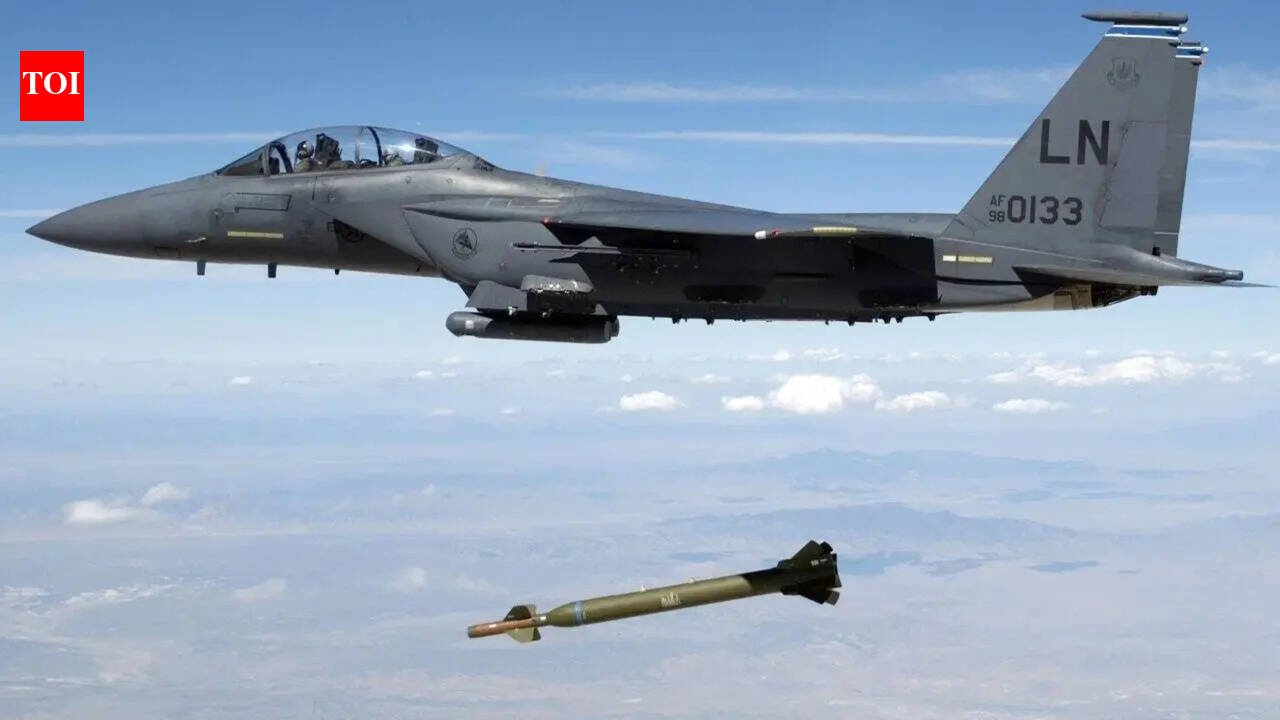
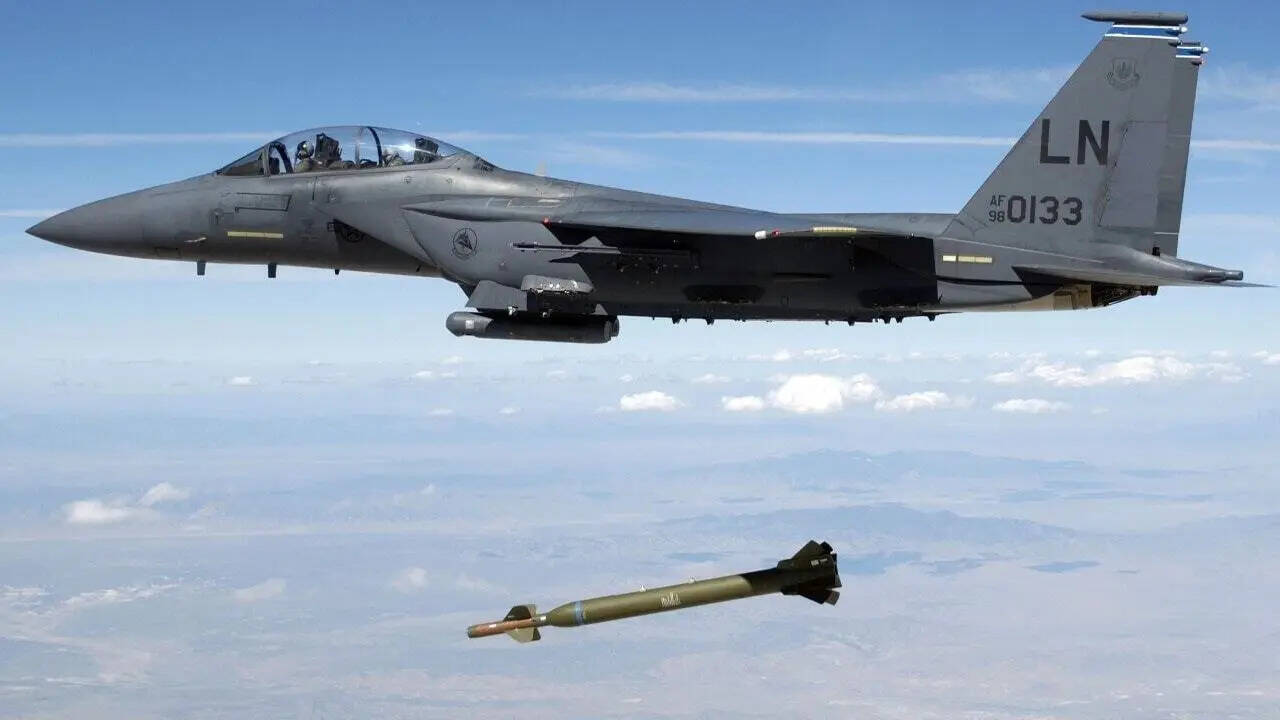
The night skies of the ancient city of Isfahan turned to blinding brightness after an airstrike. It is reported that a 2,000 pound or 900 kg bunker buster bomb hit an Iranian ammunition dump near the city. The current conflict has seen a tremendous use of bunker buster bombs as the Iranian forces have built an elaborate subterranean tunnel network in order to prevent the destruction of vital war waging assets as well as command and control networks under what the perceived would be protection from targeting from the air.The advantage for the defender here is that a defender who’s infrastructure is underground is removed from observation of targeting apparatus and is also protected from the effects of regular bombs. The practice of using underground structures for protection from exploding projectiles was most extensively used during the First World War in which fixed trenches were the targets of heavy artillery and aerial bombing.In the inter-war period and during the Second World War underground bunkers and defences such as the French Maginot line and the underground bunker complex in Berlin (where Hitler died were) built specifically for protection from threats from air and artillery. Aware of this extensive network, the American-Israeli coalition has made an extensive use of bunker buster weapons to hit these underground targets. The Israelis have been using bunker buster bombs deployed by air to fight expansive tunnel and bunker networks in both Gaza and Lebanon. The Israelis depend on their vast intelligence network to target these bunkers using specialised bunker buster guided bombs.In June of last year US Air Force B-2 stealth bombers dropped specialised GBU-57 Massive Ordnance Penetrator (MOP) on the Fardow and Natanz underground nuclear facilities in order to debilitate Iran’s nuclear program. The facility was deliberately carved in to a mountain as perceived protection from airstrikes.These specialised bombs are made of thick metal that helps them penetrate concrete and have a mechanism in their fuses that allows for detonation after a set distance after impacting the surface. Unlike a regular bomb, whose fuse is at the nose of the projectile, the fuse of a bunker buster is kept either in the centre or at the back so as to protect it as it goes through the concrete protecting a target.Bunker busters are now in the arsenals of most air forces today, as many key pieces of equipment as well as command and control centres are either buried deep underground or are protected by well constructed hardened overground shelters, that are designed to provide protection against regular bombs.

US drops 'bunker buster' bombs on Iran missile sites near Strait of Hormuz: What is it

[ad_2]

Source link

Big drop! Why bench strength of TCS, Infosys, Wipro & other IT companies has fallen by around 75,000 people

[ad_1]

Big drop! Why bench strength of TCS, Infosys, Wipro & other IT companies has fallen by around 75,000 people
Historically, companies maintained a sizeable bench by hiring in anticipation of future projects. (AI image)

Indian IT sector majors – Tata Consultancy Services (TCS), Wipro, Infosys, HCL Tech, and Tech Mahindra – have seen their bench strength drop by 25% in the last two years. Bench strength acts as a traditional reserve workforce with an aim to be a cushion during demand fluctuations. This buffer has contracted sharply, declining by roughly one-fourth over the past two years, and industry observers believe it may not return to earlier levels even if growth revives.Across major firms such as TCS, Infosys, Wipro, HCLTech and Tech Mahindra, the number of employees on the bench has dropped by around 75,000, falling from nearly three lakh to about 2.25 lakh, according to industry estimates cited by experts in an ET report.The proportion of unassigned employees has also narrowed considerably. “The bench across IT services is currently between 8-15% of the workforce compared to over 20% earlier,” said Pareekh Jain, CEO of EIIRTrend. Similarly, TeamLease Digital estimates the current range at 8-12%, down from 20-30% in previous years.

Deeper Shift In IT Sector Bench Strength Trends

Historically, companies maintained a sizeable bench by hiring in anticipation of future projects, ensuring that skilled personnel were readily available when demand materialised. This approach was viable during periods of rapid expansion. However, firms are now moving away from that model and tightening workforce utilisation.Companies that once operated with 4-5% of employees on the bench are now targeting significantly lower levels, often between 1% and 1.5%. In some cases, stricter policies have been introduced. For instance, in TCS bench duration has been capped at around 35 days annually, after which performance evaluations are initiated, and employees who remain unallocated may be asked to exit.Experts indicate that this shift is not merely cyclical but reflects a deeper structural change. “The concept of bench does not make sense unless an IT services firm can predict skill or role-based demand with 90% accuracy three months in advance,” said Gaurav Vasu, founder of UnearthInsight.Slower industry growth has been identified as the primary driver behind this contraction, rather than technological disruption. “Low growth is the bigger factor in bench reduction today. When growth returns, firms may not need to rebuild their bench because local hiring in different countries has increased significantly over the last five to six years,” Jain said.Over the past two years, hiring patterns have undergone a clear shift. Demand for traditional mid-level delivery roles has declined by roughly 20–30 per cent, while requirements for skills in artificial intelligence, generative AI, data, and cloud technologies have increased by about 30–40 per cent across the same firms, according to Neeti Sharma, CEO of TeamLease Digital.Global capability centres, however, present a more varied trend, with mid-level recruitment showing relatively greater resilience. “Leadership hiring has grown in line with overall demand, with the share of such roles increasing from around 15% in 2024 to around 20% in 2025. What has changed is the nature of these roles. Today, more than 50% of job demand is driven by emerging skills, especially in AI, cloud, and platform engineering,” said Kapil Joshi, CEO of IT staffing at Quess Corp. In contrast, hiring at the entry level has declined by around 30–35 per cent during the same period, he added.The changes are also affecting how quickly professionals are placed. The average time required to assign a benched engineer with 8–12 years of experience has lengthened to 60–90 days, compared with 30–45 days earlier, Sharma told ET.

Salary Trends

Compensation trends are diverging as well. Premiums for lateral hiring in non-AI roles have reduced to 10–20 per cent, down from 25–35 per cent in FY 2022–23. In contrast, professionals with AI capabilities continue to command premiums of 20–30 per cent and tend to secure offers more quickly, Sharma said. According to Quess data, premiums for generative AI roles range between 15–40 per cent depending on the position.The broader career structure within IT services firms is also evolving. “The people manager role is not disappearing, but its responsibilities are narrowing, shifting toward revenue expansion and profitability management away from headcount oversight,” Vasu said.

[ad_2]

Source link

Dhurandhar 2 Full Movie Collection: ‘Dhurandhar: The Revenge’ box office collection day 13 [LIVE]: Ranveer Singh film eyes Rs 900 crore net milestone on second Tuesday |

[ad_1]

'Dhurandhar: The Revenge' box office collection day 13 [LIVE]: Ranveer Singh film eyes Rs 900 crore net milestone on second Tuesday
‘Dhurandhar 2: The Revenge’ continues its record-breaking run on day 13, surpassing the lifetime India net of ‘Dhurandhar Part 1’ in just 11 days. With a domestic net of Rs. 873.99 crore and a worldwide gross nearing Rs. 1,400 crore, the Ranveer Singh starrer is successfully defying the IPL 2026 season craze. Directed by Aditya Dhar, the film is now chasing the Rs. 900 crore and eventually the Rs. 1000 crore India net milestone, a feat previously seen only by the Allu Arjun starrer ‘Pushpa 2.’

‘Dhurandhar: The Revenge’, directed by Aditya Dhar and starring Ranveer Singh, continues its historic box office run as it enters day 13 of its theatrical release on Tuesday, March 31, 2026.’Dhurandhar 2 continues its phenomenal global run, amassing a worldwide gross of Rs. 1,392.23 crore. This massive total includes Rs. 1,042.23 crore from the Indian market and an additional Rs. 350 crore from overseas territories. On the domestic front, the film has recorded a staggering Rs. 872.17 crore in net collections by end of day 12 which marked the second Monday since its release. After a historic second weekend, the film is now on a steady march toward the Rs. 900 crore India net milestone. Notably, on Sunday, the spy thriller broke a nine-year-old record previously held by the Prabhas starrer ‘Baahubali 2,’ becoming the highest-grossing Indian film in North America by crossing the USD 22.7 million mark.Dhurandhar 2 Movie ReviewWith its strong word-of-mouth appreciation and repeat viewership despite the ongoing IPL season, ‘Dhurandhar 2’ continues to reign. The film has shown remarkable strength against the 19th season of the Indian Premier League (IPL), which began on March 28, 2026. Even with high-profile opening weekend clashes like RCB vs. SRH and MI vs. KKR, theater attendance for ‘Dhurandhar 2’ remained impressively steady. This indicates that the film’s drawing factor is compelling enough to withstand the massive viewership of major cricket tournaments. Here is a full live tracking update for day 13.

‘Dhurandhar: The Revenge’ first week and second week projections

The film’s opening week set the tone with an extraordinary preview haul of Rs 43 crore, followed by a historic opening day of Rs 102.55 crore which marked the milestone of being the biggest opening day in Hindi film history. The momentum held powerfully through the extended weekend, closing Week 1 at Rs 674.17 crore. The second week continued strongly with Rs 49.70 crore on day 8, Rs 41.75 crore on day 9, Rs 62.85 crore on day 10, and the record-breaking Rs 68.10 crore on day 11, before settling at Rs 25.30 crore on day 12.The film’s performance on its second Sunday was nothing short of legendary as it officially pushed its cumulative India net past the Rs. 840.20 crore lifetime collection of its predecessor, ‘Dhurandhar Part 1.’ With the ongoing IPL 2026 season, it usually causes a dip in evening cinema footfalls. However, the film has continued to retain massive footfalls even during prime match hours of 7:30 PM IST.

‘Dhurandhar: The Revenge’ day 13 live tracking

According to Sacnilk, on its thirteenth day, ‘Dhurandhar 2: The Revenge’ is maintaining a robust presence with 6,384 active shows nationwide. Live tracking reveals the film has already added Rs. 4.97 crore to its total today, pushing its domestic net collection to Rs. 877.14 crore.With this steady Tuesday performance, the film’s cumulative India gross has climbed to Rs. 1,048.09 crore, as the final official figures are tallied for the day.

Day wise collections for ‘Dhurandhar: The Revenge’

Day 0: Rs. 43 croreDay 1: Rs. 102.55 croreDay 2: Rs. 80.72 croreDay 3: Rs. 113 croreDay 4: Rs. 114.85 croreDay 5: Rs. 65 croreDay 6: Rs. 56.60 croreDay 7: Rs. 48.75 croreDay 8: Rs. 49.70 croreWeek 1 collection: Rs. 674.17 croreDay 9: Rs. 41.75 croreDay 10: Rs. 62.85 croreDay 11: Rs. 68.10 croreDay 12: Rs. 25.30 croreDay 13: Rs. 4.97 croreTOTAL: Rs. 877.14 crore

More about ‘Dhurandhar: The Revenge’

Directed by Aditya Dhar, this sequel serves as a gritty origin story for Jaskirat Singh, tracing his transformation into Hamza, India’s most lethal intelligence asset operating deep within Pakistan. The film features Ranveer Singh in a career-defining role, alongside Arjun Rampal as Major Iqbal and Sanjay Dutt as SP Chaudhary Aslam. The supporting cast includes R. Madhavan, Rakesh Bedi, Danish Pandor, Udaybir Sandhu and Sara Arjun. Yami Gautam appears in a key special role. To achieve the gritty aesthetic of Lyari, Karachi, the team redesigned Ballard Estate in South Mumbai and utilized massive sets in Bangkok.Originally planned as a single movie, the scale of the footage led to a two-part duology. It currently holds a U/A certificate with a massive runtime of 3 hours and 49 minutes. The film’s climax features Jaskirat’s identity arc unanswered which was reportedly a conscious creative choice by director Aditya Dhar. The film features several timelines with historical moments such as the 2014 general elections and the 2016 demonetization included into the narrative.DISCLAIMER: The box office numbers and data in this article are compiled from diverse public and industry sources. All figures are approximate unless explicitly mentioned, offering a fair representation of the movie’s box office performance. These totals may change as official studio data is updated or as additional international market reports are finalized. This data is provided for informational and entertainment purposes only.

[ad_2]

Source link