Breaking News
Budget 2026: Increased expenditure, clear roadmap & more — here’s what India’s highways need

[ad_1]

India’s national highway network has grown sharply over the last decade, becoming the second-largest in the world. The total length now stands at 146,560 km, compared with 91,287 km in 2014, an expansion of over 61%. The increase has largely come from the push to build high-speed corridors and four-lane highways under the Bharatmala Pariyojana. The government’s next phase of road building is expected to focus on access-controlled highways, with greater use of technology and sustainability measures in construction. For 2025–26, the Ministry of Road Transport and Highways has been given a budget allocation of more than Rs 2.87 lakh crore. Within this, the ministry has identified a 13,400-km pipeline of projects to be developed through the public-private partnership (PPP) model. These projects are estimated to involve an investment of about Rs 8.3 lakh crore and are planned to be rolled out over the next three years, ET reported. The ministry is also preparing to launch a public infrastructure investment trust, Raajmarg InvIT. Through this route, around 1,500 km of completed and operational national highways are expected to be brought to the market over the next three to five years. The idea is to raise funds that can be used for future highway development. Despite the scale of expansion, the sector continues to face several bottlenecks:

  • Project approvals have slowed.
  • Issues around quality and timely execution remain.
  • Developers also point to the requirement of completing 80% land acquisition before work begins.
  • Cost overruns and contractual disputes also face persistent challenges.

What Budget 2026 should focus on?

  • Making an umbrella scheme to speed up approval
  • Continuing with capital expenditure approvals
  • Laying out a clear roadmap for higher monetisation

The Confederation of Indian Industry (CII) has suggested setting up a National Infrastructure Guarantee Corporation. The proposal is aimed at improving investor confidence, reducing financing costs and helping unlock stalled projects.

[ad_2]

Source link

Pakistan ties up with crypto business of Donald Trump’s family; World Liberty Financial to explore stablecoins use

[ad_1]

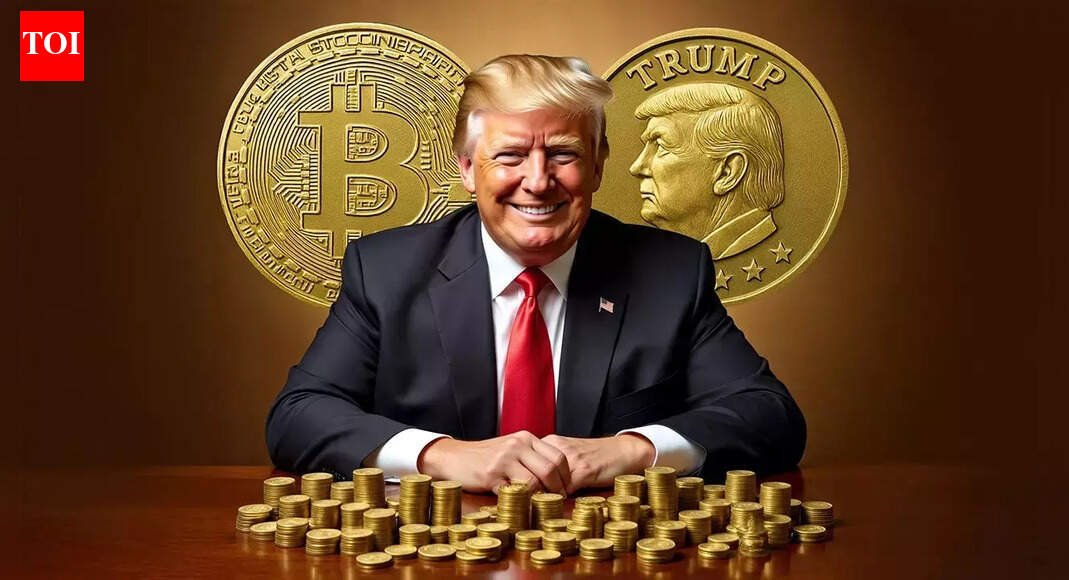
Pakistan ties up with crypto business of Donald Trump’s family; World Liberty Financial to explore stablecoins use
World Liberty Financial will collaborate with Pakistan’s central bank to incorporate its USD1 stablecoin into a regulated digital payments framework. (AI image)

Donald Trump’s family has just upped their stakes in Pakistan! World Liberty Financial, a cryptocurrency venture linked to US President Donald Trump’s family, has entered into an agreement with Pakistan. The development comes at a time of improving relations between Pakistan and the United States.According to a Reuters report, the deal will assess the use of World Liberty’s stablecoin for cross-border transactions. The report adds that the deal is among the first publicly disclosed partnerships between World Liberty, which is a crypto-focused financial platform launched in September 2024, and a national government.

‘May Not Need IMF Loans In 6 Months’: Pakistan Eyes JF-17 Sales Surge To Save Economy

Trump Family-led Firm’s Stablecoin Deal with Pakistan

As part of the agreement, World Liberty Financial will collaborate with Pakistan’s central bank to incorporate its USD1 stablecoin into a regulated digital payments framework. This would allow the token to function alongside Pakistan’s existing digital currency systems, the Reuters report said.Further specifics of the agreement involving SC Financial Technologies, a relatively low-profile firm connected to World Liberty, were not disclosed. Pakistan is expected to formally announce the deal later on Wednesday during a visit to Islamabad by World Liberty chief executive Zach Witkoff.At the same time, Pakistan has been advancing work on digital currency initiatives as part of efforts to curb reliance on cash and enhance cross-border payment channels, particularly remittances, which are a major source of foreign exchange. In July last year, Pakistan’s central bank governor said preparations were underway for a digital currency pilot, alongside the finalisation of laws to regulate virtual assets.Stablecoins are digital assets which are generally linked to the value of the US dollar. These have grown rapidly in scale over recent years. Under President Donald Trump, the United States has rolled out federal regulations that are widely viewed as supportive of the cryptocurrency sector, while governments globally are increasingly looking at how stablecoins can be incorporated into payment mechanisms and broader financial systems.World Liberty reportedly contributed to a big jump in revenues for the Trump family’s business interests, collectively known as the Trump Organization, including earnings from overseas sources during the first half of last year. In May 2024, MGX, a state-owned investment firm based in Abu Dhabi, used the World Liberty stablecoin to acquire a $2 billion equity stake in Binance, which is the world’s largest cryptocurrency exchange.

[ad_2]

Source link

New record! China trade surplus hits $1.2 trillion – what’s the outlook for 2026?

[ad_1]

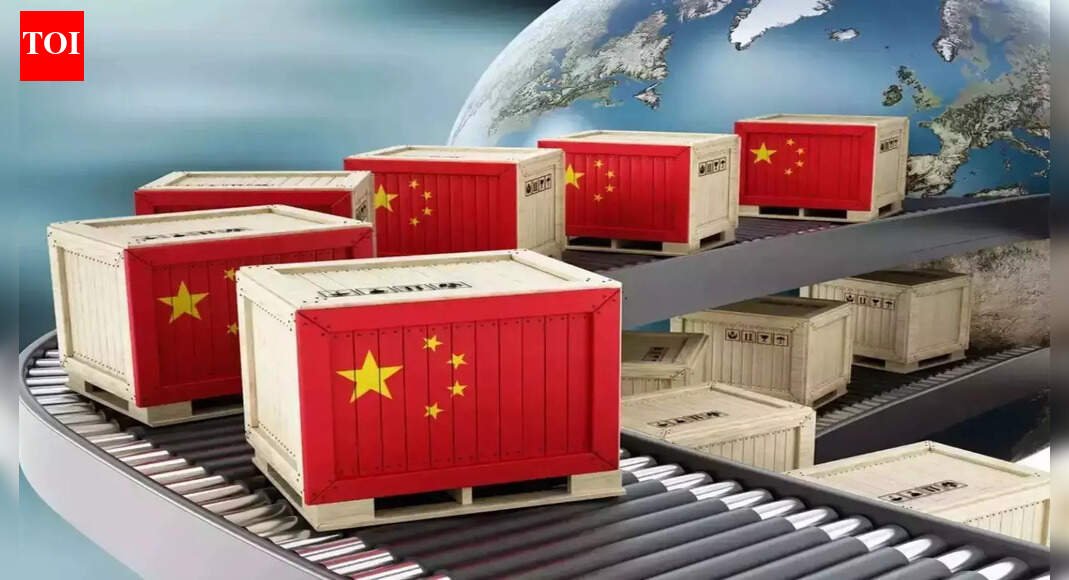
New record! China trade surplus hits $1.2 trillion - what’s the outlook for 2026?

China registered a trade surplus of nearly $1.2 trillion in 2025, the government reported on Wednesday. The record figure comes as strong exports to international markets offset slowing shipments to the United States. According to customs data cited by AP, the country’s exports rose 5.5% to $3.77 trillion last year, while imports remained steady at $2.58 trillion. The nation’s trade surplus in 2024 had stood at $992 billion. Back in December, exports rose 6.6% from the previous year in dollar terms, surpassing economists’ expectations and improving on November’s 5.9% year-on-year increase. At the same time, imports in the last month of 2025, rose 5.7% year-on-year, compared with a 1.9% increase in November.Though shipments to the United States have fallen drastically after President Donald Trump’s return to office and his escalation of the trade war with China, the decline has been largely offset by exports to South America, Southeast Asia, Africa and Europe.China’s economic growth has maintained its annual rate close to the official target of about 5%, thanks to strong exports. Other countries, meanwhile, are facing concerns about the impact of cheap imports on local industries. Last month, the head of the International Monetary Fund urged China to address economic imbalances and accelerate its shift away from export dependence by boosting domestic demand and investment. Meanwhile, a prolonged downturn in the property sector, triggered by the authorities’ crackdown on excessive borrowing and subsequent developer defaults, continues to weigh on consumer confidence and domestic spending.

Chinese economy — Outlook for 2026

Despite ongoing trade friction and geopolitical tensions, experts are anticipating that this year too exports will be driving Chinese economy.“We continue to expect exports to act as a big growth driver in 2026,” said Jacqueline Rong, chief China economist at BNP Paribas.Gary Ng, senior economist at French investment bank Natixis, extimated the trade surplus to remain above $1 trillion this year and exports will grow around 3% in 2026.

[ad_2]

Source link

H-1B hit: TCS on track to hire 15k in US in 5 years

[ad_1]

H-1B hit: TCS on track to hire 15k in US in 5 years

Bengaluru: TCS’s performance in the December quarter came in below analysts’ expectations on both revenue growth and earnings (Ebit) margins. Despite global uncertainty weighing on spending, demand for tech-led transformation remains resilient. In an interview with TOI, CEO K Krithivasan and CHRO Sudeep Kunnumal discussed the demand environment, hiring outlook, and the trajectory of its AI-led revenues. Excerpts:If Q2 marked the start of demand improvement and Q3 sustained it, what indicators give you confidence that this momentum will carry into 2026?Krithivasan: The total contract value is good despite this being a seasonally weak quarter. On the AI front, a couple of quarters ago, there was a lot of experimentation; today, many real projects are going live in production. Customers are willing to sign new projects based on return on investment and payback periods. This gives us confidence that they are willing to engage, both on cost optimisation and transformation.With discretionary spending still selective, are short-cycle and rapid-build AI projects becoming a growth lever?Krithivasan: This quarter, our AI services revenue moved to $1.8 billion on an annualised basis from $1.5 billion last quarter. The reason we talk about these rapid AI-led projects is that they deliver defined, committed outcomes in a short period. While AI is incremental today, it will become material over time.With TCS headcount down about 31,000 over 2 quarters, should AI-led growth decouple from traditional headcount expansion?Sudeep: Our demand for high-quality talent remains strong. We continue to hire while investing heavily in upskilling our existing workforce. We are hiring from campuses, laterals, and leadership roles globally.Will TCS recalibrate its campus hiring target of 40,000 given AI-led productivity gains? Some peers are offering Rs 20 lakh entry-level salaries. Will TCS match that?Sudeep: We don’t want to commit to a specific number. Demand is robust, traction is strong, and we are actively hiring from campuses at scale. Over the last 2-3 years, we adopted a tiered salary and talent structure and the share of hires in higher tiers increased significantly.If fresh H-1B approvals are closer to 1,000, does that imply nearly $100 million in visa fees?Sudeep: We applied in anticipation, but it is not necessary that we use all those visas. Over many years, we invested in building strong local employer brands. In the current quarter, most requirements were met through local hiring, reducing dependency on H-1Bs. We remain on track with our plan to hire around 15,000 people locally in the US in the next 3 to 5 years.Are investors concerned that a debt-fuelled AI data-centre build-out exposes risks?Krithivasan: Our investment thesis is grounded in strong demand in the country. Data centre costs are about 30% lower than in western markets, thus making India attractive for AI training and inference. There is also a growing need for sovereign data centres. With a balanced mix of debt and equity, we do not see material downside risks.

[ad_2]

Source link

‘Struck him repeatedly on head, face with hammer’: Wife, her lover butcher man in UP | Meerut News

[ad_1]

‘Struck him repeatedly on head, face with hammer’: Wife, her lover butcher man in UP
Image Used For Representational Purpose Only

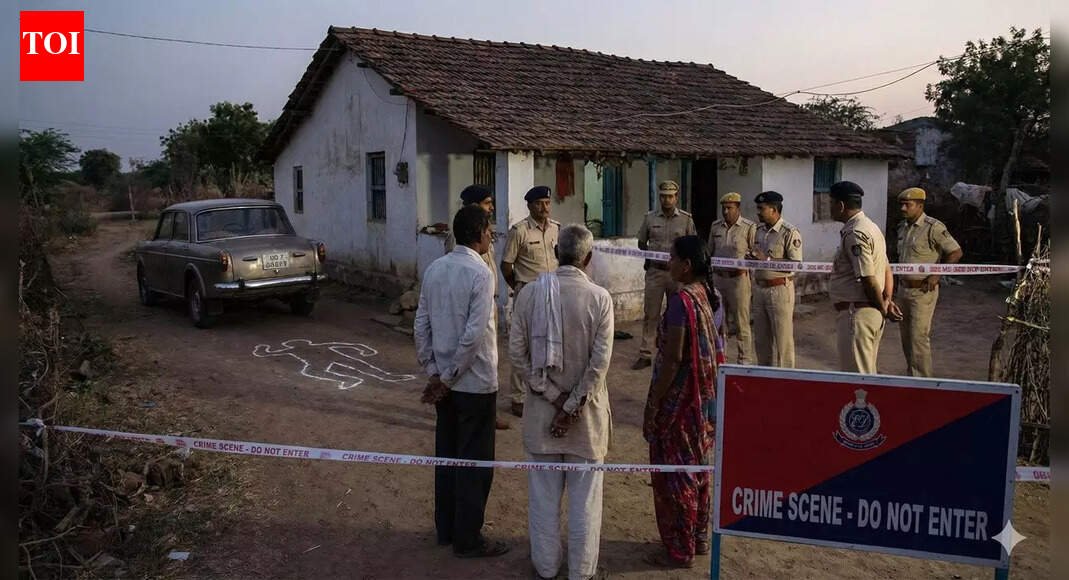
MEERUT: Police claimed to have cracked the murder case of a 50-year-old farmer who was beaten to death with a hammer in Bareilly on Saturday night and arrested his 30-year-old wife and her 26-year-old lover. The duo conspired to kill him for objecting to their affair, said police on Tuesday.Police said Mamta Devi, a native of Bihar, held her husband Sureshpal Singh down while he was asleep on a cot as her lover Hotam Singh, a daily-wage labourer, struck him repeatedly on the head and face with a hammer found in the room, killing him on the spot. Hotam fled with the weapon while Mamta remained at the house.SP (South) Anshika Verma said, “The couple had been married for 11 years and had three children. Mamta and Hotam were in an illicit relationship for the past three years. Sureshpal had come to know about the affair which led to frequent arguments between the married couple and confrontations with Hotam. Sureshpal often assaulted Mamta asking her to end the relationship and hence she conspired to eliminate him.” Sirauli SHO Vinod Singh said, “To mislead the police, Mamta woke up her eldest son Arjun, 11, who was sleeping in another room at the time of the incident and asked him to inform the village head. Mamta told villagers she panicked and could not call for help. Meanwhile, she destroyed her phone’s SIM card to erase call records and claimed that she found her husband lying in a pool of blood when she woke up to use the toilet.”ACP Verma said, “During questioning Mamta broke down and confessed to the crime. She was arrested based on call records and other evidence. Hotam was also arrested following a stakeout at Shivpuri Tiraha on the Mirganj road. The blood-stained hammer used in the crime was seized on his disclosure. An FIR has been registered under BNS section 103 (murder). Both accused were produced before a court and sent to jail on Tuesday.

[ad_2]

Source link

Nipah alert in West Bengal: Pune lab confirms 2 samples; both nurses critical, over 120 contacts in home isolation | Kolkata News

[ad_1]

Nipah alert in West Bengal: Pune lab confirms 2 samples; both nurses critical, over 120 contacts in home isolation

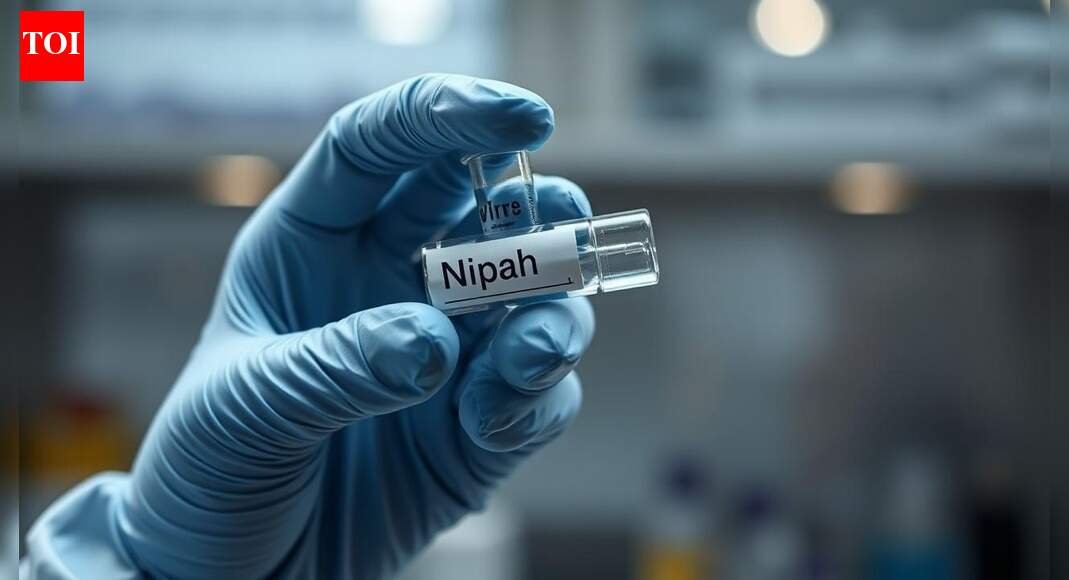
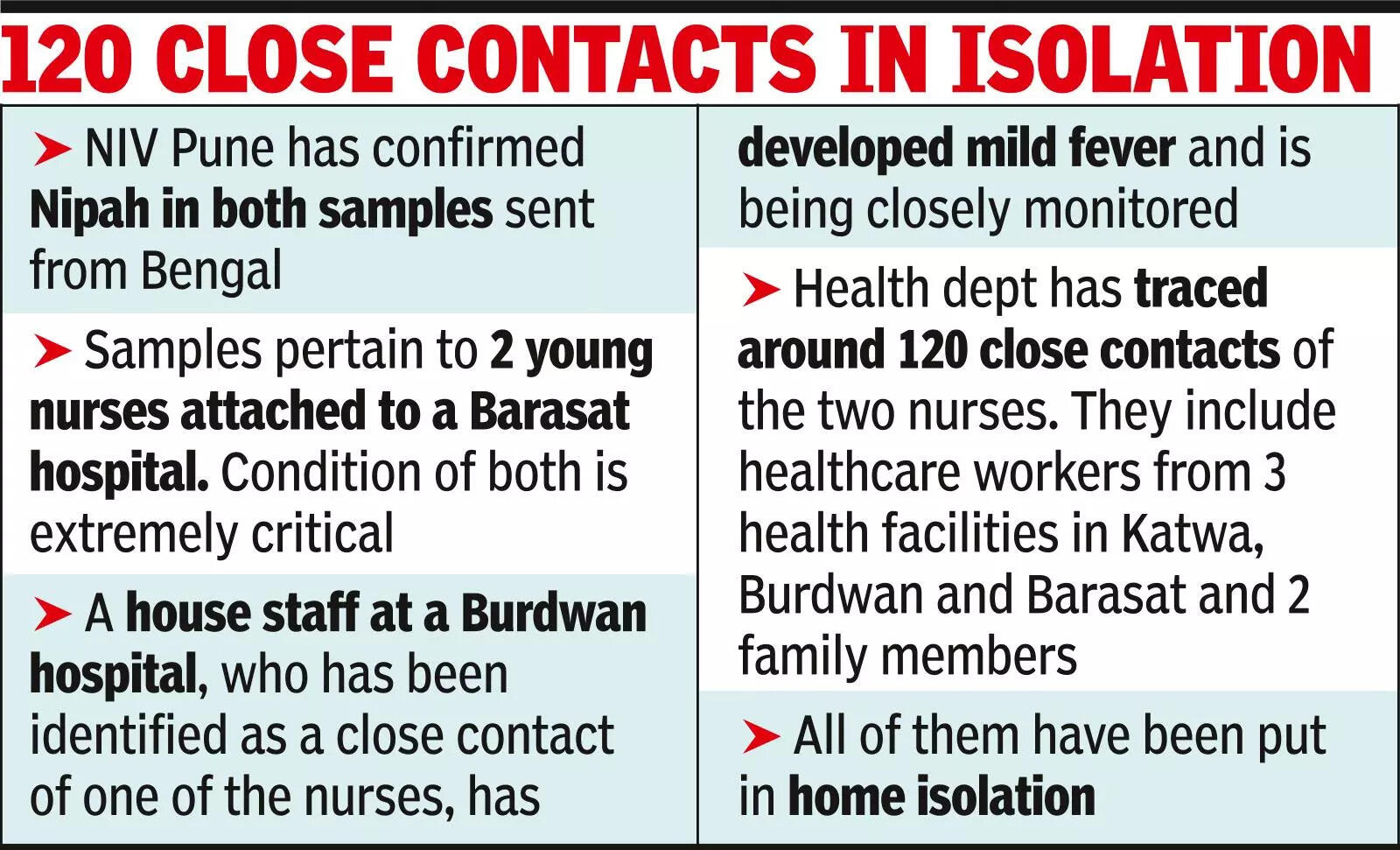
KOLKATA: The National Institute of Virology (NIV), Pune, has confirmed Nipah, a viral disease with high mortality, in both samples sent from Bengal. The samples were taken from two nurses of a Barasat hospital whose condition remain critical. A house staff at a Burdwan hospital, who came in close contact with one of the nurses, has developed mild fever, sources said. Officials are planning to bring the doctor to Beliaghata ID hospital. Earlier, samples from the two nurses, who are being treated at the Barasat hospital where they are employed, tested positive for Nipah at AIIMS Kalyani and were sent to Pune for re-confirmation.

Pune lab confirms Nipah in 2 samples, both nurses critical

The health department has identified over 120 people who came in close contact with the two nurses, one male and the other female, recently. All of them are in home isolation now. Efforts are on to identify more close contacts. “Contact tracing is on. The 120-odd close contacts identified so far include family members of the nurses and healthcare workers,” said a health department official.The healthcare personnel include nurses and doctors from the Barasat hospital and two hospitals in Katwa and Burdwan, where the female nurse was treated before being shifted to Barasat.Sources in the East Burdwan health department said 10 individuals from Katwa, including two doctors, and 38 from Burdwan, including eight doctors, are in home isolation.Apart from doctors, those under observation include nurses, ambulance drivers and other healthcare providers. Samples of some of the close contacts have been sent to AIIMS Kalyani.Sources said both patients are on ventilation, while the female nurse is in coma. “Doctors at the Barasat hospital are following all protocols. But the concern is the severity and high mortality of the infection,” said a health official.While the source of the infection is still unclear, sources indicated that the nurses might have contracted the virus from a colleague at the Barasat hospital. A healthcare worker at the hospital died a few weeks ago after showing symptoms of Nipah.“It is difficult to pinpoint the source of infection. It could be human-to-human transmission or they might have got the virus from contaminated fruits or fresh date palm sap,” an official said.The patients have no significant travel history outside the state, but they had gone home, to East Midnapore and Katwa, days before being taken ill. Health officials said many migrant workers from the state tend to come back home around this time, indicating another possibility of human-to-human transmission.“During winter, people in rural areas tend to drink raw date palm juice, which can be a potential source of infection as fruit bats feed on date palm,” said the source. A panel is coordinating with a National Joint Outbreak Response Team sent by the Union health ministry to monitor the situation.(With inputs from Mohammad Asif)

[ad_2]

Source link

India’s import of Russian crude drops 29% month-on-month

[ad_1]

India's import of Russian crude drops 29% month-on-month

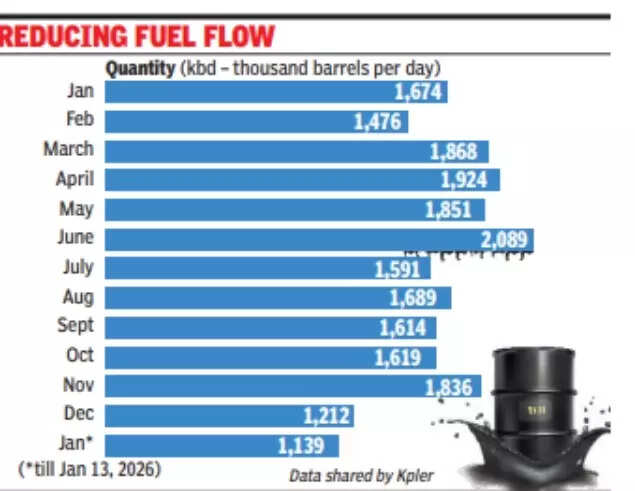
NEW DELHI: India’s import of Russian crude recorded a sharp 29% month-on-month decline, falling to the lowest volumes since implementation of the price cap policy, but is making a strong turnaround in January this year, Centre for Research on Energy and Clean Air (CREA) said in its monthly analysis of Russian fossil fuel exports for December.The report said the decline occurred despite total imports growing marginally. The drop was driven by a sharp reduction in imports by Reliance’s Jamnagar refinery – to the tune of nearly 49% – and a 15% cut by state-owned refineries in Dec. According to Kpler, a global real-time data and analytics provider, India imported over 20.4 million barrels of crude from Russia in 2025. The month of Dec saw imports of 1.2 million barrels, compared with 1.8 million barrels a month earlier. Till Jan 13 this year, India had already imported over 1.1 million barrels of crude oil from Russia.

.

In terms of value, India was the third-highest buyer of Russian fossil fuels – displaced by Turkiye from the second position – importing a total of EUR 2.3 billion of Russian hydrocarbons in Dec, CREA said in the report. While crude oil constituted 78% of India’s purchases, totalling EUR 1.8 billion, coal (EUR 424 million) and oil products (EUR 82 million) constituted the remainder of India’s monthly imports. India’s import of crude oil was recorded at EUR 2.5 billion in Oct and EUR 2.6 billion in Nov.The report added that the Jamnagar refinery cut its imports from Russia by almost half in Dec. “The entirety of their imports were supplied by Rosneft, albeit from cargoes purchased before the OFAC (Office of Foreign Assets Control in the US) sanctions came into effect. State-owned refineries also cut Russian imports by 15% in Dec,” the report stated.As per CREA analysis, Russia’s monthly fossil fuel export revenues saw a marginal 2% month-on-month decline to EUR 500 million per day – the second-lowest figure since the full-scale invasion of Ukraine. Monthly export volumes also witnessed a similar 2% month-on-month reduction. Total crude oil export revenues dropped by 12% to EUR 198 million per day.Russia’s fossil fuel exports remain highly concentrated, with China dominating coal and crude oil purchases, Turkiye dominating purchases of oil products, and the EU remaining the largest buyer of LNG and pipeline gas. While China remained the largest global buyer of Russian fossil fuels in Dec, accounting for 48% (EUR 6 billion) of Russia’s export revenues from the top five importers, The EU was the fourth-largest buyer of Russian fossil fuels, accounting for 11% (EUR 1.3 billion) of Russia’s export revenues from the top five importers.In December, five refineries in India, Turkiye and Brunei that use Russian crude exported EUR 943 million of oil products to sanctioning countries. The importers included the EU (EUR 436 million), the US (EUR 189 million), the UK (EUR 34 million) and Australia (EUR 283 million).

[ad_2]

Source link

Donald Trump tours Michigan Ford plant: US president pushes manufacturing agenda; brushes-off lingering economic fears

[ad_1]

Donald Trump tours Michigan Ford plant: US president pushes manufacturing agenda; brushes-off lingering economic fears
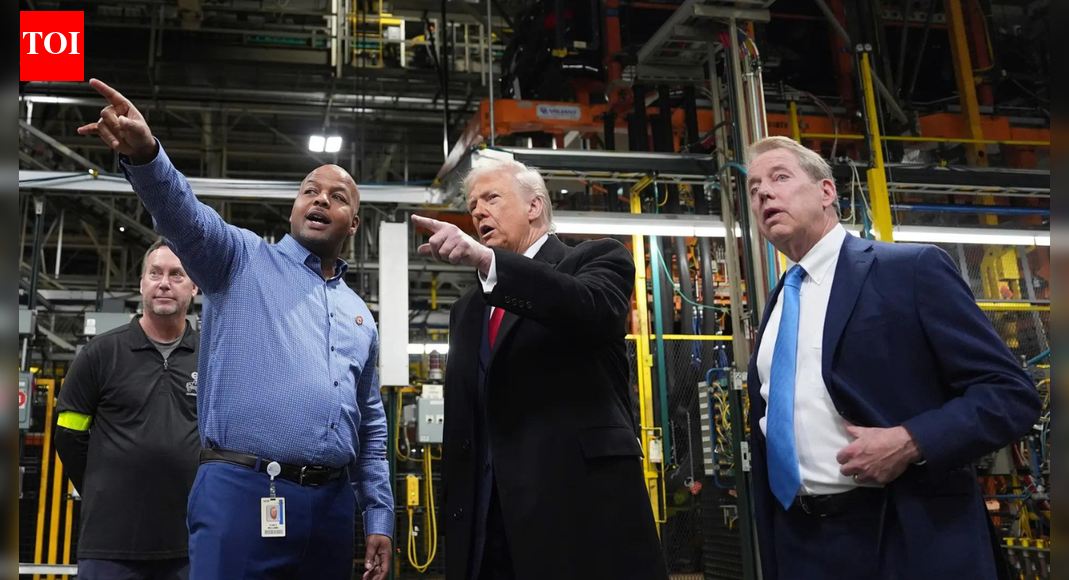
President Donald Trump speaks with Corey Williams, Ford River Rouge Plant Manager, during a tour of the Ford River Rogue complex, Tuesday, Jan. 13 (AP photo)

US President Donald Trump a visited a Ford Motor Co. assembly line in Michigan on Tuesday in an attempt to push his manufacturing agenda, as his administration works to counter voter anxiety over jobs, inflation and the cost of living. Trump walked the factory floor at Ford’s River Rouge complex in Dearborn, watching F-150 pickup trucks move through different stages of production. The F-150 is the bestselling domestically produced vehicle in the US. He observed how gas-powered and hybrid versions are assembled, along with the all-gas Raptor model built for off-road performance. Wearing a suit amid workers in reflective vests, Trump stopped to chat with assembly line employees, some of whom applauded as he arrived, and spoke with Ford executive chairman Bill Ford. “All US automakers are doing great,” Trump said, later adding that the “quality is unbelievable,” as quoted by the Associated Press. After leaving the plant, Trump headed to MotorCity Casino, where he addressed members of the Detroit Economic Club. He framed the speech as a straightforward exercise in listing his administration’s accomplishments. “This is the easiest speech to make,” Trump said, explaining that all he was doing was “spewing off what the hell we’ve done.” “Right now I’m feeling pretty good,” he added. Despite the confident tone, recent election results suggest many voters remain unconvinced. Tuesday’s stop marked Trump’s third visit to a swing state since last month focused on economic messaging, following Republican losses in off-year elections in Virginia, New Jersey and other states where concerns about everyday expenses dominated. The White House said after the trip that Trump plans to travel more frequently to make his economic case directly to the public and address lingering financial fears. Trump previously dismissed affordability concerns as a “hoax” fueled by Democrats. At the same time, his administration has imposed sweeping tariffs on US trading partners, while selectively easing some measures affecting the auto industry, including extending import levies on foreign-made auto parts until 2030. Speaking on the factory floor, Trump highlighted tariffs on vehicles imported from China and said he hopes to prevail at the Supreme Court, which is reviewing the legality of his broader tariff strategy. He also downplayed the relevance of the United States-Mexico-Canada Agreement, the North American trade deal he negotiated during his first term, suggesting it is no longer necessary for the US. The USMCA is scheduled for review this year. Earlier, before departing Washington, Trump had pointed to encouraging inflation data as evidence his economic approach is working. December figures showed inflation eased slightly as gas and used-car prices declined. Consumer prices rose 0.3 per cent in December from the previous month, matching November’s increase, according to the Labor Department. “We have very low inflation,” Trump told reporters on the White House lawn, adding that “growth is going up. We have tremendous growth numbers.” Even so, surveys continue to show Americans remain worried about inflation and rising daily expenses. Trump’s effort to refocus attention on economic growth comes amid controversy over his Justice Department opening a criminal investigation into Federal Reserve Chair Jerome Powell. Powell has described the move as a direct attempt to undermine the Fed’s independence on interest rates, a view echoed by former central bank leaders, economic officials and some Republican lawmakers. Asked about the investigation before heading to Michigan, Trump repeated his long-standing criticisms of Powell but declined to comment on the case itself. The Michigan visit also intersected with the administration’s rollback of electric vehicle policies. Ford announced in December that it was abandoning plans for an electric F-150, despite heavy investment in electrification, after the Trump administration cut targets for EV sales by 2030, eliminated tax credits and proposed easing emissions and fuel economy standards. Trump’s stop followed similar economy-focused appearances last month in Pennsylvania and North Carolina. In Pennsylvania, remarks about immigrants from “filthy” countries overshadowed his inflation message. In North Carolina, he argued that tariffs had strengthened the economy, even as residents complained of higher prices. Like Michigan, Pennsylvania’s event was also held at a casino, the Mount Airy Casino Resort. Trump carried Michigan in 2016 and again in 2024, after losing the state to Democrat Joe Biden in 2020. He marked his first 100 days in office with a rally-style speech outside Detroit, where he focused heavily on past political grievances rather than detailed economic plans. During that earlier visit, Trump also appeared at Selfridge Air National Guard Base and announced a new fighter jet mission, easing concerns about the base’s future. The move was welcomed by Democratic Gov. Gretchen Whitmer, who shared a hug with the president at the time. Democrats sharply criticised Tuesday’s trip. They pointed to national Republicans’ opposition to extending health care subsidies and recalled Trump’s comments during an October 2024 address to the Detroit Economic Club, when he warned that another Democratic term would leave the country in ruins. “Our whole country will end up being like Detroit,” Trump had said then. “You’re going to have a mess on your hands,” he added. Curtis Hertel, chair of the Michigan Democratic Party, accused Trump of political opportunism. “After spending months claiming that affordability was a ‘hoax’ and creating a health care crisis for Michiganders, Donald Trump is now coming to Detroit — a city he hates — to tout his billionaire-first agenda while working families suffer,” Hertel said in a statement. “Michiganders are feeling the effects of Trump’s economy every day,” he added.

[ad_2]

Source link

Budget 2026: COAI seeks cut in telecom licence fee; flags GST burden and ITC pile-up

[ad_1]

Budget 2026: COAI seeks cut in telecom licence fee; flags GST burden and ITC pile-up
File photo (Picture credit: ANI)

India’s telecom industry body COAI has asked the government to reduce regulatory levies and ease Goods and Services Tax (GST) norms in the upcoming Union Budget, arguing that high statutory payments continue to strain the sector’s finances.The Cellular Operators Association of India (COAI), whose members include Reliance Jio, Bharti Airtel and Vodafone Idea, has proposed lowering the licence fee to 0.5–1 per cent from the current 3 per cent, saying the existing structure places a heavy burden on telecom operators, reported news agency PTI.At present, the licence fee comprises a 3 per cent levy on Adjusted Gross Revenue (AGR), along with a 5 per cent contribution to the Digital Bharat Nidhi. “The licence fee, which is a combination of the licence (three per cent of AGR) and Digital Bharat Nidhi Contribution (five per cent of AGR), is a huge financial burden for the licensed telcos,” COAI said in its submission.The association argued that a reduced levy of 0.5–1 per cent would be sufficient to cover administrative costs.COAI has also urged the Department of Telecommunications to pause further contributions to the Digital Bharat Nidhi until the existing unutilised corpus is fully used. The industry body said such steps would help reduce financial stress and allow operators to invest more in network expansion and next-generation connectivity, in line with the government’s ‘Viksit Bharat’ vision.On GST-related issues, COAI flagged concerns over rising input tax credit (ITC) accumulation in the sector. It recommended a special GST exemption on regulatory payments such as licence fees, spectrum usage charges (SUC), and spectrum acquired through auctions, reported news agency ANI.As an alternative, the association suggested cutting the GST rate under the Reverse Charge Mechanism (RCM) on these payments to 5 per cent from the current 18 per cent. COAI said this would be revenue-neutral for the government while offering liquidity relief to telecom operators and helping reduce ITC pile-up, as per ANI.COAI director general Lt Gen Dr SP Kochhar said the current levy framework continues to impose a significant financial burden on licensed telecom operators. The association also proposed allowing the use of existing ITC balances to discharge GST liabilities under RCM on licence fees and SUC, a move it said would reduce cash outflows and improve credit utilisation.Emphasising the sector’s wider role, COAI said telecommunications is no longer a standalone vertical but a “horizontal value-added enabler” supporting multiple industries. In this context, it has called for a broader recalibration of spectrum pricing and assignment models to reflect the sector’s strategic importance in India’s digital economy.

[ad_2]

Source link