Breaking News
Reliance Industries shares fall 5%! Over Rs 1 lakh crore eroded from M-cap — What triggered the fall?

[ad_1]

Reliance Industries shares fall 5%! Over Rs 1 lakh crore eroded from M-cap — What triggered the fall?

Reliance Industries Limited (RIL) stock tumbled 5% on Tuesday, falling to an intraday low of Rs 1,497.05 on the Bombay Stock Exchange. The share price plunged after RIL denied a Bloomberg report claiming that its Jamnagar refinery will be receiving three ships of Russian crude oil.Today’s session recorded the stock’s steepest intraday decline since June 4, 2024. RIL shares slipped below their 50-day moving average, wiping out more than Rs 1 lakh crore from the company’s market capitalisation. Reliance also emerged as the single biggest drag on the Nifty 50, pulling the benchmark index down by about 82 points.Responding to the Bloomberg report, Reliance clarified that its Jamnagar refinery has not received any Russian crude cargo over the past three weeks and is not expecting any such deliveries in January.Taking to X, the company wrote, “A news report in Bloomberg claiming “three vessels laden with Russian Oil are heading for Reliance Industries Limited’s Jamnagar refinery” is blatantly untrue. Reliance Industries’s Jamnagar refinery has not received any cargo of Russian oil at its refinery in the past three weeks approx. and is not expecting any Russian crude oil deliveries in January.”The company further added, “We are deeply pained that those claiming to be at the forefront of fair journalism chose to ignore the denial by RIL of buying any Russian oil to be delivered in January and published a wrong report tarnishing our image.”The Bloomberg report, which cited data from Kpler, alleged that three vessels loaded with Russian crude were en route to the Jamnagar refinery. Reliance, which had earlier emerged as India’s largest buyer of discounted Russian oil following the Russia-Ukraine war, has paused the purchasing, ET reported.However, despite the company’s clarification, its shares continued to trade in red with heavy volumes reflecting investor reaction to the news and broader weakness in the market.India’s oil imports from Russia, according to a Reuters report, are expected to fall further in January after Reliance’s decision to halt intake of Russian crude. Moscow’s oil inflows to the country have already slowed amid tighter US and European Union sanctions, with imports dropping to a three-year low of around 1.2 million barrels per day in December, down about 40% from the peak of nearly 2 million barrels per day in June.

[ad_2]

Source link

Gold price today: How much 22K, 24K gold cost in Mumbai, Delhi & other cities – Check rates

[ad_1]

Gold price today: How much 22K, 24K gold cost in Mumbai, Delhi & other cities - Check rates

Gold prices continued to climb on Tuesday as investors turned towards safe haven assets amid growing political instability in Venezuela and rising US-Latin America tensions. On the domestic front, February gold futures on the Multi Commodity Exchange (MCX) rose by Rs 445, or 0.32%, to Rs 1,38,565 per 10 grams, with 14,949 lots traded. Internationally, Comex February gold futures advanced $24.9, or 0.56%, closing at $4,476.4 per ounce. Jigar Trivedi, senior research analyst at Reliance Securities, the yellow metal “rose above $4,450 per ounce, marking a third consecutive session of gains, driven by increased demand for safe-haven assets amid political turmoil in Venezuela.”Here is how much gold costs in your city today:

Gold price in Ahmedabad today

The price of 24K gold in Ahmedabad is Rs 12,730 and 22K gold costs Rs 13,887.

Gold price in Bangalore today

In Bangalore, 24K gold costs Rs 12,725 while 22K gold price is tagged Rs 13,882.

Gold price in Bhubaneswar today

The 24K gold price in Bhubaneswar today is Rs 12,725, while 22K gold is priced at Rs 13,882.

Gold price in Chennai today

In Chennai 24K gold is sold at Rs 12,830 and price for 22K gold is Rs 13,997.

Gold price in Delhi today

Cost of 24K gold price in Delhi today is Rs 12,740, up Rs 130. The 22K gold price is Rs 13,897.

Gold price in Hyderabad today

The 24K gold price in Hyderabad today is Rs 12,725 while 22K gold stands at Rs 13,882.

Gold price in Jaipur today

In Jaipur, 24K gold costs Rs 12,740 and 22K gold is priced at Rs 13,897.

Gold price in Kolkata today

Kolkata markets price 24K gold price at Rs 12,725 and 22K gold costs 13,882.

Gold price in Mumbai today

Mumbai sees 24K gold priced at Rs 12,725 while 22K gold price stands at Rs 13,882.

Gold price in Kanpur today

The 24K gold price in Kanpur today is Rs 12,740 while 22K gold costs Rs 13,897.

[ad_2]

Source link

Dhurandhar Full Movie Collection: ‘Dhurandhar’ box office collection day 33 (LIVE): The Ranveer Singh, Akshaye Khanna starrer begins to slow down after getting its LOWEST number in 5th week; ‘Ikkis’ and ‘Tu Meri Main Tera’ lag behind |

[ad_1]

'Dhurandhar' box office collection day 33 (LIVE): The Ranveer Singh, Akshaye Khanna starrer begins to slow down after getting its LOWEST number in 5th week; 'Ikkis' and 'Tu Meri Main Tera' lag behind

‘Dhurandhar’ has now completed a month in theatres and has been on a record breaking spree. So much so that the second week numbers of the film were more than the first week numbers. The Ranveer Singh, Akshaye Khanna, R Madhavan, Sanjay Dutt, Arjun Rampal starrer directed by Aditya Dhar remained unaffected even with the newer releases like ‘Avatar Fire And Ash’, ‘Tu Meri Main Tera Main Tera Tu Meri’ and also ‘Ikkis’ which released in the weeks after.Dhurandhar Movie Review After collecting a whopping Rs 106.5 crore by the end of its fourth week, the film began fifth Friday on a grand note and collected Rs 8.75 crore. On fifth Saturday which is day 30, it made Rs 11.75 crore. And now on Sunday, day 31, the film has made Rs 12.75 crore. On Monday, day 32, the film made Rs 4.75 which is its lowest single day number ever since it released and now the film may begin to slow down more as of course, most people across the country and worldwide may have seen it already. On Tuesday, till afternoon, it has made Rs. 1.13 crore. The total collection of the movie is now Rs. 777.78 crore according to Sacnilk.

Ranveer Singh’s ‘Dhurandhar’ Takes On Prabhas for North America Supremacy

This outcome was expected once the holiday window ended and ticket prices returned to regular levels. While the film did witness a decline in collections, it simultaneously achieved a major milestone by emerging as the highest-grossing Hindi film of all time, surpassing the Rs 735 crore nett-plus record previously held by ‘Pushpa 2’.In the post-pandemic era, it stands as the second biggest HIT after the Allu Arjun starrer. The key difference, however, is that ‘Pushpa 2’ was a sequel, while ‘Dhurandhar’ is not. Going forward, the clear target for the next instalment of ‘Dhurandhar’ will be to outperform ‘Pushpa 2’ across all circuits, which would firmly establish it as a bigger hit overall. Meanwhile, ‘Tu Meri Main Tera’ is now fizzling out. It made 0.3 Cr on Monday and now on Tuesday which is its day 13, the film has made Rs. 0.1 crore. The total collection is now Rs. 32.4 crore.‘Ikkis’ has made Rs. 0.28 crore on Tuesday. The collection now stands at Rs. 21.78 crore.

[ad_2]

Source link

Wipro changes work from office rules: Employees asked to work at least 6 hours from office; check details of new policy

[ad_1]

Wipro changes work from office rules: Employees asked to work at least 6 hours from office; check details of new policy
Wipro will continue to allow for temporary remote working, but the allowable number of such days has been reduced to 12 from 15 in a calendar year.

IT services giant Wipro has tweaked its work from office policy, putting in more stringent checks for employees. The new rules require employees to stay in the office at least six hours. Wipro is currently following a hybrid work model under which employees are mandated to work from the office at least three days in a week. The Bengaluru-based company, which employs around 234,000 people, rolled out the updated policy with effect from January 1, 2026.Although the requirement to attend office three days a week has been in effect for some time, the stipulation of a six-hour minimum stay, measured between entry and exit punches, is a new element of the company’s hybrid work framework in India.

Wipro’s New Work From Office Rules Effective January 2026

Employees who do not meet the weekly attendance requirement will see their leaves being deducted accordingly. Additionally, those who spend fewer than six hours in the office on a mandated day will see a half-day leave deduction, according to an ET report.Wipro will continue to allow for temporary remote working, but the allowable number of such days has been reduced to 12 from 15 in a calendar year. These days can be used for personal health needs, illness, or caregiving responsibilities.Communicating the changes through a recent internal email, the company said hybrid work remains central to its future workplace strategy. “We trust all associates will follow the policy in both letter and spirit as it supports collaboration across teams while providing flexibility,” the email reportedly said.The communication also clarified that the six-hour requirement refers only to the minimum duration of office presence and not the total daily working time, which continues to be 9.5 hours. Employees are expected to complete the remaining working hours from home on the same day and ensure delivery of assigned tasks.The changes to work from office rules come as the $283 billion information technology industry faces sluggish topline growth, with the rapid adoption of artificial intelligence beginning to erode its traditional people-led delivery model.According to industry experts, increasingly tight project schedules and the need for closer coordination have pushed technology companies to scale back remote work and emphasise in-person collaboration.“Earlier, applications used to be rolled out every two or three years. Now, the way software is designed and coded is different, with applications being rolled out in as little as eight weeks. So, with upgrades getting faster, people have to collaborate and work much quicker, which makes remote working inefficient,” said Guruprasad Srinivasan, executive director at staffing firm Quess Corp.He added that while routine, process-driven activities such as accounting, data handling and legal services can still be carried out independently, product development and project execution, often referred to as transformational work, require teams to be physically present to improve turnaround time and output quality.

Indian IT Sector’s Work From Office Rules

India’s largest IT services provider, Tata Consultancy Services, introduced a five-day-a-week office attendance policy last year. The framework allows employees to work from home for two days a month in case of health-related issues. It has also tied variable compensation to office attendance, with full payouts applicable for attendance above 85%, reduced payouts for lower levels, and no variable pay for attendance below 60%.Although TCS mandates a nine-hour workday at the office, its monitoring system sends alerts only when an employee’s office presence falls short of four hours. Infosys, the country’s second-largest IT firm with a staff strength exceeding 300,000, announced its return-to-office policy on November 20, 2023. Under the policy, employees at job level 5 and below are required to work from office for at least 10 days each month.

[ad_2]

Source link

Apple executives are ‘booking extended hotel stays’ in South Korea and the reason is Samsung and SK Hynix

[ad_1]

Apple executives are 'booking extended hotel stays' in South Korea and the reason is Samsung and SK Hynix
Tech giants, including Apple, are reportedly camping out in South Korean hotels to secure crucial memory chip supplies. A global shortage, driven by AI demand, has sent RAM prices soaring, forcing companies to negotiate long-term contracts. This situation could lead to higher iPhone prices or reduced memory in future models.

Apple has stationed executives in South Korean hotels near Samsung and SK Hynix factories. The iPhone maker is desperately trying to secure long-term memory chip supplies amid a worsening global shortage. RAM prices have skyrocketed by as much as 300% since mid-2025, forcing tech giants to take extraordinary measures.According to The Korea Economic Daily, Apple’s purchasing teams have taken up semi-permanent residence at hotels in Hwaseong, Gyeonggi Province. They’re positioned within striking distance of Samsung and SK Hynix’s semiconductor plants. The goal is to negotiate two- to three-year contracts for LPDDR5X RAM needed in upcoming iPhone models. A 12GB memory module now costs Apple approximately $70 per unit. That’s a staggering 230% increase from early 2025 prices.

Tech Giants camp out as memory suppliers hold all the cards

Apple isn’t alone in its Korean hotel marathon. Dell, Google, and Amazon executives have also established extended stays in the region. Local media describes this as a “semiconductor boom” for South Korea’s hospitality industry. Business hotels like the Doubletree and Nine Tree in Pangyo have seen surging demand for long-term accommodations.The memory manufacturers aren’t budging on long-term agreements. Samsung and SK Hynix are sticking to quarterly contracts. They anticipate continued price increases through 2027. Both, according to The Korea Economic Daily, are supplying server DRAM in Q1 2026 at a respective 60-70% rise over Q4 2025 supplies.

AI demand creates perfect storm for memory shortage

The crisis is a result of the unabated demand by AI companies for HBM3E-a stacked memory built by stacking DRAM chips. This type of memory is manufactured by stacking DRAM chips. Nvidia’s H200 AI accelerator requires eight HBM3E units each. Chinese customers alone have placed approximately $3 billion in new orders since receiving US export approval. This production priority has created severe shortages of standard server and mobile DRAM.According to industry analyst Jukan, memory now makes up more than 20% of smartphone production costs, up from around 15% a few quarters ago. One potential consequence of the shortage is that it could force Apple to raise the price of its iPhones or ship models with less RAM. The company’s efficient iOS architecture and higher profit margins, however, may make it better placed to weather the disruption than its competitors.

[ad_2]

Source link

Gold price prediction today: Where are gold & prices headed in the near-term? Check outlook

[ad_1]

Gold price prediction today: Where are gold & prices headed in the near-term? Check outlook
Gold may test the resistance at $4550. Dip buying is the favoured strategy. (AI image)

Gold price prediction today: Gold prices are expected to continue their rally as demand for safe haven assets picks up, says Praveen Singh, Senior Fundamental Research Analyst- Currencies and Commodities at Mirae Asset Sharekhan. Here’s his outlook on gold prices:Gold Performance:

  • Spot gold attracted safe haven bids on Monday, i.e., January 5 and surged more than 2.5% as the US President Trump capturing and removing Venezuelan leader Maduro heightened geopolitical risks that other countries with strained relations with could also be targeted.
  • The metal surged to $4456, highest in a week.
  • At the time of writing this article, spot gold was changing hands at $4445, up 2.65% for the day, while the MCX February contract at Rs 137,997 was up 1.65%.
  • Earlier, the shiny metal tumbled over 4% in the week ending January 2 on profit booking and margin hike related selloff.

Geopolitics watch:

  • Maduro’s forcible removal has ignited a fresh wave of geopolitical concern, especially among nations whose relations with the United States have historically been uneasy. Many view the episode through the long arc of US interventionism in Latin America—from early 20th‑century regime changes to Cold War–era interventions—raising fears that countries deemed unfriendly to Washington could face similar pressure.
  • The US operation in Venezuela serves as a stark reminder of Washington’s apparent revival of the Monroe Doctrine, first articulated in 1823 to oppose external powers’ influence in the Western Hemisphere and later invoked throughout the 20th century to justify strategic interventions.
  • The Venezuela Episode signals a clear message to contemporary rivals such as China and Russia: The Western Hemisphere remains firmly within the traditional US sphere of influence.
  • Geopolitical risks loom large: The US President Trump has threatened military action against Colombia as he accused the nation of selling cocaine to the US.
  • Trump has once again expressed interest in Greenland as a strategic region for the US interests.
  • US Treasury of State Marco Rubio, in a show on NBC on Sunday, called Cuba a huge problem.
  • Many Chinese social media users opined that the Venezuelan operation offers a template for how China could handle the Taiwan issue.

Data roundup:

  • US ISM manufacturing Index fell to 47.90 in December from 48.20 in November; the data trailed the estimate of 48.20; thus, contracted more than expected. Manufacturing contracted for the tenth straight month as it suffered the worst contraction since October 2025. ISM prices remained elevated at 58.50 while new orders and employment contracted.
  • China’s RatingDog PMI composite at 51.30 in December beat the prior reading of 51.2 as Services Index in December at 52 remained encouraging.

Upcoming data:

  • Major US data on tap this week include ISM services Index (January 7), JOLTs job openings (January 7), nonfarm payroll report (January 9) and University of Michigan sentiment and inflation readings (Jan. 9).
  • China’s PPI and CPI for the month of December will be released on January 9. China will update its forex reserves data on January 7; it will update its gold holdings also in the process.
  • Major Eurozone on the deck include Services PMI (January 6), CPI (January 7) and retail sales (Jan. 9).
  • UK’s services and composite PMIs will be out on January 6.
  • Richmond Fed President Barkin will speak on economic outlook and monetary policy at Raleigh Chamber Economic Forecast 2026:

Fedspeak:

  • Federal Reserve Bank of Minneapolis President Neel Kashkari said Monday that interest rates may be close to a neutral level for the US economy now. He added that incoming data should guide the central bank’s actions.

Dollar Index and yields:

  • At the time of writing this article, the US Dollar Index was trading at 98.60, up around 0.20% for the day.
  • 2-Year US yields were down by 1 bps to 3.46%, while ten-year yields fell 2 bps to 4.17%.

ETF holdings and COMEX inventory:

  • As of January 2, total known global gold ETF holdings stood at 98.84 MOz, down 0.1 MOz for the week, though holdings hover around the highest level since September 2022.
  • Registered COMEX gold inventory remained unchanged at 19.362 MOz for the seventh straight day as of January 2.

COMEX Gold delivery:

  • COMEX gold delivery amounted to 369 units in the week ending January 2, lowest weekly delivery volume since the third week of September.

CFTC data:

  • Updated CFTC data shows that investors are increasing their net longs in several commodities, most notably of which are gold, gasoline, copper and silver as they increase their net long positions on commodities currencies like Brazilian Real and Mexican Peso.

Gold Price Outlook:

  • Spot gold is expected to extend its rally on renewed safe haven demand. The Caribbean geopolitical situation will serve as an additional boost to the global central banks’ drive to increase gold’s share in their forex reserve holdings.
  • Risk will come from the US ISM services, JOLTs and nonfarm payroll data. In addition, the CME could hike margins further to curb speculative instincts. Commodity Index rebalancing induced selling is yet another risk. Five-day Index rebalancing will begin from January 8.
  • The metal may test the resistance at $4550. Dip buying is the favoured strategy.
  • Support at $4393/$4296.Resistance is at $4472/$4550.

Silver outlook:

  • Shaky looking silver caught fresh aggressive bids on Monday on geopolitical concerns.
  • Total known global silver ETF holdings remain elevated at 863.79 MOz, highest since June 2022. Spot silver jumped over 5% on January 5.
  • At the time of writing, the grey metal was trading at $77.63, up around 7% for the day. The MCX March Silver contract at Rs 247,455 was up 4.70%.
  • One-month silver lease rate at 8.52% remains elevated and is at the highest since October 23.
  • Healthy risk appetite is also boosting silver prices.
  • Silver may test the resistance around $80/$81. A surge to $85 is not ruled out should the US Dollar soften.
  • Support is at $75/$73.36/$72.50/$70. Resistance is at $78.69/$80.72/$85.

Risks include Index rebalancing selling, margin hikes and the US data as listed above; thus, dip buying remains the preferred strategy as the metal is quite extended at the current level(Disclaimer: Recommendations and views on the stock market, other asset classes or personal finance management tips given by experts are their own. These opinions do not represent the views of The Times of India)

[ad_2]

Source link

More countries face $15,000 US visa bonds requirements! Trump admin adds 7 more nations — full list here

[ad_1]

More countries face $15,000 US visa bonds requirements! Trump admin adds 7 more nations — full list here

The United States has tightened the noose for foreign travellers looking to enter the country. The Trump administration has now widened a visa rule that requires applicants from certain countries to post a hefty financial bond, adding 7 more countries to the list.The changes, were made without a formal which were reflected in a notice on the travel.state.gov website, came into effect on January 1. With this addition, the number of countries under this regulation has risen to 13, with 11 of them being in Africa.

Trump’s H-1B Visa Chaos: Jobs At Risk, Families Traumatised As Wait Pushed To Late 2026

The newly added countries by US State Department are:

  1. Bhutan
  2. Botswana
  3. Central African Republic
  4. Guinea
  5. Guinea-Bissau
  6. Namibia
  7. Turkmenistan

These join Mauritania, Sao Tome and Principe, Tanzania, Gambia, Malawi and Zambia, which were added to the list in August and October last year. The move has raised concerns that the cost of applying for a US visa has become unaffordable for many applicants. Under the policy, visa applicants from listed countries may be asked to post a bond ranging from $5,000 to $15,000. US officials argue that the measure is designed to discourage visa overstays and ensure compliance with immigration rules. However, even paying the bond does not ensure that a visa will be issued. The amount is refunded if the application is rejected or once the traveller proves they have followed the terms of their visa. The bond requirement forms part of a broader tightening of US entry rules under the Trump administration. Recent measures include compulsory in-person interviews for visa applicants from all countries that require visas, along with demands for extensive disclosures of social media use and detailed records of applicants’ own travel histories and those of their family members.

[ad_2]

Source link

Microsoft AI CEO Mustafa Suleyman has a ‘test’ for Sam Altman, Marc Benioff and other CEOs betting big on AI Agents: Can an agent take …

[ad_1]

Microsoft AI CEO Mustafa Suleyman has a 'test' for Sam Altman, Marc Benioff and other CEOs betting big on AI Agents: Can an agent take ...
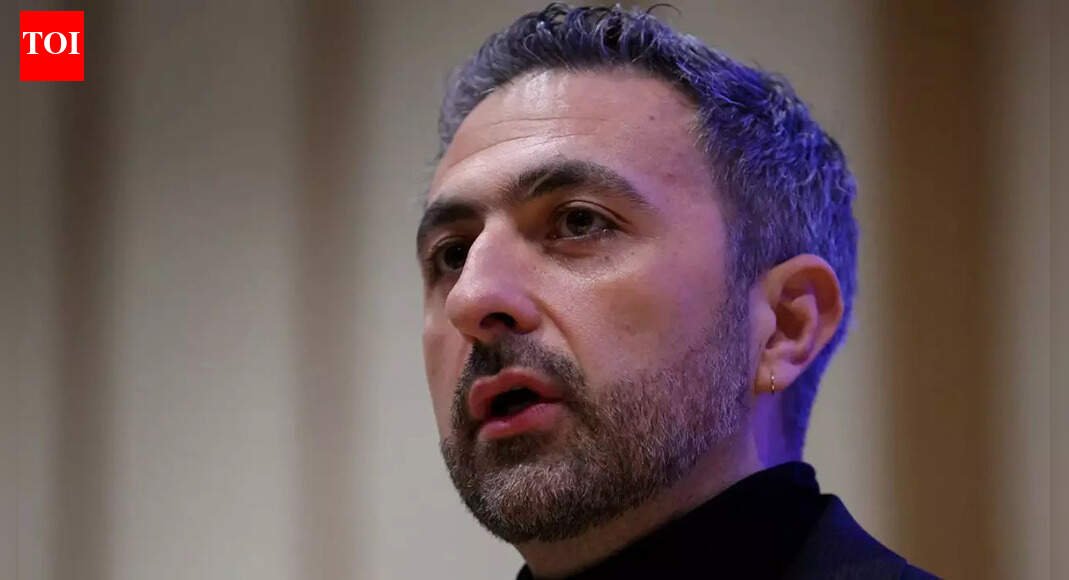
Microsoft AI CEO Mustafa Suleyman proposes a new test for advanced AI: can an agent legally grow $100,000 into $1 million? This “Artificial Capable Intelligence” benchmark, he believes, will reveal AI’s real-world planning and decision-making prowess. While tech leaders like Sam Altman champion AI agents, some, like Andrej Karpathy, caution against current “slop” in autonomous systems.

Microsoft AI CEO Mustafa Suleyman recently shared what he sees as a key test for the next stage of artificial intelligence (AI). As companies race to build AI agents that can act independently, Suleyman said he is watching for a milestone he calls Artificial Capable Intelligence (ACI) on the path toward artificial general intelligence (AGI). He said that the test is simple in context but difficult in execution – whether an AI agent can legally take $1,00,000 and turn it into $1 million. He described the test as “modern turing test”, suggesting it will show how AI systems can plan, reason, make decisions and operate within real-word rules. “The next big milestone I’m watching for on our way to AGI: Artificial Capable Intelligence (ACI). Can an agent take $100k and legally turn it into $1M? To me that’s the modern Turing Test,” Mustafa Suleyman wrote in a post on microblogging platform X (formerly Twitter).

Microsoft CEO ‘Thrilled’ About India’s Growing Data Centre Capacity, Details Meet With PM Modi

Suleyman’s comments come as several technology leaders including OpenAI CEO Sam Altman and Salesforce CEO Marc Benioff bet heavily on AI agents as the next major shift in enterprise software. Companies such as OpenAI, Salesforce, Microsoft and others are promoting agents that can carry out tasks with limited human input, from writing code to managing business workflows.Last year, Salesforce CEO Marc Benioff called the rise of AI in the workforce a “digital labor revolution,” estimating that the software company has reached about 93% accuracy with the technology. In an interview with Bloomberg then, he revealed that AI is doing up to 50% of the work at Salesforce. In 2025, OpenAI CEO Sam Altman predicted that AI could soon automate up to 40% of the tasks humans currently perform. He also claimed that AGI could arrive before 2030.

OpenAI cofounder disagrees with CEO Sam Altman on AGI timeline

Recently, OpenAI cofounder and AI researcher Andrej Karpathy pushed back against the “agentic AI” hype, characterizing the current generation of autonomous AI systems as “slop.” Karpathy has directly challenged the notion that autonomous AI agents are on the cusp of delivering as promised, positioning himself in contrast to the optimistic timelines often suggested by figures like OpenAI CEO Sam Altman.“I feel like the industry is making too big of a jump and is trying to pretend like this is amazing, and it’s not. It’s slop,” Karpathy said on The Dwarkesh Podcast.“They’re not coming to terms with it, and maybe they’re trying to fundraise or something like that. We’re at this intermediate stage,” he added.

[ad_2]

Source link

Rupee rebounds! Currency rises 18 paise after 4-day losses; reaches 90.12 against US dollar

[ad_1]

Rupee rebounds! Currency rises 18 paise after 4-day losses; reaches 90.12 against US dollar

Rupee began strong on Tuesday, strengthening by 18 paise to 90.12 against the US dollar, snapping its four-day losing streak.The currency’s rebound comes a day after it ended lower on Monday, closing at 90.30 against the greenback amid ongoing geopolitical uncertainty and weak domestic equities. According to traders, after the American military operation in Venezuela, US dollar had gained traction globally as investors towards safe-haven assets.Since December 30 last year, when it had ended at 89.75 against the dollar, rupee has fallen 55 paise. In calendar year 2025, the currency plunged almost 5%, marking its weakest momentum since 2022.“The Indian rupee has endured a persistent downward spiral, losing ground in nine out of the past ten trading sessions. This weakness is primarily fueled by ambiguity surrounding bilateral trade agreements between Washington and New Delhi, alongside a sluggish domestic stock market triggered by an exodus of foreign capital,” Dilip Parmar, Research Analyst, HDFC Securities, told PTI.He added that a surge in geopolitical uncertainty had further boosted the dollar’s appeal. “This flight to safety followed the detention of Venezuelan leader Nicolas Maduro by American military personnel over the weekend,” Parmar said. According to him, the USD-INR spot pair faces resistance near 90.45, while support is expected around the 89.90 level in the near term.In global markets, the dollar index, which measures the greenback’s strength against a basket of six currencies, was trading 0.27% higher at 98.68. Brent crude, the international oil benchmark, was up 0.91% at $61.30 per barrel in futures trade.SBI has predicted that the currency will be declining by around 2% in the next financial year, with the exchange rate hovering near 92 against US dollar.Meanwhile, the Reserve Bank of India’s latest data released on Friday showed that India’s foreign exchange reserves rose by $3.293 billion to $696.61 billion in the week ended December 26. In the previous reporting week, the reserves had increased by $4.368 billion to $693.318 billion.

[ad_2]

Source link

Ceasefire violation: Cambodia’s ‘operational error’ breaks 10-day truce; 1 Thai soldier wounded in border clash

[ad_1]

Ceasefire violation: Cambodia’s 'operational error' breaks 10-day truce; 1 Thai soldier wounded in border clash

Thailand on Tuesday said its Cambodian counterpart claimed that fresh cross-border fire was ‘an operational error’, following Bangkok’s allegation that Cambodian forces violated a 10-day-old truce.“A military unit in the area was contacted by the Cambodian side who claimed there was no intention to fire into Thai territory and said the incident was caused by an operational error by Cambodian personnel,” the Thai army said in a statement.

‘Not Aware Of Acts’: Thailand Slams Trump Claim Cambodia Conflict As Bangkok Vows Retaliation

The statement comes after Thailand earlier accused Cambodia of violating the same ceasefire, alleging that Cambodian forces fired mortars into a Thai border province, wounding one soldier.Thailand’s army said the incident took place on morning in Ubon Ratchathani province, along the disputed border. In a statement, the army said, “Cambodia has violated the ceasefire,” accusing Cambodian forces of firing mortar rounds into Thai territory. It added that one Thai soldier was wounded by shrapnel and was being evacuated for medical treatment.The allegation comes despite a truce agreed on December 27, which was meant to end nearly three weeks of fighting between the two Southeast Asian neighbours. The ceasefire was signed after weeks of intense clashes that included fighter-jet sorties, rocket fire and artillery barrages, marking the worst fighting between the two countries in years.At the time of the agreement, the defence ministers of both countries said they would freeze troop movements along the border. In a joint statement, they said, “Both sides agree to maintain current troop deployments without further movement.” The statement warned that “any reinforcement would heighten tensions and negatively affect long-term efforts to resolve the situation,” according to CNN. The truce was signed by Thai defence minister Natthaphon Narkphanit and his Cambodian counterpart Tea Seiha, ending around 20 days of fighting that killed at least 101 people and displaced more than half a million civilians on both sides.The long-running conflict between Thailand and Cambodia dates back more than a century, with both countries contesting sovereignty at several undemarcated points along their 817-kilometre land border. While the dispute has simmered for decades, it has periodically erupted into violence.Tensions escalated again last year, with clashes in December killing dozens and forcing around one million people to flee their homes across border regions. The latest round of fighting was re-ignited in early December after the collapse of a previous ceasefire that had been brokered with the involvement of US President Donald Trump and Malaysian Prime Minister Anwar Ibrahim.The agreement had also included humanitarian steps, such as the return of displaced civilians and a pledge that neither side would use force against civilians. Thailand had also agreed to return 18 Cambodian soldiers captured during earlier clashes if the ceasefire held for 72 hours.

[ad_2]

Source link