Breaking News
Don’t go to Harvard for STEM: Malcolm Gladwell’s warning explained

[ad_1]

Don’t go to Harvard for STEM: Malcolm Gladwell’s warning explained
Malcolm Gladwell’s warning explained (Image credit: Getty)

For years, science students have been taught a simple equation: the harder the institute is to enter, the brighter the future that awaits outside. The assumption runs so deep that questioning it can feel almost heretical. But Malcolm Gladwell — a Canadian journalist, author, and public speaker — has never been particularly interested in reassuring ambition. He is more interested in examining what ambition does to people when it collides with reality.That is why his latest warning — blunt, uncomfortable, and aimed squarely at elite universities — has struck a nerve.“If you’re interested in succeeding in an educational institution, you never want to be in the bottom half of your class. It’s too hard,” Malcolm Gladwell told in a recent episode of the Hasan Minhaj Doesn’t Know podcast, according to a Fortune report. “So you should go to Harvard if you think you can be in the top quarter of your class at Harvard. That’s fine. But don’t go there if you’re going to be at the bottom of class. Doing STEM? You’re just gonna drop out,” he added.He also advised students to consider their second or third choice institutions instead. These, according to him, are places where young aspirants are more likely to perform at the top rather than struggle at the margins.What makes the remark sharper is that it is not new. Gladwell has been making the same case for years: STEM persistence is shaped as much by where you stand in the room as by how smart you are.“If you want to get a science and math degree, don’t go to Harvard,” Gladwell said in a Google Zeitgeist talk in 2019 also, Fortune reports. “Persistence in science and math is not simply a function of your cognitive ability,” . “It’s a function of your relative standing in your class. It’s a function of your class rank,” he added.It is a line that sounds provocative, almost reckless. But Gladwell is not attacking Harvard University. He is questioning something far more foundational: Whether prestige-heavy academic environments help most science students persist long enough to succeed.

Why Gladwell keeps sounding the same alarm: The ‘big fish, small pond’ problem

Malcolm Gladwell’s argument has always been about psychology, about what happens inside students long before grades translate into careers. When he warns science students against placing themselves at the bottom of elite classrooms, he is not making a comment on intelligence or effort. He is describing a behavioural pattern he believes quietly determines who persists and who gives up. In highly competitive academic environments, Gladwell suggests, students do not measure themselves against global standards or long-term potential. They measure themselves against the peers they see every day. And that comparison, repeated over semesters, begins to shape identity.His contention is straightforward: When capable students constantly experience themselves as “below average” within an elite cohort, the psychological cost becomes cumulative. Struggle starts to feel like inadequacy. Temporary difficulty begins to look like permanent unsuitability — especially in STEM, where early coursework is rigid and unforgiving.That idea was formally laid out earlier in his 2013 book, David and Goliath, drawing on what researchers call “relative deprivation” and the Big-Fish–Little-Pond Effect. Gladwell argued that people derive confidence, motivation, and persistence not from being objectively exceptional, but from feeling competent in their immediate environment. A student who is a big fish in a smaller or moderately competitive pond may develop stronger academic self-belief than an equally talented student who is a small fish in an elite one.Seen through this lens, Gladwell’s advice sounds less like provocation and more like consistency. The recent podcast comment, the 2019 talk and the 2013 book are variations of the same claim: Talent does not fail in isolation; it fails in contexts that quietly convince people they are failing. For science students, whose paths demand endurance more than early brilliance, the environment they choose can matter as much as the ability they bring with them.

‘Don’t go to Harvard’ can also be bad advice for some

Gladwell’s warning is useful — but only when read as a way to think, not as a rule to follow.For one, elite campuses can genuinely deliver. They offer deep research ecosystems, stronger lab access, higher funding density, and networks that can open doors early — sometimes before a student has even figured out what kind of scientist they want to become. And for some students, the intensity is not corrosive; it is catalytic. A high-achieving peer group can raise standards, sharpen discipline, and make excellence feel normal rather than exceptional.Then there is the age problem. The “top quarter” test sounds decisive, but at 17, it is often guesswork. Many students misjudge fit in both directions. Some arrive convinced they will dominate and discover, quickly, that everyone was a topper somewhere. Others arrive feeling underqualified and surprise themselves — not because they were secretly brilliant, but because they found the right supports, mentors, and rhythm.So the best way to interpret Gladwell is as a stress-test, not a prophecy:

  • If your plan depends on never being average, it is a fragile plan.
  • If your self-worth collapses after the first B-minus, STEM will start to feel personally humiliating.
  • And if you want a science career in 2026, you need an environment that still lets you keep building — skills, confidence, work habits — even when you are not the smartest person in the room.

Reading Gladwell right: A tricky act of balance for students

On paper, it can look like we are contradicting ourselves. We are saying elite universities can help, and also that they can harm. But that tension is the point. Gladwell is not offering a neat rule. He is pointing to a risk that is easy to ignore when we are dazzled by brand names.The context matters more now than it did even a few years ago. In 2025 and 2026, a STEM degree is no longer the finish line people imagine it to be. It is closer to an entry badge and what separates students is the proof they carry alongside it. The World Economic Forum’s Future of Jobs Report 2025 frames 2025–2030 as a churn cycle, where a large share of skills will change and adaptability becomes a workplace currency. The PwC 2025 Global AI Jobs Barometer adds a sharper twist: In AI-exposed roles, skills are changing faster, and employers are also easing away from degree requirements faster than before.So the modern science student is running two races at once. One is inside the classroom — grades, labs, curves, weed-out courses. The other is outside it — projects, internships, research exposure, tools, portfolio, AI fluency. The second race quietly depends on something we do not talk about enough: Mental bandwidth.This is where Gladwell’s warning begins to make sense without turning into dogma. If an elite environment consistently pushes a student into the bottom half, the danger is not only that they may switch out of STEM. It is that they may be too depleted to build the extra proof-of-work that today’s STEM hiring expects. In other words, the cost is not just academic. It is cumulative.But it is also true that elite campuses can deliver — sometimes spectacularly. The labs are deeper, the funding is denser, the networks travel farther. For many students, the peer environment is not crushing, rather, it is catalytic. They rise to the pace, and the pressure becomes productive.So the right way to read Gladwell is not as a ban on prestige. It is a question about fit and, more specifically, about pipelines. The real question for science students is no longer: Is this university famous? It is: Will I get early access to the kind of work that will make me employable?That usually means:

  • Research exposure, even if it starts small,
  • Lab access that is not reserved for a select few,
  • Faculty bandwidth and mentorship,
  • Internship pathways, and
  • A peer culture where struggle is treated as part of training, not as evidence you do not belong.

If prestige expands those opportunities, it can be worth it. If prestige shrinks a student’s confidence so early that they stop building, it can quietly backfire.In 2025–26, choosing a university is not merely choosing a pond. It is choosing a pipeline — one that lets a science student keep accumulating competence, visibility, and resilience, even on days when they are not the smartest person in the room.

[ad_2]

Source link

Stefon Diggs scans the stands searching for Cardi B after New England Patriots’ big 42-10 win over New York Jets | NFL News

[ad_1]

Stefon Diggs scans the stands searching for Cardi B after New England Patriots’ big 42-10 win over New York Jets
(Image via X: Stefon Diggs and Cardi B

The New England Patriots had just crushed the New York Jets by an unbelievable score of 42-10! How does their star wide receiver celebrate? He runs to the NFL stands looking for his partner for life. “Where she at?” Stefon Diggs asked the person holding a smartphone with Cardi B on it. “She’s walking to the field,” the person replied. Diggs addressed Cardi on a video call, “Where you at?” The Grammy-winning rapper replied, “I’m coming down. Wait for me.” The standout wideout asked, “Y’all about to leave the game?” The person replied, “No! She went inside to get warm!” This “cuteness overloaded” gesture, full of love and innocence, received mixed reactions online, ranging from unwanted criticism to unfaltering warmth. Let’s check them out.

After reportedly spending Christmas away, Stefon Diggs couldn’t take his eyes off Cardi B even for a second after Patriots vs Jets game

The Patriots vs. Jets game on Sunday took place after Christmas. Diggs and Belcalis Marlenis Almánzar reportedly spent the holiday apart. The 32-year-old former Buffalo Bills star celebrated with his family in Maryland, while the “Bodak Yellow” singer celebrated with her kids, Kulture Kiari Cephus, Wave Set Cephus, Blossom Belles, and her newborn baby boy with NFL boyfriend Stefon Diggs, reportedly at her home in New York City. Since they were apart for the holiday, it was only natural to miss each other when they met again. Stefon had even expressed how much he missed the “Am I the Drama?” creator on Instagram: “Miss yaw!!! Don’t be squeezing him too tight you making him soft.” So, when New England triumphed over New York, Diggs rushed to the stands innocently looking for his girlfriend. He did not want to take his eyes off her.

All for the internet

This cute moment quickly became a cyberspace sensation, sparking reactions from around the globe. “She cheat on her man with you but think she won’t cheat on you?” one user speculated. A fan pointed out, “This is cute but we haven’t forgotten that you chose to spent Christmas with the other baby mama not her 😭😭.” Another wrote, “They did this for the internet 😂.” A third user commented, “All for the internet 🤦🏾‍♂️ yall really buying this fake pretend [—-] love fairytale😂😂 loved her so much he had 2 more kids behind her back.” A fourth user expressed, “He don’t love her he loves the attention he getting an so does she 🫩.” A user compared the 33-year-old American rapper with Kansas City Chiefs star tight end Travis Kelce’s beau Taylor Swift: “She’s so annoying but we’ll take her over Taylor Swift lmaoo.” Another added, “Cardi NFL > Taylor NFL.” A third fan wrote, “NFL about to lose Taylor Swift with Kelce’s retirement so they’re looking for a replacement.”

People wish they had Stefon Diggs-Cardi B kind of a relationship

A user said, “Love don’t cost a thing ❤️❤️❤️❤️❤️❤️❤️❤️.” Another added, “He loves her.” A third wrote, “I actually love this relationship.” A fourth fan found it cute, “Awwww yall was about leave me? 😭😭.” A fifth expressed, “Man walked off that field like he had somewhere way more important to be. Stefon didn’t even fake the celebration route.” One fan summed it up, “People wish they had this kinda relationship.”Also Read: Stefon Diggs reportedly posts his son’s photo on Instagram with special instructions for partner Cardi B

[ad_2]

Source link

Industrial production at two-year high! IIP records 6.7% growth in November; fueled by mining, manufacturing sectors

[ad_1]

Industrial production at two-year high! IIP records 6.7% growth in November; fueled by mining, manufacturing sectors

The country’s industrial output reached a two-year highk, growing by 6.7 per cent in November, according to the official Index of Industrial Production (IIP) data released Monday.This marks an improvement from the 5 per cent growth recorded in November last year, according to data released by the National Statistics Office (NSO). The surge was largely because of strong performances in mining and manufacturing sectors. “The growth is led by Manufacture of basic metals and fabricated metal products, pharmaceuticals and motor vehicles,” stated the ogvernment press release.The manufacturing sector led the growth surge, expanding by 8 per cent, up from 5.5 per cent in the same month last year. Mining also recorded huge gains, rising by 5.4 per cent compared to 1.9 per cent a year ago.However, not all sectors showed growth. The electricity sector faced challenges, with production dropping by 1.5 per cent, as compared to the 4.4 per cent growth seen in the same period last year.Looking at the broader picture, the NSO also revised October industrial production growth slightly upward to 0.5 per cent from the earlier estimate of 0.4 per cent. The current growth rate is still below the 11.9 per cent peak of November 2023.The overall industrial growth for April-November has slowed down. The growth rate stands at 3.3 per cent, slightly lower than the 4.1 per cent recorded in the same period last year.

[ad_2]

Source link

China’s maritime escalation: Zhongda 79 cargo ship armed with 60 missiles in open display — see pics

[ad_1]

China’s maritime escalation: Zhongda 79 cargo ship armed with 60 missiles in open display — see pics

China is advancing its maritime capabilities by converting the 97-meter cargo ship Zhongda 79 into an arsenal ship. Online images, shared by Militarnyi and citing Chinese agencies, reveal containerized launchers—loaded with up to 60 missiles—now installed aboard the vessel.At Shanghai’s state-owned Hudong-Zhonghua Shipbuilding shipyard, the vessel now features installations supporting a broad array of weapons—including anti-ship, cruise, hypersonic, and anti-aircraft missiles.China’s navy, known as the People’s Liberation Army Navy or PLAN, has been focusing on increasing its vertical launch systems in an attempt to match the VLS capabilities of the US Navy.As per the reports by a UK-based think tank International Institute for Strategic Studies, on December 20, PLAN has surpassed 50% of the US Navy’s firepower.

Taiwan war plan?

This development signals China’s strategic pivot toward rapidly converting civilian merchant vessels into potent warships, bypassing traditional naval construction timelines amid escalating tensions in the Taiwan Strait. The Zhongda 79 transformation exemplifies a “maritime militia” evolution, where containerised missile launchers turn ordinary cargo ships into floating arsenals. This approach leverages China’s vast commercial fleet, allowing surge capacity for blockades or invasions without depleting its blue-water navy, a tactic long rehearsed in PLA exercises simulating Taiwan scenarios.Such conversions form a cornerstone of Beijing’s broader anti-access/area denial (A2/AD) strategy targeting Taiwan, where overwhelming missile barrages from improvised platforms could saturate US and allied defenses during a cross-strait assault. By upgrading ships like Zhongda 79, China blurs civilian-military lines, complicating international responses under laws like the UN Convention on the Law of the Sea. This fits a pattern of dual-use innovations, including roll-on/roll-off ferries and fishing trawlers armed for gray-zone coercion, positioning the PLA for a high-intensity conflict by 2027 as signaled in recent defense white papers.Satellite images of Zhongda 79Satellite images of Zhongda 79 have surfaced online, though the exact date when they were taken remains unclear. The location, however, has been identified as Hudong-Zhonghua Shipbuilding’s yard in Shanghai, which is also the construction site of the Sichuan Type 076 amphibious assault ship, hat is believed to have completed its second sea trials earlier this month.One of the satellite images shows Zhongda 79 berthed close to the Sichuan at the shipyard.According to the South China Morning Post, other photos show several containers on the freighter bearing the words “Plan for the maritime revival of the Chinese nation and the community of shared future for mankind in the ocean.”Another part of the phrase reflects a maritime extension of Chinese President Xi Jinping’s broader political concept of building a “community of shared future for mankind.””Zhongda 79′ upgrade As Militarnyi reports, had not been engaged in regular domestic shipping operations for some time. Between April and August, the vessel underwent refitting at a shipyard in Longhai. The ship has been docked at the Shanghai shipyard since August 2025, where the final stage of the container ship’s transformation into an arsenal ship is believed to have taken place.At present, the Zhongda 79 still retains its civilian status as it hasn’t been listed as a part of the auxiliary fleet by the PLAN.

[ad_2]

Source link

Premium homes take precedence over affordable real estate; lenders rethink home-loan strategies: Report

[ad_1]

Premium homes take precedence over affordable real estate; lenders rethink home-loan strategies: Report

Real estate developers today are also concentrated on high-end and luxurious projects, rather than affordable housing schemes. This is forcing lenders to reconsider their home loan market strategies, according to Antique Stock Broking’s BFSI Conference 2025, cited by ANI. Developers are now reluctant to build homes under Rs 50 lakh due to high land costs, lower profits, and lack of government incentives.Housing finance experts at the conference talked about two major challenges in the affordable housing segment. First, developers are moving away from building budget-friendly homes. Second, traditional affordable housing projects in Tier 1 and 2 cities are being replaced by premium developments.The situation is particularly severe in cities like Mumbai, where soaring land prices have made affordable housing projects financially unfeasible for builders. Instead, there’s a growing trend towards homes in the Rs 2-3 crore range, while affordable housing supply continues to shrink.“Banks are not inherently set up to cater to the micro-level assessment required for affordable housing. They are expected to enter via co-lending partnerships rather than direct exposure,” the after-conference report stated. Housing Finance Companies would have to expand their presence in Tier 3 and 4 cities to remain competitive.Meanwhile, as public sector banks and large banks dominated the salaried customer market with pre-approved offers, experts quoted by ANI, suggested focusing on proprietorship and partnership firms. They noted that while salaried cash flows are predictable but offer lower yields, non-salaried cash flows are more complex to assess but provide higher yields and face less competition from traditional banks.“By targeting these premium customers, the company avoids putting in more efforts to disburse individual loans,” the report added, explaining how lenders are adapting to the changing market landscape.

[ad_2]

Source link

‘Exhausted, frightened’: Kuldeep Sengar’s daughter Ishita pens open letter after SC verdict on Unnao rape sentence; speaks about 8 years of silence | India News

[ad_1]

‘Exhausted, frightened’: Kuldeep Sengar’s daughter Ishita pens open letter after SC verdict on Unnao rape sentence; speaks about 8 years of silence
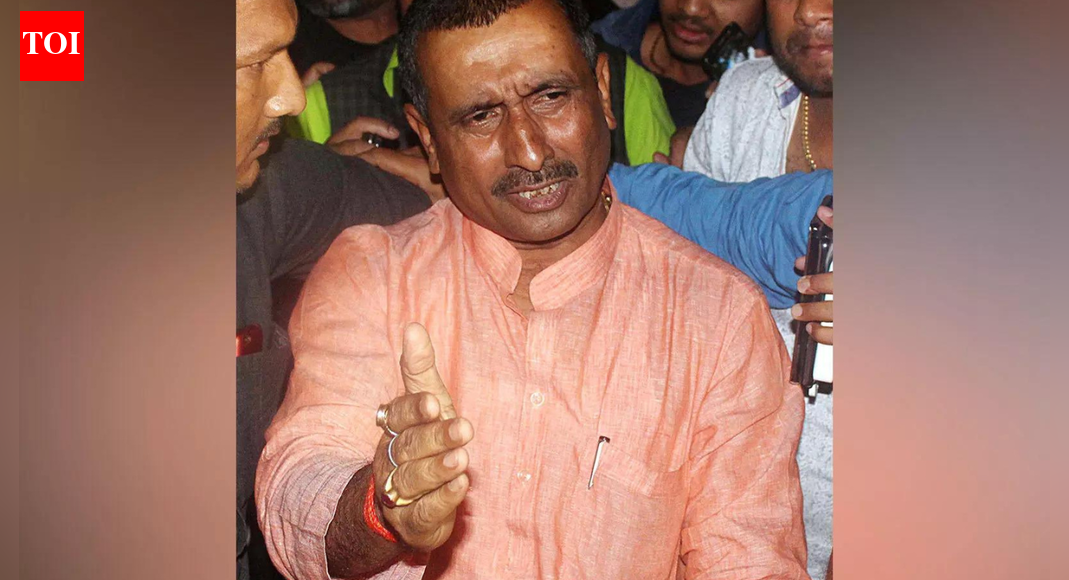
Kuldeep Sengar (ANI image)

NEW DELHI: Ishita Sengar, daughter of former BJP MLA and Unnao rape case convict Kuldeep Singh Sengar, penned an open letter on Monday saying that she is “exhausted, frightened and slowly losing faith”. Her statement came after the Supreme Court stayed a Delhi high court order that had suspended her father’s life sentence.

Unnao Rape Case: Activists Protest Outside Delhi High Court Over Sengar Bail

In her letter, Ishita wrote: “I am writing this letter as a daughter who is exhausted, frightened, and slowly losing faith, but still holding on to hope because there is nowhere else left to go.”The Supreme Court stayed the operation of the December 23 Delhi high court order and directed that Kuldeep Singh Sengar shall not be released from prison in connection with the 2017 Unnao rape case.A three-judge vacation bench comprising Chief Justice of India Surya Kant and Justices JK Maheshwari and AG Masih passed the order while hearing a plea filed by the Central Bureau of Investigation (CBI). The bench observed that although courts usually do not stay bail orders once a convict is released, the present case involved “peculiar facts” as Sengar remains in jail in another criminal case.“We are conscious of the fact that when a convict or an undertrial has been released, such orders are not ordinarily stayed by this court. But in view of the peculiar facts where the convict is convicted for a separate offence, we stay the operation of the Delhi High Court order,” the bench said.Kuldeep Singh Sengar, an expelled BJP MLA from Unnao, was sentenced to life imprisonment in December 2019 for the rape of a minor under the Indian Penal Code and the Protection of Children from Sexual Offences (POCSO) Act. He is also serving a separate 10-year sentence in a CBI case related to the custodial death of the rape survivor’s father.In her letter addressed to the “Hon’ble Authorities of the Republic of India,” Ishita Sengar said her family had waited silently for eight years, trusting the legal system.Explaining why the family chose not to protest publicly, she wrote: “We chose silence not because we were powerful, but because we believed in institutions. We waited because we believed that truth does not need spectacle.”

..

She alleged that despite being labelled “powerful” because of her father’s political identity, her family remained unheard.“People call us ‘powerful.’ I ask you what kind of power leaves a family voiceless for eight years?” she said. Ishita added that her family had been “drained financially, emotionally, and physically” while seeking justice.Ishita also claimed she had received rape and death threats on social media over the years, which eventually silenced her.“Over these years, I have been told countless times that I should be raped, killed, or punished simply for existing,” she wrote, describing the abuse as “daily” and “relentless.”She further expressed concern that fear and public outrage were beginning to overshadow facts and due process.“If pressure and public frenzy begin to overshadow evidence and due process, what protection does an ordinary citizen truly have?” she asked.Clarifying her intent, Ishita said the letter was not written to seek sympathy or special treatment.“We are not asking for a favour. We are asking for justice because we are human,” she wrote, urging that the law be allowed to function “without fear” and evidence be examined “without pressure.”During the Supreme Court hearing, Solicitor General Tushar Mehta, appearing for the CBI, described the case as a “very horrific” instance of child rape and argued that Sengar, being an MLA at the time, occupied a dominant position over the victim, attracting stricter punishment under the POCSO Act.The bench also expressed concern that excluding lawmakers from the definition of “public servant” under POCSO could create legal immunity for MPs and MLAs.Meanwhile, the rape survivor’s mother welcomed the Supreme Court’s order, saying it gave her hope that her daughter would finally get justice.The Supreme Court has issued notice to Sengar and sought his response within four weeks. The matter is scheduled to be heard again in the last week of January.

Aishwarya Sengar’s big charge after SC order in Unnao case

Following the apex court’s decision, Kuldeep’s daughter Aishwarya Sengar alleged that her family was not given an opportunity to present its arguments on the merits of the case and claimed that key facts were being overlooked.“We couldn’t even start arguing on the merits of the case today, that she has changed her statement several times, changed the timing thrice, starting from 2 pm, 6 pm and then finally 8 pm. There’s a finding of the AIIMS medical board that she was more than 18. I’ve been fighting for justice for the past eight years, but maybe the sorrows of me and my family mean nothing. We have been stripped of our dignity, our peace, and even our fundamental right to be heard. Still hope for justice. I request that the media not spread any misinformation,” Aishwarya said.

[ad_2]

Source link

Silver prices crash! Silver drops Rs 21,000 in just an hour after hitting life-time high of Rs 2.5 lakh per kg- what’s the outlook?

[ad_1]

Silver prices crash! Silver drops Rs 21,000 in just an hour after hitting life-time high of Rs 2.5 lakh per kg- what’s the outlook?
So far this year, silver has surged 181%, outperforming gold. (AI image)

Silver price today: After a stunning rally, silver prices for the MCX Silver March futures crashed sharply on Monday, dropping by a huge Rs 21,000 per kg in just an hour of afternoon trade. MCX Silver march futures dropped to an intraday low of Rs 2,33,120 per kg as investors rushed to lock in gains.According to an ET report, the decline in silver prices came after the white metal had rallied to a record high of Rs 2,54,174 earlier in the session. Globally, silver saw heightened volatility, briefly crossing the $80 per ounce threshold for the first time on Monday before reversing course and sliding below $75.

Why have silver prices crashed suddenly?

So far this year, silver has surged 181%, outperforming gold, supported by its classification as a critical mineral in the US, constrained supplies and depleted inventories against the backdrop of rising industrial usage and investor interest.Today’s pullback in silver price rally was driven by profit taking and reports suggesting progress in discussions between US President Donald Trump and Ukrainian President Volodymyr Zelensky over a possible peace agreement, according to ET.Trump said on Sunday that he and Zelensky were “getting a lot closer, maybe very close” to an agreement to end the war in Ukraine.The sharp correction in silver prices also reflects a wider bout of profit booking across the bullion market, as easing geopolitical risks have dented safe haven demand. Additional pressure has come from a margin increase announced by the Chicago Mercantile Exchange, which runs key derivatives platforms including CME, COMEX, CBOT and NYMEX, effective from today.The exchange has increased the initial margin requirement for the March 2026 silver futures contract to around $25,000, compared with $20,000 earlier this month.Jigar Trivedi, senior research analyst at Reliance Securities, said the broader outlook for silver remains constructive but marked by sharp swings, adding that the Rs 2.4 lakh level is emerging as an important near-term support.US financial services firm BTIG has cautioned that the rally in precious metals has turned “parabolic,” a pattern it says typically ends with a swift and sharp reversal rather than a gradual correction. “Parabolas only end one way, with an equal and opposite downside reaction. They do not correct through time,” the firm said.From a technical perspective, silver is currently trading about 89% above its 200-day moving average. BTIG noted that, apart from the Hunt Brothers driven squeeze in 1979, instances where silver traded even 60% above its 200-DMA were followed by significantly lower prices 20, 30 and 40 days later. “Even if the underlying fundamentals are different this time, the 174% year-to-date rally appears to have already factored in much of the positive narrative,” the firm said.Silver surged more than 10% on Friday, marking one of its biggest single-session gains on record. BTIG analyst Jonathan Krinsky pointed out that the last comparable move, when prices rose 10% while reaching a multi-month high, occurred in 1987 and was followed by a drop of about 25% in the weeks that followed.Manish Banthia, chief investment officer for fixed income at ICICI Prudential Mutual Fund, said historical patterns show that such dramatic advances in silver seldom conclude smoothly.“History offers some stark reminders. During 1979-80, silver climbed from $6 to $49 an ounce before plunging by over 90%. In 2011, prices peaked close to $48 and subsequently declined by more than 75%. In both episodes, silver had already risen multiple times before the downturn set in. Since the pandemic lows, prices have increased more than six times, and over the past year alone they have nearly tripled,” he said according to the ET report.Past market cycles indicate that once the upward momentum fades, silver prices can correct sharply, often by 50% or more, the report added.(Disclaimer: Recommendations and views on the stock market, other asset classes or personal finance management tips given by experts are their own. These opinions do not represent the views of The Times of India)

[ad_2]

Source link

RBI rate cuts, reforms to support India’s growth in 2026: Invesco Report

[ad_1]

NEW DELHI: India’s outlook for 2026 improved amid geopolitical challenges due to ongoing reforms and optimism in the US-India relations, said a report by Invesco Strategy & Insights.In its “2026 Annual Investment Outlook Resilience and rebalancing”, Invesco mentioned that despite equity market underperformance amid geopolitical tensions, we are cautiously optimistic on India in 2026, due to ongoing reforms and signs of stabilization and room for potential improvement in US-India relations.“We expect India to remain the world’s fastest growing large economy, with growth modestly accelerating on Reserve Bank of India (RBI) rate cuts. Domestic economic reforms remain crucial for raising trend growth and for long-term resilience, in our view. We expect gradual progress given political constraints,” the report said.However, in terms of Emerging Market (EM) Equities, Invesco report said the EM equities have the most attractive valuations relative to other regions, albeit with wide variation within EM. “We anticipate Chinese stocks to continue to outperform while India may struggle.”We expect a weaker USD and better growth outside of the US to support performance of non-US assets, especially emerging market (EM) equities and EM debt.The report further mentioned that the global financial markets are poised for continued gains in 2026, supported by resilient private-sector balance sheets and a shift toward broader market leadership.The report highlighted that the lower US policy rates and greater fiscal spending in Europe, Japan, and China should lead to an improved global growth trajectory next year, and higher global equity markets.“With many major central banks on hold, Fed cuts should contribute to a soft dollar environment. Falling costs for hedging US dollar (USD) exposure are likely to encourage investors to increase hedge ratios and exert downward pressure on the dollar,” it said.The outlook points to a rebalancing of investment opportunities. While U.S. equities, particularly large technology and artificial intelligence-related stocks, remain expensive, Invesco sees more attractive valuations in non-U.S. markets, smaller-capitalization stocks and cyclical sectors.A pickup in global activity could support broader market participation and reduce concentration risks tied to mega-cap technology shares.

[ad_2]

Source link

‘Statement misconstrued’: Lalit Modi reacts after backlash over video with Vijay Mallya; issues apology | India News

[ad_1]

'Statement misconstrued': Lalit Modi reacts after backlash over video with Vijay Mallya; issues apology

Lalit Modi and Vijay Mallya (File photo)

NEW DELHI: Former IPL chairman Lalit Modi on Monday issued an apology for his recent social media remarks after a video featuring him with fugitive businessman Vijay Mallya triggered a backlash.In a post on X, Lalit Modi said he never intended to offend anyone, particularly the Indian government, and claimed his comments had been “misconstrued”.

“People Who Are…” MEA Responds To Viral Mallya And Modi “Biggest Fugitive” Video

“I apologise if I have hurt anyone’s feelings, especially the Indian government, for whom I have the highest respect and regard. The statement was misconstrued and was never intended to be as played out. Once again, my deepest apologies,” he wrote.The apology came after Lalit Modi posted a clip on Instagram in which he jokingly referred to himself and Mallya as “the two biggest fugitives of India”.“Let me do something to break the internet again. Happy birthday my friend #VijayMallya. Love u,” Lalit Modi captioned the post.After the video surfaced, the ministry of external affairs reiterated India’s position on those facing charges at home but living abroad.“We remain fully committed that people who are fugitives and are wanted by law in India return to the country. For this particular return, we are in talks with several governments, and processes are on,” MEA spokesperson Randhir Jaiswal said during a weekly media briefing in New Delhi.Both Lalit Modi and Vijay Mallya face legal cases in India over alleged financial irregularities, allegations they have denied.Lalit Modi, a former cricket administrator and the founder of the Indian Premier League, left India in 2010 after probes were launched into financial irregularities linked to the league’s early years. He has remained abroad since.Vijay Mallya is believed to be out on bail in the UK and has continued to oppose his extradition to India while a “confidential” legal matter.Earlier this year, a consortium of Indian banks led by the State Bank of India (SBI) won a London court appeal that upheld a bankruptcy order against Mallya. The case is part of a long-running effort to recover about £1.05 billion owed by Kingfisher Airlines.

[ad_2]

Source link

Dense fog paralyses Delhi: Over 120 flights cancelled, nearly 200 delayed and few diverted; rail services also hit | India News

[ad_1]

Dense fog paralyses Delhi: Over 120 flights cancelled, nearly 200 delayed and few diverted; rail services also hit
Delhi airport is seeing flight delays and cancellations. (ANI photo)

NEW DELHI: Dense fog blanketed Delhi and large parts of North India on Monday, triggering widespread disruption across air and rail networks, with hundreds of flights cancelled or delayed and trains running hours behind schedule, leaving passengers stranded and frustrated.At the Indira Gandhi International (IGI) Airport, at least 128 flights — 64 departures and 64 arrivals — were cancelled, while eight flights were diverted due to low visibility conditions. Nearly 200 flights were delayed, with an average departure delay of around 24 minutes, according to flight-tracking website Flightradar24. Visibility at the airport dropped to as low as 50 metres, forcing operations to continue under CAT III conditions, an advanced landing system used during dense fog. Delhi’s AQI also crossed 400 on Monday, hitting ‘severe’ category of air pollution.Delhi International Airport Ltd (DIAL) said runway visibility was gradually improving but warned that departures and arrivals could remain affected.IndiGo cancelled 80 flights across its network due to bad weather, with around half of those cancellations at Delhi airport. Other affected airports included Mumbai, Bengaluru, Kochi, Hyderabad, Kolkata, Amritsar, Chandigarh, Jaipur, Dehradun, Indore, Patna and Bhopal. While the airline did not explicitly disclose the number of cancellations in its advisory, it acknowledged that fog-related disruptions were likely to extend into the afternoon hours. “Fog continues to persist across Delhi and several airports in northern India. Visibility remains reduced and, as a result, flight movements are presently slower than normal,” IndiGo said in a post on X.The airline has been cancelling flights in significant numbers since the start of the fog season on December 10, following earlier large-scale disruptions caused by stricter pilot duty norms. The Directorate General of Civil Aviation (DGCA) has designated December 10 to February 10 as the official fog window this winter, during which airlines must deploy CAT-IIIB-compliant aircraft and pilots trained for low-visibility operations.Airlines including IndiGo and Air India urged passengers to regularly check flight status and assured them that safety remained the top priority as operations continued to adjust to fluctuating weather conditions.Rail services hitRail services were also hit hard. Several trains were delayed by hours at New Delhi and Hazrat Nizamuddin railway stations, prompting passenger complaints. Gagan, travelling to Kanpur, told ANI that his train was delayed by eight hours, while students expressed concern about missing meals, exams and connections due to prolonged delays. Taxi drivers at stations reported a sharp drop in business as late-arriving trains reduced passenger movement.The fog also raised safety concerns on roads, with commuters warning of increased accident risks due to poor visibility. Meanwhile, smog reduced visibility in parts of Mumbai, adding to travel woes.

[ad_2]

Source link