Breaking News
This day, that year: December 27, 1911 — When ‘Jana Gana Mana’ was first sung in Calcutta | India News

[ad_1]
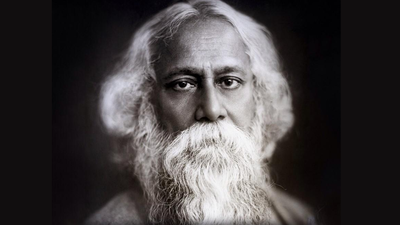
This day, that year: December 27, 1911 — When ‘Jana Gana Mana’ was first sung in Calcutta
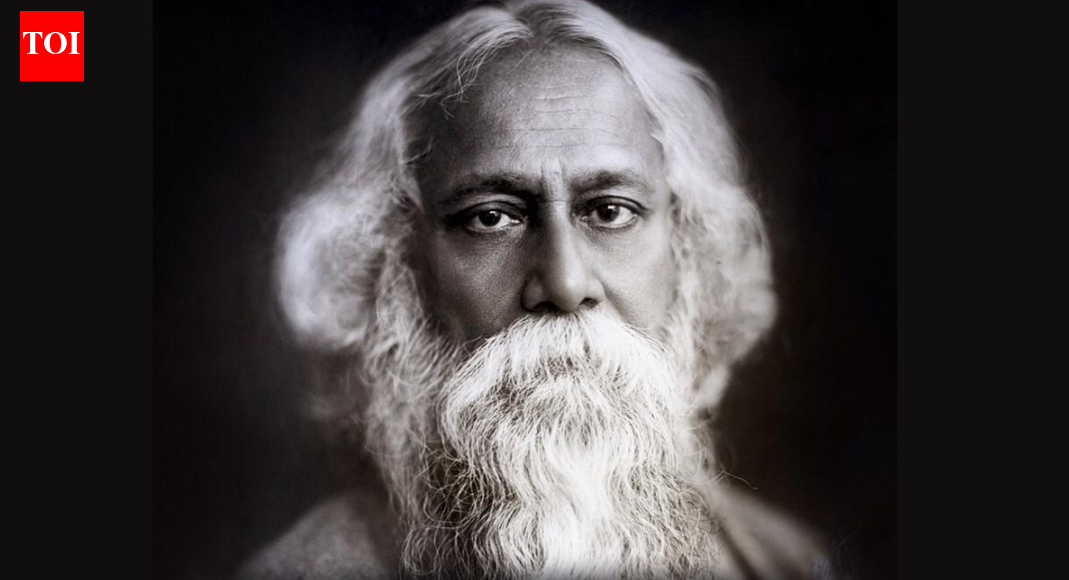
Rabindranath Tagore’s ‘Jana Gana Mana’ was publicly sung for first time on December 27, 1911

December 27, 1911– the day a song first heard at a Congress session in Calcutta began a chapter that would culminate in becoming India’s National Anthem, and become a shared national voice.Composed by Rabindranath Tagore, originally in Bangla, the hymn would, nearly four decades later, be adopted as the National Anthem of India. At the time of first rendition, it was introduced simply as a patriotic composition at a gathering of a political organisation that was still shaping its role in India’s anti-colonial movement.

The Calcutta Session of 1911

The 1911 Congress session was held at the Bharat Sabha, a single-storeyed structure on Bowbazar Street in Calcutta, in presence of then-Congress president, a senior moderate leader Bishan Narayan Dhar. Other prominent figures there were Ambika Charan Mazumder and Bhupendra Nath Bose.At this point in its history, the Indian National Congress was not a political party in the modern electoral sense but a national organisation bringing together leaders, intellectuals, professionals, and activists seeking constitutional reforms and, increasingly, self-government. Its annual sessions were platforms for political resolutions as well as cultural expressions aligned with emerging nationalist sentiment.
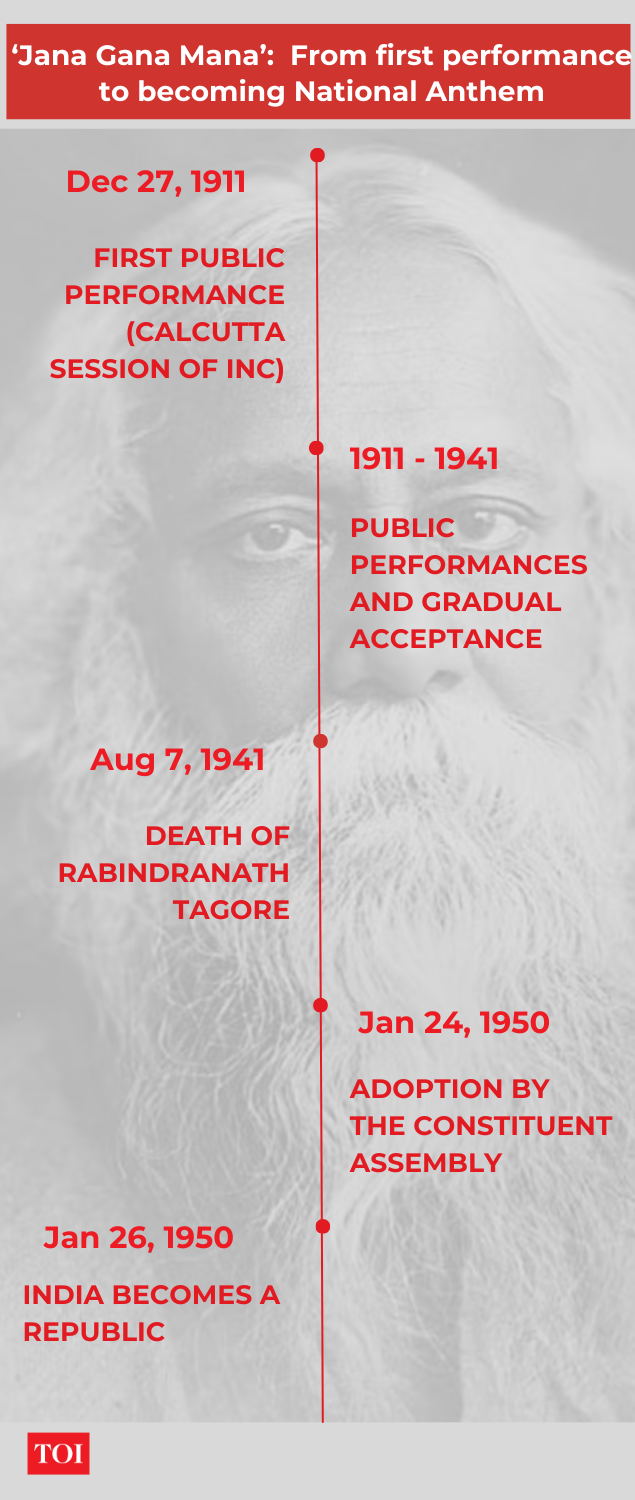
How 'Jana Gana Mana' ulitmatelt became the national anthem

The first performance

Jana Gana Mana was sung before the assembled delegates 114 years ago, which was the 2nd day of the Calcutta session. The performance was led by Tagore’s niece Sarala Devi Chowdhurani, along with a group of students. Contemporary Congress records referred to the composition as “Janaganamana Adhinayaka”, describing it as a patriotic song.The lyrics were written in highly Sanskritised Bengali, employing a register familiar to audiences associated with the Brahmo Samaj and the emerging Bengali intelligentsia. The song addressed “Bharata Bhagya Vidhata”, a phrase referring to the guiding force or destiny of India.

The political context of 1911

The Congress session came on the heels of the Delhi Durbar of December 1911, held to mark the coronation of King George V and Queen Mary as Emperor and Empress of India. It was also at the backdrop for the announcement made by the British Government about the nullification of the division of Bengal and moving the Imperial Capital from Calcutta to Delhi.While Jana Gana Mana was being performed in this politically fraught atmosphere, there are some newspaper accounts of that time that suggested that it was meant to serve as a welcome or tribute to the British monarch.

Tagore’s clarification

Rabindranath Tagore did not immediately respond publicly to these claims. However, in later years, he explicitly rejected the suggestion that the song praised George V. In a letter written in 1937, Tagore recalled refusing a request from an acquaintance to compose a song in honour of the British king, describing his reaction as one of “amazement mingled with anger.”In a more forceful letter written in 1939, Tagore stated that he found it insulting to suggest that he would write in praise of a temporal ruler. He clarified that the “Adhinayaka” of Jana Gana Mana referred to a timeless guiding spirit of the Indian people, not a colonial sovereign. These letters have since been cited in official and scholarly accounts addressing the controversy.“I should only insult myself if I cared to answer those who consider me capable of such unbounded stupidity as to sing in praise of George the Fourth or George the Fifth as the Eternal Charioteer leading the pilgrims on their journeys through countless ages of the timeless history of mankind,” he had said.

Publication as Bharata Vidhata

Within a month of its first performance, the song was published in January 1912 in Tattvabodhini Patrika, the journal of the Brahmo Samaj. The journal was edited by Tagore himself. In print, the song appeared under the title “Bharata Vidhata” and was classified as Brahmo Sangeet.At the time of publication, the composition consisted of five stanzas. Each verse invoked different aspects of India’s geography, people, and collective experience. The published text confirmed that the song was conceived as a hymn rather than a political chant.

Subsequent early performances

On January 25, 1912, less than a month after its Congress debut, Jana Gana Mana was performed again at a public gathering in Calcutta celebrating the Hindu month of Magh. This performance took place under Tagore’s direct guidance.Over the following years, the song circulated primarily within cultural and nationalist circles, without any official political status. It coexisted with other patriotic compositions, most notably Vande Mataram, which had already acquired widespread popularity during the Swadeshi movement.

English translation

In 1919, Tagore journeyed to southern India and stayed at the Theosophical College in Madanapalle in what is now the state of Andhra Pradesh. It was here that he made a translation of “Jana Gana Mana” in English in his own handwriting. He titled it “The Morning Song of India.”This translation was not meant for replacement of the original text written in Bengali language, but to introduce its meaning in other languages. The handwritten manuscript has since been preserved and reproduced in various archives.
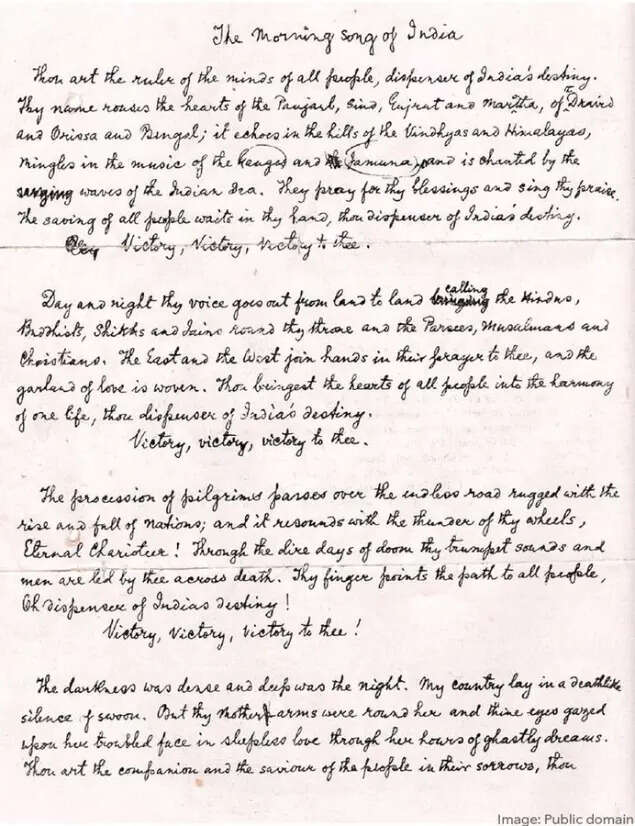
image (7)

An English translation of Jana Gana Mana by Rabindranath Tagore (Image credit: Nobel Prize handle on X)

The song during the freedom struggle

During the 1920s and 1930s, Jana Gana Mana continued to be performed at cultural gatherings, though it did not displace Vande Mataram as the most widely recognised nationalist song. Both compositions occupied distinct places within the freedom movement’s symbolic repertoire.The song acquired additional political resonance during World War II, when it was adopted by Subhas Chandra Bose’s Indian National Army (INA) as one of its anthems. It was sung by INA units in Southeast Asia and later by INA members in Japan. This further mainstreamed the song’s association with anti-colonial resistance.

1947: International exposure

Jawaharlal Nehru, the then Prime Minister of India, reported in a letter that the performance of “Jana Gana Mana” received positive reviews, with delegations of different countries requesting a copy of its sheet music.However, at that point, India had not yet adopted a national anthem, and no official choice had been considered either.

Debate in the Constituent Assembly

After Independence, the newly established government faced the question of choosing a national anthem. The decision was essentially one of constitutional and symbolic significance. Thus, the matter was therefore referred for consideration before the Constituent Assembly.Both Jana Gana Mana and Vande Mataram were considered. While Vande Mataram had played a central role in the freedom struggle, there were some apprehensions about its suitability for performance at international events as well as about its musical adaptability.The matter was raised in Parliament by Prime Minister Nehru on August 25, 1948. He said, “It was thought by some people that the “Vande Mataram” tune with all its very great attraction and historical background was not easily suitable for being played by orchestras in foreign countries, and there was not enough movement in it. It seemed, therefore, that while Vande Mataram should continue to be the national song par excellence in India, the National Anthem tune should be that of Jana-Gana-Mana.

Adoption as the National Anthem

On January 24, 1950, two days before India became a republic, Dr Rajendra Prasad, President of the Constituent Assembly, formally announced the adoption of Jana Gana Mana (hindi version) as the National Anthem of India. The announcement specified that, “The composition consisting of the words and music known as Jana Gana Mana is the National Anthem of India, subject to such alterations in the words as the Government may authorise as occasion arises; and the song Vande Mataram, which has played a historic part in the struggle for Indian freedom, shall be honoured equally with Jana Gana Mana and shall have equal status with it. I hope this will satisfy the Members.”Only the first stanza of Tagore’s original five-verse composition was adopted. The officially recognised version has a playing time of approximately 52 seconds.

Aftermath and legacy

Rabindranath Tagore did not live to witness the acceptance of his composition as the national anthem. He passed away in August 1941, almost nine years before the Constituent Assembly took its decision.Notably, Tagore is the only person in world history to have penned two national anthems. His song “Amar Sonar Bangla” was Constitutionally adopted as the national anthem of Bangladesh in 1972.With time, the final four verses of ‘Jana Gana Mana’ gradually phased-out. Although, the anthem has been performed in its entirety on special occasions. The musical composition of the national anthem of India was standardized to accommodate orchestral performances during official or international gatherings.
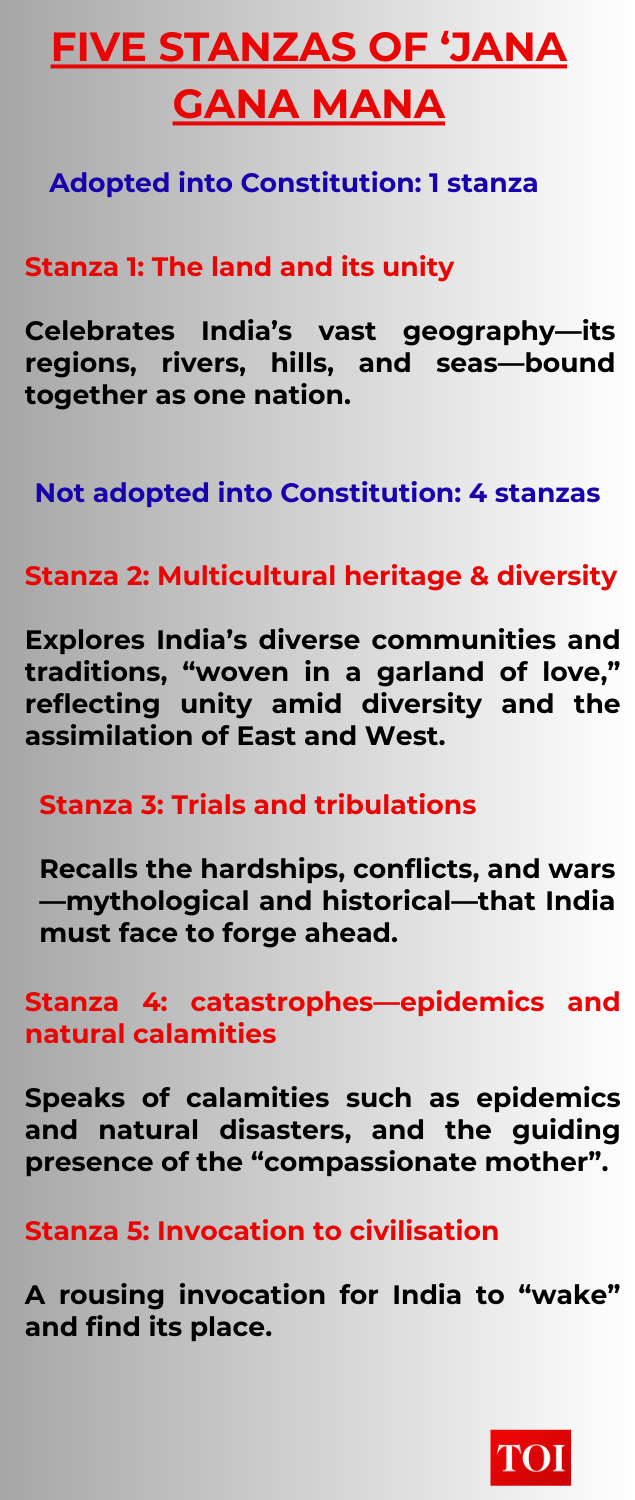
​What the five stanzas of "Jana Gana Mana' meant​

From its initial performance in a small auditorium at Calcutta way back in 1911 to its eventual adoption as a national anthem in 1950, Jana Gana Mana followed a long and documented journey shaped by political change, cultural debate, and constitutional process.

[ad_2]

Source link
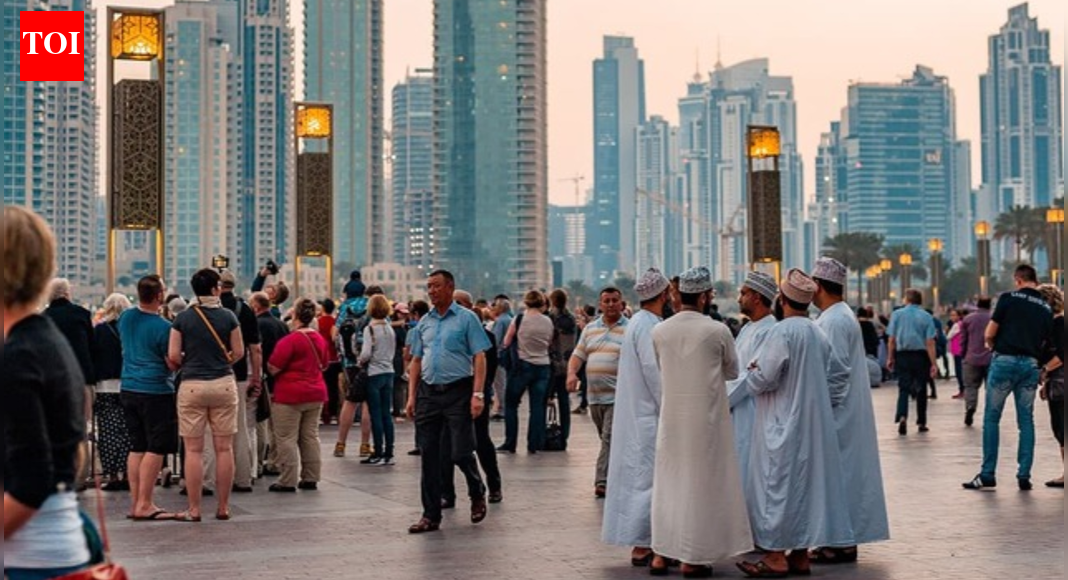
UAE salaries 2025: What workers really earn without a minimum wage | World News

[ad_1]

UAE salaries 2025: What workers really earn without a minimum wage
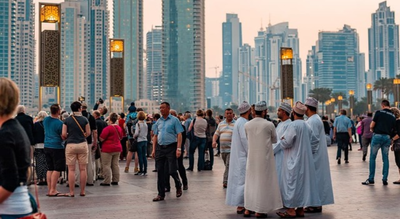
The UAE is gradually moving toward structured wage regulation, with benchmark salaries and mandatory payment systems shaping worker protections despite the absence of a national minimum wage/Image: Pexels

As of 2025, the UAE has not enacted a formal nationwide minimum wage for all private-sector workers. The current labor framework, outlined in Federal Decree-Law No. 33 of 2021, provides the Ministry of Human Resources and Emiratisation (MoHRE) with the legal authority to establish a national wage floor but no binding law has yet been implemented.Instead, salaries are regulated through employment contracts and visa-related requirements. Employers must pay wages via the Wage Protection System (WPS); a government-monitored payroll platform. Failure to comply can result in suspension of new work permits, fines, and company blacklisting.Recent reforms have expanded WPS coverage to include domestic and semi-professional workers like private teachers, caregivers, nannies, and farm technicians. This shift reflects a broader move toward labor standardization and income protection across job categories.

What workers typically earn: A benchmark view

Although no legally enforced floor exists, salary benchmarks function as de facto minimums in many professions. These reflect industry standards, cost of living, and immigration thresholds.

Domestic workers:

Housemaids, nannies, and drivers employed in homes now fall under stricter payment rules, with most salaries ranging from AED 1,200 to AED 1,800/month (₹28,044–₹42,066), depending on experience and nationality. WPS compliance is mandatory for these roles, ensuring regular wage transfers and legal accountability for employers.

Construction and skilled trades:

Labourers and tradesmen form the backbone of the UAE’s infrastructure sector. While base pay for unskilled labourers often starts at AED 1,200–1,500/month (₹28,044–₹35,055), skilled tradespeople such as electricians, plumbers, and masons can earn between AED 2,000 and AED 4,500/month(₹46,740–₹105,165). Many of these roles are protected under labour laws that mandate written contracts, paid leave, and access to dispute resolution.

Retail and service staff:

Workers in retail outlets, supermarkets, cafes, and delivery platforms typically earn AED 2,500 to AED 4,000/month (₹58,425–₹93,480). In these sectors, wage variability is influenced by location (Dubai salaries often exceed those in Sharjah or Ajman), nationality, and employer size.

Office and administrative roles:

Clerical staff, receptionists, and data entry assistants generally receive AED 3,000 to AED 5,000/month (₹70,110–₹116,850), with larger companies or public sector institutions offering higher packages. For visa eligibility especially family sponsorship—employees must earn a minimum of AED 4,000/month (₹93,480), or AED 3,000 (₹70,110) plus housing.

University graduates and skilled technicians:

For professionals with technical or university qualifications, MoHRE guidelines recommend salaries of at least AED 5,000 to AED 12,000/month (₹116,850–₹280,440), depending on the nature of the role. Engineers, IT professionals, and finance specialists typically command salaries within or well above this range.

Visa rules and wage enforcement

Though no national wage law exists, immigration requirements act as an indirect filter. For example:

  • Family visa sponsorship: The UAE mandates a minimum salary of AED 4,000 (or AED 3,000 plus accommodation) for an expatriate to sponsor dependents.
  • Golden Visa applicants in employment-based categories must earn at least AED 30,000/month (₹701,100), particularly in scientific or technical fields.
  • Employment contracts must specify wages in UAE dirhams and be registered with MoHRE to be legally recognised.

The Wage Protection System ensures salaries are paid into local bank accounts within 10 days of the due date. Any delay beyond 15 days triggers automatic alerts, and repeated violations can lead to bans on new hiring.

Rising costs and reform pressures

Over the past few years, Dubai and Abu Dhabi have seen substantial increases in rent, school fees, and healthcare costs. As a result, there is growing pressure on authorities to formalise wage protections and align pay standards with inflation.While some companies voluntarily adjust salaries to retain talent, many low-income workers remain vulnerable to economic shocks. Calls for an indexed minimum wage system adjusted annually to match living costs, growing louder, particularly from labour advocates, unions in labour-sending countries, and international observers.

The road ahead: Formal minimum wage in sight?

Although the UAE has avoided a one-size-fits-all national wage model, change is on the horizon:

  • Free zones may begin enforcing internal wage floors for certain industries to standardise competition.
  • Sector-specific minimum wages could emerge in healthcare, hospitality, and logistics where migrant workers dominate and wage disparity is high.
  • Public-private harmonisation efforts may also push for parity, as Emirati workers often earn significantly more than expatriate counterparts in similar roles.

MoHRE has already hinted at “exploring mechanisms” to address income disparities. If implemented, a flexible minimum wage varying by sector or emirate which could strike a balance between labour protection and economic competitiveness.

Verdict

While there is no official minimum wage in the UAE today, the country is moving toward greater wage transparency, stronger payment enforcement, and benchmark-based income protection. Domestic workers, skilled labourers, and administrative staff now operate under more structured payment conditions—backed by technology and labour law.As the UAE positions itself as a global employment hub, expectations for formal wage regulation will continue to rise. A future where salaries are legally anchored to fair benchmarks seems not only possible but likely.

[ad_2]

Source link

Startups in 2025: Fewer closures but big names stumble — BluSmart, Dunzo & others exit

[ad_1]

Startups in 2025: Fewer closures but big names stumble — BluSmart, Dunzo & others exit

Despite a difficult funding climate, this year emerged as a comparatively stable year for India’s startup ecosystem, with shutdowns falling sharply from last year’s highs. Around 730 startups ended operations in 2025, a major decline from the 3,903 closures recorded in 2024. According to the department for the promotion of industry and internal trade (DPIIT), India, at present, has over 2.06 lakh registered startups. Though the number of closures was lower, it included several prominent names, spanning electric mobility, hyperlocal delivery, consumer internet and ecommerce. Here are some of the startups that said good byes in 2025:BluSmartElectric ride-hailing startup BluSmart was among the most notable exits. Launched in 2019, the company offered fully electric vehicles, assured rides and salaried drivers. The firm had gained roughly 9% market share in Delhi. Soon the ride company expanded its fleet to more than 8,000 electric vehicles across the country and raised around $168 million from investors, including BP Ventures and celebrity backers. However, according to ET, operations were suspended in April after Sebi detected large-scale financial misconduct at Gensol Engineering, a listed solar EPC firm promoted by BluSmart’s founders, the Jaggi brothers. While Gensol did not hold equity in BluSmart, it owned a substantial share of the startup’s EV fleet, resulting in close financial ties. Sebi said the promoters had siphoned off at least Rs. 262 crore from EV loans, forged lender documents, manipulated share prices, misled investors through false disclosures, and diverted funds towards stock trading and personal luxury purchases. Following the revelations, BluSmart faced internal disruptions, including delayed salary payments, declining ride volumes and leadership exits, before suspending services and transferring its fleet to Uber.Dunzo Hyperlocal delivery platform Dunzo also shut down after years of financial strain. Once a pioneer in the category, the startup drew widespread attention in 2022 when it secured $240 million from Reliance Retail. However, the platform struggled to compete with fast-scaling quick-commerce rivals such as Zepto, Swiggy Instamart and BlinkIt. The company failed to raise additional capital to support operations and expansion, while expenses, including those linked to its IPL sponsorship, added to financial stress. By September, Dunzo’s sole remaining co-founder, Kabeer Biswas, exited to build Flipkart’s quick-commerce arm Minutes, bringing the company’s prolonged downturn to a close.Hike Messaging app Hike, founded in 2012 by Kavin Mittal, was once viewed as India’s answer to global platforms such as WhatsApp and Telegram. Backed by investors including Tiger Global, SoftBank and Tencent, the company raised over $250 million within four years, with Mittal asserting, ‘we’re here to stay.’ At its peak, Hike had more than 100 million registered users and handled over 40 billion messages each month. However, the platform began winding down in 2021, when it shut its core messaging service, citing the challenge of competing with global network effects, ET reported. Hike later pivoted to Rush, a real-money gaming platform, following earlier attempts to reposition its messaging product, including its 2019 rebrand as Hike Sticker Chat. The company’s remaining operations ended in September after the Promotion and Regulation of Online Gaming Act imposed a blanket ban on real-money gaming apps.Good Glamm Group The Good Glamm Group, once valued close to unicorn status, also scaled back significantly. With a portfolio of over a dozen brands, the company aimed to replicate the roll-up ecommerce model by acquiring and integrating digital-first consumer brands. Over time, weaknesses in this approach became apparent. Heavy acquisition-related debt, slowing growth and limited access to fresh funding weighed on the business. Several acquired brands, including Sirona and The Mom’s Co, were wound down as anticipated efficiencies from shared marketing and supply chains failed to materialise. The group’s troubles reflected the broader challenges facing roll-up ecommerce models in India.Otipy Grocery delivery startup Otipy, launched during the pandemic by former Blinkit CTO Varun Khurana, also shut operations this year. The NCR-based B2B2C firm differentiated itself through a subscription-led, farm-to-fork model, connecting consumers with farmers via community resellers handling last-mile delivery in Mumbai and Delhi-NCR. The startup raised $44.2 million during its early years but struggled as ultra-fast delivery became the industry standard. Financial pressures mounted, leading to delayed salary payments and pending vendor dues. In May, the Crofarm India subsidiary ceased operations, affecting around 300 employees and delivery partners. Industry-wide data reflects a broader easing in shutdowns. Tracxn data cited by ET shows that startup closures fell nearly 80% this year, compared with the peak period of 2021–22, when more than 11,000 startups wound down. Over the past five years, enterprise applications have accounted for the largest share of closures, followed by retail and edtech, with healthtech, entertainment and media also seeing significant exits. Maharashtra and Karnataka have recorded the highest number of shutdowns among states during this period.

[ad_2]

Source link

Strong fundamentals, big-ticket investments to propel India’s FDI in 2026

[ad_1]

Strong fundamentals, big-ticket investments to propel India's FDI in 2026

FDI inflows into India are expected to register robust growth in 2026, supported by strong macroeconomic fundamentals, big-ticket investment announcements, sustained efforts to improve the ease of doing business, and a new generation of investment-linked trade pacts.To ensure that India remains an attractive and investor-friendly destination, the government reviews the FDI (Foreign Direct Investment) policy on an ongoing basis and makes changes from time to time after holding extensive consultations with stakeholders.The Department for Promotion of Industry and Internal Trade (DPIIT) has this year held a series of meetings with stakeholders on ways to promote FDI. In November, Commerce and Industry Minister Piyush Goyal also held consultations on ways to attract greater investments by making processes faster, smoother, and more efficient.Investor-friendly policies and regulatory practices, strong return on investments, a talented workforce, easing compliance burdens, decriminalising minor industry-related offences, and streamlined approvals are key measures that are keeping foreign investors focused on India despite global challenges.In 2024-25, total foreign direct investments (FDI) have crossed USD 80.5 billion amid global uncertainties. Gross overseas investments during January-October 2025 have crossed USD 60 billion.DPIIT Secretary Amardeep Singh Bhatia said India has attracted remarkable investments in the last eleven years due to a series of measures taken by the government.“It has touched an all-time high of USD 80.62 billion in 2024-25. We are hopeful that this year (2026), FDI may cross the last year’s data of USD 80.62 billion,” he told PTI.India is also banking on its free trade agreement with the four-nation European Free Trade Association (EFTA), under which the bloc has committed to invest USD 100 billion in foreign direct investment into the country over 15 years.The pact came into force on October 1, 2025, and on the very day of its implementation, Swiss healthcare major Roche Pharma announced a commitment to invest 1.5 billion Swiss francs (about Rs 17,000 crore) in India over the next five years.This will be pure FDI and not foreign institutional or portfolio investments by sovereign wealth funds of the EFTA nations – Switzerland, Norway, Iceland, and Liechtenstein.A similar commitment of USD 20 billion has been made by New Zealand under its trade pact with India, which is slated to be implemented in 2026.Certain reports have also projected a positive outlook for foreign direct investment into India.According to UNCTAD’s World Investment Report 2025, global FDI flows fell by 11 per cent in 2024 to USD 1.5 trillion. However, this figure conceals wide differences in performance across economies.Developed countries experienced a 22 per cent contraction, while flows to developing economies were stable. In Asia, particularly, east and southeast Asia, as well as India, investors maintained strong project activity, the report has said.Some of the major global firms have announced big-ticket investments this year.Microsoft CEO Satya Nadella has announced an investment of USD 17.5 billion by 2030 to help build infrastructure and sovereign capabilities for the country’s AI-first future.Amazon plans to invest USD 35 billion in India over the next five years to expand its businesses from quick commerce to cloud computing and artificial intelligence. Google will invest USD 15 billion over the next five years to set up an AI hub in India.iPhone maker Apple is expanding its presence in India, and South Korean electronics major Samsung is also expanding its manufacturing portfolio in the country.Arcelormittal Nippon Steel India is aiming to increase the colour-coated steel capacity to 10 lakh tonnes per year by 2026 from the present 7 lakh tonnes.As per the National Statistical Office (NSO), the Indian economy grew 8.2 per cent in the second quarter of 2025-26. The government, on its part, has come out with the second edition of the Jan Viswas bill to promote ease of doing business by decriminalising minor industry-related offences.Experts, too, have stated that India’s strong economic fundamentals and resilience, along with a sustained reform push, will be a big reason for a revival of FDI in 2026.“As India diversifies its economic relationships amid geopolitical uncertainties and moves up the value chain in manufacturing and services, these developments are expected to channel greater long-term FDI into services, software and electronics,” Rumki Majumdar, Economist, Deloitte India, said.Rudra Kumar Pandey, Partner, Shardul Amarchand Mangaldas & Co, said FDI from the Gulf Cooperation Council (GCC) countries has emerged as a strategic and increasingly durable pillar of India’s foreign investment landscape.“Technology-led services are expected to remain the primary magnet for foreign capital, with increasing emphasis on artificial intelligence, data analytics, cloud infrastructure, and Global Capability Centres focused on AI deployment and applied research,” he added.The top investors in India include Mauritius and Singapore (together accounting for about 49 per cent), followed by the US (10 per cent), the Netherlands (7.2 per cent), Japan (6 per cent) and the UK (5 per cent).The key sectors which attracted the maximum FDI in India include the services segment, computer software and hardware, telecommunications, trading, construction development, automobile, chemicals and pharmaceuticals.FDI is allowed through the automatic route in most of the sectors, while in areas such as telecom, media, pharmaceuticals and insurance, the government approval is required for foreign investors.At present, FDI is prohibited in certain sectors. They are lottery, gambling and betting, chit funds, nidhi company, real estate business, and manufacturing of cigars, cheroots, cigarillos and cigarettes using tobacco.FDI is important as India would require huge investments in the coming years for its infrastructure sector to boost growth. Healthy foreign inflows also help in maintaining the balance of payments and the value of the rupee.

[ad_2]

Source link

‘Scolded over AI use during exam’: Class 10 student dies by suicide in Greater Noida West; father accuses school of abetment | Noida News

[ad_1]

'Scolded over AI use during exam': Class 10 student dies by suicide in Greater Noida West; father accuses school of abetment

NOIDA: A class 10 student died by suicide on Dec 23, allegedly hours after she was pulled up by her teachers at a private Greater Noida West school for using AI on her mobile phone to write her pre-Board exam papers. The girl’s father submitted a police complaint Thursday seeking an FIR against the school, accusing them of abetment to suicide. Hauled up for using AI during exam, girl dies by suicide, father accuses school of abetment While police are examining allegations before registering an FIR, the principal told TOI that the student, though reprimanded, was not harassed and told that cheating in the board exam could earn her a five-year suspension from writing the test. According to the minor’s father, the 16-year-old allegedly jumped from her eight-floor flat early on Dec 23. He alleged that his daughter was deeply distressed after she was scolded and humiliated by teachers for bringing her phone to the exam hall on Dec 22. In his complaint, the father said he has three daughters, all of whom study at the same school. He alleged that his eldest daughter had “unknowingly” carried her mobile phone to school on the day of the exam. She was caught by the invigilator, who reprimanded her and informed her class teacher. The student was then taken to the principal. The principal called the girl’s parents to the school, and her father arrived shortly afterwards. He alleged that even in his presence, the teachers and principal continued to scold and insult the student aggressively. He also claimed that he was called “careless” by the teachers. The father claimed his daughter was shaken by the incident and that the harsh words used by her teachers had a severe psychological impact. He named the child’s class teacher, Poonam Dubey, another teacher, Taapas, and the school management in his complaint, accusing them of pushing his daughter towards taking an extreme step. He has urged police to register a case under BNS Section 108 (abetment of suicide), and other relevant provisions. He claimed the incident had left his other two daughters traumatised and fearful of returning to the school. The school has strongly denied the allegations. The principal told TOI over the phone that the student was not harassed and that the school followed standard protocol prescribed by the Central Board of Secondary Education. “The girl was found with a mobile phone during the pre-board examinations. When the invigilator checked the device, it appeared that she had been using AI to get answers. The phone was confiscated, and she was brought to the examination head, who then brought her to me,” the principal said. She said she had informed the student that using such methods during the CBSE board examinations could lead to a ban of up to five years from appearing in the exams. “That is the rule, and the child was only told about the consequences,” she said. According to the principal, the student’s parents were informed immediately and reached the school within 10 to 15 minutes, as they lived nearby. She said the interaction took place at the reception area and was brief.

[ad_2]

Source link

Silver price today: White metal soars 9% to record high; gold, platinum & others follow the momentum

[ad_1]

Silver price today: White metal soars 9% to record high; gold, platinum & others follow the momentum

Silver price jumped nearly 9% to trade at a record high of $78.65, on Friday (local time) according to the New York Commodity Exchange. With this surge, the white metal has outpaced gold this year, with prices up more than 158% over the past 12 months. The rally extended across the broader metals market. Spot gold climbed to an all-time high of $4,549.71 an ounce, while platinum touched a record $2,454.12 after gaining around 10%, according to Reuters. Spot palladium also recorded the sharpest move of the session, rising more than 14% to $1,924.03 an ounce. Gold, meanwhile, edged up just over 1.2% to reach a high of $4,562.70.

Precious metals soar – What’s behind the rally?

Silver rose on the back of tight supply, rising industrial demand and expectations of more rate cuts by the Federal Reserve. Analysts have also pointed to a mix of lower interest rates, growing use of silver in AI data centres, supply constraints and uncertainty around tariffs as key drivers behind the white metal’s surge this year.“Prospect of lower US interest rates is still supporting demand for gold and silver, lifting both metals to new record highs,” UBS analyst Giovanni Staunovo told Reuters. In early trading, silver crossed the $75-per-ounce level for the first time, as both precious and industrial metals rallied amid economic and political uncertainty.Gold is on course for its strongest annual performance since 1979, supported by Federal Reserve policy easing, geopolitical risks, central bank buying, higher ETF holdings and ongoing de-dollarisation. Silver has benefited from structural supply deficits, its designation as a US critical mineral and strong industrial demand, far outpacing gold’s nearly 72% rise.Platinum and palladium, widely used in automotive catalytic converters, have also advanced sharply amid tight supply conditions, tariff uncertainty and a shift in investment demand away from gold. Platinum has gained about 165% this year, while palladium is up more than 90% year to date.“Momentum-driven and speculative players have been powering the rally in gold and silver since early December, with thin year-end liquidity, expectations of prolonged US rate cuts, a weaker dollar and a flare-up in geopolitical risks combining to push precious metals to fresh record highs,” Kelvin Wong, senior market analyst at OANDA, told Reuters.“Looking ahead into the first half of 2026, gold could move towards the $5,000 level, while silver has the potential to reach around $90,” Wong further said.Traders are currently pricing in two US rate cuts next year, a support that continues to lift non-yielding assets such as gold and silver. At the same time, market sentiment has also been influenced by geopolitical developments, including US moves related to Venezuelan oil and strikes against Islamic State militants in northwest Nigeria following attacks on Christian communities.

[ad_2]

Source link

Indian dairy sector faces tight supply as demand strengthens ahead of 2026: Report

[ad_1]

Indian dairy sector faces tight supply as demand strengthens ahead of 2026: Report

India’s dairy sector is entering a phase of tighter supply and margin recalibration after navigating sharp cycles of disruption, surplus, and recovery over the past three years, according to insights from an expert session hosted by Systematix Institutional Equities.The post-COVID period of 2022-23 proved challenging for the industry, marked by an unreasonable fall in milk prices that failed to cover farmers’ production costs.According to the Systematix report, this led to reduced cattle induction and a sharp drop in milk output.From mid-2023, however, renewed farmer engagement by leading cooperatives and private players, including sustainable fodder programs, helped restore confidence and revive supply.These efforts resulted in a sharp rebound during the October 2024-March 2025 flush season, when milk production surged by nearly 25 per cent, creating a temporary surplus.Dairy companies responded by expanding value-added product mixes, strengthening cold-chain infrastructure, and increasing advertising and promotions to absorb excess supply, it noted.Large players also intensified backend investments and last-mile distribution to manage inventories.The surplus, however, was short-lived.In 2025, early and unseasonal rains disrupted the usual summer demand-supply pattern, while geopolitical disturbances, including the India-Pakistan conflict, affected key northern milk belts, including Punjab, Haryana, and Jammu and Kashmir.At the same time, robust festive demand further eroded inventories, leaving the industry with a limited surplus heading into late 2025, according to the expert session.As a result, milk procurement costs have firmed up across regions, even as product prices have largely remained stable following the recent GST cut.Some regional price hikes of Rs 1-1.5 per litre were reported in states such as Bihar and Andhra Pradesh.Industry participants expect procurement cost corrections around April 2026, coinciding with the Ramzan period.Demand has been supported by reduced prices and increased grammage post-GST cut, particularly in small stock-keeping units, though this has pressured margins due to channel disruption and supply-chain costs.According to Systematix, companies are now evaluating selective price hikes or rolling back higher volumes to restore profitability.A notable structural trend is the accelerating shift toward value-added products such as curd, paneer, ghee, and ice cream. Ice cream demand, once concentrated in peak summer months, is now spreading across a wider seasonal window. Dairy products are increasingly purchased on impulse, as consumers shift from carbonated beverages to milk-based alternatives.Distribution dynamics are also evolving rapidly. Quick-commerce and e-commerce platforms are gaining prominence, while general trade is losing share, it observed. Modern trade, despite offering visibility, continues to deliver lower margins, forcing dairy players to make careful decisions.

[ad_2]

Source link

Massive! Deepti Sharma smashes records, becomes first Indian cricketer to … | Cricket News

[ad_1]

Massive! Deepti Sharma smashes records, becomes first Indian cricketer to ...
Deepti Sharma became the first Indian — across both men’s and women’s cricket — to reach the 150-wicket mark in T20 Internationals. (PTI Photo)

NEW DELHI: India’s premier all-rounder Deepti Sharma produced a record-laden performance during the third T20 International against Sri Lanka, overtaking Australian great Ellyse Perry to become the third-highest wicket-taker in women’s international cricket.Go Beyond The Boundary with our YouTube channel. SUBSCRIBE NOW!Deepti returned figures of 3 for 18 at Thiruvananthapuram, a spell that took her overall tally to 333 international wickets, moving her past Perry, who finished her career with 331 wickets from 271 matches. Only England’s Katherine Sciver-Brunt (335 wickets in 275 matches) and Indian legend Jhulan Goswami (355 wickets in 291 matches) now sit above Deepti on the all-time list.

Gautam Gambhir’s year as India coach ends like it started – on a chaotic note

The performance also saw Deepti create history in the shortest format. She became the first Indian — across both men’s and women’s cricket — to reach the 150-wicket mark in T20 Internationals. In the process, she drew level with Australia’s Megan Schutt as the leading wicket-taker in women’s T20Is, with 151 wickets in 131 matches at an impressive average of 18.73. Her best figures in the format remain 4 for 10.In one-day internationals, Deepti continues to climb the charts as well. She is currently the eighth-highest wicket-taker in women’s ODIs and India’s second-most successful bowler in the format after Jhulan Goswami, with 162 wickets from 121 matches at an average of 27.32. Her ODI record includes a career-best 6 for 20, along with three four-wicket hauls and four five-fors. In Test cricket, she has claimed 20 wickets in five matches at an average of 18.10, with both a four-for and a five-for to her name.Adding another milestone to an already glittering list, Deepti became the first cricketer in the history of the game — men or women — to score 1,000 runs and take 150 wickets in T20 Internationals. Alongside her 151 wickets, she has amassed 1,100 runs in 131 matches at an average of 23.40 and a strike rate of 104.26, including two half-centuries.In the match itself, India won the toss and opted to bowl. Sri Lanka managed 112 for 7 in their 20 overs, with Imesha Dulani (27), Hasini Perera (25) and Kavisha Dilhari (20) being the only batters to cross the 20-run mark. Renuka Singh starred with the ball, picking up 4 for 21.India’s chase was wrapped up in emphatic fashion, led by a blistering unbeaten 79 off 42 balls from Shafali Verma. Captain Harmanpreet Kaur added 21 as India cruised to an eight-wicket win in just 13.2 overs. Shafali registered her second consecutive half-century and continued her fine run in 2025, scoring 333 runs in eight T20Is at an average of 55.50 and a strike rate exceeding 173.

[ad_2]

Source link

‘We wish to have an alliance’: Ajit Pawar meets NCP (SP) leader ahead of BMC polls; decision on alliance ‘soon’ | India News

[ad_1]

'We wish to have an alliance': Ajit Pawar meets NCP (SP) leader ahead of BMC polls; decision on alliance 'soon'

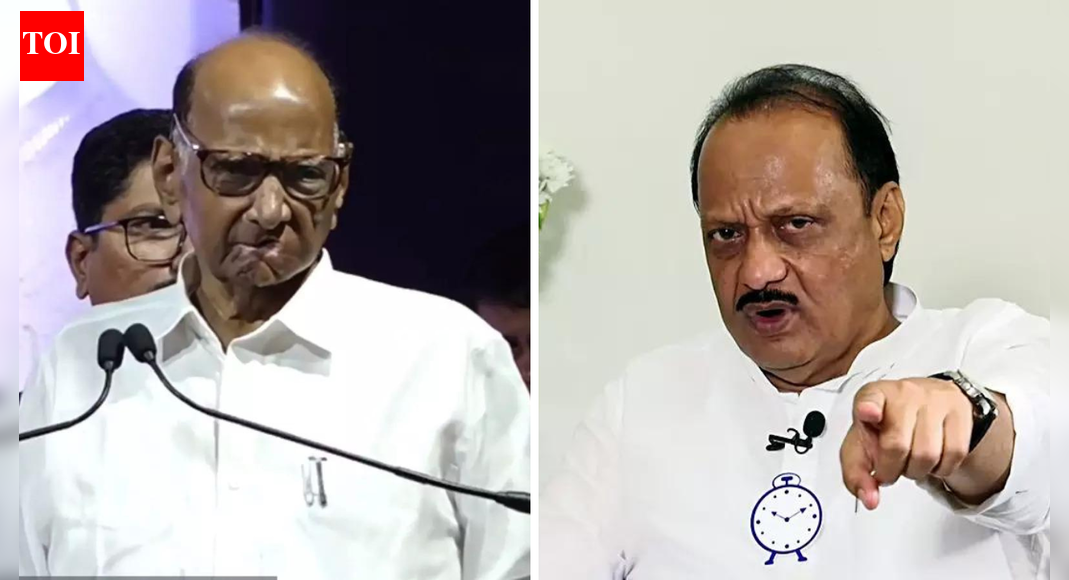
NEW DELHI: Amid ongoing speculation of an alliance ahead of the BMC polls, Maharashtra deputy chief minister Ajit Pawar on Friday met NCP (SP) leader Azam Pansare in Pimpri-Chinchwad.Talking to reporters after the meeting, Pansare said that the NCP (SP) “wishes” to have an alliance with Ajit Pawar’s faction.“Ajit Pawar came to meet me after a long time. We had a lot of discussions on general issues. We wish to have an alliance (between NCP SP and NCP). He told me that a decision will be taken soon,” Pansare said.This comes days after NCP (SP) MP Supriya Sule hinted at a possible alliance, saying that her party is in talks with Ajit Pawar and that senior party leaders have spoken to each other.“Of course, we are looking at all alliances. Ajit Pawar constantly says that he has not given up that ideology. Right now, the focus is on the corporation elections. A lot of our colleagues have spoken to each other,” Sule had said.“We are engaged in dialogue with them, but no decision or final offer has come,” she added.Earlier, Maharashtra minister Sanjay Shirsat also said that efforts were under way in Pune to bring both NCP groups together.“Both the NCPs are coming together by forming an alliance for the upcoming municipal corporation elections,” he said, adding that such local-level adjustments could be the beginning of a broader political understanding.The undivided NCP, founded by Sharad Pawar, split in 2023, with the Ajit Pawar-led faction not only joining the BJP–Sena alliance in the state government but also bagging the “real NCP” status through an Election Commission ruling.The NCP (SP) has since been contesting against the NCP in various polls and on social issues.As municipal corporation elections in Maharashtra are expected to be held next month, various parties have been working on different alliance combinations. With the BJP having established its dominance in both the Pune Municipal Corporation (PMC) and Pimpri Chinchwad Municipal Corporation (PCMC) areas, the Ajit Pawar-led NCP has been contemplating an alliance with the senior Pawar’s party in both these municipal corporations of Pune district.

[ad_2]

Source link